I wrote about the protein content of different foods previously. I summarized how much beef versus pea and wheat flour one would need to eat in order to consume the recommended daily intake (RDI) of ‘complete proteins’ – foods that contain all of the essential amino acids that compose protein. These amino acids are called ‘essential’ because, unlike the conditionally essential or non-essential amino acids, your body can’t produce them from other inputs. Here, I want to expand more on complete proteins when eating on a budget.
Step 1: What We Need
To start, there are nine essential amino acids with hard to remember names for non-specialists, so I’ll just use the abbreviations (H, I, L, K, M, F, T, W, V). The presence of all nine essential amino acids is what makes a protein complete. But, having some of each protein is not the same as having enough of each protein. Here, I’ll use the World Health Organization’s (WHO) guidelines for essential amino acid RDI for a 70kg person. See the table below.

Step 2: What We Need to Eat
What foods are considered ‘complete proteins’? There are many, but I will focus on a few animal sources: Eggs, Pork Chops, Ground Beef, Chicken, & Tuna. Non-animal proteins will have to wait for another time. Below are the essential amino acid content per 100 grams expressed as a percent of the RDI for each amino acid. What does that mean? That means, for example, that eating 100 grams of egg provides 85% of the RDI for M, but only 37% of the RDI for H.

Visually inspecting, eggs are less dense in most amino acids. Beef, chicken, and tuna, while having different compositions of specific amino acids, are all relatively comparable overall. Pork is uniquely dense in amino acids. It’s super dense. If your goal is to get your RDI and you’re offered a free serving of something, then go for the pork. Eating a 100g serving satisfies seven out of the nine essential amino acid RDIs.
While that’s nice for 100g, how much should one eat in order to completely satisfy the RDI for each essential amino acid? That’s exactly what the table below illustrates. So, if you want to minimize the serving size and still satisfy your ‘complete protein’ requirements, then pork is the way to go.

Step 3: The Price of What We Need to Eat
If I ended here, then this wouldn’t be an economics blog. Indeed, health professionals like to make all kinds of recommendations as if tradeoffs don’t exist. While pork might have the greatest density of essential amino acids, it’s not the cheapest. So, which protein should one eat if we minimize the cost of satisfying the RDI?
Once we include the opportunity cost (expressed in dollars using prices from Oct. 2024*), eating pork is suddenly less attractive. While unexceptional in its amino acid profile, chicken is so gosh-darn cheap that it takes the cake if we are trying to satisfy the amino acid RDI while on a budget. If you enjoy the act of eating itself, then there’s the added bonus of getting 155g of chicken rather than the 115g of pork.
Finally, nothing says that we are only allowed to eat one type of protein. We can mix and match if we want. For example, beef is a light on W. So, maybe we’d want to supplement it with a serving of pork or tuna which have higher levels of W. That’s perfectly allowed because the source of an amino acid is mostly unimportant. Some H from one source is the same amino acid as some H from another source. If we are minimizing the cost of satisfying the essential amino acid RDI, then we need to know their prices. It varies by food.
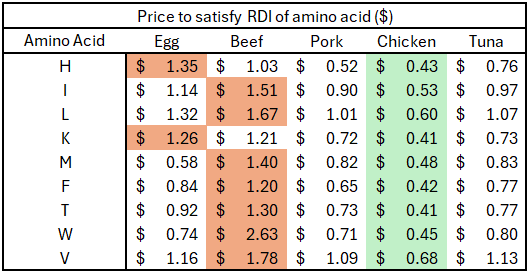
The above table includes the price of each RDI-satisfying amount of amino acid. As it turns out, there is no mixing necessary. Chicken is so cheap that it doesn’t make sense to mix-in another protein. Every single essential amino acid can be most cheaply obtained by buying chicken.
RDI:
https://iris.who.int/bitstream/handle/10665/43411/WHO_TRS_935_eng.pdf
Prices:
- https://fred.stlouisfed.org/series/APU0000708111
- https://fred.stlouisfed.org/series/APU0000703112
- https://fred.stlouisfed.org/series/APU0000FD3101
- https://fred.stlouisfed.org/series/APU0000706111
- https://fred.stlouisfed.org/series/APU0000707111
- https://fred.stlouisfed.org/series/IR01000
- *Price of tuna is from 2017, and then inflated by the import price index of fish and shellfish to get the 2024 estimated price.
Amino Acid Content:
 Economist Writing Every Day
2 thoughts on “The Price of a Complete [Animal] Protein”