Last week I did a comparison of “time prices” for several goods and services in 1971 compared with 2024. For almost all goods and services, it took fewer hours of work in 2023 to purchase them. In some cases, huge increases in affordability; air travel is 79% cheaper and milk is 59% cheaper, in terms of how much time an average worker needs to labor to pay for them.
There was one major exception though: housing. Especially the cost of buying a new home. Just using the median sale price of a home, the cost (in terms of hours of work) roughly doubled between 1971 and 2024. That’s not good!
Many who commented on the post mentioned that houses are much bigger today, and I noted that in the post but still claimed this is a worrying trend: “since 1971 you can’t really argue the quality improvements make up for the increase. Yes, houses are much bigger (about double in size), but that’s not clearly driven by consumer demand (more so by zoning and other laws). The 1971 house also had indoor plumbing (but maybe not air conditioning).”
Furthermore, housing is the largest expense for most families, both today and in 1971. In the early 1970s it was 30.8% of consumer spending, and in 2023 it was slightly higher at 32.9%. Given all this, it is worth investigating further.
First, let’s consider the size of a typical house. For most of the 1971 data, I will use this HUD report on new single-family homes. And I will use the similar Characteristics of New Housing report for 2023 (the latest year available) to compare.
Are houses bigger today? Yes, but not nearly enough to account for the decreasing affordability I showed in the previous post. In 1971, the median new home had 1,400 square feet of floor space. In 2023, it was 2,286. That’s a big increase (over 60%), but let’s now do the time-price affordability calculation, which I show in the table below.

As you can see, in 2023 it took 31 percent more hours of work to buy a square foot of the median home, compared with 1971. That’s not as bad as the 96 percent increase I showed in last week’s post, but it’s still counter to the trend of most other goods and services. And while mortgage rates have fluctuated a lot between 1971 and today, the rates in 1971 and 2023 were actually quite similar (see also this older post on mortgage affordability back to 1971).
Other than increasing size, what other features of homes have improved since 1971? Potential candidates like indoor plumbing are definitely improvements compared with 1924, but not with 1971. By then, 93 percent of all homes had complete indoor plumbing, so almost certainly close to 100 percent of new homes did.
Other than the raw size of the home and features related to that (such as number of bedrooms and bathrooms), I think the two clear improvements since 1971 are central air conditioning and garages. Appliances are also better today, but these are often not sold with new homes, so it’s a separate consideration.
Central A/C was something of a luxury in 1971, with only about 37 percent of new homes having it. Today, it is practically universal for new homes. Garages were somewhat common in 1971, with over half of homes having garages, but today almost all new homes have them, especially for detached homes (it’s 98 percent for those, versus 95 percent for attached homes such as condos). This also means, of course, that the median home in 1971 did have a garage, so the primary improvement since 1971 is central air conditioning.
Is the 31 percent size-adjusted cost increase enough to justify the presence of central air? Keep in mind too that it’s not like central A/C wasn’t available in 1971: over one-third of new homes had it! So the question we need to answer is how much it would cost to install central A/C in 1971. Using the same 1971 HUD report (Table 38), we can see that the median price for homes with A/C was $28,100, about $4,500 more than homes without (undoubtedly there are other differences between these two groups of homes, but it’s probably a reasonable number to use).
Putting that $28,100 price for a new home with A/C in 1971 into the calculation from the table, and assuming the air-conditioned homes were the same size as the median home, time price per square foot increases to 5.5 hours. But even with that, it’s a 17 percent increase from 1971 to 2023 in the number of hours it takes to buy a new home. And if we assume that home was slightly bigger, say 1,500 square feet, the real cost increase jumps to 26 percent. We would really have to torture the data (or identify some other big quality improvement) to say that houses are cheaper today than in 1971.
Bottom line: even adjusting for the fact that homes are bigger and have central air conditioning today, they are still 17 percent more expensive than 1971 in terms of the time price.
One final note: doing the “hours of work to buy one square foot of housing” calculation over the past several decades reveals an interesting pattern. It has ranged from a lower of about 5 hours of work (both in 1971 and 2011), to almost 7 hours of work at the peaks of housing cycles (1988, 2005, and 2022). The 2023 number is towards the high end, but it fell slightly from 2022.
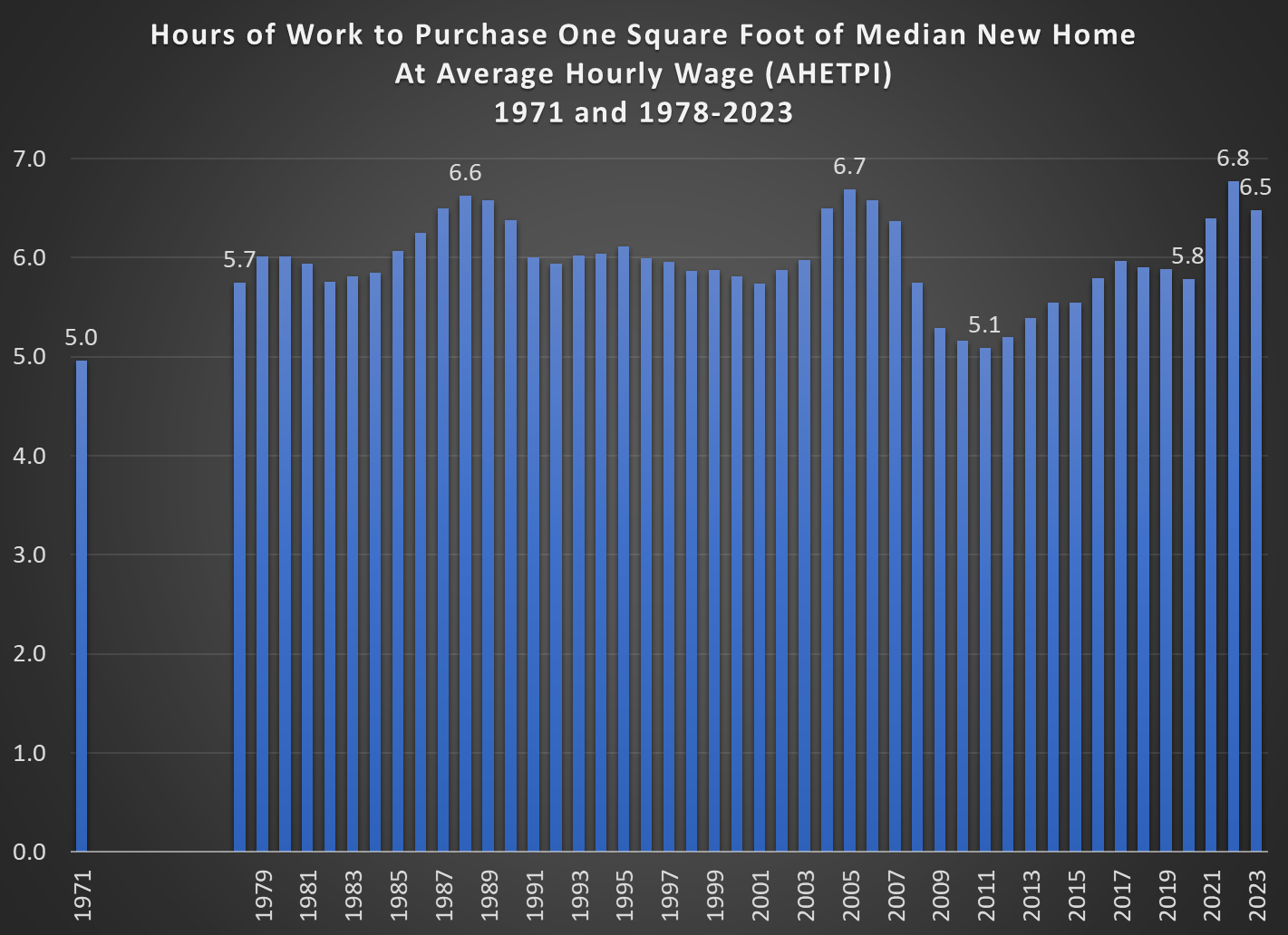
Will we have another cyclical decrease over the next few years? Part of these depends on policy. You could have policy which crushes demand (as in the mid-2000s), or you could have policy which increases supply. Either of these would lower prices, but one is bad (crushing demand) while one is good (increasing supply). Alternatively, we won’t have a fall in real prices, or they could get even worse. I am bad at making predictions, and I’m usually optimistic, but it’s hard to have optimism given the political challenges of policies to increase supply (despite some victories in some states!).
 Economist Writing Every Day
Great write up!
Our one and only new single-family home was built in 1983/4. The one I am sitting in right now was built in 1921. This one came with a shared driveway and a single car garage. As we had some plumbers over yesterday, we were discussing how things have changed in the last 100 years. The movie the Graduate came to mind- Plastics/materials- yesterday. This morning, I recalled that the movie Andromeda Strain came out in 1971 which reminded me of the digital revolution….
As we had some time waiting for the boiler to heat up, we talked a bit about the 5-foot copper 2-inch diameter persuasion bar (pipe) they used to R&R a few 2-to-4-inch diameter fittings. Russ noted that the scrap value of the pipe was 80 bucks or so! No wonder copper isn’t used much anymore for residential plumbing. I showed Russ the ¾” galvanized water line that was abandoned decades ago in favor of copper. It’s in the teens, degrees F, this morning with the wind chill temperature a bit below 0F. I am glad that the bathroom above the garage had its copper piping upgraded to a polymeric material awhile back.
New homes these days have lots of manmade materials that can lead to less energy needed for HVAC. Our 1983 home didn’t come with air conditioning as it was built in a very mild climate. The one I am typing this note in, was upgraded for central air in on the second story a decade ago. Our portable mini-heat pump does a great job of reducing the humidity on the first floor.
Mark
LikeLike
You need to look at the cost of land.
LikeLike
Great write up!
Our one and only new single family home was built in 1983/4. The one I am sitting in right now was built in 1921. This one came with a shared driveway and a single car garage. As we had some plumbers over yesterday we were discussing how things have changed in the last 100 years. The movie the Graduate came to mind- Plastics/materials yesterday. This morning I recalled that the movie Andromeda Strain came out in 1971 which reminded me of the digital revolution….
As we had some time waiting for the boiler to heat up we talked a bit about the 5 foot copper 2 inch diameter persuasion bar (pipe) they used to R&R a few 2 to 4 inch diameter fittings. Russ noted that the scrap value of the pipe was 80 bucks or so! No wonder copper isn’t used much anymore for residential plumbing. I showed Russ the ¾” galvanized water line that was abandoned decades ago in favor of copper as the supply line to the house. It’s in the teens, degrees F, this morning with the wind chill a bit below 0F. I am glad that the bathroom above the garage had it’s copper piping upgraded to a polymeric material awhile back.
New homes these days all have lots of man-made materials that can lead to less energy needed for HVAC. Our 1983 home didn’t have air conditioning as it was built in a very mild climate. The one I am typing this note in, was upgraded for central air on the second story a decade ago. Our portable mini-heat pump does a great job of reducing the humidity on the first floor in the summer and it’s adding some BTU’s to the living room currently.
Mark
LikeLiked by 1 person
You should also adjust for location. If the median house in 1971 was built in Cleveland, then you should look at the median price now in Cleveland.
If you transported an average Cleveland house to a better place, it would automatically be worth a lot more: people pay for California weather and environment.
LikeLike
Another thought: all of the other products in the list are new: however, some 90% of house sales each year are existing, not new houses. So a better way to compare would be to see what the price of an existing house is over the years.
Of course, mortgage rates and demographics are wild cards.
LikeLike
Super interesting article. I think the difference comes on the regulations cost. I found an article that shows the average new home has 93k of regulations cost in it. I couldn’t find a comp for 1971 so maybe you could, but that accounts for 25% of the cost.
LikeLike