I’ve written about proteins twice before. Once concerning protein content generally and then another concerning amino acid content of animal proteins. The reason that I stuck to animal proteins initially was because I held a common and false belief: Singular vegetarian foods aren’t complete proteins. The meat-eaters gotchya claim is that meats contain complete proteins. After all, we’ve heard a million times that beans and grains are often eaten together because they form a complete protein. The native North Americans? Corn and beans. Subcontinent Indians? Rice and Lentils or chickpeas. Japan? Rice and soy. Choose your poor or vegetarian population in the world, and they combine beans and grains. We’ve always been told that it’s because the combination constitutes a ‘complete protein’.
But you know what else constitutes a complete protein? Any of those foods all by themselves. What the heck. I haven’t been lied to. But I’ve certainly been misled. Let me briefly tell you my research journey. My recommended daily intake (RDI) are from the World Health Organization and the amino acid data is from the US Department of Agriculture. Prices are harder to pin down in a representative way, but I cite those too.
I started by looking for what I thought were the best ‘complete protein’ candidates among vegan fare. Below is the amino acid profile for 100g of Quinoa, Tofu, Tempeh, and hemp seeds. Hemp seeds was a stretch since people don’t usually sit down and eat a quarter cup at a time. I omitted chia, flax, and nutritional yeast and other low volume alternatives. Generally, I was disappointed in the results. Except for hemp, you’d have to eat about 300g of quinoa or tempeh in order to get a complete protein. And tofu lacks much amino acid M. So you’d need 500g of that for a complete protein.

There are two takeaways. 1) All of them are complete proteins! Great… But, 2) They’re not great complete proteins. So, I looked around a little bit more. What about the less exotic vegetarian foods? Below is the amino acid profile of several popular nuts. I happen to eat almonds every day with breakfast. How fortuitous! About ¾ cup of almonds and you’re set on your amino acids for the day. They’re the pork of the nut world. Pistachios might be the tastiest, but they have the least complete essential amino acid profile. And peanuts aren’t so special next to other nuts.

But nuts are still pretty unique. Most people don’t sit down to a dinner that’s piled high with nuts. What about the plainer foods, like grains? Below is the profile of popular grains. Wheat is the winner in terms of roundness. Rice has all of the tryptophan that you need and isn’t too bad either. Corn and oats aren’t great however. Grains are almost all lower in protein according to my preconceptions. But THEY ARE ALL COMPLETE PROTEINS.

Finally, what about what’s commonly considered the protein-iest of proteins – legumes? I was very disappointed by the performance of red lentils, mostly because they’re so tasty. But Pintos aren’t half bad! In fact, eating 200g (dried) satisfies your daily essential amino acid requirements, full stop. Black beans do alright too.
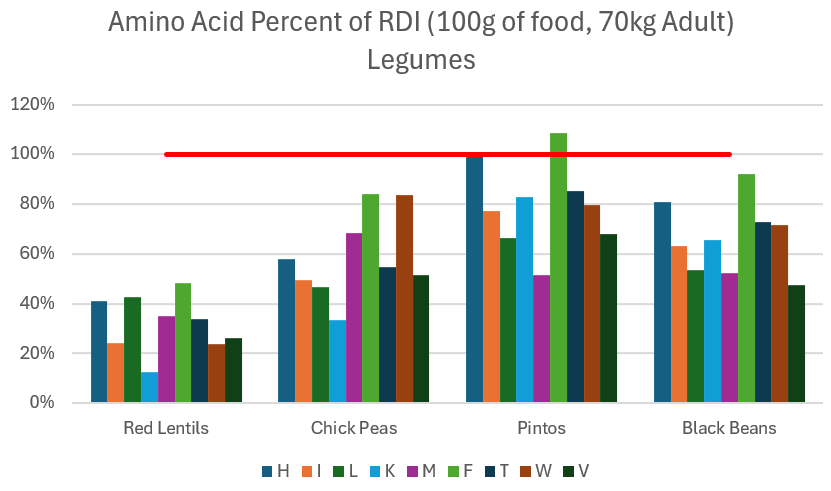
Not a single one of these foods is an ‘incomplete protein’. Yes, the mass that you’d need to eat differs, but there is not much that is exciting about legumes and grains as a combination. Beans are higher in amino acid K, and that compensates for the lower levels in grains. But nuts and meat are also low in that component relative to the other amino acids. So, there is nothing special at all about beans and rice in particular when it comes to their nutritional content.
But do you know what is special about them? Their prices. See the below tables of the price per RDI-satisfying essential amino acids.

Both nuts and the specialty vegan foods are a bit pricy per amino acid. But grains and beans are CHEAP. Like, really cheap. Poorer people and countries don’t eat beans and rice because they are especially complete. Rather, it’s because they are affordable. I feel like the whole myth of beans and rice as complete proteins is just more of a social signal. Like, “if you want to be healthy, then eat meat” and if you’re poor then you must take care to get a complete protein. But really, now that I know the data, the myth of rice and beans seems more derogatory. Poor people eat cheaper foods. That’s why they eat rice and beans. It has everything to do with their incomes and prices. Meat, while rich in essential amino acids (especially pork), isn’t special in this regard. It’s a high-price global luxury item. Lucky for us in the US, it’s not a luxury at all. But let’s not mythologize why poor people eat rice and beans. It’s because they’re poor.
Amino Acid Content Weird Vegetarian Food:
https://fdc.nal.usda.gov/food-details/168874/nutrients
https://fdc.nal.usda.gov/food-details/174291/nutrients
https://fdc.nal.usda.gov/food-details/174272/nutrients
https://fdc.nal.usda.gov/food-details/170148/nutrients
Nuts:
https://fdc.nal.usda.gov/food-details/172434/nutrients
https://fdc.nal.usda.gov/food-details/170567/nutrients
https://fdc.nal.usda.gov/food-details/170187/nutrients
https://fdc.nal.usda.gov/food-details/170162/nutrients
https://fdc.nal.usda.gov/food-details/170184/nutrients
Grains:
https://fdc.nal.usda.gov/food-details/168883/nutrients
https://fdc.nal.usda.gov/food-details/168889/nutrients
https://fdc.nal.usda.gov/food-details/170288/nutrients
https://fdc.nal.usda.gov/food-details/169705/nutrients
Legumes:
https://fdc.nal.usda.gov/food-details/174284/nutrients
https://fdc.nal.usda.gov/food-details/173756/nutrients
https://fdc.nal.usda.gov/food-details/175199/nutrients
https://fdc.nal.usda.gov/food-details/173734/nutrients
Prices:
Quinoa: $1.815 per pound (Amazon)
Tofu: $3 per 14oz (Between Walmart and Publix)
Tempeh: $3.79 per 8 oz (Target)
Hemp: $7.78 per 7 oz (Amazon)
Peanuts: $8.58 per 52oz (Sam’s Club)
Almonds: $11.78 Per 48 oz (Sam’s Club)
Walnuts: $9.98 per 48 oz (Sam’s Club)
Cashews: $11.98 per 33 oz (Sam’s Club)
Pistachios: $15.98 per 24 oz (Sam’s Club)
Rice: $1.061 per 16 oz https://fred.stlouisfed.org/series/APU0000701312
Wheat: $19.95 per 80 oz (Amazon)
Corn: $58.23 per 384 oz (Amazon)
Oats: $9.98 per 160 oz (Sam’s Club)
Red Lentils: $63.95 per 400 oz (Amazon)
Chick Peas: $62.95 per 400 oz (Amazon)
Pintos: $36.98 per 800 oz (Sam’s Club)
Black Beans: $11.78 per 192 oz (Sam’s Club)
 Economist Writing Every Day
Ah, another myth busted: “…nothing special at all about beans and rice in particular when it comes to their nutritional content.” Nice work.
I once lived for a while in a Global South country, and we ate a lot of rice and beans. Maybe the combo is not amazing in terms of amino acids, but it sure was more palatable that just a lot of rice alone or beans alone.
LikeLike