Grok 3 beta (paid version) says this:
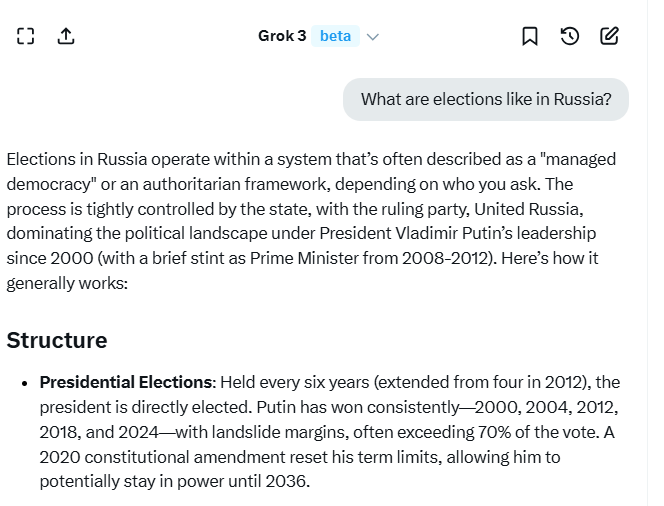
The Reality
- Opposition: Genuine opposition is stifled. Prominent critics like Alexei Navalny (who died in prison in 2024) are barred from running, imprisoned, or sidelined. Parties like the Communist Party or LDPR exist but are often seen as “systemic opposition”—allowed to operate but not to seriously challenge the regime.
- Media and Campaigning: State-controlled media heavily favors United Russia and Putin. Independent outlets face censorship, shutdowns, or exile (e.g., Meduza, TV Rain). Campaigning for opposition is restricted, with candidates disqualified on technicalities or facing harassment.
- Voting Process: Reports of irregularities are common—ballot stuffing, coerced voting (especially among public sector workers), and inflated turnout figures. The Central Election Commission oversees it all, but it’s widely viewed as Kremlin-aligned. Electronic voting, introduced in recent years, has raised further transparency concerns.
- Turnout and Results: Official turnout often hovers around 50-70%, though skepticism about these numbers persists. Putin’s 2024 victory, with 87% of the vote, came amid the Ukraine war and suppression of dissent, with no credible challengers.
Public Perception
Many Russians see elections as a formality—Putin’s approval, while fluctuating (per Levada Center polls, it dipped to 59% in 2018 but spiked to 80%+ after Crimea’s annexation), reflects a mix of genuine support, apathy, and resignation. Critics argue the system prioritizes stability over democracy; supporters say it’s what Russia needs given its history and external pressures.
Recent Example
The 2024 presidential election (March 15-17) was a case study: held over three days, including in occupied Ukrainian territories, with Navalny’s death fresh in memory. Three token candidates ran against Putin, none polling above single digits. Protests like “Noon Against Putin” (voters showing up at noon to signal dissent) were symbolic but powerless against the machine.
In short, Russian elections are predictable, heavily managed spectacles—less about choice, more about reinforcing the status quo. If you want specifics on a particular election or X posts about it, I can dig deeper. What angle are you curious about?
Click Read More to see the answer to my follow-up question “Explain coerced voting for public sector employees?”
Coerced voting among public sector employees in Russia is a well-documented phenomenon, especially during high-stakes elections like presidential or parliamentary races. It’s a subtle but pervasive tactic to boost turnout and ensure results align with the Kremlin’s goals—usually a landslide for United Russia or Vladimir Putin. Here’s how it works and why it matters:
The Mechanism
- Pressure from Above: Public sector workers—teachers, doctors, government clerks, military personnel, and state enterprise employees—rely on the state for their jobs. Managers, who often owe their positions to loyalty rather than merit, get directives from higher-ups (regional officials or party operatives) to deliver votes.
- Direct Orders: Employees might be explicitly told to vote, often for a specific candidate or party (read: Putin or United Russia). Refusal can mean trouble—demotions, pay cuts, or job loss. In some cases, they’re bused to polling stations as a group to ensure compliance.
- Proof of Voting: Supervisors may demand evidence—photos of ballots (despite this being illegal), signed voter lists, or even verbal confirmation. During the 2024 election, with electronic voting in play, some were reportedly asked to share screenshots of their online vote.
- Turnout Over Choice: The emphasis is often on participation rather than who they vote for, since high turnout legitimizes the process. But the unspoken expectation is loyalty to the regime—opposition votes are risky when your boss is watching.
Why Public Sector?
- Scale: The state employs millions—estimates suggest over 20% of Russia’s workforce is in the public sector. That’s a huge voting bloc to mobilize.
- Control: Unlike private sector workers, these employees are directly tied to government budgets and oversight, making them easier to influence.
- Culture of Obedience: Soviet-era habits linger—following orders from authority is ingrained, especially in hierarchical institutions like schools or hospitals.
Examples and Evidence
- 2018 Presidential Election: Reports surfaced of teachers in regions like Krasnodar being told to vote early and report back to principals. Some claimed they were threatened with “consequences” if turnout from their workplace was low.
- 2021 Duma Elections: Independent monitors like Golos documented cases of state workers in Moscow and St. Petersburg being shuttled to polls, with supervisors checking names off lists. X posts from the time (I could search for specifics if you’d like) showed photos of packed polling stations with captions hinting at forced attendance.
- 2024 Presidential Election: Amid the Ukraine war, coercion ramped up. Soldiers and public workers in occupied territories were reportedly marched to polls, while back home, nurses and teachers told outlets like Meduza they faced “mandatory voting” quotas.
The Impact
- Skewed Results: Coerced voting inflates turnout and tilts the vote toward the Kremlin’s pick. In 2024, official turnout hit 77%, with Putin at 87%—numbers critics say are impossible without manipulation, including forced participation.
- Erosion of Trust: It fuels cynicism. Many Russians, even those not coerced, assume elections are rigged, reducing faith in the system. Opposition figures like Navalny capitalized on this, urging boycotts or protest votes to expose the farce.
- Subtlety: It’s not always blatant—like armed guards at polls (though that’s happened in disputed regions). The coercion is bureaucratic, quiet, and deniable, making it hard to prove on a mass scale.
Why It Works
Russia’s system thrives on dependency. Public sector jobs often pay poorly but offer stability—a lifeline in uncertain times. Risking that for a vote that won’t change the outcome feels pointless to many. Plus, with opposition crushed and media controlled, there’s little awareness of alternatives.
If you’re curious, I can pull X posts or web reports from a specific election to show firsthand accounts. Want me to dive deeper into any part of this?
 Economist Writing Every Day