You’ve probably heard a lot about BLS data recently (or at least more than usual) with Trump firing the BLS Commissioner after a bad monthly revision to the nonfarm payroll jobs figures. But this didn’t come out of the blue, as there was plenty of criticism of the jobs numbers during the Biden term as well, mostly coming from the political right.
The two main criticisms leveled at the BLS, in my reading of it are:
- The BLS is getting worse at estimating jobs numbers over time, leading to larger revisions
- The revisions are done in a way that is favorable to Democrats
I think both of those claims can be analyzed with the following chart, which also shows those claims to be incorrect:
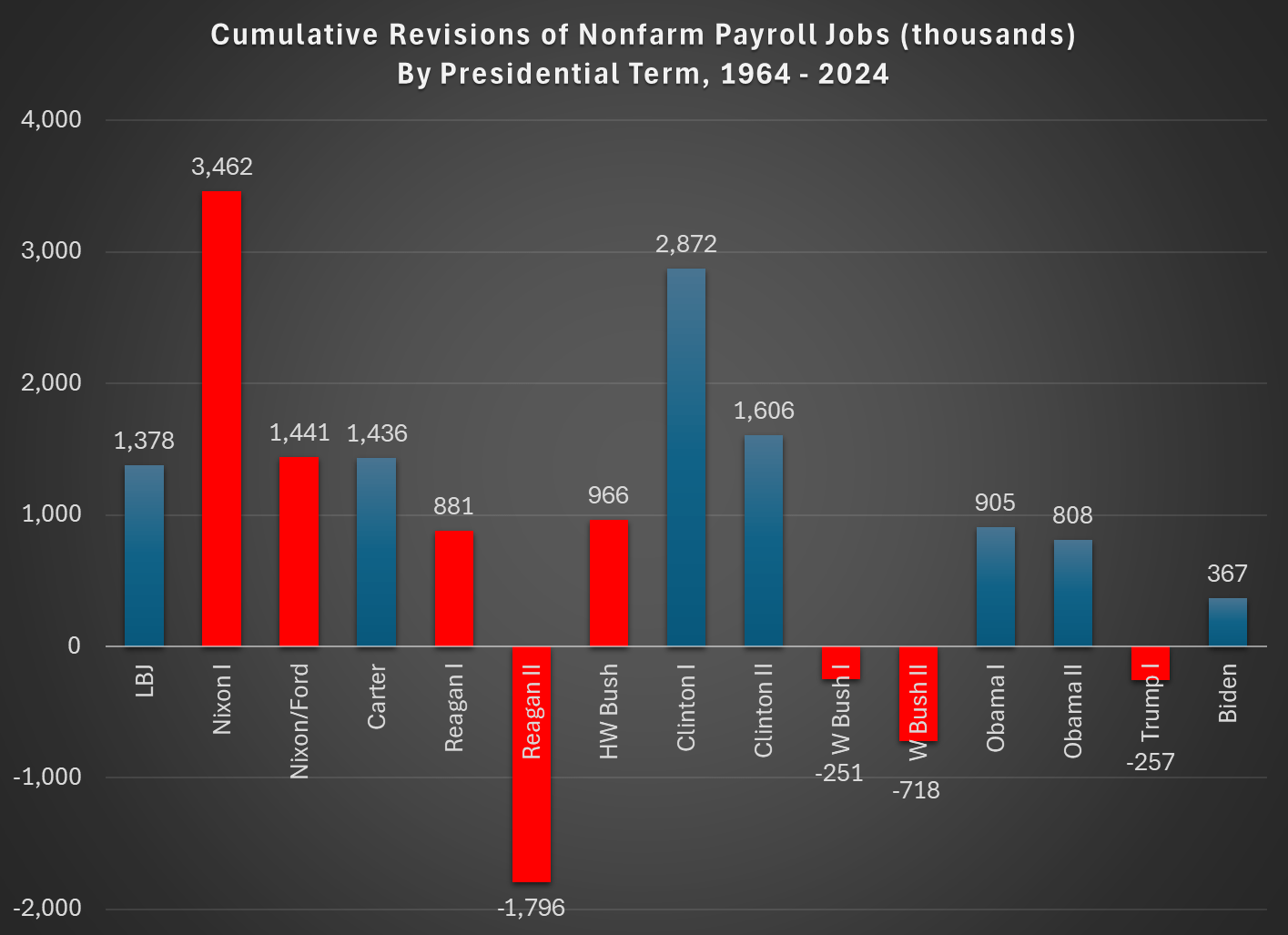
The chart shows the cumulative total of revisions to the nonfarm payroll jobs number, grouped by 4-year Presidential terms (I start the term in February of their first year). I added up the total difference between the first estimate of jobs published in the monthly Employment Situation report and the most recent estimate from benchmarking or whatever else is the most current revisions (the data comes from the Philadelphia Fed). For example, if the first estimate said that the economy added 418,000 jobs, but the most recent estimate is 425,000 jobs, then I call this a positive 7,000 jobs revision. Revisions can be negative too. If there is another month in that President’s term that has a revision of -7,000 jobs, the two months cancel out in my chart above, and the cumulative revision over those two months would be 0 jobs (see more below if we want to use the absolute values of each month).
On the first question, it is quite clear that the BLS is getting more accurate over time. The cumulative revisions under Trump and Biden were only about 1/5 the size (in absolute terms) as the revisions in the mid-1970s under Nixon/Ford/Carter — and this in absolute terms! The labor force today is about twice the size of the mid-1970s, so really these revisions are 10 times smaller in the most recent Presidential terms. As is clear in the chart, the last six Presidential terms stand out as being particularly good.
Is there a bias in the revisions that helps Democrats? First, it depends on what we mean by revisions that would benefit a particular party. A common claim is that downward revisions are helpful to a President, because the initial estimates get bigger headlines than the revisions. Upward revisions are unhelpful by this logic, since Presidents will only get the credit in a less celebratory way, possibly even after they have left office.
By this logic, there is actually a bias in favor of Republicans. From Clinton’s terms to the present, all Democrats have later had upward revisions, and all Republicans have had subsequent downward revisions! This is very much the opposite of what many are claiming, including Stephen Moore’s recent set of charts presented in the Oval Office (see Chris Clarke’s excellent analysis of Moore’s charts). In absolute terms, the revisions have been on average larger on Democrats, especially from Clinton to the present, but the revisions don’t fit the logic of the BLS trying to juice the numbers for Democrats. If anything, for recent Presidents the bias has run against Democrats, with both Clinton and Obama missing large numbers of jobs in the initial reports.
Finally, perhaps the first chart isn’t the best way to approach these questions. Maybe instead of having negative and positive revisions cancel out, we should take the absolute value each month, and then add up all those absolute values. So the +7,000 revision and the -7,000 revision add up to a 14,000 jobs error, rather than no error. The following chart shows the numbers in this fashion, and also adjusts for the growing size of the labor force:
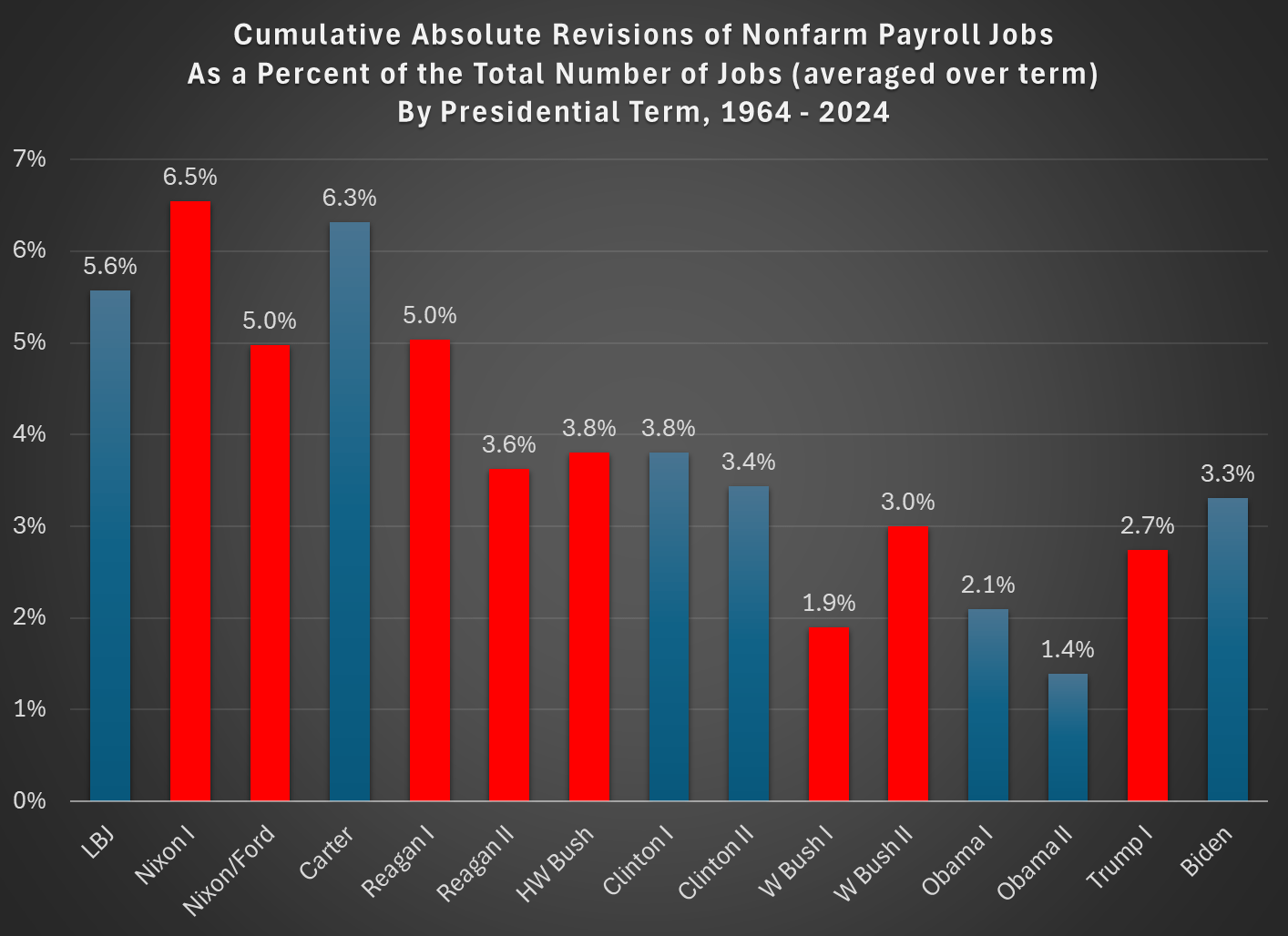
This chart shows the same general improvement over time in the accuracy of the jobs reports. You could say that Biden stands out as being worse than the past 5 terms, but really the number is similar to Trump’s first term and Bush’s second term. There’s also no obvious partisan pattern, given that some of the smallest revisions in absolute terms are under Obama’s two terms. The average error over all of these Presidential terms is 3.7% under Democrats and 4.0% under Republicans. That’s pretty close. It’s similarly close if we look at the most recent 6 terms: 2.3% under Democrats and 2.5%.
Many things could be done to improve the accuracy of the estimates. Recent BLS Commissioners have called for increased funding to modernize surveys such as the CPS (not used for the data discussed in this post, but still used for other employment data). And the response rate for the CES, the survey for the initial estimates discussed in this post, has been declining over time from about 60% ten years ago, to almost 40% today. But this is a completely separate question from whether the BLS is “rigging” the data to hurt Trump and Republicans, as the President has repeatedly claimed.


Great summary of key facts here, thanks.
LikeLike