When reading an old novel or watching a period drama movie or TV show, it is almost inevitable that some historical currency amounts will be mentioned. This is especially true when the work is dealing with money and wealth, for example the series “The Gilded Age” is about rich people in late 19th century America. So money comes up a lot. I wrote a post a few weeks ago trying to contextualize a figure of $300,000 from 1883 for that show.
A new Netflix series “The House of Guinness” is another period piece that spends a lot of time focusing on rich people (the family that produces the famous beer), as well as their interactions with poorer folks. So of course, there are plenty of historical currency values mentioned, this time denominated in British pounds (the series is primarily set in Ireland, where the pound was in use). On this series, though, they have taken the interesting approach of giving the viewers some idea of what historical currency values are worth today, by overlaying text on the screen (the same way they translate the Gaelic language into English).
For example, in Episode 4 of the first season, one of the Guinness brothers is attempting to negotiate his annual payment from the family fortune. He asks for 4,000 pounds per year. On the screen the text flashes “Six Hundred Thousand Today.”
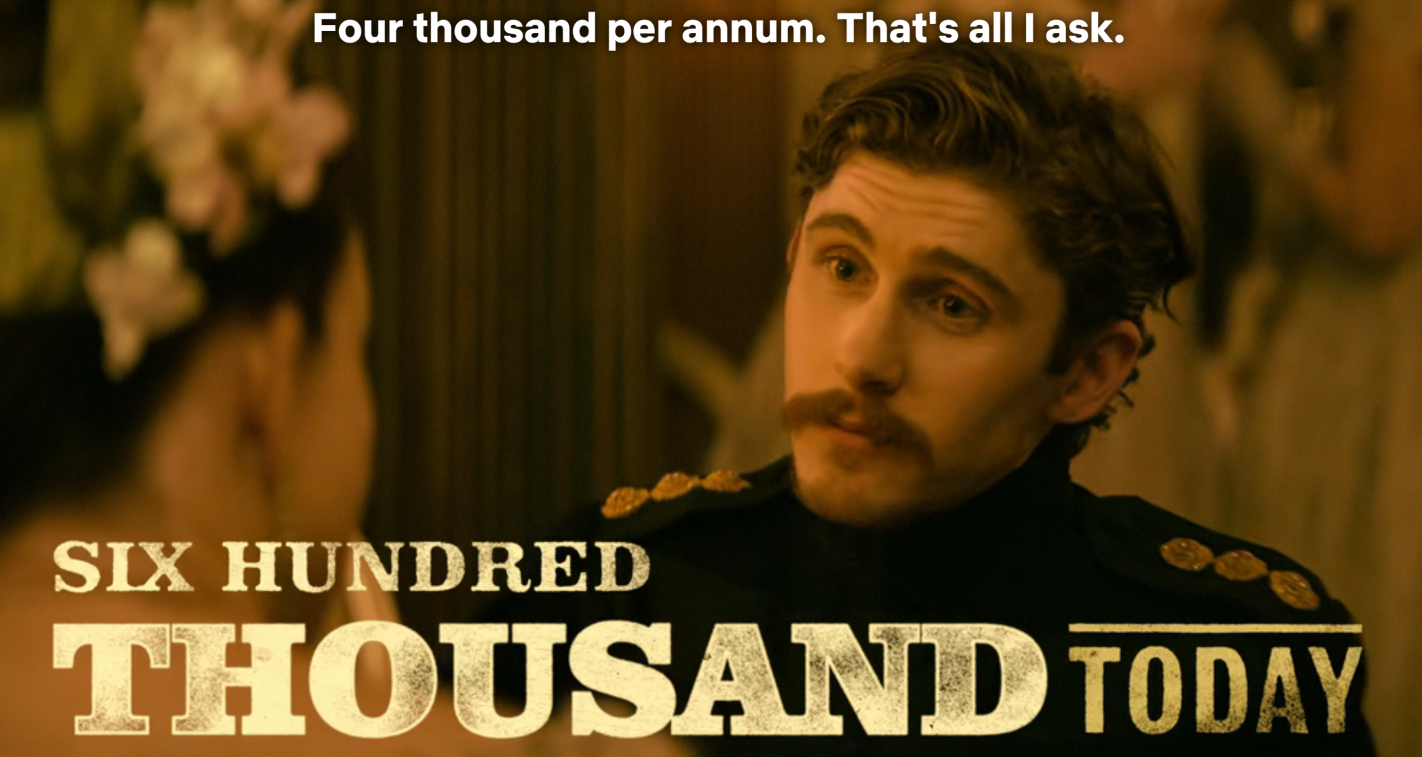
The creators of the show are to be commended for giving viewers some context, rather than leaving them baffled or pausing the show to Google it. But is 600,000 pounds today a good estimate? Where did they get this number? As with the “Gilded Age” estimate, it’s complicated, but it is probably more than you think.
The simple answer, I believe, to how they got 600,000 was to use the Long-Run Retail Price Index Series from the UK’s Office of National Statistics. In 1868, when the show was set, that retail price index had a value of 10. In 2024, the index had a value of 1,525.5, which you can use to multiply the 4,000-pound annual payment by 152.6, which yields you about 610,000 pounds. Or maybe they used the slightly different Retail Price Index from Measuring Worth, which converts the 1868 value to about 485,000 pounds, and then converted it to US dollars which, depending on when you choose the exchange rate, is somewhere around $650,000 (this would be convenient if they assume their audience is American).
But whether it is pounds or dollars today, 600,000 is a handsome annual income (essentially for doing nothing, this is the brother who is — SPOILER ALERT — not going to be running the brewery), but it’s not mega-rich: a married couple where both are doctors or lawyers today could easily be earning that much in the US today. Not bad money, but not stinking rich.
Either way, I think the 600,000 figure vastly understates how we should understand that dollar amount in the context of the show.
The Measuring Worth calculator mentioned above is useful because it contains a range of estimates. And 485,000 pounds is on the low-end of those estimates. For example, relative to the earnings of an average worker, the 4,000-pound income would be equivalent to 3.3 million pounds, or almost $4.5 million. That’s because, according to the Measuring Worth wage series, the average worker in the UK only earned 44 pounds per year, so the income he has proposed is roughly 90 times what the average worker earned at the time.
Keep in mind the show is set in Ireland, which was the poorer part of the UK (Ireland has caught up significantly, though exactly how much is complicated). The Measuring Worth series only covers England in 1868. At the time, agricultural wages for men in England were about 14 shillings, 6 pence per week, while in Ireland the average was only 10 shillings per week. Agricultural workers were the largest class of workers (and often lower paid), but even if we use the overall average adult males it was about 22 shillings, 6 pence in England and 14 shillings, 4 pence in Ireland. This suggests that Irish workers only earned 60-70% of what English workers earned at the time. Looking at GDP per capita is even more pessimistic for Ireland, which was about 50% of the UK in 1870, but at least we are in the ballpark.
Putting that all together, and using 60% as a rough Irish wage-level compared to England, a 4,000-pound annual income is roughly 150 times what the average worker would earn in Ireland. And since life expectancy was less than 50 years, it’s roughly the amount a person could earn in 3 lifetimes (provided they worked from birth to death and earned the wage of an average male. As a rough US-dollar equivalent, we can use median personal income of $45,000, which would make the Guinness brother’s proposed stipend worth $6.7 million per year (150 times median income). Now that is something that is, if not mega-rich, certainly beyond the reach of anyone without a superstar occupation.
Speaking of mega-rich, it is worth mentioning another inflation-adjusted amount from Episode 2 of the series. They tell us that the late Benjamin Guinness’ estate is worth 1.1 million pounds, that this equals “162 million today.” That’s certainly a lot of wealth, around $200 million in the US, but not ultra-rich: you wouldn’t even make the Forbes 400 list (minimum amount today is almost $4 billion). But if instead we use the Measuring Worth calculator again and compare it relative to national income, this amount of wealth would 3.1 billion pounds today (yes, we are comparing a stock to a flow here, but total national wealth is harder to pin down in the past, even if it is a better denominator). That gets us more in the ballpark, perhaps not to US billionaires like Musk or Ellison, but certainly compared to the richest Brits today, who have on the order of 10-30 billion pounds.
As a final note, when Edward Guinness (the son of the late Benjamin Guinness that ends up running the family business) dies in 1927, his estate was valued at 13 million pounds, the largest probate in UK history up to that time. He was therefore, probably the richest person in the UK, and his father before him likely was too. So it makes sense that the father’s estate should be thought of in billions, not hundreds of millions, to give better context for the show. As a share of national income, the 13 million pounds from 1927 is about 8 billion pounds today, close to the wealthiest British citizens today.
You might be wondering: if I think the standard inflation adjustments aren’t useful, what even is the point of them? It’s not that they are useless, only that their use is limited. If we want to know what income today could buy roughly the same amount of real goods and services as in 1868, a standard inflation adjustment is useful and correct. But that’s not always what we want to know, and I think in the context of this show (and others like it), it’s probably not the best comparison. Though it may be helpful, if you tell your audience that’s what you are doing.
 Economist Writing Every Day