A recent essay by Jeffrey Tucker asks “Has Life Really Improved in Half a Century?” Specifically, Mr. Tucker is interested in measuring median income of families (he uses household income, but families are clearly what he is interested in).
Tucker grants that real median household income has increased by about 40 percent from 1984 to 2024 (if he had used family income instead, the increase is almost 50 percent). But… he says this is illusory. That’s because it now takes two incomes to achieve that median income, whereas it only took one income in the past:
“Adding another income stream to the household is a 100 percent rise in work expectations but it has yielded only a 20-plus percent rise in material income. The effective pay per hour of work for the household has fallen by 40 to 50 percent!”
(He makes a data error by saying that in 1976 real median household income was $68,000-$70,000, when it was actually $59,000 in 2024 dollars in 1976 — real income didn’t fall from 1976 to 1984!)
The fundamental error in his analysis is to assume that the 1984 (or 1976) family had one earner but the 2024 family has two. At the median, this is incorrect. As I discussed in a previous post, dual-income families have certainly been on the rise in the second half of the 20th century — this is possibly the biggest and most widely known fact about the labor market in that period. However, by the late 1970s, most married couples were already dual-income families. There was an increase, to be sure, but it surpassed 50 percent (the median family) sometime around 1980 depending on the measurement, and then it plateaued in the 1990s. So at a minimum, you can’t explain much about the growth of family income after the 1990s by the growth of dual-income families (sorry, sitcom memes). But if we are looking at median incomes, you really can’t even explain the growth in income since the late 1970s by appealing to more two-income households. It had already happened by that point, at least at the median.
I think the charts in my previous post pretty well address that claim, but let me include one more that really drives it home. Instead of just looking at all married couples, let’s look at a specific group that Mr. Tucker and others are interested in: married couples with children.
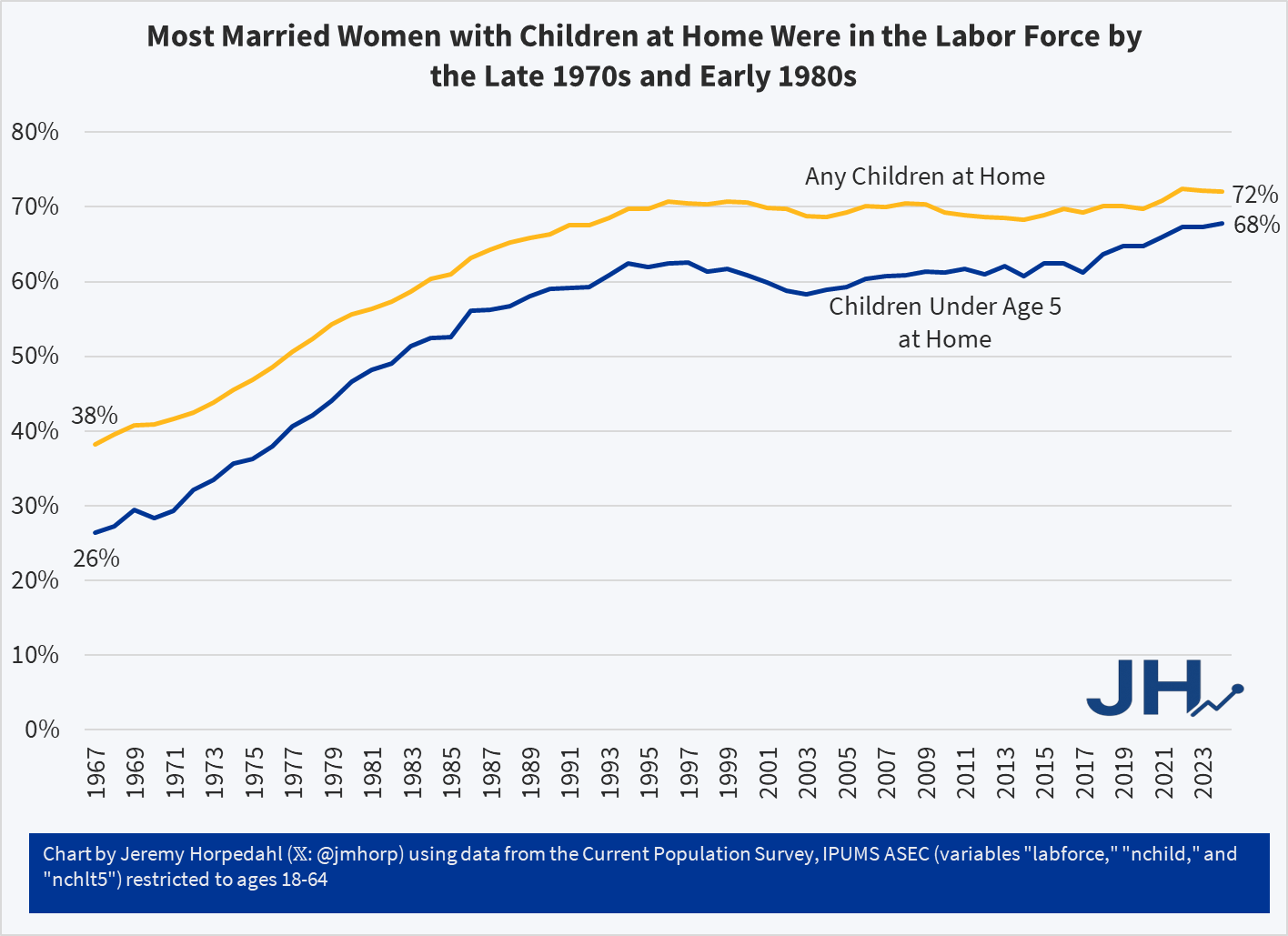
By 1977 over half of married women with children at home were in the paid labor force. If we restrict the analysis to women with children under age 5 (before they would be in school), it takes a few more years to get to 50 percent, but this happens by 1983. So for the years mentioned in the Tucker essay, 1976 and 1984, he almost perfectly hits the years when a majority of married mothers were already in the labor force. If the comparison were to, say, median income in 1967, the analysis performed by Tucker might make sense. Back then, well under half of married women with children were working.
But the long growth of labor force participation by mothers was mostly complete by the late 1970s, and certainly was complete by about 1990. As Bailey and DiPrete show using Census data, the change starting from the beginning of the 20th century was quite massive (see Figure 2 in their paper): at the beginning of the century, fewer than 10 percent of women with young children worked, while around 60 percent did by the end of the century. That’s a huge change! But it doesn’t affect our analysis of growth in median income since the late 1970s/early 1980s.
We can provide one more check on Tucker’s math, when he claims that “The effective pay per hour of work for the household has fallen by 40 to 50 percent.” By using data from a fantastic paper by Corinth and Larrimore, we can see in Table 4 and Table A3 a few important facts. First, the growth in total working hours for married couples did increase, but the increases were from the Greatest to Silent to Boomer generations. Once we get past the Boomer generation, there is no subsequent increase in total average household working hours (Table 4).
From these working hours, we can calculate an implied hourly wage rate (Table A3), and if we focus on the change from the Silent Generation (who would have been in the 36-40 range the paper uses in 1976) to the Millennial Generation at about the same age, we see that real wages for the household have increased by 26 percent at the median and 38 percent at the mean. These are very similar to the increases in median household income!
The gains in real median household or family income since the 1970s are not being distorted in any major way. Total hours of work didn’t double in the household — they increased modestly, by about 12 percent at the mean and 39 percent at the median. And this increase stopped after the Boomer generation (roughly in the mid-1990s). Furthermore, we can adjust household income for these increases, whereby we see a rise of 26-38 percent, not a fall of 40-50 percent as Mr. Tucker claims.
 Economist Writing Every Day
One thought on “Most Married Women with Children Were Working By the Late 1970s”