Oppenheimer Film Thoughts

Even though I had already heard that it will disappoint high expectations, I wanted to be in on the conversation. I’m going to link the film to some other posts and ideas.

I haven’t seen Barbie, but I agree with Ross:

I can see why Tyler was disappointed. However, if you don’t go in with those high expectations, it still is a thoughtful period piece. It’s more interesting than the next Marvel installment.

Los Alamos National Laboratory, Attribution, via Wikimedia Commons

Though it almost drowns in the unwieldy plot, this is a movie about talent. Hitler was alienating and killing Jews in Germany, which affected the kind of talent mobilized on both sides of the war. There are several explicit references to antisemitism and motivation among physicists. Matt Yglesias observes, “They beat Heisenberg to the bomb — in part because Niels Bohr refuses to help the Nazis…”

I had written about talent and wars earlier, also concerning World War II but a different kind of doctor. “In 1939, Keynes had hired János Plesch, a Hungarian Jewish doctor who had relocated to London after fleeing Nazi persecution.”

How to manage talent becomes the challenge once brilliant scientists have been recruited to Los Alamos. The scientists did coordinate their activities enough to succeed in making the bomb, but some of the drama hinges on their rebellions against Oppenheimer. Now that machines are becoming smart, this ties into a previous post about managing artificial intelligence. “A question this raises is whether we can develop AGI that will be content to never self-actualize.”

Yet another theme of the film is the Communist movement in America in the 1930’s. I have studied this through the biographies and essays of Joy Davidman. Davidman was a committed member and then left the Party, as did several characters in the film.

And yet another tiny theme was women scientists on the project. There is a woman who complains that she was asked to be a typist even though she went to Harvard for science. Oppenheimer briskly puts her on one of the scientist teams. It goes by fast. I felt like the director was saying, “If you went to see Hidden Figures, here’s a 20 second recap of Hidden Figures for the people who like that, NEXT!” This is an example of hurrying everything in order to stuff 8 movies into 3 hours. The Advanced Placement Program® (AP) has a blog on “Women Scientists of the Manhattan Project” I know from my research on getting people to code, that women today study AP Computer Science at a considerable lower rate than male high school students.

Success in starting

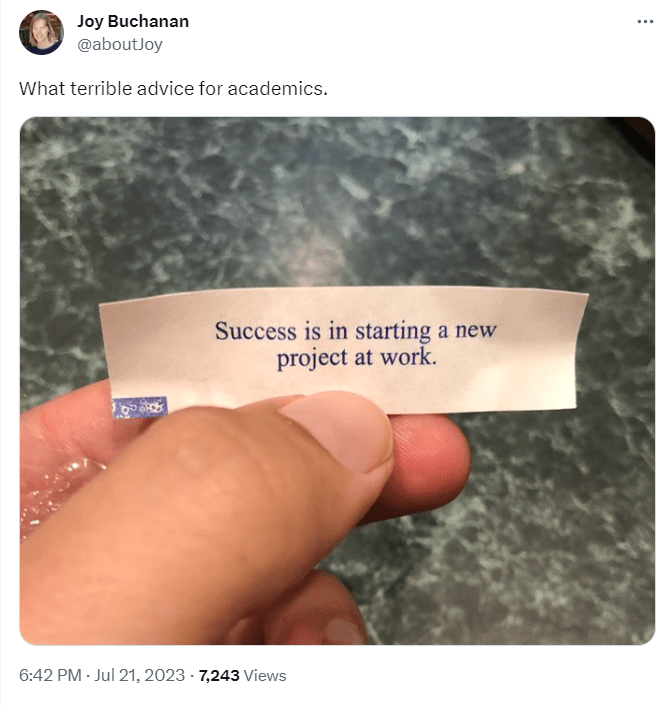
At a Chinese restaurant, I got a fortune that said, “Success is in starting a new project at work.” It struck me as very funny, and it resonates with other people on Twitter.

Starting a new project at work does not translate to success in academia. The danger is usually in starting too many projects and finishing too few.

Starting a new research project, whether alone or with coauthors, is exciting. You fall in love with a new idea.

The hard part is sticking with that idea until the very end of the publication process. This is more comparable to staying married. The project will see you at your worst, and you will discover that the project is not as wonderful as it seemed initially. You might end up re-writing the manuscript several times, years after the initial infatuation has worn off.

Academics do need to start projects. It is important to start the right projects. A reason to not start too many projects is to preserve time for the best work. A downside to being overloaded is that you might have to say no to a new project when an actual good opportunity comes along.

In my post on the Beatles documentary Get Back, I observed the way that the bandmates start new songs together. It reminded me of coauthors convincing each other to start a new project.

Their creative process resembles co-authoring a research paper. When Paul is working out a song and humming through places he hasn’t worked the lyrics out yet, that reminds me of the early drafts of a paper. You don’t have to have the whole Introduction written. The hook of a song is a bit like the main result of a research paper. Persuading yourself and your coauthor that you have a project worth finishing is the first step. Coauthors have unspoken agreements on how the project is going to proceed. The tacit knowledge of the collaborative process is one of the most important things you can learn in graduate school.

Darwyyn Deyo wrote several posts for us on the research process, including: “The Research Process: Identifying the Ideas that Motivate You

Greg Mankiw’s career advice intersects with starting projects:

Advice for new junior faculty (2007)

My Rules of Thumb (1996)

This quote from Rules of Thumb was surprising: “None of this is part of a grand plan. At any moment, I work on whatever then interests me most. Coming up with ideas is the hardest and least controllable part of the research process. It is somewhat easier if you have broad interests.” He goes on to say: “I sometimes fear that because I work in so many different areas, each line of work is more superficial than it otherwise would be. Careful choice of co-authors can solve this problem to some extent, but not completely.”

He really refutes my fortune cookie with this line, “Deciding which research projects to pursue is the most difficult problem I face in allocating my time.” Success is about starting the right projects and no others.

Smoky Mountains Tourism

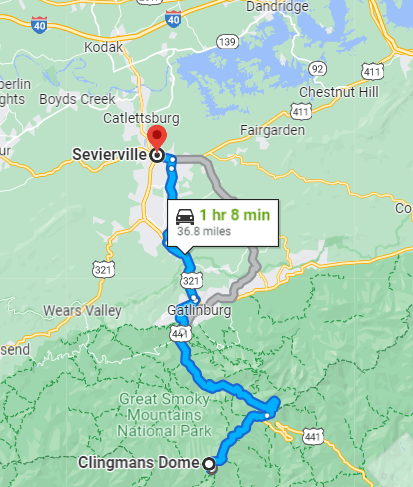
The area from Sevierville, TN to the peak of the Smoky Mountains is a popular destination for summer road trips.

Much of the American Southeast is too hot in July for hiking. The nice thing about the Great Smoky Mountains National Park is that you can keep driving up in elevation until you get to 70 degrees F or less.

The problem with the Smoky Mountains is that too many people want to go. The economist Donald Shoup has written about The High Cost of Free Parking. Entry to the national park is still free, however as of 2023 parking is paid. Good for them. The fee is very cheap. You can print a pass before you go or easily buy one on the way in.

The parking pass didn’t deter many people when we went in 2023. I recommend going early if you want to be able to park near a trailhead, or if you want to avoid a line getting into the Clingman’s Dome parking lot.

Our family has a running joke about “the pancake cabin people”. As we drive into the mountains in the morning, we pass parking lots full of cars outside of restaurants called pancake cabins. As long as you are up early enough to beat the pancake cabin people, you should be able to park where you want to.

There are more attractions in the national park than you could see in one day. The most dramatic view is at the top of Clingman’s Dome. The most historic educational sites are at Cades Cove. The best swimming (that I know of) is in the creek at Chimneys picnic area.

There are dramatic lookouts that you can drive right up to. Cades Cove is mostly a driving experience with lots of optional stops (closed to cars on Wednesdays).

With little kids in tow, it’s hard to make progress on the hikes. The map says just 2 miles to a waterfall. Sounds great. We make it 0.3 miles in. Then someone demands to be carried. Someone trips and breaks down crying. Our snacks are gone. We turn around and return to the car… it’s all good as long as you get excited about leaves and bugs. If you are in the stroller stage of life, don’t expect to get far on any hikes.

If you get a hotel within an hour of the national park on the Tennessee side, there is a lot to do. I might call it “the Orlando of the mountains.” Dollywood is darling at Christmas time.

Years ago, I sent out a note from Chattanooga, a few hours away in Tennessee. That’s another cute green place with hiking and restaurant options, on a smaller scale than the Smoky’s area. Their aquarium is fantastic. It’s neat how their “River building” starts by showing how small streams in the Smoky Mountains feed into the Tennessee River.

Secondhand by Adam Minter

Secondhand: Travels in the New Global Garage Sale is a great book in my summer stack on fast fashion. I have always been interested in the combination problem-blessing of too much stuff. Adam Minter explains perfectly what many of us have been curious about.

Secondhand is America-centric, but he also travels to Japan to observe a country that is ahead of us both in terms of the demographic crisis and the mechanisms for handling old stuff. The reports from Africa are very interesting.

I have been wondering what is happening with Goodwill and with recycling in general. What hope do we really have of keeping goods out of the landfill? What should I do with a shirt my kid has grown out of? (The lady at work I used to give clothes to now runs away at the sight of me. I gave her too many bags.)

The Goodwill collection center near me looks cluttered and weird. After reading Secondhand, I’m more optimistic about dropping off bags there.

The barrier to sorting the used goods of the rich world is the scarcity of time and attention. This paragraph about a used book seller in Japan is heart-breaking:

It’s a thirty-year-old hardback novel, and the edition is rare. If it were at a traditional bookstore, it’s command a premium price. But Bookoff is about volume, and there’s a problem: not only does it lack a barcode, but it lacks an ISBN… “So there’s no way to price it in Bookoff’s system,” Kominato says. With a grimace, he gently places it on top of the books filling the recycling cage and steps away. (pg 40)

At least the book will get recycled into new paper, and the reality is that it was providing negative value as clutter in someone’s home.

Back in America, Minter describes what happens to donated goods at Goodwill in detail. Sometimes high-quality clothes are identified, but it is hard to get a good price for them. Some customers expect to pay less than $5 for a shirt, no matter what.

Customers are all about price, not quality…They won’t buy a $6.99 shirt that will last.  If that’s the option, they’ll buy a $2.99 shirt from Walmart. (pg 57)

Some consumers are in the habit of treating clothes almost like disposable goods instead of durable assets. They won’t pay for quality. Going out and getting a new replacement shirt costs less than lunch.

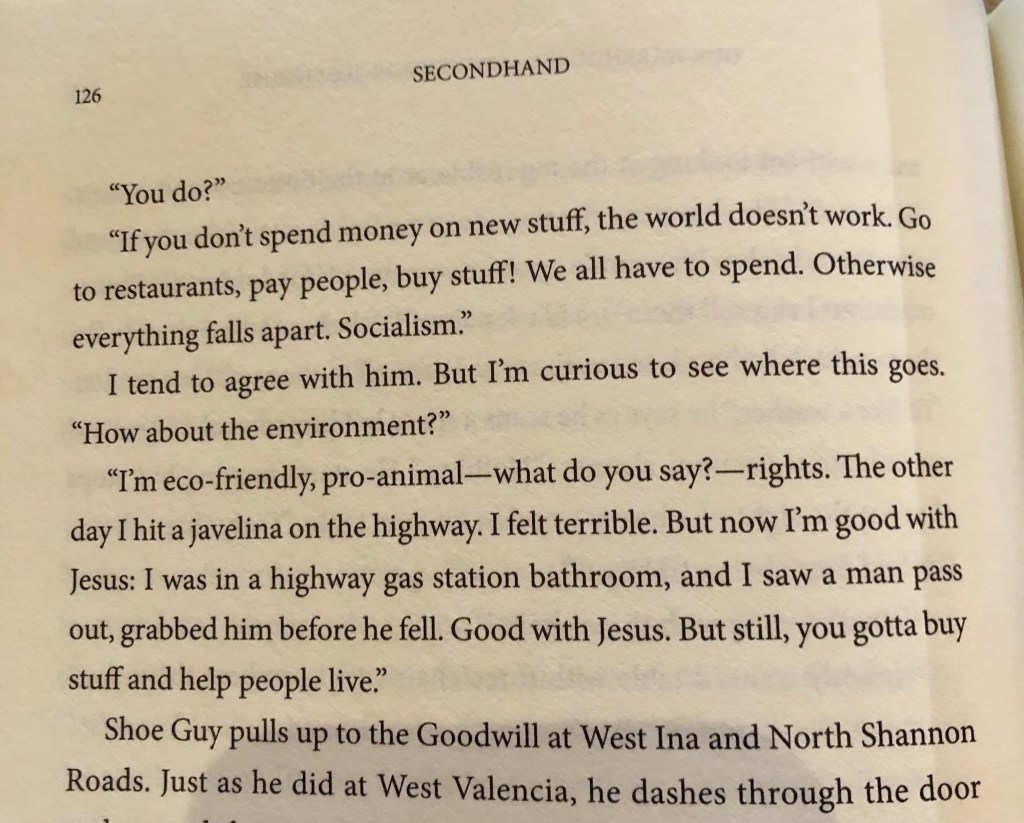
I don’t want to give away too much, since you will want to go get the book yourself. Here’s the funniest page:

Lastly, I’ll share a personal win. I know that I’ll need a school backpack for my youngest in August. I went to a local rummage sale and went to the backpack section. I found one that is good enough (some scuffs but plenty of sparkles). I’m happy about keeping this sparkly pink backpack out of the landfill for a few more years. I walked out of the sale with a load of gear that cost a total of $10. Next, I went to a coffee shop to work where I also spent $10. Used textiles and books are dirt cheap.

EconTwitter Platforms and Threads

There is a community called #EconTwitter. This agglomeration of not-anonymous accounts links together professional economists, academics, and independent intellectuals. Twitter.com is the home base and origin of #EconTwitter. Mike wrote about turmoil in EconTwitter in December 2022. Find me on Twitter at @aboutJoy

The #EconTwitter group has experimented with leaving Twitter to join new networks. For some people, getting away from the billionaire owner is the explicit goal. Others join the new platform to be where the people are.

Mastodon launched in 2016 but it was not until recently that #EconTwitter made a go at that.

Mastodon is also part of the Fediverse ensemble of computer servers, which use shared protocols allowing users to interact with other users on computers running compatible software packages such as PeerTube and Friendica. Mastodon is crowdfunded and does not contain ads.

https://en.wikipedia.org/wiki/Mastodon_(social_network)

Fediverse? Protocols? The average Twitter user does not want to be bothered with “computer servers”. That’s part of the problem. On Mastodon I am @JoyBuchanan@econtwitter.net

When I joined, I was not confident that it would build on the initial momentum. The reason that the move to Mastodon was large and sudden is that Paul Goldsmith-Pinkham volunteered to set up econtwitter.net It’s paid for out of his research budget and he serves as the monitor. He can ban anyone who violates his speech/civility rules. So there is a moderator but not one paid by Mastodon.

I wrote about “Content Moderation Strategy” back in April 2022 when Elon at Twitter was big news.

Elon Musk buying Twitter is the big news this week. He wants to enhance free speech on the site and, according to him, make it more open and fun. Some fans are hoping that he will make the content moderation and ban policy more transparent. 

me in April 2022

Some people thought Twitter would crash – as in go offline – because of Elon. That has not happened, but users and brands have been irked by his management and personal style.

EconTwitter at Mastodon is still going. As far as I can tell, most people have reverted to Twitter for their main feed because the audience is larger and writers want engagement. The level of engagement at Mastodon probably peaked about a month after Paul started the server for economists. One reason I think it never overtook real EconTwitter is that economists like having a big audience that includes journalists and sociologists. Silo-ing on an EconTwitter-dedicated server was less fun. People say they don’t want to have to deal with weird strangers online, but revealed preference indicates otherwise.

Another notable development was the launch of Bluesky. I’m there as @joybuchanan.bsky.social

Making a good handle at the beginning is easy and there is some upside if it turns out to attract a large community. A few “Twitter famous” people will join these new apps and commit to posting just in an attempt to unseat Twitter. This sort of works in the sense that both networks are still operating, however neither ever got close to the Twitter scale.

Threads, launched this week, might be different.

Mark Zuckerberg opened up Threads for anyone with an Instagram account, which most of us already have. Millions of people joined in just two days. If you already have an Insta, then you can download the free Threads app on your phone and port over your Insta account.

I’m @_Joy_Buchanan_ on Threads. The underscores might look awkward, but there is no “early adopter” phenomenon here, unless you were an early adopter of Instagram.

Brands and celebrities are comfortable on Threads, so it will be able to make money without asking users to pay for a Blue Check. I have no problem with Elon asking Twitter users to pay. Someone who is worried about free speech should want to be able to pay for service.

The Silicon Valley phrase is: “If you’re not paying for the product, you are the product.

That’s going to be true on Threads, since I’m not paying for the product.

Threads will not kill Twitter, but it is going to make a bigger dent than Bluesky and Mastodon did. Nothing is free and nothing is perfect. I know a lot of people are upset about Twitter. However, there are some people who got a voice through it. People stuck inside authoritarian countries had a way to send messages out to a global audience.

Here is my most bullish case for Threads: it might unite the “TikTok generation” that never joined Facebook or Twitter but had Instagram with the older people from Twitter who never joined TikTok. The Twitterers will stay if they get enough attention.

Thus, Threads might put a dent in TikTok, too. Zuckerberg is probably sophisticated enough to make a “TikTok person” feel engaged by sending them more food videos and less BLS update charts.

Continue reading

Awards for young talent are antinatalist

Another announcement just went out in my field to apply for an award for research support. This one is for early-career people. There are parameters about who can apply.

I know one of the men on the committee, and it would never occur to him in a thousand years that the structure of this prize discriminates against mothers. He probably thinks he’ll give equal consideration to everyone, which might be true in a sense, but there are a lot of people who are not allowed to put themselves in the pool. For this specific research prize, they don’t actually list an age limit, but they care about how fast you have progressed through the PhD->job track.

Let’s just say that this blog post is about every “under 30” or “under 40” prize that you can think of. Any prize that is age-limited sends the message that you had better accomplish whatever you are going to accomplish professionally first. Having kids needs to be the afterthought, chronologically.

Biologically, for men and especially women, having a kid before you turn 30 makes sense, if you ever want to have one. Professionally, there are a lot of implicit barriers to doing this. One of the few remaining explicit barriers that I can think of is these age-stage-specific prizes.

In case someone out there is thinking that IVF solves this, I’d like to point out that it’s really miserable and of course does not always work. In case someone out there is thinking “Bryan Caplan already showed that parenting is easy, so why does this matter?” I have a whole rant about that from last year.

The Part I Remember from Eat, Pray, Love

Elizabeth Gilbert of Eat, Pray, Love delivered an insight, second-hand from “Deborah the psychologist”.

I remember a story my friend Deborah the psychologist told me once. Back in the 1980s, she was asked by the city of Philadelphia if she could volunteer to offer psychological counseling to a group of Cambodian refugees—boat people—who had recently arrived in the city. Deborah is an exceptional psychologist, but she was terribly daunted by this task. These Cambodians suffered the worst of what humans can inflict on each other—genocide, rape, torture, starvation, the murder of their relatives before their eyes, then long years in refugee camps and dangerous boat trips to the West where people died and corpses were fed to sharks—what could Deborah offer these people in terms of help? How could she possibly relate to their suffering?

“But don’t you know,“ Deborah reported to me, “what all these people wanted to talk about, once they could see a counselor?“

It was all: I met this guy when I was living in the refugee camp, and we fell in love. I thought he really loved me, but then we were separated on different boats, and he took up with my cousin. Now he’s married to her, but he says he really loves me, and he keeps calling me, and I know I should tell him to go away, but I still love him and I can’t stop thinking about him. And I don’t know what to do…

This is what we are like.

Continue reading

Practical Sewing, Washing, and Drying Tips

I don’t agree with Elizabeth L. Cline on everything, but she’s written a reasonable book for Americans today. The Conscious Closet has some good advice for everyone.

A decade ago, Cline wrote Overdressed: The Shockingly High Cost of Cheap Fashion which investigated the environmental toll of clothes and the labor controversies. Since then, she has been working on what consumers can do differently.

Not every American household has practical knowledge of laundry and sewing anymore. Cline offers suggestions on how to economically maintain clothes longer by making sensible home repairs or washing them less. (Don’t wash a pair of jeans after just one wear. I don’t.) The Conscious Closet came out in 2019, so it’s up-to-date concerning chemicals and certifications and websites that operate today.

The way we wash and dry our clothes uses a lot of water and energy. If a person was looking for a way to lower their environmental footprint, then a marginal reduction of laundry loads might be a relatively easy way to do it. Since almost every American has an electric dryer, we have lost the tacit knowledge of how to air dry clothes. She gives the practical reminder, for example, that dark color clothes will fade if exposed to extended sunlight.

I feel like Cline could be even more conscious about the opportunity cost of time. She does explicitly acknowledge that in her chapter about re-selling your unwanted clothes.

Chapman University Economic Forecast Update 2023

I watched the Chapman Economic Forecast Update for 2023 live on June 22 (you can watch the whole thing free here). Go to their website for free videos and links. They have an excellent track record for being correct.

This time, Dr. Jim Doti believes we are headed for a recession by the third quarter of 2023 or at least what he conservatively calls a “slowdown”. He hates to make dramatic predictions or deliver bad news, but he saw the inflation brewing back in 2021, and I remember him correctly predicting what was to come.

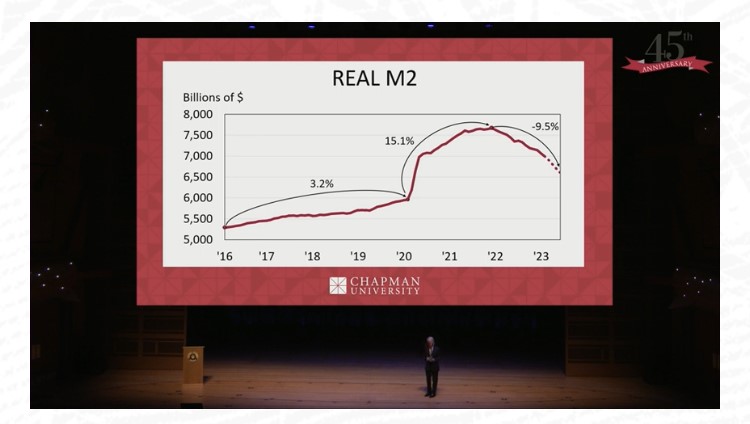
For one thing, the dramatic growth in the money supply at the beginning of the pandemic has been corrected into a sharp contraction of the money supply.

People have been joking about how the recession isn’t happening.

We’ll see who’s laughing in 2024.

The middle segment of the forecast, which I recommend watching, is about investing. Fadel Lawandy cautions that stocks are not a good bet right now, with a likely recession looming.

The third segment is focused on the economy of California. I didn’t finish that part, since I don’t live there anymore.

To Dunk or Not to Dunk

I’m writing an article about fast-fashion, so I’m reading Fashionopolis by Dana Thomas. 

This paragraph is from the intro chapter:

Since the invention of the mechanical loom nearly two and a half centuries ago, fashion has been a dirty, unscrupulous business that has exploited humans and Earth alike to harvest bountiful profits. Slavery, child labor, and prison labor have all been integral parts of the supply chain at one time or another – including today. On occasion, society righted the wrongs, through legislation or labor union pressure. But trade deals, globalization, and greed have undercut those good works.

She invokes religion with “good works.” Thomas and I are of different opinions concerning globalization and “greed” and legislation. My instinct is to rip this paragraph apart. Has legislation never been motivated by greed? Has globalization not improved the lives of children? Has the mechanical loom not improved the lives of women who used to spend hours spinning and weaving by hand?

I am also reading pastor Tim Keller’s biography right now, so I’m having a What Would TK Do moment.

With his gifts (smart, funny, articulate…), Keller could have made a fortune by taking a side. He could have picked the Right or the Left. He could have expertly appealed to a Side, convincing them that they were good-smart and the Other is evil-stupid. Instead, Keller relentlessly stayed in the center. One of his books is actually called Center Church.

Continue reading