Labor market tournaments and the cost of almost making it

Two weeks ago Tyler Cowen observed the increasing presence of family lineages in the NBA. The post is without much commentary, so I won’t impute any theory on Tyler’s behalf, but I suspect most people would observe this as the a product of genetics combined with the increased ability of NBA teams to precisely identify the attributes and aptitudes they want. There could also be a component of nepotism i.e. 2nd generation players are given greater leeway and time to develop, but given the revenues on the line in professional sports and the dependence on labor to compete, those effects are likely to be weak.

I’d like to offer an alternative theory to genetics that I refer to as “Better last than second”. There are certain lines of work, such as athletics, acting, music, or twitch streaming that are best thought of as winners-take-all labor tournaments. Any occupation where the concept of “making it” is well understood by its participants as an elusive but desirable goal can be considered a labor tournament.

There are lots of labor tournaments (academia for instance), but in most of them 2nd, 3rd, or Nth place are reasonably tolerable outcomes because the rewards correlate fairly linearly with any success level beyond abject failure. Nobody worries about being the 27,342nd ranked accountant in the world – that person likely makes a good living. Even if they can’t get a job as an accountant, they have skills that readily translate to a variety of other well-paid occupations. Winning is merely a (highly remunerative) cherry on top of an already pretty good oucome.

Basketball players worry a great deal about being the 474th best in the world.


The NBA at any given moment has 450 employees on their rosters. A couple dozen more float in and out on short term contracts to fill in for injuries and other player absences. The league minimum salary is $925k per season. The NBA developmental league (the G League) pays about 37k per season. That already makes it sound like the earnings dropoff from being the 449th best player to the 474th player is enormous, but it’s actually much, much worse.

It’s worse because basketball skills translate to the tiniest sliver of other jobs. Television acting, DJing house music, colorfully live streaming a Castlevania speed run: these are all skills that can pay large sums of money if you cross some imaginary threshold and “make it.” The catch that distinguishes “better last than second” markets from other winner-take-all labor tournaments is that participation requires the dedication of tens of thousands of hours building human capital whose rewards are skewed almost entirely towards a selected few. Those thousands of hours play out over the course of a survival game where, month by month, year by year a new round of “losers” is selected out.

The irony being that losing first is better than than getting the silver medal. Losing first means rebooting your life early and building up your human capital in something else (hopefully in something more forgiving of merely being very, very good). The silver medalist is, in fact, the biggest loser. The opportunity cost of time and energy they will never get back and never be rewarded for. I don’t worry about players that don’t get NCAA scholarships or drafted for the NBA. I worry about the guys hanging around in the G league until they’re 34 only to get released from their contract over a text message. I worry about the actors who’ve spoken 15 lines across 24 television guest spots and 3 commercials in 11 years based mostly on aesthetics, only to wake up at 34 and find themselves in the uncastable valley of normalcy. I worry about the members of all the bands I like but none of my friends have ever heard of.

Which brings us back to NBA lineages and why they seem to be becoming more common. If your father was in the NBA in the 80s or 90s, you probably come from upper-middle class or better means and, in turn, have the backing to tolerate the financial risk of not making it. Second, almost making it is likely to be less costly for you because you are part of a basketball family. Your name will grant you far greater access to the small number of basketball-adjacent jobs that will value your skills (i.e. coaching, scouting, recruiting, commentary, etc). Being part of a lineage makes that silver medal a lot more valuable. Maybe just as importantly, your family is likely to be a lot more supportive and tolerant of the risk you are taking. If your one of your parents had a six year run on Dynasty or made a living on the LPGA tour, they’re that much more likely to see a path to success for you.

As athletics become more lucrative, they become better understood. As they become better understood, the body of highly specific tacit knowledge grows as well. Lineage players will have access to this tacit knowledge through their parents. Dell Curry knew his son wasn’t going to particularly tall (Steph Curry is listed as 6′2", and official NBA heights are notoriously generous). This lead him to entirely reinvent his son’s shooting form in a manner that rendered him unable to shoot from any distance at all for months, entirely based on his understanding as a former NBA player that his son’s lack of genetic predisposition to play in the NBA required a motion that would catapult shots over much taller players. Even if lineage players do have genetic advantages in the high school and college stages of the tournament, the value of these advantages pale in comparison to the advantages of tacit knowledge precisely because of the stage of the game at which they are leveraged.

One could even argue that any genetic advantages that correlate to success at the early stages of a “better last than second” tournament (i.e. being 6’8″) are akin to a resource curse, giving the false impression of a non-trivial probability of “making it.” Conversely, a lack of genetic gifts (i.e. being 6’2″) while having access to the tacit knowledge valued at the last stage of the tournament truly are a blessing. If you survive the tournament until the last round without the obvious endowments other players have, you probably have a rich portfolio of other skills which, combined with the previously mentioned late-stage tacit knowledge, means you’ve been playing the game with less risk and greater expected value than others.


“Better last than second” labor tournaments are common in high prestige entertainment fields, but they aren’t limited to them. Any academic field that produces PhDs with little to no demand in the private market shuttle thousands of students through exactly such a tournament. The only difference is that the gold medal is a $87k a year job with the job security of tenure and “almost making it” often includes crippling student loans. It shouldn’t be much of a surpise that academia is full of lineages, too. And with those academic parents will come the knowledge of how decisions made in high school, college, grad school, and beyond will determine they win their respective labor tournaments. Or lose and have to settle for saving the world.

The story of social media isn’t over

Saturday I opened twitter and was immediately confronted with bad news that threatened to turn tragic.

This was horrible. “That’s horrible” I said. I spent a moment’s thought reflecting on what might have happened and then continued down my feed.

Within seconds of continued scrolling, I was confronted with this:

My mentality changed immediately. This was no longer a tragic event happening to an anonymous person in a context I had no capacity, nor obligation, to offer assistance. This was a problem and time was a factor. I started thinking about who I knew in Florida. Did I have any friends holding a position through which they could offer assistance? Was there a social cluster I was connected to I could reach out to through social media? Hospitals, law enforcement, travel. Who did I know? I became despondent when it became clear I had nothing to offer but a retweet.

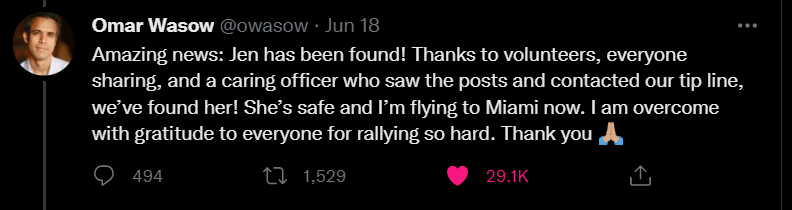
After a few seconds I returned to reading what I realized was a thread of tweets only to be given the relief of wonderful news, a happy ending that was directly a product of sharing on twitter:

The arc of drama (from the privilege of my physical and personal distance from actual events) was over in less than 30 seconds. What I was left with was a simple truth: I was sympathetic, but comfortably detached from a tragic event actively unfolding. It wasn’t my problem nor was it something I could do anything about until I found out I knew someone involved.

Barely knew. I had exchanged a couple messages with Omar about a year ago. A handful of polite thoughts about something Omar tweeted that was of mutual interest. That’s it. That’s the totality of our interactions. But with it came a completely different framing, a level of connection that elevated an evocation of standard sympathy to a potential call to action.

Twitter, that engine of animosity and toothless rage, had made me care more about a stranger through the simplest of social connections.


Comedians and other entertainment professions often tell the same simple story about online trolls that goes something like this:

  1. Someone writes something mean about the entertainer on twitter
  2. The entertainer responds to the troll in a polite and controlled manner that invites them to more civil engagement or simply reveals that the trolls comments are hurtful.
  3. The troll evaporates, replaced by a person excited to re-acknowledge the basic humanity and worth of their previous target.

A moment of direct interaction transforms, in the eyes of the troll, a previously two-dimensional narrative prop into a flesh and bone person worthy of dignity. We’re awash in the denigration of targeted individuals by detached opportunists seeking status and approbation through targeted cruelty. What is underappreciated is the opportunity in this moment for the target to reach back and give the troll what they actual want: to be seen.


This next part is probably not the leap you are expecting, but there is a long history of media radically changing how we acknowledge and internalize the humanity of others. In this vein, there is arguably no more famous and impactful image than the seal of the The Society for the Abolition of the Slave Trade (1787), asking “Am I not a man and a brother?”

Not to be glib about such an important and horrifying part of our history, but this image blew people’s minds. In David Levy’s amazing history of how economics came to be referred to as “The Dismal Science”, he relates the efforts of Thomas Carlyle, Charles Dickens, John Ruskin, and other figures in English literature to deny the basic humanity of non-White men and women, particularly those from Africa and Ireland. Key to their efforts were stories, particularly those coupled with drawings, that explicitly portrayed the targets of their denigration as something far removed from humanity as a species. It was to their chagrin that the “Man and Brother?” image went the 18th century equivalent of viral.

It not only shocked households all over England to learn that the victims of the slave trade were clearly human in every sense of the word, it sparked an undeniable chain of logic. If these are men and women, then they can learn to read. If they can read, then they can come to know the Bible and their souls can be saved. If they can be saved then we have an obligation to teach them to read, offer them a Bible, and welcome them as brothers and sisters.

This image forced the reconsidered worth of others and with that reconsideration a calling for their liberation and salvation. This image, and others like it, changed who was human.


Social media is currently how many of us stay on the bleeding edge of news. It’s a way for us to promote ourselves and our work. It’s also a hellscape of acrimony, bad faith arguments, bullying mobs, and malicious propaganda. That’s what it is today. But that doesn’t mean that’s all it can ever be. Film and television changed the world as entirely passive, one-directional media. Most of the downsides of social media are born of interactions that, by little more than the inertia of the mob, often behave as if it were a one-directional media, carrying the masses along in the tidal wave of an irresistible narrative. There remains the possibility, the hope, that the capacity to interact meaningfully will eventually reclaim it as a multi-directional discourse, where the people we interact with become more real. More human. Where calls to serve can overwhelm and displace calls to destroy.

The story of social media isn’t over. There is still time for it to become something more. Where the people on the other side of claims and jokes and accusations become more human, not less. Where we broaden the ranks of who we offer our best to and shrink those whom we condemn with our worst.

It’s nice going to the movies again

Everything Everywhere All at Once is one of those truly great movies that manages to be high and low art at the same time. It is beautiful, absurd, timeless, and inspiring. It is without question my favorite expression of positive nihilism in popular art I’ve ever come across. There is no intrinsic meaning to life, but in that absence there is the opportunity to fill that empty vessel with meaning of your own design. As the characters ponder their own designs on how to impose meaning on the shifting and chaotic ocean of the multiverse, they present theories of strength, weakness, destiny, and fashion. I loved this film.

I also saw the new Top Gun film. I consumed a heroic amount of popcorn and diet pepsi. I learned absolutely nothing. I’m not sure I ever had a serious thought during it’s entire run time. I thoroughly enjoyed every second of it. I’m just so terribly happy to be going to the movies again.

The Political Economy of Crazy

The Ohio State House of Representative has passed an absolutely insane law granting adults the option to challenge the gender of children participating in youth sports. This thread has the details, read at your own emotional peril:

Now, let’s keep a few things in mind. First, it hasn’t passed the Senate yet, which won’t make a decision until November. Second, there is no guarantee the governor would sign it into law if it passes the Senate. Third, the likelihood that such a law would hold up in court seems slim, though I’m certainly not a legal expert. Fourth, it strikes me as extremely unlikely the Republican party has any interest in having the legally prescribed violation of children as something they have to defend in subsequent elections.

So then what the hell just happened? Why have state houses of representatives become places where the lunatic fringe not only can get an institutional toehold, but actually push legislation through?

Let me answer my own question with a different question.

Can you name your state house representative? Name you name any representative from your state house? Can you name anyone who has been a representative in your state house that didn’t subsequently gain fame in national politics?

I can’t either.

The simple fact seems to be that voters don’t pay much attention to state representatives. Voter turnout is dependent on the draw of elections for national offices, and subsequent voter decisions largely leverage party brand. But that doesn’t mean candidates don’t have options. There are, of course, brands within parties (progressive Democrats, Trumpist Republicans, etc), which are particularly important in primaries. There are campaign platform choices that may resonate with informed voters, as well. The notion that informed voters can swing an election depends depends on the Miracle of Aggregation and the Law of Large Numbers. Simply put, if the voter errors are random, then completely ignorant voters should cancel out, leaving the outcome to be determined by the minority of informed voters.

What happens with a vanishingly thing number of people are informed, though? Candidates could inform them, but this is a state house election. Candidates don’t have any campaign money to inform them with. What they need is free campaign advertising. What they need is attention.

You know what gets attention? Crazy. Crazy gets attention.

Proposing and passing legislation to allow strangers to demand that children be physically inspected to determine their gender, that will get attention. That the “legitimacy” of a childs physical appearance be publicly brought into doubt, in front of peers and a crowd of peers. The shock, the tears, they chumming of the waters for the angriest parents and the most unhinged theories, that gets people to write articles and tweets. Articles and tweets that might include a candidate’s name. And if people know a candidate’s name, they might check their box come election time.

Social media gives the impression that everyone is paying attention to everything, but I suspect it is exactly the oppositve. We’ve never bored anymore, which means that the price of grabbing our attenion is higher than ever. For shoestring campaigns, the only way to get over the top is to offer somethings so irresistible that voters will be compelled to grant them a moment’s thought. Which isn’t to say that all of this insanity is pure pantomime. Sure, there are incentives to acting crazy. But causality can go the other way as well. The less we pay attenion to state politics, the more that elections will select for crazy.

This is all a long way of saying that I don’t see any reason it won’t keep getting even dumber.

What Moved My Priors: Homicide in London

I’ll write about violence and gun control at a later date, but I thought I’d share the moment that levered my position on gun control. It was about 5-6 years ago when I looked up crime statistics in London out of little more than curiousity.

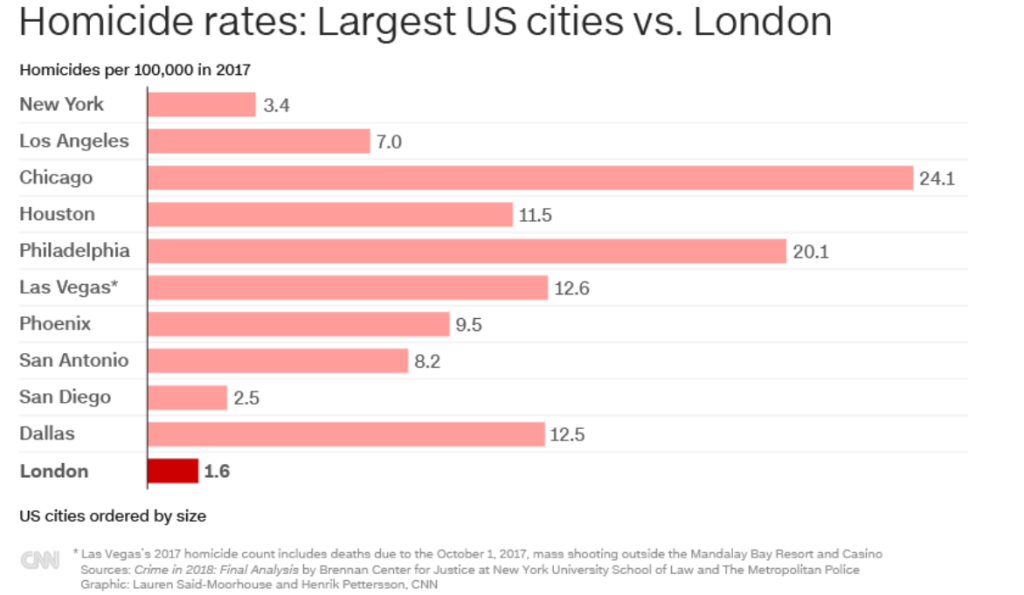
London is a city of 9 million people, larger than any US city. It is an economically, religiously, and racially diverse city. Londoners struggle with soaring rents like people in most major cities. You will not be shocked to learn that London has crime rates commensurate with any other major city, including violent crime.

Except for homicide.

I spent the day looking up statistics trying to see if London had “solved” crime, but it certainly had not. It’s a crowded city full of people who are occasionally desperate and exhausted. Of course there is crime. Just not homicide. It’s one city, but it’s more than an anecdote. As far as comparisons go, it’s like someone made a synthetic control for US cities, but will strict gun control laws. And I don’t want to give the impression that I was staunchly laissez faire with regard to firearms only to have a few London statistics lift the scales from my eyes. But it was certainly a moment when a single set of sylized facts created a chain reaction in my mind, when things fell into place. It’s a complicated issue that I have deeper thoughts on, but there remains the fact that the citizens of London do not live in fear of their government or their neighbors for want of firearms, but they appear to be a lot safer for it.

Whether or not you personally want to own firearms is a different question. But limits on firearms does appear to have significant postive effects. London homicide is a fraction of the safest US city. The country as a whole has (I believe) not had a mass shooting since the tragedy that lead to nationwide gun restrictions 26 years ago. The US has had more mass shooting events in the last month than the UK has had in 26 years. And it’s not just mass shoootings. There’s a potentially coincidental, but nonetheless pronounced, drop in London violent crime since gun restrictions went into effect.

London violent crime since 1981

US citizens increasingly live under the watchful eye of armed professionals in our schools and places of business, with little or no positive effect save the knowledge that we are surrounded by firearms. I see little reason we are safer or more independent of government supervision for it. Conversely, places with less armed supervision, but also fewer firearms, are experiencing better outcomes. There are arguments to be had about what constitutes optimal firearm policy. But “firearms restrictions don’t work” simply doesn’t appear to be true.

7 Quick Takes of Undeniable Insight, Absent Evidence or Significant Explanation

  1. Over-fraternization within a line of work leads to all kinds of pathologies as social networks become too insular. If you’re a police officer and you spend your days constantly interacting with civilians having the worst day of their life, it’s really important you spend your free time with people who are having a perfectly normal and safe week. Same goes for politics, academia, entertainment, etc. This is not a “pop your bubble to improve the quality of your opinions” take. This is purely advice for your own personal mental health. Academics and entertainers need people in their life that they are rightfully embarrassed to complain in front of, to keep perspective on what the stakes of their decisions actually are. Cops and soldiers need reminders that the world is not constantly coming apart at the seams. Most of us will call the cops maybe once in our lives, and it probably won’t be because something good happened. Not a week goes by in a beat cop’s life where they don’t interact with someone who had to call the cops. They need to fill their set of observed experiences with stories uncorrelated with events where someone had to call the cops.
  2. The distribution of people’s opinions of Elon Musk needs to be compressed. Everyone with an above 75th percentile opinion needs to downgrade their estimation of him as a thoughtleader or agent of positive chaos/liberty. Everyone with a below 75th percentile opinion needs to upgrade their appreciation of him as an engineering genius committed to building tangible infrastructure innovations.
  3. The current political era we are living through isn’t defined by extremism, it’s defined by gambles on different sides of the “median voter vs institutional inertia” coin. The Democratic Party is struggling to hold together a coalition of progressives and moderates with nothing but bubble gum and reproductive rights because they believe the median voter remains an irresistible force. The Republican party, on the other hand, continues to bet the entire franchise on an activated base of extremists and gerrymandering. This bet is not ignorant, or in denial, of the median voter. It’s a bet that institutional inertia combined with potentially two decades of control of the Supreme Court will yield benefits greater than the costs of eventually losing control of all three branches across multiple elections.
  4. The best super hero movies are the ones where they take an auteur with at least 5 movies under their belt and say “make the most ‘you’ movie possible, but with our characters in our universe”. Why is “Doctor Strange and the Multiverse of Madness” so good? Because they hired Sam Raimi and gave him the greenlight to make “Evil Dead 4”.
  5. Even the people who *know* that crypto and blockchain technology will create enormous value – even those people aren’t sure if the coins that currently exist will have significant commodity value down the road.
  6. There are lots of right wing political positions that I view as wrong or costly, but most of them I view as “deviations from an uncertain optimal state of the world” which is to say I don’t worry about them in the slightest. The embrace of White replacement theory and increased framing of their opposition as enabling of sexual predation of children, on the other hand, scares me a lot because there is no action or option that is taken off the table for the people who believe them. Say what you will about corporate conspiracy theories and other intellectual pathologies of the current progressive left, they consistently keep terrorism and violence of the table. It can be hard to pin down the intellectual center of a political party or coalition, but the moral center is always composed of the voices that keep violence out of the choice set. I’m don’t know who those voices currently are in the Republican political and media coalition.
  7. The key to popular support for capitalism is the continued to expansion of mint-chocolate flavored options in our choice sets.

The propaganda premium puzzle

Beliefs I currently hold:

  1. In the past we have been surprised by the capacity of blatantly false information to persuade large groups of people.
  2. In the future we will continue to be surprised by the ability of blatantly false information to persuade large groups of people.

From the point of view of classic economic theory, this is almost a two-way paradox. First, why aren’t people rationally updating their beliefs to be more skeptical of the information presented to them by state and private media with fairly transparent agendas? If we accept the premise of the first, though, it invites a second question: why is anyone surprised by the efficacy of propaganda and the credulity of large swaths of the public? Shouldn’t we, the meta-observers, also be updating our beliefs?

My preferred explanations, as they stand, are:

  1. Preference Falsification i.e. people are not fooled, they just happen to believe that at the moment it is safer and more rewarding to appear as though they believe the lies.
  2. Social coordination i.e. narrowly held false beliefs make more better coordination mechanisms for solving collective action problems than broadly held truths

The first is a classic theory that originated with Timur Kuran’s seminal work. Whenever the median voter, or median would-be voter in an autocracy or failed democracy, seems to be held in sway by particularly transparent propaganda, I usually start from the default assumption of preference falsification. These people know the media regime they live within is a menagerie of lies that exist solely to flatter leadership and disrupt any opposition, but they also know that their short run futures remain more secure if they not only publicly accept, but actively parrot the lies.

For now at least. Preference falsification is an inherently fragile equilibria. As effective and impenetrable as propaganda can appear at a given moment, public support for those lies can collapse in the blink of an eye, a dynamic only intensified by modern communication technology.

The ability of false beliefs to solve coordination problems is more subtle, but no less salient to the propaganda premium puzzle, particularly when a regime is dependent on a small subset of a society to hold on to power (a “selectorate“) or the support of a political “base” who would otherwise have difficulty signaling their identity to one another. The reality is that obvious or widely shared truths have almost no value when trying to signal mutual affinity and trustworthiness to individuals trying to solve collective action problems. Patently ridiculous beliefs, on the other hand, work precisely because the only people who would publicly commit to holding such beliefs are those who are committed to the collectively produced club good.

So why does propaganda continue to work better than we think it should? Because we’re using the wrong metrics. Or, more precisely, because the right metrics aren’t available to us. We can ask people what they believe, but we can’t make them tell us the truth. And even if we could make them tell us the truth, we can’t measure the benefits motivating their reasoning, the value of the club goods they are gaining access to because they’ve performed the mental gymnastics necessary to hold those beliefs. Sure, it was cognitively costly to convince yourself the earth is likely flat, but those costs are trivial in the face falling out of the tightest network of friends you’ve ever been a part of.

All of this armchair theorizing is really just a long-winded way of suggesting that fighting propaganda is decidedly not about curing people of their false beliefs. If you want to unravel preference falsification, people don’t need the truth. They already know the truth. What they need are safe channels to express it to one another. If subgroups are forming around false beliefs, the answer is not to shame them for their beliefs. That will only strengthen their group and members’ committment to one another. Rather, the answer is to provide superior substitutes for the club goods they are currently receiving. When in doubt, if you want to break a social equilibrium, you’re better off giving people what they need rather than demeaning what they have.

Come to think of it, that’s probably pretty good life advice in general.

Let’s Talk about the NBER

The National Bureau of Economic Research (NBER) sent out its membership invitations this week. My twitter timeline quickly filled with explicit congratulations and oblique commentary. My private messages filled with…less than oblique commentary. Academia has always been hierarchical and economics has never been an exception. Talk of “top” departments and people is ubiquitous, but those categorizations remain fuzzy – “There are 40 departments in the Top 25” is a common adage. Aside from the obvious humor, I think there is also some healthy truth to it. There are lots of good departments and no one has any final say on who they are. Departments compete for recognition of contributions and the rewards that come from status in the profession. Having 40 or 50 “top 25” departments just means more status for everyone, which strikes me as nothing but welfare enhancing.

The NBER, on the other hand, has hard boundaries of membership. Though I doubt it was founded with any such intention, it has become the club within the broader profession that comes with more prestige than any other. Exclusionary clubs are not unto themselves problematic, but it is hard to shake the feeling that the advantages exclusive to NBER members are greater than ever.

For those who are sick of preamble, let’s start building a hypothesis. Academic economics has acquired some pathologies of publication and promotion that are creating an increasingly grumpy and anxious profession, particularly amongst our junior colleagues. These pathologies are manifest as broad public goods (e.g. timely evaluation and dissemination of research to inform tenure and promotion decisions, professional network development, the transition into a discipline more dependent on significant outside funding, etc.) that the discipline is consistently failing to produce.

The NBER is producing exactly these public goods. They didn’t create any of these problems, but for their members they may have solved them.


Originally founded as a research institute in 1920, largely to produce and disseminate macroeconomic data, the NBER has evolved into a collection of 20 research programs and 14 working groups, all built around a bureaucratic hub that has 100 years of institutional experience running research groups, disseminating research, and organizing events. It has a storied history and deserves every ounce of the prestige it both enjoys and bestows.

From the point of view of any scholar looking to get a research agenda off the ground, an affiliation with the NBER offers 4 key advantages or “club goods”:

  1. The prestige of listing an NBER affiliation at the top of your CV and on every paper you write and submit.
  2. Invitation to NBER conferences, most importantly the Summer Institute collection of meetings every July in Cambridge, MA.
  3. The option to channel your grants through the NBER instead of your home institution’s bureaucracy.
  4. Permission to disseminate your new papers through the NBER working paper series.

I would like to contend that all 4 of these privileges confer enormous advantages for any scholar, doubly so for young faculty. I am not contending that these advantages are unearned or even necessarily unfair, but I do think that they are often underappreciated in their magnitudes, and that this under-appreciation offers some insight into the frustration expressed by those on the outside. So let’s talk about them.

Signal value #1 may be the most or least important, depending on your point of view, but it’s definitely the least interesting. Every CV is filled with myriad signals, the NBER is just another one. In fact, the only aspect worth discussing is its seeming correlation with another key signal: PhD-granting institution. It seems, with nothing more than a glancing ocular regression, that being invited to join as a faculty research fellow (i.e. a pre-tenure affiliation) correlates heavily with having a Cambridge, MA PhD or having an PhD advisor at an elite institution who is themselves an NBER Research Associate (i.e. post-tenure member). There’s nothing inherently bad here, but this compounding of highly correlated signals is a little ominous for the outsider trying to get their own career off the ground. If exclusion from the club is unto itself what bothers you the most about the NBER, you’re missing the point and you should probably just get over it. And yourself, for that matter.

Conferences. #2 is more interesting because the NBER conferences, including the Summer Institute, are widely appreciated for the important networking events that they are. What I don’t think is as appreciated are how they relate to the journal reviewing process. First, if you hang out there long enough people will learn your name and face. While academic economics is famously rigorous and occasionally brutal in its seminar and reviewing culture, the fact remains that humans are more forgiving, more generous of the benefit of the doubt, once we put a face to a name. It’s just harder to be mean or assume the worst in someone once you’ve had a real conversation with them and confirmed their genuine humanity. Second, and this is probably more important, to present a paper at an NBER conference is to present to the pool your eventual reviewers will be drawn from and receive pre-submission referee reports. Being able to learn the perceived weaknesses of your paper before submitting to the magical top-5 and elite field journals is a prodigious advantage, particularly for scholars who don’t yet have a decade of experience trying to publish in their field.

Grant Management. Being able to funnel grants (#3) is probably both the most boring and most underappreciated of member advantages, particularly for scholars building research agendas at smaller schools that place more teaching and service demands on faculty. Being awarded a significant grant can be something of a curse to the pre-tenure scholar if their institution doesn’t have the internal human resources and institutional experience to manage a grant properly. Losing 15 hours a weeks to bureaucratic transaction costs is crippling. If I were trying to start a career running field experiments, I’d probably spend my first semester camped out on the NBER’s front porch like I was petitioning for admission to a Buddhist monastery.

Working Papers. Access to the working paper series (#4) is probably what would strike non-professors, or even just non-economics professors, as trivial, but is actually the most important. I know it’s what I want access too. Lets explain why:

Academic economics has a publishing problem. This is nothing new. What I think is underappreciated is that the NBER solved it for its members.

When the authors of a paper feel that its contribution has been established, that it can exist independent of any supplemental explication with tolerable risk of significant changes between now and its final form, they put it out into the world as a working paper. As the submission and review process has lengthened over the past few decades, the working paper stage of a project’s life cycle has grown in importance. It’s not crazy to suggest that most economics papers reach their total citations “half-life” while they are still working papers.

Whether that sounds crazy to your or not, however, doesn’t actually matter. What matters is that the timeline from first submission to acceptance at a journal continues to expand while the tenure clock remains fixed at 6 years. I’ve written before about how we might mitigate some of the problems in the journal publication process, but that’s a far less pressing concern if you are an NBER member because your papers enter the field as contributions through their NBER-branded working paper series years before acceptance at a journal. The prominence of NBER working papers is sufficient to the point that publication for members exists solely to provide additive signals of quality for long-term career tracks. The contribution itself, how it is internalized in the field and propogated forward within the authors’ research agendas, is adjudicated by the jury of the authors’ peers years before an editor acquiesces and agrees to sacrifice invaluable journal real estate as tribute unto the paper’s now long established contribution. Published papers are old news.

It is no less important that research also enters the seminar, media, and policy cycle as soon as it is disseminated as an NBER working paper. I’ve been in discussions where whom to invite to a workshop reduced for many to nothing more than scrolling through the previous 3 months of NBER working papers. Journalists subscribe to the series for ideas on columns and features. Thinktanks similarly fill their calendars of lunch talks and policy events. The authors will know if their project is a success, or if they are on the wrong track, months before their first rejection and years before their final acceptance. The world learns of them, their research, and their specific expertise through a channel entirely separate of formal peer review or historic outlet prestige.

The NBER solved the economics journal problem by disintermediating scientific debut and evalutation from the publication process. But again, only for their members.

Have I said enough about the working paper series? Let me summarize with a only a touch of hyperbole: if I ran a regression to find the determinants of expected citations, I would expect nothing on the right hand side of the equation, not university affiliation, not PhD-granting institution, not even journal ranking, would have a bigger coefficient than a binary indicator for was it an NBER working paper.

So what should we do?


First of all, I’m not a member, so there is no we about it. Second, I’m not sure we should do anything. It’s not my club, it’s been wildly successful, and just because some of us don’t get to enjoy it’s benefits doesn’t mean it should be changed. So, rather than complaining about the NBER or telling them what to do, I would like to suggest that the discipline has some public goods problems. and that the NBER might be able to contribute to mitigiating them.

One more thing to keep in mind – the club goods provided by the NBER are broadly characterized by decreasing returns to scale. Personal time and attention simply do not scale, which means the answers to most concerns will rarely lie in increasing broad membership or access (though I agree fully that the solution is without question inclusive of letting you in, as you are very smart and grossly underappreciated).

That all said, let’s now revisit the four NBER club goods currently exclusive to members.

#1. The prestigate of membership. I hope you didn’t read this far hoping I’d try to “solve status” in academia. That said, when an exclusive club acquires this much value, you have to expect that the process of admission is going receive all the more scrutiny. As a grossly uninformed outsider, the shadows I see on the wall of a cave from a considerable distance through a crack in the wall is an irregular nomination process that probably bottlenecks in some places while spreading idiosyncratically across networks in others. My guess is that a lot of people who are asked to provide 100 hours of attention in an already 70 hour work-week are effectively being tasked with filling in the next round of nominations. This leaves them with little choice but to take the path of least cost, and that path is making nominations of the former students they came across in their own hallways and those of their closest peers. Occasionally this also grants opportunties for gratuitous favortism and subsequent resentment. More importantly, though, in increases the tightness and redundancy of academic networks, furthering the gap between insiders and outsiders.

How do we fix this? We probably don’t, but here’s one thought: delay the nomination process. If this is the most prestigious club in economics, why are we nominating new PhD recipients before they’ve produced a research agenda? One way to make an institution’s admission process seem more transparent is to have criteria that are at least partially realized, rather than just subjective potential. It probably wouldn’t hurt to make nominators into publicly observable sponsors of record. Never underestimate shame as a tool for mitigating the various ills than can characterize an institution. (NB: these could actually be internally transparent. Remember: just because I am writing this doesn’t mean I am particuarly well informed)

#2. Conferences. An insider has sugggested to me that the Summer Institute used to be far easier to crash, but relented in the face of skyrocketing costs, flooded sessions, and problematic favoritism of local schools. Reiumbursing travel costs extended the radius of access, but also dramatically increased the cost per attendee to the NBER.

One suggestion: the NBER should only pay for the expenses of graduate students and junior faculty. Everyone else, including members, should pay their own way (or at least expense the trip to their home deparments). The hope is that this will make it easier for the NBER to subsidize access to non-members outside of the immediate ring of members. It may also be beneficial to prioritize non-members who have never previously attended. I’ll give you one more, and this works even better if membership nominations are delayed until later in careers: reserve presentation slots in the winter meetings exclusively for junior scholars and non-members.

#3 Grant organization I got nothing except maybe allow non-members to apply for grant-organization access. I mean, if there’s a scholar from a smaller school who’s already established a track record of outside funding in desperate need of institutional support for their research, this sure seems like a hell of a public good that the NBER could provide. Would a lot of people take advantage of it? I have no idea. But it certainly sounds promising and my guess is that it would actually net add to the NBER coffers.

#4 The working paper series. I’ve thought about it a lot, and this is what I’ve got: allow non-members to apply for “working paper series (NBER WPS) membership.” There’s simply no way around the fact the NBER itself cannot possibly scale to include every scholar who “deserves to be a member”. That said, I can’t help but think decreasing returns to scale are going ramp up a lot later for the working peper series.

The changes I imagine are relatively straight-forward. Scholars are allowed to apply for NBER WPS membership, submitting a CV and a recent working paper. If they are denied they cannot apply again for 3 years. If they are admitted they may submit papers to the WPS, on the understanding that the NBER reserves the right to apply a more rigorous review process than with full members and to deny any paper at their discretion. This isn’t a trivial cost proposition, mind you, and it would be entirely borne by the NBER, but they have access to sufficient human resources (cough graduate students) to provide cursory reviews of papers to make sure they are up to basic snuff, pushing potential questions up the chain when a paper might not be of a high enough standard. This would be an enormous service to the profession that they are in a unique position to provide.

In a final closing sentiment, let me state a few things that are probably obvious, but hell, you read this far. I have the luxury of being a tenured professor, so the consequences of these institutions are pretty minimal to me. But I’ve also been a bit of an outsider in the profession since the beginning. I was 9 years and two “top-5″s into my career before I got my first seminar invite, 10 years before I attended my first NBER summer institute. Which is to say I am sensitive to the frustrations of younger scholars who feel like there are walls between them and what they need to get their careers off the ground. We shouldn’t dismiss their genuine (and not unreasonable) anxiety as prestige envy or a grotesquely privleged version of populism. The discipline of academic economics has real problems, and if the NBER has figured out internal solutions to some of those problems, then I’d like to think they might be interested in spreading access just a little farther.

Attention as Rational Addiction

I’ve never gotten this much attention before. Which is to say, my writing receives a small sliver of attention on occasion, but that small sliver is nonetheless far more than I’ve received previously in my life. To put it in better context, I’ve had a couple posts and tweets go mini-viral, which by the standards of major pundits or celebrities amount to little more than a throwaway post, but by the standards of my life up until now they elicited tidal waves of attention.

It felt pretty good.

Those good feelings, though, morphed into something else within a couple days. First, there came the fear of saying something wrong while more people were paying attention. That fear of negative approbation is nothing new or special, but it was certainly heightened. What was more disconcerting, however, was how the anticipation of attention, or more importantly possible lack thereof, crept into the back of my mind as I sat down to write future posts and tweets.

Here’s a an interesting phenomona: once you have enough followers on twitter, the lack of likes/retweets on anything you write becomes recognizable as implicit disapproval. You know what you wrote was put in front of a couple thousand people and yet nearly none of them felt it warranted a tenth of a second click. It stings.

That sting from the absence of approbation changes the incentives in front of you, maybe for some even more than the initial serotonin-dump from previous bursts of positive attention. You feel the pull to write about the things that got attention before, to write in the same manner or mood. To give the customers what they want.

And the customer that matters most is the part of your brain that wants to re-live the thrill of thousands of strangers telling you that you are good and smart and pretty and are totally worth keeping around. This is an addiction. Now there is, of course, no shortage of people calling social media an addiction. What I would like to argue is that it is a particularly dangerous addiction because it is a perfectly rational addiction.

A Rational Addiction Model of Attention

I’ll skip any real math, but indulge me a moment of framing:

A simple model of rational addiction to attention starts with three inputs: positive approbation (P), negative approbation (N), and total attention (T), where T = P + N.

Now lets assume that your utility is increasing with P and decreasing with N, while also increasing with T. That’s all pretty uncontroversial for humans. Let’s also assume that negative attention is easier to reliably generate than positive attention (i.e. trolling is harder to ignore). To put a little structure on it, we’ll assume that they are all substitutes, but with different weights .

U = T^w1 + P^w2 – N^w3

What that means is that people have an incentive to pursue attention, but how they allocate their efforts across plays for positive and negative attention will depend on how much they weight the cost of negative attention relative to what they gain from total attention.

Here comes the twist, though.

What if T is not the absolute total attention you are receiving today, but instead T is the total attention you are receiving today relative to the average attention you have received in the past, the level of attention you have become accustomed to?

U = (T- T_mean)^w1 + P^w2 – N^w3

Well now you’re on a hedonic treadmill, but for attention instead of wealth or luxury. Your brain has grown used to a rush of serotonin from the attention of millions of strangers. You’re like an adrenaline junkie, but instead of jumping out airplanes you’re trolling public figures and latching on to “Twitter’s main character” everyday.

What’s interesting about this model of rational addiction, however, is how quickly you can find yourself pursuing negatiive attention. ostensibly producing negative utility (i.e. actively making yourself unhappy) by pursuing negative attention because the total cost of that negative attention to you is less than the even costlier option of no one paying attention at all. Would you log on to twitter everyday if if cost you a hundred dollars? You would if not logging on cost you ten thousand. Same thing for those who are rationally addicted. What started out as a positive reaction to a small number of well-received insights has created a utility monster trolling the world in a desperate plea for negative attention in the hopes that it will grant the slightest reprieve from the icy desperate loneliness inside that haunts my every moment.

I’m fine. Really. I’m making a point.

When we talk about the problems of social media for mental health, we tend to focus on bullying, dysmorphic self-images, and the creation of false standards of value. I think all of those problems are extremely real, but they also seem like things that can be addressed with policies, oversight, or cultural adaptation. What I want us to consider is that attention at this scale is something that is so baked into the construct of social media that problems emerge from perfectly rational engagement by otherwise well-intending people. I’ve previously tried to model the loneliness that can come with being extermely online, but this in some ways is actually deeper.

What if, for most of us, the only way to win at social media is not to play?