How This Economist Cares for a Baby

I have four children, and all them were or are babies. As an economist, I know that becoming more productive includes contributions to labor, capital, and technology. Caring for and pacifying babies is no different. Here are some of my methods for pacifying and employing babies who are 4-18 months old.

Own a pacifier. You don’t need to use it or even force it into your baby’s mouth. But just have it around. Paul Romer said that we learn and innovate by interacting with capital. So, let’s get the capital.

Employ your baby’s labor. Children as small as 2 or 3 can go get the eggs from the hen house. But what about a smaller baby? Of course we need to stimulate, feed, water, change, and rest the baby. But sometimes, you just need them to be quiet. What to do? Babies respond to Pavlovian stimulus at a very early age. If they’re crying or even just somewhat bored, then place the pacifier in their hand and say, in a very low but normal voice, ‘pacifier’. Babies will instinctively put the pacifier in their mouth. If you have it clipped on, then eventually, they’ll be able to find it when they need it. Developing physical human capital takes work experience and time. I always insist that my older children place the pacifier in the baby’s hand rather than the baby’s mouth. Greater human capital will yield productivity gains.

There came a point when my baby would awaken at night. I wouldn’t even get out of bed. I’d just calmly, and dispassionately say ‘pacifier’. And our baby would pop the pacifier in their own mouth. Employ your baby’s labor. Innovation happens when you interact with capital.

In the same vein, I’d balance the baby bottle on my child’s front side, and place their hands on it. Next thing I knew, my baby was holding their own bottle earlier than the internet said that I should expect them to. Those little hands aren’t useless. They’re low marginal product labor just waiting to be employed. Given that home production is a team effort and labors have interaction effects, that small marginal product for the baby frees your labor to have a larger marginal product for the household. Take advantage of interaction effects, specialization, and comparative advantage.

How do you produce sleep in a baby? Let’s examine the production function. It typically includes: warmth, a clean diaper, darkness, a full belly, maybe some motion, and a lack of disruptive noise. Once the baby is asleep, you really only need the warmth, darkness, and peaceful noise. Leverage your capital to make yourself more productive. Capital may not be able to replace you in helping your baby fall asleep. But it can replace you to help keep them asleep. Repurpose your current stock of capital. If only there was a warm, dark, white noise chamber in your house already. There is. It’s called a bathroom. Get your infant to fall asleep, then put them in the dark bathroom with the fan on. Now you can grade your papers, clean the house, or write your articles.

Addendum on diaper changing:

When it comes to changing a diaper, you should act like you have a low discount rate. That is, you should bear the cost of preparing a changing space so that your future self is thankful. This means preparing the changing pad, opening the new diaper, unfolding the wipes, preparing for diaper disposal, and preparing any new clothes. This makes the diaper changing process much easier and mitigates stochastic costs like leaks, mid-change accidents, etc. Further, your MPL is lower when you have to mind a baby who’s on an elevated surface. Employ your labor when it’s more productive – before you lay them down.

Do you have a baby who fights or cries during diaper changes? Take a hint from the Fed and engage in forward guidance. Did you know that if you blow in a baby’s face, that they instinctively close their eyes and mouth and stop flailing? Early on this can act as a reset and interrupt crying. As a baby gets older, they’ll learn to anticipate the blown air. But only if you build your reputation.

When my 12 month old would start to fight, I’d audibly inhale. My baby would immediately stop fighting and clothes her eyes and mouth, and stop flailing in preparation of me blowing in her face. That’s called forward guidance. Building a reputation of action means that signaling action is often just as good as the act itself. But be careful, if you always blow in their face, they grow accustomed to it due to expectations augmented responses. So, I introduce stochastic bluffs wherein I audibly inhale, but then neglect to blow in their face. Stimulus only works repeatedly if you can violate their expectations.

Stay tuned for more economist parenting tips.

Pistol Squats Complete the Home Workout

A good strength workout includes a push, a pull, and legs. When I can get to the gym I like to alternate bench press and incline press for the push; rows and pulldowns for the pull; and squats and deadlifts for the legs. But with a baby to take care of at home, its been hard to find time for the gym. Between driving, waiting for equipment, and the actual lifts, the gym takes an hour. Doing a similar workout at home can take just 10 minutes, and has the advantage that you can watch a baby while doing it.

But the big challenge with home workouts was finding a good leg exercise. Pushes are easy: just do pushups. Pulls are pretty easy: just buy a $15 pullup bar to hang over a door. But how to do a good leg workout without costly barbells and plates that take up lots of space? Enter the pistol squat.

The idea is simply to start from a stand and lower yourself down almost to the ground on a single leg, then come back up on one leg, with the other leg out front for balance:

Source: Snapshot from this video, which shows how to do the standard pistol plus many variations

I find this to be about as difficult as doing a traditional two-legged barbell squat with 1x bodyweight on the bar. The traditional squat has two legs lifting 2x bodyweight (your body itself, plus 1x bodyweight on the bar); the pistol squat has one leg lifting 1x bodyweight (just your body itself), which is about equal. This was perfect for me because I was doing about 3 sets of 5 reps of squats with 1x bodyweight on the bar, so I just do the same number of pistol squats. But what if you’re not exactly at that weight?

Going lighter is easy– just put one hand on something sturdy nearby like a table and lean on it until it takes enough of your weight that you can do the squat. This helps with balance too if that is an issue. Going heavier is harder, but you could carry something heavy in your hands, turn the rise into more of an explosive jump, or just do more reps.

I’d still rather be at the gym, but the complete home workout seems like a good application of the Pareto Principle– you get most of the benefits of the gym while paying only a small fraction of its time and money costs.

Books the 8-year-old likes

One of my personal interests is encouraging my kids to read. This is a list of books that my 8-year-old son really likes.

If you count Calvin and Hobbes as reading (it’s a comic book), then it is his first love and continues to be a favorite.  

Calvin and Hobbes (Volume 1) Paperback

The Calvin and Hobbes Lazy Sunday Book (Volume 4)

These next two are STEM-friendly goofy books with lots of pictures to break up the text. Currently, if he has to do independent reading time, these are first choices.

Big Bangs and Black Holes: A Graphic Novel Guide to the Universe

The 39-Story Treehouse

These chapter books are prime read-aloud choices for us to read to him that hold his interest.

The Phantom Tollbooth

The Silver Chair

Ender’s Game – Still incredible. Still feels futuristic, although the emphasis on “smart desks” instead of “smart phones” is funny. It was published in 1985.

The Great Brain

Bonus, for 5-year-olds:

The 5-year-old picked out “Woodpecker Wants a Waffle” at our local library and has been delighted by it. It’s a funny picture book that holds up to re-reads. See if your library has it. Public libraries are especially great for 5-year-olds who are ready to explore beyond the Dr. Suess classics at home but also not able to commit to any books worth buying.

Intelligence for School Closing

I don’t have much time to write this week because I lost so many work hours to schools closing for “weather.”

Tyler has been saying that we should welcome more intelligence (in the form of LLMs – I’m not getting any smarter). What would we want intelligence for? How about reducing the error rate on school closing?

First, I will recognize that things are already getting better due to computers. The internet and texting and radar help. Compared to when I was a child in New Jersey, it’s more efficient to text all the parents the night before, as opposed to having people get up at 6am to scan the radio for news. Weather forecasting has presumably gotten better.

Now my rant: Right around what was already a three-day official weekend, school was closed three times. Even my kids were irate when that last day was announced. In my opinion, only one of those closures was justified for extreme weather.

There is a lot of dumb in a city. People complain about routine processes being suboptimal. It would be great if we humans could figure out ways to apply more intelligence to these local problems and make less mistakes.

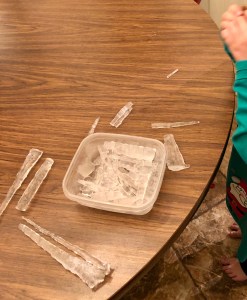
This is a joke for any readers in cold climates. My Alabama kids thought it was fun to collect icicles because they have almost never seen them before.

Cal Newport on Smartphones for Kids

EP. 246: KIDS AND PHONES

Are smartphones bad for kids? Cal walks through the data on this question, including how researchers came to be worried, their findings, critiques of their findings, and where we are today. He then gives recommendations for how to think about technology when it comes to your kids.

In May of 2023, Cal Newport shared well-informed opinions about whether smartphones harm young people. In the first half of the podcast, he talks about depression and loneliness data.

Minute 30 of the podcast: Screentime harms teenagers because they inhibit the development of critical thinking skills. Deep critical thinking skills require training. Reading an analog book is better than screens (see my review of Tyler’s AI generative book and poastmodernism).

See my summary of Emily Oster on video games for kids. She does not clutch her pearls over violent video games. However, she is concerned about what activities get crowded out by screentime. She is especially worried about sleep, because on that topic the data are clear.

Minute 31, Call Newport: Tweens and teens scroll on their phones for too long instead of going to sleep. A 13-year-old boy with a smart phone will “be up until 4 in the morning.” A tween told him that middle school girls arrive at school too exhausted to function because they have been on their phones all night.

FYI, if you are the parent in an Apple device network, you can set time limits on the devices in your family. I filed this report about smart watches last year, incidentally in the same week as the release of Newport’s podcast episode.

EWED Recommends Gifts 2023

This is the 4th year in a row that the crew has put together some recommendations on products or books that we actually use, for your consideration in holiday gift buying. I’m going to put things into categories of Stuff for Adults, Kid’s Toys, Books for Adults, and Kid’s Books

Stuff for Adults (Men can be hard to shop for, so this might save Christmas!)

Scott says these scissors are amazing: “Fiskars 9 Inch Serrated Titanium Nitride Shop Shears”, available from Amazon here. Unlike some thick, heavy, or stubby heavy-duty shears, these have the feel of regular scissors, with fairly long, narrow blades. The handles are fairly substantial, and very comfortably contoured to the hand/thumb. The real magic is in the blades. They are sharp, with a very hard titanium nitride coating. Also, they have fine serrations in the cutting edge, that tend to grip the material in place as you are cutting. 

Zachary recommends 5 things that he really uses at home

#1: High Lumen Candelabra Bulbs (for lighting up rooms that require candelabra bulbs)

#2 Worm-Gear Clamp (It’s great for any project that needs a quick and secure solution. Probably would fit nicely in a giftwrapped box.)

#3 Hitch Rack (seems aimed at car trips with kids)

#4 Lawn-Mower Blade Sharpener (he says it’s worth it)

#5 Transplanting Spade (if you move plants in the yard, it’s worth it over a standard shovel)

The ever-practical Jeremy just wants to make sure you are Finding Deals on Food

Food makes great presents for adults. Just give me Doritos, thanks.

Kid’s Toys

A wonderful game that you might not already have is Protect the Penguin. It’s high-energy but much less work than something like Twister. I actually enjoy playing it, too.

I’ll re-up from last year that Spot It is incredible and fits in your coat pocket. Fun for all ages. Several versions of the game. Not everyone has to know how to read or add to play so good for events with lots of ages represented. LEGO sets are always fun. If you keep the difficulty level age-appropriate than your kid should be able to play independently for an hour. I’ll put up one link but of course there are many thousands to choose from that can be tailored to any interest. My son likes Minecraft-themed sets.

Books for Adults

If you want to see all the books we have read and reviewed, just click on the Books category or go to

https://economistwritingeveryday.com/category/books/

Not all of those posts are going to give you quick gift ideas, so if I had to pick out one from the last year it would be:

Secondhand: Travels in the New Global Garage Sale is a great book in my summer stack on fast fashion. I have always been interested in the combination problem-blessing of too much stuff. Adam Minter explains perfectly what many of us have been curious about.

You might have a relative who is very environmentally conscious or works hard to reuse and recycle. They might think it’s interesting to learn about the secondhand markets in America and beyond.

Kid’s Books

I’m reading The Hobbit aloud to my son right now and I highly recommend the experience. It’s going to take us months to get through it by reading a few pages at a time around bedtime.

Camp Out!: A Graphix Chapters Book (Bug Scouts #2) Funny graphic novel series about a group of friends in a scout troop. Probably especially fun for a kid who is in some kind of scouts program.  Calvin and Hobbes is another comic series that my kid genuinely looks forward to reading.

Joke books can lead to great conversations. If the kid wants to know why something is funny, you can end up talking for a long time about the complex world.

See what we recommended in previous years. We have always had a mix of kid and adult items.

EWED Recommends Gifts 2022

EWED Recommends Gifts 2021

EWED Recommends Gifts for 2020 Holidays

Kids Are Much Less Likely to Be Killed by Cars Than in the Past

On X.com Matt Yglesias posted a chart that sparked some conversation about child safety:

Of course, it was probably more his comment about the “rise of more intensively supervised childhood activities” that generated the feedback and pushback. And I assume his comment was partially tongue-in-cheek, as often happens on Twitter, and designed to generate that very discussion. Still, it is worth thinking about. Exactly why did that decline happen?

I’ve posted on this topic before. In my March 2023 post, I looked at very broad categories of child death. While all death categories have declined, about half of the decrease (depending on the age group, but half is about right) is from a decline in deaths from diseases, as opposed to external causes. And fewer disease death can largely be attributed to improvements in healthcare, broadly defined. Good news!

Of course, that means that about half of the decline is from things other than diseases. What caused those declines? Let’s look into the data. Specifically, let’s look into the data on deaths from car accidents.

Continue reading

It Takes a Village

Many households are now 2-income households. And that can make parenting a slog.

You go to work for 8-10 hours, you may or may not need to provide transportation for children to/from school, and child-care can eat a substantial portion of income. If the children are small, then the parents clean the floors, the dishes, and the clothes. Not to mention any home improvements or repairs. And food! Do you want to eat a home-cooked meal as a family? If both parents work typical hours, then prepare to eat no earlier than 6 PM, and maybe as late as 7:30.

Hey but there’s the weekend, right? NOPE! Someone has to do that big weekly shopping trip. How long is that going to take? The whole ordeal is enough to make someone think twice before having that 2nd kid. After all, if one kid getting sick throws a wrench in even a single day’s routine, then the whole week can be affected. How many sick kids before things stop getting done? Having a grandparent around to help would be a huge privilege and blessing.

At this point, I think that I can begin to call myself an experienced parent. I’ve got 4 kids who are ages 6 and younger. Plenty of modern conveniences make life easier. Many groceries can be purchased ahead of time for ‘order pick-up’ or online for delivery. Nice. Books are super cheap, and so are bubbles and drawing supplies. If I have to get some work/chores done while the kids are awake, then I can buy myself some time. But, like it or not, when the kids are asleep in the evening is when most chores will get done.

Continue reading

Assorted Links on Women and Family

First, there have been many tweets about Sophie Turner as a young mom and human who is getting divorced. Here’s an article (Stylist UK).

Also so many tweets about the 29-year-old who made eggs on the weekend. Here’s an article about it by Mary Harrington.

Thirdly, Understanding the Baby Boom (Works in Progress)

Parenthood rapidly became much easier and safer between the 1930s and 1950s. The spread of labour-saving devices in the home such as washing machines and fridges made raising children easier; improvements in medicine making childbirth safer; and easier access to housing made it cheaper to house larger families.

Anvar Sarygulov & Phoebe Arslanagic-Wakefield

I hate to be the next person publicly talking about Joe Jonas and Sophia Turner. I wish them both the best, and this kind of attention is probably hard on their kids. Anyway… what interests me about this case is that parenting seems to have been hard on them, even though Joe Jonas is worth $50 million. They could have a washing machine on every floor of their huge house. So, do the Works in Progress authors really understand the Baby Boom?

Cool the Schools

Short post today because I’m busy watching my kids, who had their school canceled because of excessive heat, like many schools in Rhode Island today.

I thought this was a ridiculous decision until my son told me he heard from his teacher that his elementary school is the only one in town that has air conditioning for every classroom. Given that, the decision to cancel given the circumstances is at least reasonable, but the lack of AC is not.

It’s not just that hot classrooms are unpleasant for students and staff, or that sudden cancellations like this are a major burden for parents. Several economics papers have found that air conditioning significantly improves students’ learning as measured by test scores (though some find not). Park et al. (2020 AEJ: EP) find that:

Student fixed effects models using 10 million students who retook the PSATs show that hotter school days in the years before the test was taken reduce scores, with extreme heat being particularly damaging. Weekend and summer temperatures have little impact, suggesting heat directly disrupts learning time. New nationwide, school-level measures of air conditioning penetration suggest patterns consistent with such infrastructure largely offsetting heat’s effects. Without air conditioning, a 1°F hotter school year reduces that year’s learning by 1 percent.

This can actually be a bigger issue in somewhat Northern places like Rhode Island- we’re South enough to get some quite hot days, but North enough that AC is not ubiquitous. Data from the Park paper shows that New York and New England are actually some of the worst places for hot schools:

This is because of the lack of AC in the North:

The days are only getting hotter…. it’s time to cool the schools.