Robinhood’s Casino Comps

I just got the new Robinhood Gold credit card after 4 months on their waitlist. It offers 3% cash back on everything- except travel, which is an even better 5%. This seems to be a much better deal than the typical credit card (which offers ~0-1% back in cash or equivalents), and even better than the previous best alternative I know of (the Citi Double Cash, which pays 2% back). So, is there a catch?

As far as I can tell, there are two, but one is minor and the other is avoidable.

The minor catch is that while they advertise the Gold Card as having no annual fee, you need to be a Robinhood Gold member to get it. Robinhood Gold has a $50/year fee, though it comes with other benefits, and getting the extra 1%+ back on the credit card will itself pay for the fee assuming you spend at least $5k/yr on the card.

The potentially major catch, and the reason I assume Robinhood is offering such a good deal, is that they want to entice you to open a brokerage account and to make bad decisions with that account that make them money. Much like a casino that offers you free drinks and cheap hotel rooms in the hope that you will choose to gamble and end up losing way more than the cost of the “complimentary” things they gave you. This is a major risk, but if you know what to avoid you can still come out ahead. The last time my friends dragged me to a casino I got handed plenty of free drinks despite the fact that I never gambled. Similarly, Robinhood might nudge its users to lose money in ways large (options) and small (overtrading with market orders).

But while Robinhood’s interface might suggest these bad choices, it absolutely does not require them. You can simply choose not to enable options trading, not to over-trade (and to turn off price alerts that nudge you to do so), and to use limit orders instead of the default market orders when buying stocks. In fact, you could avoid using Robinhood to buy stocks altogether, and simply use their brokerage account as a way to earn 5% interest while using it to pay off your credit card (though on the other hand, Robinhood could benefit people if it nudges them to do stock investing at all instead of keeping everything in a checking account).

The fact that Robinhood Gold brokerage accounts pay 5% interest on uninvested cash is its other big advantage. You can find savings accounts elsewhere paying 5% or a bit more, but many won’t maintain that rate, and they have transaction limits. Robinhood also pays a 1% bonus on cash transferred in if you keep it there.

Someone moving to the Robinhood ecosystem from a bad setup (paying with cash, or debit cards, or credit cards with no rewards that are paid off from a checking account that earns 0%) could in theory increase their real spending power by 8%+. Even someone in a more common situation (has a 1% rewards card but most of their spending is on things like mortgages that aren’t credit-card-eligible, pays the credit card from a 0% interest checking account but sweeps excess cash to a high-yield savings account paying 4%) could still increase their total spending power 1-3%. Not huge, but a big deal for something that can be set up for less than a days work.

This is now the best single-account setup I know of- assuming you can stay out of their casino. Churning through different accounts can get you a better return, but it is also a lot more work and has its own risks. If you want to up your returns some without the fees or risk of the Robinhood ecosystem, then something like the Citi Double Cash paid from a high-yield (4%+) savings account is probably the way to go.

Disclaimer: I might be wrong about this but if so I am honestly wrong; this post is not sponsored and I’m not even using referral links when I easily could. Still, do your own research and let me know if I’ve missed anything

Update: Robinhood CEO Vlad Tenev did an interview on Invest Like the Best this week where, reading between the lines, he confirms both the positive and negative things I say here. They make most of their money overall on options and active traders; 3% cash back exceeds the interchange fees they get from merchants, but they expect the card to be profitable because some users will carry a balance (and pay interest) and because it will push people to sign up for Gold (so pay fees and perhaps trade more). He notes that there is another card that offers 3% cash back, but it is only available to those with at least $2 million managed by Fidelity.

Publish or Perish: A Hilarious Card Game Based on Academia

I had the opportunity to play an advanced copy of “Publish or Perish,” a new card game that satirizes the world of academia. Created by Max Bai, this game offers a funny take on the often cutthroat world of academic publishing.

Official website for the game: here

My group of eight friends divided into teams to accommodate the game’s six-player limit, which I’d recommend not exceeding. From the moment we started reading the instructions aloud, we were laughing.

The gameplay is engaging. One unexpectedly hilarious rule involves clapping for each other’s achievements. The game’s core revolves around publishing manuscripts, accumulating citations, and navigating the waters of peer review and academic politics.

I was impressed by the calibration of the trivia questions. They struck a great balance – challenging enough that we often couldn’t answer them, yet not so obscure that they felt unreasonable. This aspect added an educational twist to the fun, sparking interesting discussions.

The humor in “Publish or Perish” is spot-on, especially in the details. The manuscript cards had us in stitches, with journal names like “Chronicle of Higher Walls” (a clever play on the real “Chronicle of Higher Education”) and absurd paper titles.

My favorite paper title was “The Great Avocado Toast Crisis: Socioeconomic Impacts of Millennial Breakfast Choices”
Esteemed friend and economist Vincent Geloso liked “The Economics of Building a Death Star”

The two other full-time academics in our group were so impressed that they pre-ordered copies on the spot. While the game is probably most enjoyable with at least one academic in the group, our mixed party – including a government statistician and several non-academics – found it entertaining.  One of my non-academic friends summed it up as follows: “This game brought several people from different backgrounds and areas of expertise together for a thoroughly enjoyable evening.”

“Publish or Perish” manages to be both easy to learn and refreshingly original. I predict it will carve out its own niche with its unique theme and mechanics. Players can engage in academic shenanigans like plagiarism, P-value hacking, and even sabotaging opponents’ work – all in good fun.

Continue reading

You, Parent, Should have a Robot Vacuum

Do you have a robot vacuum? The first model was introduced in 2002 for $199. I don’t know how good that first model was, but I remember seeing plenty of ads for them by 2010 or so. My family was the cost-cutting kind of family that didn’t buy such things. I wondered how well they actually performed ‘in real life’. Given that they were on the shelves for $400-$1,200 dollars, I had the impression that there was a lot of quality difference among them. I didn’t need one, given that I rented or had a small floor area to clean, and I sure didn’t want to spend money on one that didn’t actually clean the floors. I lacked domain-specific knowledge. So I didn’t bother with them.

Fast forward to 2024: I’ve got four kids, a larger floor area, and less time. My wife and I agreed early in our marriage that we would be a ‘no shoes in the house’ kind of family.  That said, we have different views when it comes to floor cleanliness. Mine is: if the floors are dirty, then let’s wait until the source of crumbs is gone, and then clean them when they will remain clean. In practice, this means sweeping or vacuuming after the kids go to bed, and then steam mopping (we have tile) after parties (not before). My wife, in contrast, feels the crumbs on her feet now and wants it to stop ASAP. Not to mention that it makes her stressed about non-floor clutter or chaos too.

Continue reading

Borrowing, Beef, and Break-even

Interest rates communicate the value of resources over time. For example, if you take out a loan, then the interest rate tells you how much you must to pay in order to keep that money over the life of the loan. The interest rate also reflects how much the lender will be compensated in exchange for parting with their funds. On the consumer side, the interest rate reflects the price that the borrower is willing to pay in order to avoid delaying a purchase.

When a business borrows, the interest rate reflects the minimal amount of value that they would need to create in order to make an accounting profit. For example, if a business borrows $100 for one year at an interest rate of 5%, then they need to earn $105 by the time that they repay the loan in order to break even with zero profit. The business would need to earn more than 5% in order to earn a profit on their borrowing and investment venture.

The longer the business takes to repay their loan, the more interest that accrues. And, the higher the interest rate, the more they need to earn in order to repay their loan.

This logic applies to all production because all production takes time. If production takes very little time, then the impact of the interest cost is miniscule. But, if production takes longer, then interest rates become increasingly relevant. These kinds of products include trees, cheese, wine, livestock, etc. Anything that ages, ferments, or has a lengthy production process will be more sensitive to the cost of borrowing.

How?

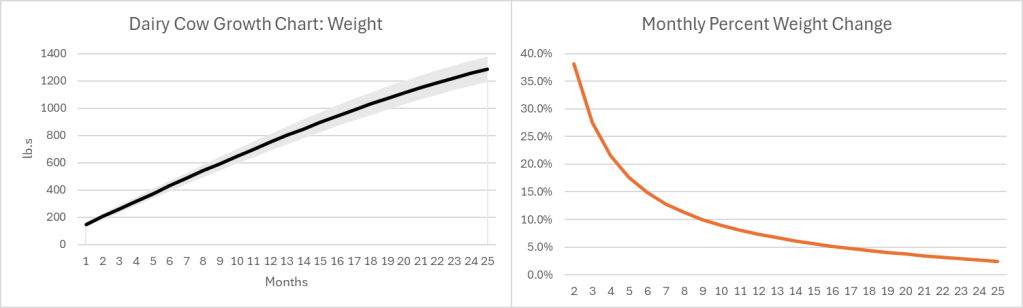
The growth pattern for most (all?) goods looks similar. Below-left is a growth chart for dairy cows . Notice that calves grow quickly at first, and their growth slows over time. For the sake of argument, let’s say that the change in value of a cow mimics the change in weight (Yes, I know that dairy and beef cows are different, but the principle is the same).  Below-right is the monthly percent change. Even at an age of 25 months a cow is still growing in value at 2.4% per month or 33% per year.

Of course, there is a risk that some cows don’t survive to slaughter, lowering the expected growth rate. Since most cattle are slaughtered between 18 and 24 months of age, their growth rate at the time of slaughter is 4.4%-2.7% per month. As the interest rate at which farmers borrow rises, the optimal age at slaughter falls. Otherwise, the spread between the growth rate and the interest rate could go negative. Even so, what an investment! If you can borrow at, say, 8% per year, then you’ll make money hand-over-fist on the spread.

Except… Cows cost money to raise, and most of that cost is feed. According to the production indicators and estimated returns published by the USDA, the cost of feed in February of 2023 was $158.11 per hundred pounds of beef. The selling price of beef was $161.07. That leaves $2.96 or a profit of 1.87% earned over the course of 1.5-1.75 years. That investment is starting to look a lot less good, especially since it doesn’t include the cost of maintaining facilities, insurance, etc. It’s no wonder that farmers and ranchers are serious about their subsidies. Clearly, with such tight margins, farmers and ranchers are going to look good and hard at the interest rates that they pay on their debt. And, they do have debt.

However, the recent increase in beef prices is not caused by higher interest rates.

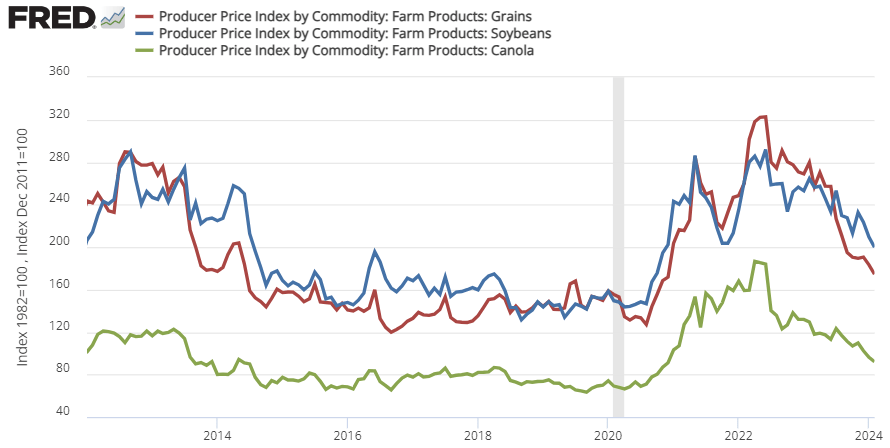
That 1.87% profit margin is at prices and costs from February 2023. Since 2020, the price of cattle feed ingredients (grain, bean, and oil) peaked in the summer of 2022 and are still substantially more expensive than pre-Covid (see below). That means that cows getting slaughtered right now were raised on more expensive feed. This February 2024, the cost of feed per 100lb. of cattle was $191.80. But the cattle selling price was only $180.75. That’s a $11.05 loss for cattle raising. Wholesale prices of cattle might be up recently, but the cost of feed is up by more. It’s not the cattle farmers who are benefiting from the high beef prices. In fact, they’re getting squeezed hard.

There is good news. The cost of feed ingredients has been falling recently, which means that beef farmers should begin to see some relief if the recent trend continues. For Consumers, the price of beef is already down from its 2023 peak.

Hazards of the Internet of Things 1. Hacking of Devices (Baby Monitors, Freezers, Hospital Ventilators) in Homes and Institutions

For my birthday this year, someone gave me a “smart” plug-in power socket. You plug it into the wall, and then can plug in something, say a lamp, into the smart socket, which you can then control via the internet. Yay, I am now a part of the Internet of Things (IoT). What could possibly go wrong?

However, my Spidey-sense started to tingle, and I chose to give this device away.  At that point, I was thinking mainly of the potential for such devices to get hacked and then recruited to be part of a vast bot-net which can then (under the control of bad actors) conduct massive attacks on crucial internet components. For instance,

Mirai [way back in 2016] infected IoT devices from routers to video cameras and video recorders by successfully attempting to log in using a table of 61 common hard-coded default usernames and passwords.

The malware created a vast botnet. It “enslaved” a string of 400,000 connected devices. In September 2016, Mirai-infected devices (who became “zombies”) were used to launch the world’s first 1Tbps Distributed Denial-of-Service (DDoS) attack on servers at the heart of internet services.  It took down parts of Amazon Web Services and its clients, including GitHub, Netflix, Twitter, and Airbnb.

But it turns out the hazards with smart devices are widespread indeed. IoT devices are so useful for bad guys that that they are attacked more than either mobile devices or computers. One layer of hazard is the hacking of specific, poorly-secured devices in a home or institution, with subsequent control of devices and infiltration of broader computing systems. This will be the focus of today’s blog post. Another layer of hazard is the use to which masses of (sometimes private and personal) data snooped from “unhacked” smart devices are put by large corporations and state actors; that will be considered in a part 2 post.

Here are results from one study from nearly three years ago:

https://www.thalesgroup.com/en/markets/digital-identity-and-security/iot/magazine/internet-threats

A study published in July 2020 analyzed over 5 million IoT, IoMT (Internet of Medical Things), and unmanaged connected devices in healthcare, retail, manufacturing, and life sciences. It reveals an astonishing number of vulnerabilities and risks across a stunningly diverse set of connected objects….

The report brings to light disturbing facts and trends:

  • Up to 15% of devices were unknown or unauthorized.
  • 5 to 19% were using unsupported legacy operating systems.
  • 49% of IT teams were guessing or had tinkered with their existing IT solutions to get visibility.
  • 51% of them were unaware of what types of smart objects were active in their network.
  • 75% of deployments had VLAN violations
  • 86% of healthcare deployments included more than ten FDA-recalled devices.
  • 95% of healthcare networks integrated Amazon Alexa and Echo devices alongside hospital surveillance equipment.

…Ransomware gangs specifically target healthcare more than any other domain in the United States. It’s now, by far, the #1 healthcare breach root cause in the country. …The mix of old legacy systems and connected devices like patient monitors, ventilators, infusion pumps, lights, and thermostats with very poor security features are sometimes especially prone to attacks.

So, these criminals understand that stopping critical applications and holding patient data can put lives at risk and that these organizations are more likely to pay a ransom.

I know people in organizations which have been brought to their knees by ransomware attacks. And I have read of the dilemma of the guy who was on vacation in the Caribbean or whatever, and got a text from a hacker instructing him to deposit several hundred dollars in a Bitcoin account, or else his “smart” refrigerator/freezer would be turned off and he would come home to a spoiled, moldy mess.

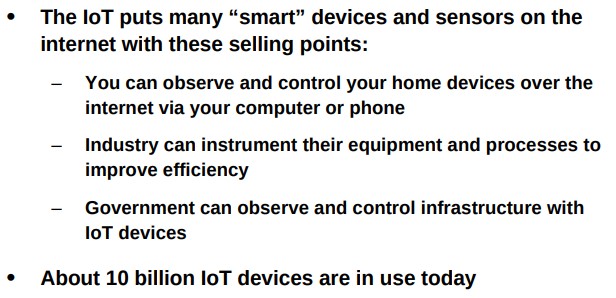
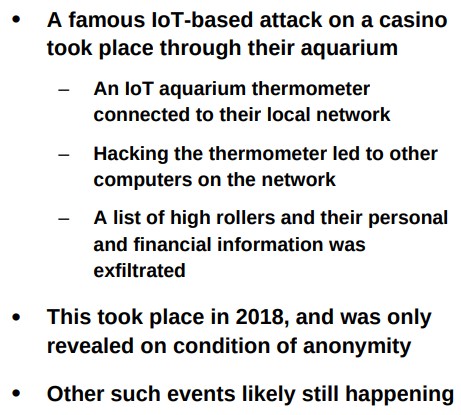
What brought all this IoT stuff to my attention this week was a talk I ran across from retired MIT researcher Timothy Wallace, titled “Effects, Side Effects and Risks of the Internet of Things”, presented at the 2023 American Scientific Affiliation meeting. The slides for his talk are here. I will paste in a few snipped excerpts from his talk, that are fairly self-explanatory:

(My comment: 10 billion is a really, really big number…)

(My comment: this type of catastrophic compromise of computer systems being enabled by hacking some piddling little IoT device that happens to be in the home or institution local network is not uncommon. Which is why I am reluctant to put IoT devices, especially from no-name foreign manufacturers, on my home wireless network).

Many of these vulnerabilities could in theory be addressed by better practices like always resetting factory passwords on your smart devices, but it is easy for forget to do that.

And just to end on a light note (this cartoon also lifted from Wallace’s slides):

Supply & Demand, With gifs

I’ve discussed the ways to teach supply and demand in the past. Regardless, almost all principles of economics classes require a book. But even digital books are often just intangible versions of the hard copy. Supply and demand are illustrated as static pictures, using arrows and labels to do the leg-work of introducing exogenous changes. There’s often a text block with further explanation, but it lacks the kind of multi-sensory explanation that one gets while in a class.

In a class, the instructor can gesticulate and vary their speech explain the model, all while drawing a graph. That’s fundamentally different from reading a book. Studying a book requires the student to repeatedly glance between the words and the graph and to identify the appropriate part of the graph that is relevant to the explanation. For new or confused students, connected the words to one of many parts of a graph is the point of failure.

This is part of why the Marginal Revolution University videos do well. They’re well produced, with context and audio-overlaid video of graphs. It’s pretty close to the in-person experience sans the ability to ask questions, but includes the additional ability to rewind, repeat, adjust the speed, display captions, and share.

Continue reading

EWED Recommends Gifts 2023

This is the 4th year in a row that the crew has put together some recommendations on products or books that we actually use, for your consideration in holiday gift buying. I’m going to put things into categories of Stuff for Adults, Kid’s Toys, Books for Adults, and Kid’s Books

Stuff for Adults (Men can be hard to shop for, so this might save Christmas!)

Scott says these scissors are amazing: “Fiskars 9 Inch Serrated Titanium Nitride Shop Shears”, available from Amazon here. Unlike some thick, heavy, or stubby heavy-duty shears, these have the feel of regular scissors, with fairly long, narrow blades. The handles are fairly substantial, and very comfortably contoured to the hand/thumb. The real magic is in the blades. They are sharp, with a very hard titanium nitride coating. Also, they have fine serrations in the cutting edge, that tend to grip the material in place as you are cutting. 

Zachary recommends 5 things that he really uses at home

#1: High Lumen Candelabra Bulbs (for lighting up rooms that require candelabra bulbs)

#2 Worm-Gear Clamp (It’s great for any project that needs a quick and secure solution. Probably would fit nicely in a giftwrapped box.)

#3 Hitch Rack (seems aimed at car trips with kids)

#4 Lawn-Mower Blade Sharpener (he says it’s worth it)

#5 Transplanting Spade (if you move plants in the yard, it’s worth it over a standard shovel)

The ever-practical Jeremy just wants to make sure you are Finding Deals on Food

Food makes great presents for adults. Just give me Doritos, thanks.

Kid’s Toys

A wonderful game that you might not already have is Protect the Penguin. It’s high-energy but much less work than something like Twister. I actually enjoy playing it, too.

I’ll re-up from last year that Spot It is incredible and fits in your coat pocket. Fun for all ages. Several versions of the game. Not everyone has to know how to read or add to play so good for events with lots of ages represented. LEGO sets are always fun. If you keep the difficulty level age-appropriate than your kid should be able to play independently for an hour. I’ll put up one link but of course there are many thousands to choose from that can be tailored to any interest. My son likes Minecraft-themed sets.

Books for Adults

If you want to see all the books we have read and reviewed, just click on the Books category or go to

https://economistwritingeveryday.com/category/books/

Not all of those posts are going to give you quick gift ideas, so if I had to pick out one from the last year it would be:

Secondhand: Travels in the New Global Garage Sale is a great book in my summer stack on fast fashion. I have always been interested in the combination problem-blessing of too much stuff. Adam Minter explains perfectly what many of us have been curious about.

You might have a relative who is very environmentally conscious or works hard to reuse and recycle. They might think it’s interesting to learn about the secondhand markets in America and beyond.

Kid’s Books

I’m reading The Hobbit aloud to my son right now and I highly recommend the experience. It’s going to take us months to get through it by reading a few pages at a time around bedtime.

Camp Out!: A Graphix Chapters Book (Bug Scouts #2) Funny graphic novel series about a group of friends in a scout troop. Probably especially fun for a kid who is in some kind of scouts program.  Calvin and Hobbes is another comic series that my kid genuinely looks forward to reading.

Joke books can lead to great conversations. If the kid wants to know why something is funny, you can end up talking for a long time about the complex world.

See what we recommended in previous years. We have always had a mix of kid and adult items.

EWED Recommends Gifts 2022

EWED Recommends Gifts 2021

EWED Recommends Gifts for 2020 Holidays

Great Presents: Fiskars Scissors That Will Cut Nearly Anything and Leatherman Micra Tool

My rave product for this year is “Fiskars 9 Inch Serrated Titanium Nitride Shop Shears”, available from Amazon here. I randomly bought these scissors a few years ago for a relative, and then realized how useful they were. So, I got a pair for our household, and it became our go-to scissors. When we lost that pair a few months ago, we felt the loss keenly enough to go and buy a replacement.

What is so great about them? Unlike some thick, heavy, or stubby heavy-duty shears, these have the feel of regular scissors, with fairly long, narrow blades. The handles are fairly substantial, and very comfortably contoured to the hand/thumb. The real magic is in the blades. They are sharp, with a very hard titanium nitride coating. Also, they have fine serrations in the cutting edge, that tend to grip the material in place as you are cutting. They will set you back about $24. Made in China, of course.

Two images from the Amazon site are:

With 935 ratings, the average rating on Amazon is a stratospheric 4.9/5.  Reviewers find themselves reaching for superlatives:

We have an embroidery shop and find regular scissors dull quickly. These do not. They cut through everything!

The best heavy duty scissors. Period… These pups will handle any cutting job even remotely appropriate for this tool.

My wife has multiple pair of shears that she uses on her sewing table. She would not miss one pair if I were to borrow them for the shop, right? Well, that did not work. I’m in purgatory for that, for sure. So… I bought these. These shears are MY shears. I get to use them for all of those things in the shop that need to be cut. No, I don’t cut asphalt roofing shingles and corrugated steel roofing with them, but I cut rough and heavy and coarse and dirty stuff that needs cut with the accuracy of using shears. Stuff where a razor knife is not quite adequate. You know the stuff I mean. Ladies, do the old man a favor… and do yourself a really good deed… and buy a pair of these for him. He’ll hopefully not be using yours any more.

The best pair of shears I’ve ever used… I swear, you could split the atom with these things. Matter simply parts at their touch. I’ve been using them daily for all my shearing needs for the last six months, and they’re as sharp and perfect as the day I received them.

Well, you get the picture. We use them for food cutting in the kitchen, cutting cloth, cardboard, thin sheet metal, wire, etc. They can also handle ordinary cutting of paper, although they do leave fine teeth marks.

Honorable Mention: Leatherman Micra Tool

Another cutting implement I find very useful is the Leatherman Micra Tool. At about 2 inches long all folded up, it is small enough to easily fit in a pocket or purse, though just a bit heavy to hang on a keychain. It has small but very capable scissors (can cut fingernails well) ; a very sharp little knife ; a diamond-grit file for nails, etc.; some light-duty screwdrivers; tweezers (not the best); and an old-fashioned bottle-cap opener. Also, it has ruler markings, which I have used on occasion. So many items now come packaged in very tough, clear plastic covering that you can’t peel or rip with your fingers. It is great to be able to whip out this Micra and quickly slice through that plastic. The quality of the workmanship is so good that anyone who appreciates tools will feel good about it.

This is an easy win as a present. If someone has no use for it, they can easily regift it. Once upon a time when I was a project leader, I bought one for everyone as a celebration for reaching milestone. I got them from Leatherman, engraved with the project name. They were a hit.

The only downside is the price. I am used to getting these for like $25 or so. But when I just looked on Amazon, I see the new price has jumped to $57 (though you can get them cheaper at the Leatherman.com site). That seems kind of steep. These are made in the U.S.A.  You can purchase Chinese knock-offs for much less, though the quality may vary.

There is, however, a lively market for used Micra tools. Below are two images for one for sale on eBay, for $13.00 plus $4.75 shipping. If you are getting one for yourself or say a son/father/brother or buddy, getting a high quality tool with a few scratches and no packaging may be fine. Other recipients may not appreciate a used item.

Is the repair revolution coming?

Every sentence in this article is fascinating, since I have been writing about fast fashion.* Anything I put in quote form comes from The Guardian.

The word “revolution” in the title of this article is minor clickbait. Perhaps it would be more accurate to say: “Clothes repaired in workshop, 19 people employed” That wouldn’t get any clicks. However, I am an idealist, and I am going to stay a bit on board with the revolution. I, too, have pondered and grieved over the amount of waste heading into landfills. There could be some kind of revolution ahead, whether it is of the repair type or not.

The communal garden and bespoke textile art lend a creative startup feel, and the slogan “repair is the new cool” appears everywhere. But what’s happening here is far from ordinary startup stuff. At United Repair Centre (URC), newcomers to the Netherlands from across the world, many of them former refugees, are using their tailoring skills to mend clothes on behalf of some of the world’s biggest brands. 

Immigrants are sewing, but no Dickensian horrors here. This place “has a laid-back Dutch vibe.”

Ambrose, who greets me, mans the front desk. He’s a 20-year-old Palestinian fashion fan, who was born in Syria and lived in Abu Dhabi before moving to the Netherlands in May; he is working in parallel with studying for a fashion and design diploma. Ambrose started at URC in May and loves it: the way he gets to work in collaboration with the tailors, giving advice and learning from their years of experience. “It’s really easy, fun, chill … “

The verdict is in. Work is fun.

Repair might be cool, but is it new? Consider Jo March from “Little Women” who was an American bouncing around between rich and poor status in the 1860s. American GPD per capita in 1860s was less than $3,000. That would be considered very poor today. Since manufactured goods were expensive and Jo March had a low opportunity cost of time, she spent lots of time mending clothes. Her passion was writing but she had no choice – that was how she contributed to her household production. Very few families at that time, even in the upper class, could afford to regularly buy new clothes from a shop.

Don Boudreaux explained that even modern rich people “recycle” clothes when it’s in one’s selfish interest. Washing and “re-use” of clothes, typically, is beneficial enough to outweigh the cost of maintaining and storing them. Sometimes we go above and beyond by donating them or maintaining them specifically because we are trying not to “waste” something, but that comes at an individual cost to us.

The author of the article writes:

I take a taxi from the station to URC because I’m running late, but I’m taken aback when en route the driver points out the many conveniently located stations and tram stops I could use for my return journey.

This is a perfect encapsulation of why rich people do not repair clothes. They are zipping around to high-productivity work meetings. The opportunity cost of time has gone up. Taking the bus is costly in terms of time, the scarcest resource of the rich.

Where I see hope for the repair “revolution” is in artificial intelligence (AI). AI can make up for our scarce time and attention. If AI can make repairs less costly in terms of time, then rich people might do it. If it doesn’t make economic sense, then it won’t scale the way the author is hoping.

Currently, the “revolution” is employing 19 people full-time. By the year 2027, all they are hoping for is to expand to 140 tailors. Hardly a revolution on the jobs front. But that’s the hopeful scenario. If it’s labor-intensive, then it won’t work. (See my ADAMSMITHWORKS post on cloth production and labor.)

Is repair reaching a tipping point?

There’s one unlikely scenario in which expensive repairs will get paid for. What rich people resoundingly want is kitchen renovations and new clothes, partly because it confers status. Could it become cool to live with those outdated cabinets and wear that repaired Patagonia vest for the next two decades? … could it? Vision: “Wow. I see that you guys have outdated ugly countertops. Nice. You resisted the desire to renovate your kitchen even though it’s within your budget.”

Even changing status markers are unlikely to tip the scale in the case of broken equipment or torn clothes. AI might allow us to repair a refrigerator instead of trash it.

URC tracks repairs using software initially developed by Patagonia, which it has built on and uses for the other brands involved.

There it is. Software makes the dream work.

Shein and the like are out there, churning out, in dizzying volumes, fast fashion that can’t be repaired.

In my conversations with Americans, many do not know what “fast fashion” is. That’s fast fashion. The 19-140 tailors are currently no match for Shein.

There isn’t always much common language – operational manager Hans says they resort to Google Translate quite a bit – but there’s plenty of laughter.

The AI, again! We are living in the globalized AI-powered future.

Lastly, the article was brought to my attention on Twitter (X) by Bronwyn Williams and Anna Gat.

* I’m going to have a fashion article coming soon in this series: https://www.cato.org/defending-globalization