Do you have a robot vacuum? The first model was introduced in 2002 for $199. I don’t know how good that first model was, but I remember seeing plenty of ads for them by 2010 or so. My family was the cost-cutting kind of family that didn’t buy such things. I wondered how well they actually performed ‘in real life’. Given that they were on the shelves for $400-$1,200 dollars, I had the impression that there was a lot of quality difference among them. I didn’t need one, given that I rented or had a small floor area to clean, and I sure didn’t want to spend money on one that didn’t actually clean the floors. I lacked domain-specific knowledge. So I didn’t bother with them.
Fast forward to 2024: I’ve got four kids, a larger floor area, and less time. My wife and I agreed early in our marriage that we would be a ‘no shoes in the house’ kind of family. That said, we have different views when it comes to floor cleanliness. Mine is: if the floors are dirty, then let’s wait until the source of crumbs is gone, and then clean them when they will remain clean. In practice, this means sweeping or vacuuming after the kids go to bed, and then steam mopping (we have tile) after parties (not before). My wife, in contrast, feels the crumbs on her feet now and wants it to stop ASAP. Not to mention that it makes her stressed about non-floor clutter or chaos too.
A President has about a 1 in 6 chance of dying while in office*, making it by far the most dangerous job in the United States. Sources of danger include stress, public speaking in inclement weather, and targeted violence. They clearly age rapidly, estimated by at least one doctor to be at twice the normal rate. Given this danger, their compensation seems comparably modest. One possible explanation is asymmetric information, though this should diminish after four years on the job, which leaves open the possibility of coercion. In what looks to me to be a truly awful and underpaid occupation, that so few Presidents step down after their first term is at least suggestive evidence that many Presidents serve under the duress of their parties. If it was any other job, OSHA would be inundated with complaints.
I’ve often said that Nixon resigning was the greatest day in the history of American democracy. The commander in chief of the most powerful army in the history of the world to that point was asked to give up power. And he did, with no blood shed, a moment arguably unprecedented in the history of the world. Yesterday the President chose not to run for re-election. He was, with little doubt, pressured by members of his party to do so. This is a truly great thing. Regardless of whether or not he would have won or lost, been a good President or not, the point is that powerful people wanted to influence a decision made by the most powerful person in the world and did so, again without any threat of violence. This is as good a sign as you can ask for that democracy is maintaining its single greatest advantage over other forms of government: the peaceful transition and acquisition of power.
*Yes, I know the 1 in 6 number is based on deaths throughout the 250 years and that it, like other jobs, has probably gotten safer. I still think the relative danger ranking remains accurate but, in any case, maybe just learn to play along.
Spain just defeated England 2-1 to win the UEFA European Championship. I watched a fair amount of the last two European championships and the previous Men’s and Women’s World Cups, and one thing that stood out is the dichotomy in playing styles amongst the top 4-6 teams in their relative risk aversion. Putting aside the bottom teams whose relative talent level make it difficult to play anything but highly defensive soccer (bunkering in with 11 players behind the ball AKA parking the bus), it nonetheless remains shocking their seeming chasm in aggression between teams.
Watching England and Spain over the previous month, it is uncanny how much more willing to lose the Spanish sides were. Pressing hard, playing incisive but risky passes, each and every game they ran the risk of losing to a team that was fortunate enough to score off of an poorly placed pass or chaotic bounce. England, in point of contrast, played incredibly conservatively, themselves looking to win a close match by converting a small number of scoring opportunities at a higher rate through their superior talent and/or settling the match in a penalty shootout.
Playing conservatively is a valid strategy. Jose Mourinho bored countless millions of viewers while coaching superior teams to trophies that should have 1-0 etched onto them for eternity. But while watching these games and the those in the English Premiere League I’ve become aware of the compulsion English announcers have to for ascribing nearly every goal to an error made by the defense rather than an achievement of the offense. Spain scored two stunning goals today and the English commentator could not help but attribute at least (maybe both?) to the English team “falling asleep”.
This to me is another opportunity to ask yourself and others “What we are maximizing or minimizing?” Spain was maximizing the chance of winning the tournament. That meant focusing on nothing but the probability of winning each game. They were maximizing the mean. England, on the other hand, was minimizing the probability of losing to an inferior team. They were minimizing the variance. For two-thirds of the final, they continued to minimize the variance and eventually ended up down 1-0. They then subbed their obviously injured captain (who happens to be the best penalty kick taker in the world, maybe ever), put on a younger player, and were immediately more aggressive. They scored and then were scored upon. The bore the fruits and the costs of greater risk. I don’t know what would have happened if they had taken more risk the whole game, but I suspect their probability of winning would have increased.
When you see an organization that is minimizing variance that is often a good thing. It means they are valuing downside risk in a proper manner. In many sports contexts, however, over emphasis on minimizing downside risk is, to my eyes, an example of actors minimizing expected criticism. If England is looking for an explanation why they, the oft-proclaimed inventors of football, have not won a major international tournament in 58 years, the intense risk aversion within team managers seems a first order concern. Yes, I know, Italy has won plenty of tournaments being boring, but I would note that as offensive tactics have reduced the expected mean outcome of conservative play, they have themselves adapted, while England appears to be “fighting the last war”, so to speak.
I’m not English and have no particularly rooting interest, other than a hatred for boring sports (Audere est Facere). Boring, however, doesn’t offend me quite much as suboptimal outcome maximization and resource deployment. For that I must applaud the Spanish national team on their victory. May they stand as an example of the rewards for bravery, rational bravery, in any market.
Macron calls for a snap election, the gears of political bargaining begin turning after Marine le Pen wins the first round and the threat of a nationalist government becomes very real,a center-left coalition emerges, and et voila a surprisingly strategic median voter snatches victory from the jaws of xenophobic cruelty.
BREAKING FAR RIGHT REJECTED in France after tactical voting between Left-Green Alliance in 1st place and Macron’s party in 2nd place
Can such things happen in the US system? Yes and no. The US is neither a parliamentary system nor do we have a two-stage majority-rule electoral rule, but the same bargaining occurs beyond closed doors, yielding new and sometimes surprising coalitions. The political bargaining behind candidates, however, is beholden to the primary system, so it’s not always clear when bargaining plays out and what actually transpires. For example, as the prospects of President Biden winning re-election over former President Trump, there is increasing speculative expectation of an alternative Democratic candidate despite the party already nominating the President.
The process happening as we speak is a messy process, absent explicit institutional rules and, in the case of the Democratic candidate, a player with veto power, both effectively and literally. The gravity of the median voter is far weaker when the rules, or in this case the absence of specific rules, lead to large transaction costs and, in turn, enormous uncertainty. Whether the US median voter will hold in November’s election is unclear. All we can do for the moment is doff our caps to French voters, their (in my opinion superior) voting rules, and the political operators who bargained the country out of a potentially disastrous new administration.
As maybe the least libertarian economist on this blog roll, its interesting that the timing of today’s Supreme Court Decision falls on my watch. The best thing to read is probably Sotamayor’s dissent which lays it out plainly: the President is, by today’s ruling, clear to use their power with almost complete immunity from criminal prosecution. It feels like hyperbole, but this is really dark stuff. The kind of thing I didn’t think I would ever see in my lifetime. I know many are framing this in terms of Trump and his current slate of legal cases, but those costs are comparatively trivial relative to the costs going forward.
Justice Sotomayor's dissent is one of the most terrified and terrifying pieces of judicial writing I've ever encountered—she lists the criminal acts that presidents can now take with immunity and says "the president is now a king above the law." https://t.co/ovLYlcsF4spic.twitter.com/6mx4nP0SHE
How did we get here? It’s tempting to trace back a conspiratorial timeline, but I think the answer is far more banal. It only takes the appointment of a few incompetent careerists to undermine the collective wisdom of a nine person voting body and here we are:
Derek Thompson has been writing about the “exporting of despair” from the US, both in terms of the news and social media. His thoughts are always worth reading. Here’s mine.
If you want to be terrified of stepping outside your front door, the surest method is to simply watch the local news every day. Your experienced life will become overweighted towards tragedy, born of both bad luck and malign intent, and soon your distorted personal data set will yield the logical conclusion that the only viable strategy is to isolate and insulate yourself from the outside world. One man’s agoraphobia is another man’s purest sanity.
The root of this tragically distorted information set held by our dedicated local news consumer is the old adage “if it bleeds it leads.” If you are programming the local news, you know the best way to grab and hold viewers’ attention is a “Lucy and Ethel at the chocolate factory” conveyor belt of tragedy and violence, preferably both. This logic has extended to the “rivalry” based news model, where tragedy and violence is coupled with blame, specifically blame for either the “other side” or just “others” who are pointedly not “us”. That’s a model of news bias. Let’s bring it back to despair.
Social media means that we are all, to varying degrees, local news. In the “local news programming” portion of our minds that are trying gain and retain attention, we know that if it bleeds it leads. The catch, of course, being that bleeding is both costly and unstainable. With all due respect to the cast of Jackass, most of us don’t have the ability to consistently manifest attention with our own steady physical destruction. What we can do, however, is be sad.
Professing despair is a manner in which we can garner attention for the metaphorical trainwreck or dumpster fire that is our lives. Good news, or even just positive vibes, feels like bragging. It’s the “Live Laugh Love” wall art of public status updays. It’s cringe. You scroll through cringy good vibes. You comment-prayer hands-heart emoji states of despair.
I have a lot of theories about how despair goes viral in English speaking places. I’ll just share this tidbit, from an analysis of 170 years of American news coverage.
We really are living in an era of negativity-poisoned discourse that is (*empirically*) historically unique. pic.twitter.com/zyP4dZFmCu
People respond to incentives, so when you receive greater love and approbation the more grisled your public emotional state, the more you lead with what’s bleeding. Climate change fears, rage over Gaza, abortion, Trump, Biden, student loans, etc. You don’t talk about these things, however. You talk about how they make you feel. And how they make you feel seems to get worse and worse. Perhaps because you feel worse, but I suspect what is more likely is that the professed negativity of your emotional state has to compete for attention with the negativity of everyone else’s emotional state. You are in a race to the emotional bottom, a status competition where everyone is competing to be the worst off.
So here we are, with millions of local news channels, all trying to lead with the very worst news. Ask any actor and they’ll tell you they take their performances home with them. There is an emotional residue to any professed state, doubly so when there is considerable truth underneath it. An actor playing a cancer patient will take home that anxiety and despair, but at the end of the day they don’t actually have cancer. The route to emotional recovery is direct and observable. Fears over climate change or student loan payments, on the other hand, are based in something very real. Elevating your public despairing over them is going to create an emotional state that is far trickier to undo in the rest of your life. You’ve added fuel to real, rather than artificial, emotional fire. I think many people are finding that the anxiety they’ve pantomimed for humor and sympathy becomes very real over time.
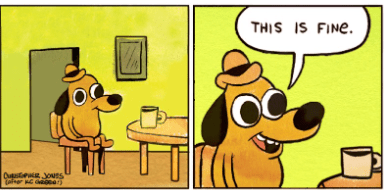
TL;DR: What if it is actually fine? We used to just enjoy our coffee, but it seems like more and more are dumping gasoline on our floors because nobody reacted to story on instagram before we added the fire.
I don’t have an answer, research to reference, or really even ideas regarding the optimal amount of time off. All I know is that I took 5 days off – actually off, with no work to speak of other unless you count reading short stories on a couch as work – and I feel much better. Not that I felt bad before, it wouldn’t even be that noticeable save that working is easier now. Focusing is easier, following through is easier. Enjoying the work is the easier. I never stopped caring, but I had become easier to distract.
Five days isn’t a lot. I didn’t go off the grid for a month. I didn’t try on a new identity in a foreign country. I ate granola with my wife at top of a beautiful mountain, so maybe that counts as eating, praying, and loving. I liked my job before and I still like it now, but sometimes you can end up too deep and caring a little too much, particularly about the bureaucratic details and status-oriented outcomes.
I am firmly team vacation, but with the caveat that your vacation actually be a vacation. Something stimulating and relaxing at the same time. The kind of thing where you are excited to get out of bed to do stuff but also free to do nothing for long languid periods of time, preferably with the hot or cold beverage of your choice.
As for the question presented at the outset, I still don’t know what the optimal length of time is. My closest approximation is a period of time long enough that don’t remember what you were working on the day that you left but not so long that the discontinuity becomes a source of stress and anxiety.
Or maybe its a schedule – 3 days every 2 months, 1 week every year, 1 month every 3 years, 3 months every decade. I’d love to say there is no rule, that you’ll know what you need when you need it, but I didn’t. I might schedule rereading this post every 6 months though.
You can find my paper with Will Hickman “Do people trust humans more than ChatGPT?” at the Journal of Behavioral and Experimental Economics (JBEE) online, and you can download it free before July 30, 2024 (temporarily ungated*).
Did we find that people trust humans more than the bots? It’s complicated. Or, as we say in the paper, it’s context-dependent.
When participants saw labels informing them (e.g. “The following paragraph was written by a human.”) about authorship, readers were more likely to purchase a fact-check (the orange bar).
Informed subjects were not more trusting of human authors versus ChatGPT (so we couldn’t reject the null hypothesis about trusting humans, in that sense). However, Informed subjects were significantly less likely to trust their own judgement of the factual accuracy of the paragraph in the experiment, relative to readers who saw no authorship labels.
Some regulations would make the internet more like our Informed treatment. The EU may mandate that ChatGPT comply with the obligation of: “Disclosing that the content was generated by AI.” Our results indicate that this policy would affect behavior because people read differently when they are forced to think up front about how the text was generated.
Inspiration for this article on trust began with observing the serious errors that can be produced by LLMS (e.g. make up fake citations). Our hypothesis was that readers are more trusting of human authors, because of these known mistakes by ChatGPT. This graph shows that participants trust (left blue bar = “High Trust”) statements *believed* to have been written by a human (so, in that sense, our main hypothesis has some confirmation).
Conversely, in the Informed treatment, readers are equally uncertain about text written either by humans or bots. Informed readers are suspicious, so they buy a fact-check. “High Trust” (the blue bar) is the option that maximizes expected value if the reader thinks the author has not made factual errors.
So, in conclusion, we find that human readers can be made more suspicious by framing. In this case, we are thinking of being cautious and doing a fact-check as a good thing. The reason is that, increasingly, the new texts of society are being written by LLMs. Evidence of this fact has been presented by Andrew Gray in a 2023 working paper: “ChatGPT “contamination”: estimating the prevalence of LLMs in the scholarly literature” Note that is the scholarly literature, not just the sports blogs or the Harry Potter – Taylor Swift- crossover fanfics.
What about the medical doctors? What is the authority on whether you are getting surgery or not? See: “Delving into PubMed Records: Some Terms in Medical Writing Have Drastically Changed after the Arrival of ChatGPT”
At the same time, renewables and nuclear power accounted for roughly half of US electricity in March.
Good morning with good news: Renewables and nuclear power generated 49.4% of USA's electricity in March! RE alone produced 29.85%, with wind and solar at 21.2%.
USA nears its first month in many generations, when fossil fuels will provide less than 50% of its power for a month! pic.twitter.com/uGQ2JDiiSH
— John Raymond Hanger (@johnrhanger) May 29, 2024
If you were wondering why Saudi Arabia is trying to get into the sports business, this is why. They have almost single-handedly held the line on OPEC’s export restrictions, but the strain has become too great. After posting a fiscal deficit for 9 of the last 10 years, Saudi Arabia will spread the burden a little wider, which means accepting a lower price that will, in turn, likely generate (much needed) greater total revenue. The world is moving to a new equilibrium.





 Economist Writing Every Day