Buying in Bulk: Money Saver or Self Sabotage?

Recently, I’ve been buying a lot more non-durable goods when they are on sale. Whereas previously I might have purchased the normal amount plus one or two units, now I’m buying like 3x or 4x the normal amount.

What initially led me here was the nagging thought that a 50%-off sale is a superb investment – especially if I was going to purchase a bunch eventually anyway. I like to think that I’m relatively dispassionate about investing and finances. But I realized that I wasn’t thinking that way about my groceries. The implication is that I’ve been living sub-optimally. And I can’t have that!

If someone told me that I could pay 50% more on my mortgage this month and get a full credit on my mortgage payment next month, then I would jump at the opportunity. That would be a 100% monthly return. Why not with groceries? Obviously, some groceries go bad. Produce will wilt, dairy will spoil, and the fridge space is limited. But what about non-perishables? This includes pantry items, toiletries, cleaning supplies, etc. 

Typically, there are two challenges for investing in inventory: 1) Will the discount now be adequate to compensate for the opportunity cost of resources over time? 2)  Is there are opportunity cost to the storage space?

For the moment, I will ignore challenge 2). On the relevant margins, my shelf will be full or empty. I’ve got excess capacity in my house that I can’t easily adjust it nor lend out. That leaves challenge 1) only.

First, the Too Simple Version.

Continue reading

Presentation Today – “Firearms and Violence Under Jim Crow”

I’ll be giving a presentation today at 12pm ET over Zoom for the Ostrom Workshop Colloquium Series at Indiana University. It is my understanding that it is open to the public. The format is different than your typical economics seminar. I will give an introduction and brief summary of the paper for 20 minutes followed by questions.

https://ostromworkshop.indiana.edu/pdf/announcements/2021fall-colloq/11-08-makowsky.pdf

You can find the full working paper here.

The history of work and the myth of a leisurely past

Since Marshall Sahlins in the 1970s (and thanks to James Suzman’s Work ), a weird idea has worked its way into popular imagination: people of the past did not work much. Well, more precisely, the idea is that for most of human history our ancestors worked far less and thought very differently about work than we do now. That is based on a weird starting point and a misunderstanding of how “work” works.

The starting point is the pre-neolithic era when the vast majority of time was spent hunting and gathering. In that setting, the effort to acquire calories was modest largely because food was abundant relative to a tiny human population. Some early estimates suggest that, because of that relative endowment, people worked maybe less than 20 hours per week hunting and gathering. Some say even less. That is probably correct and also wrong.

Notice that I italicized hunting and gathering above suggesting that the time commitment of these two tasks was quite small. However, this is not the sum of all work people did then. One has to understand that nomadic groups were nomad in part because the largest share of their calories was also quite mobile. This meant moving around significantly to track food under a key constraint — that calories from gathering be available.

This meant that people moved from “oasis” to “oasis” or from “patch” to “patch”. Between each patch/oasis, there was a lot of time spent “in transit” (let’s call this d for dead time). That time is technically not work for hunting or gathering — but it is work. Not counting it is a mistake.

To see how it matters, consider the graph below which depicts a forager who moves between oases/patches where food is available. As they stay in a oasis, the yield of food y is marginally decreasing so that at one point he may have an incentive to move on. When he moves on, he incurs the cost d which is dead time while moving. Suppose also that a single oasis/patch per year (which encompasses multiple time periods) is insufficient to survive the year. Thus, multiple patches must be exploited. Supposing that all oases are equally distant, of equal quality and that there are many oases in total, how can we picture the decision to move to another? If you want to maximize your food intake over a long period of time, you have to go to multiple oases in a year. This is where we introduce the dashed blue line which is the total yield from all oases/patches divided by time. Notice that it starts at origin so that we are capturing the cost of d.

Figure 1: How people in the past worked

These two lines tell us that you stay at a single oasis until its marginal return is inferior to the average yield over all oases/patches. Why does this matter? Well, imagine the implications if each patch is less productive? You have to move more to reach a certain target and incur d more frequently. That effectively means that you have to exploit a greater territory to meet a certain target of food (e.g. survival).

The estimate of time spent hunting and gathering are essentially the time within patches rather than the time spent for all patches. Thus, there is a massive underestimate. The yield on a single oasis/patch was so low in the pre-neolithic that moving was something that clans did often. In the late Ice Age, family groups apparently moved every 3-6 days. Modern nomads in certain regions move some 400 km per year. At 5km/h, this is 80 hours of work per year. However, that 5km/h is too high as there were children to carry which slow things down. At 3km/h, we are talking 133 hours per year (or roughly 2.6 extra hours per week). This is just dead time but it is work. As such, more exhaustive worktime estimates suggest values of 35 to 43 hours per week. Most western countries are below this level. Moreover, it is worth considering that work started at young ages and there was no retirement. With shorter lives and earlier work-entry, a smaller fraction of awake life-time was spent in leisurely pursuits. Ergo, it is insanely likely that no society today exhibits more “life-time” work than the prehistoric humans.

Finally, it is worth pointing out the very obvious. The introduction of agriculture, by removing the need to move around and also reducing variability in calories (i.e. fewer chances of catastrophes), essentially increased the benefit of working (i.e. making leisure relatively costlier). It is unsurprising then that the introduction of agriculture led to some increases in labor supply. However, that being said, it is clearly false than we work more today than our prehistoric ancestors did. There is no way around it.

You Current Grade: It’s Complicated

By now, most US universities are 4-5 weeks away from the end of the fall semester. Whether it’s now, or just prior to the withdrawal deadline, student tend to demonstrate increased interest in their grade for their courses. They say that they want to know how they are doing. But they often prefer to know what grade they will earn at the conclusion of the course. The answer to the latter question could include all kinds of assumptions. But “What is my grade right now?” is a deceptively subtle question.

It seems direct. We could easily be curt and claim that it shouldn’t be complicated to tell a student what their grade is, and that it’s a failure of the teacher or of the education system writ large if it is complicated. While I entirely agree that a teacher should have an answer, it’s important to emphasize that “What is my grade right now?” is an ill-defined question. The problem is that a student can mean two different things when they ask about their grade.

Q1) What proportion of possible points have I earned so far?

Q2) What proportion of points will I have earned if my performance doesn’t change?

It’s important for teachers to ensure that their students understand which question is being answered.

First, I’ll illustrate when there is no distinction between the answers. Let’s say that there are two types of assignments: Exams, which are worth 75% of the course grade, and quizzes, which are worth 25%, of the course grade. So long as the two assignment types are identically distributed throughout the semester, Q1 & Q2 have the same answer. Below is a bar chart that illustrates a distribution of points over 4 weeks. The proportion of points for each assignment type is identically distributed over time (not necessarily uniformly distributed).

What is the student’s grade at the end of week 2 if they have scored 90% on the exams and 70% on the quizzes? By the end of week 2, there have been 30 possible exam points and 10 possible quiz points. The student has earned 34 of the 40 possible points so far. The math for Q1 is:

(0.9)(30)+(0.7)(10) = 27+7=34

34/40 = 85%

And, if they continue to perform identically in each assignment category, then they can expect to earn an 85% in the class. The math for Q2 is:

(0.9)(75)+(0.7)(25) = 67.5+17.5 = 85%

Both Q1 and Q2 have the same answer. And, honestly, principles or introductory courses have formats that often lend themselves well to having assignments distributed similarly over time. My own Principles of Macroeconomics class matches up pretty well with the above math. Each week, there is a reading, a homework, and a quiz. By the time students complete the first exam, they’ve completed about one third of all points in each assignment category.

Higher level classes or classes with projects tend *not* to have identical point distributions across time among assignments. Maybe there are presentations, projects, or reports due throughout the semester or at the culmination of the course. For example, my Game Theory class has two midterm exams, but no final exam. It has homework in the first half of the semester, and term paper assignments in the latter half.

The bar chart below displays a point-split among the same quizzes and exams, but they now are differently distributed throughout the semester. Quiz points have been frontloaded.

What is the student’s grade at the end of week 2 if they have scored 90% on the exams and 70% on the quizzes? By the end of week 2, there have been 30 possible exam points and 15 possible quiz points. The student has earned 37.5 of the 45 possible points so far. The math for Q2 is:

(0.9)(30)+(0.7)(15) = 27+10.5=37.5

37.5/45 = 83.33%

And, if they continue to perform identically in each assignment category, then they can expect to earn an 85% in the class. The math for Q2 is:

(0.9)(75)+(0.7)(25) = 67.5+17.5 = 85%

All I did was frontload 5 percentage points for quizzes and now the answers to Q1 and Q2 differ by 1.66 percentage points. That may seem like small potatoes. But consider that a) many students and universities use and care about the +/- system of grades, and b) a grade difference of 1.66 points was caused by a mere change of 5-point change in the distribution. Bigger changes result in bigger differences. Frontloading the remaining 5 quiz points from the end of the semester would result in a Q1 score of 82% – yielding a 3 point difference between the two calculation methods.

The differences between Q1 & Q2 illustrated above are even more pronounced once you begin to include extra credit. One point of extra credit has a smaller effect on the answer to Q1 as more and more possible course points have been earned.

If students only care about their ultimate grade in the course, then they will always prefer to receive the answer to Q2. But, students may also want to know how effective their recent study habits have been so that they can re-evaluate them conditional on the knowledge of the assignment point distributions. Q2 requires more assumptions if an assignment type hasn’t even occurred yet. Students can ask “Have I given this course the appropriate amount of attention given the types of assignments that we’ve had?”.

For example, my Principles of Macroeconomics course has the first exam at week 5. Students should have an average score that is greater than 90% by the end of week 4 because the reading assignments are simple, the homeworks are lenient, and the quizzes permit practice attempts. Students who have an 80% by the end of week 4 are going to have a rougher time once they encounter an exam.

Reasonable people can disagree about which calculation is more useful. And more mathematically inclined students can calculate their own grades anyway. Therefore, after every exam, I send a mail-merge email to each of my students in order to update them about their grade. I give them the answer to both Q1 & Q2, and I illustrate the impact of several alternative scenarios for their future performance. If there is information that a student wants about their grade, then it’s in that email.

In conclusion, teachers should take great care in making student grades and progress reports clear. Students should take great care to understand what they are asking and and what the answer means. Grades can be very important for students who are close to the margin for scholarships, academic probation, or failure. While students may care too much about their grades, teachers should be sensitive to the fact that the care is real none the less. Teachers owe their students a firm and clear indicator of performance.

*There is another case in which Q1 & Q2 have the same answer. It’s when the student earns exactly the same grade in each assignment category, regardless of whether the category points are distributed identically across time.

Give someone you love the gift of two hours

The good people at EWED have asked me to recommend a gift for the upcoming holiday season. I know there’s no fewer than three economists that publicly recommend the gift of cash every year. This is ostensibly done in earnest, but really it’s for the LOLs. If we take a slightly more behavioral tact (but only slightly), the optimal gift to give is the thing that people are systematically biased against purchasing for themselves even though it offers a net benefit in exchange. Great. So what are people systematically biased against?

I’d like to suggest people are biased against purchasing things they are a little too good at producing themselves, a sort of “absolute advantage bias”. If you want to give someone a great gift, buy them something they typically produce themselves even though outsourcing it would cost-effectively save them two hours. If you can make manifest in an adult human life two hours of free time you are nothing short of a hero.

Buy them two hours of a cleaning service. Two hours of lawn care. Two hours of babysitting. Two hours of laundry pick up, folding, and drop-off. Two hours of cooking (i.e. a DoorDash gift card). Two hours of car cleaning. Two hours of document proofreading. Two hours of anything that if you recommended it to them they’d shrug their shoulders and sigh “I can’t pay for that when I can just do it myself”.

And it doesn’t matter what they do with the two hours, either – they’ll maximize that with ruthless efficiency. You ever take a two-hour nap on a Sunday afternoon? I defy you to think of anything you can buy an adult for $50 that is better than a two hour nap. I’m getting dreamy-eyed just thinking about it.

Buy the people you love some time for themselves this holiday season. It’s better than cash, it shows you are invested in their well-being, and I’ve never met anyone who couldn’t use it.

Supply chain failures and the O-Ring

Difficulties in the global supply chain are a recurrent news item since the beginning of fall. The result has been that many pundits or politicians have argued for new policies that spout platitudes such as the need to “rethink trade“. For my part, all I could think of was the O-Ring theory of development developed by Michael Kremer.

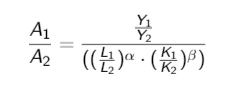
The name for that theory is taken from the 1986 Challenger disaster, in which the failure of one small, inexpensive part caused the shuttle to explode upon take-off. Generally, the theory is applied to questions of development and speaks to high complementarities between inputs. Suppose the economy is divided into multiple sectors that exchange intermediaries goods between them (i.e. all firms are dependent on each other). Each of these goods can be labelled as n and producing these goods require skills q. However, each sector buys multiple different n as intermediary goods. For example, this would mean that sector “Vincent” buys goods from sectors “Joy”, “Jeremy” and “James” to produce the “Vincent” goods.

Imagine now that q is the percentage chance that n is produced with sufficient quality so that it bears its full market value (in which case, 1-q is the probability that n is produced so poorly that it gets a zero-price). This means that, to produce its goods, sector “Vincent” needs sectors “Joy”, “Jeremy” and “James” to produce high-quality goods. If one of the intermediary goods “Vincent” buys from the other is inefficient, all of Vincent’s production is worthless. Hence, the analogy to the O-Ring of the Challenger disaster.

So what’s the link with the supply chain failures you ask? Well, its pretty straightforward: the O-Ring theory implies that the impact of a bottleneck has a multiplicative effect on other productions. Now, everyone may be excused for thinking that I simply explained in a complex way something that is simple (i.e. dont half-ass things). However, this way of formulating is very helpful because of q.

If q is the probability of a badly-performed task, what determines q? Some could say its the pandemic, but that would be incorrect. An article in Nature shows that COVID-19 has yielded widely disparate effects on supply chains in different countries. If it was global, it should be roughly similar everywhere. Ergo, some local factors must be in play. Local factors of relevance would be laws on shipping such as the Jones Act in the United States or the public ownership of ports in many western countries. By preventing cabotage and limiting foreign ships, such as in the Jones Act, there is little excess capacity in the American shipping industry available when demand shocks occur. By being more bureaucratically rigid, ports may be unable to adapt to unforeseen events (which is why there are papers in transportation economics that show that privatizing ports tends to increase productivity and reduce shipping costs notably by speeding turnarounds).

Each of these local factors have to do with local policies that reduce q and tend to increase the likelihood of failures (i.e. bottlenecks) which then reverberate on total output (beyond the narrow supply chain sector). From this, I get to a simple: complications that we attribute to the COVID crisis are more likely the results of local factors.

Go watch Dune

That’s the column this week. No ad hoc economic theory, no deep insight into the profession. No silly sports talk. Just a recommendation to watch a beautiful looking and sounding movie. Allow yourself to get invested in the world they are building. Reward their willingness to be sufficiently faithful to a masterpiece while also having the maturity to know that much of the intrigue, as designed in the book, wouldn’t translate to the screen.

They’re building a world where a single commodity is so valuable, and it’s supply so inelastic, that it serves as the fulcrum for an entire galaxy. Worries about peak oil feel like fretting about a possible shortage of student selfies when compared to the economics of spice. The political economy is coming, don’t you worry. For the moment though, just take in a cool movie.

Go watch Dune.

Stocking Stuffers: First Mover Advantage & Nested Utility Functions

I have two gift recommendations for you this year. Typically, I purchase a lot of very practical items. My wife makes fun of me for requesting tools and hardware as gifts – but hopefully the following list will provide some crossover between practicality and good gift ideas.

Depending on your family’s traditions both of these gifts are stocking stuffers.

1) Laurie Berkner CDs

Having children means that you hear opinions and preferences from more people. And children are sure to share those opinions. When you’re in the car, I recommend that you strike first with 2 different CDs (or mp3 albums) by Laurie Berkner. Laurie Berkner is a singer songwriter who creates outright good children’s music. She has variety and produces earworms that are not too bad to have around. The Ultimate Laurie Berkner Band Collection is a crowd-pleaser. If you’ve got a more intense personality and your children can handle it, then I strongly recommend The Dance Remixes. It rocks.

The idea here is game theoretical. Your children are going to find something that they like. A lot. Odds are good that waiting for them to encounter something won’t bode well for your happiness once they find it. Take the first-mover advantage and introduce them to Laurie Berkner. They’ll get hooked and you’ll be stuck listening to a lot of children’s music. But at least it will be good/tolerable that you also enjoy… Unlike some other alternatives

2) Highly Specific Treats

We live in a rich society. Most of us walk the store aisles implicitly saying ‘no’ to the vast majority of goods. Even the ones that we like. Take the opportunity that the holiday season provides and say “yes” to getting some special treats. These treats fall into two categories: 1) “Nostalgic Treats” & 2) “I’ve never tried it”.

1) Sharable Nostalgic Treats

When I was about 4-5 years old, I remember getting great big bags of pretzels that were covered in a mustard powder (“mustard pretzels”). As it turns out, they are only a regionally available product and I never saw them again after my family moved from Tennessee. But 33 year old me thought “Surely, the internet has them”. And indeed they do! I made this purchase at a per-unit price that I would not typically indulge. However, I got to share the story and the experience with my family. It pleased me to share a deep memory with them and it pleased them to get a ‘special’ snack. For me, it was mustard pretzels. For my wife, it was a bulk pack of Heath and Skor bars.

2) I’ve never tried it

Separately, while watching Captain America and the Winter Soldier, it occurred to me that I had never knowingly had Turkish Delights. So, I found a variety pack of fancy ones. First, they’re delicious and you feel fancy while eating them. Second, this is 21st century America. What’s the point in saying that we’re rich if we’re not willing to act like it a little? Maybe it’s not Turkish Delights for you. Maybe it’s Pilipino rice candies or Mexican Tamarind candies. Make sure that you get a couple of new treats and share them with others. The purchases are much more worth the price when you consider the nested utility function among your loved ones.

La Dolce Vita Economica

I thought about writing about soccer (again). I thought about writing about time management and personal production functions. I considered writing about Lebron James or how I manage multiple research projects. I thought about writing about a classic, and entirely addictive to the point of career ruination, video game. They all seem a little redundant at the moment, though, because they are all the same basic story.

One soccer manager is over-exhausting their resources because of a confluence of bad contractual incentives while another team is witnessing a renaissance in a player they essentially forced to take 7 weeks off. While so many NBA careers of the 80s evaporated in a cloud of cocaine and clubbing, Lebron James’ entire life is built around managing the only two resources whose limits are salient to his life: his body and relationship with his family. Playing baseball growing up I watched pitchers blow out their arms before they finished puberty in service to Little League glory, while modern professional pitchers are (finally) on strictly managed pitch counts to maximize their expected output.

There are two manners in which I armchair quarterback the rest of the world. One is the things in which I have just enough knowledge to be frustrated by others decisions, but no so much as to actually know what I am talking about. These frustrations are ephemeral, they flatter myself to the point of mild embarrassment upon reflection, and, if I am being honest with myself, are fun.

The other manner is resource management. These are the times when armchair quarterbacking is less fun and more exasperating because they are the moments when outsiders, with inferior levels of narrowly-applicable expertise, are often actually right. Which is not to say the knowledge that resources are being poorly managed is uniquely held by outsiders. Insiders are more often than not quite aware of the suboptimal deployment and conservation of resources, but are unable to overcome the status quo institutions, incentives, or inertia of decision-making power loci. It’s obvious to lots of people that athletes, CEOs, doctors, and congressional representatives are over-extended. What’s not obvious is how to get out of these equilibria.

When I see most attempts at self-improvement, I am generally skeptical of anything that doesn’t start with the identification of a key resource that is salient to outcomes and the options available to better manage it. Maybe its calories and how to budget them. Maybe its time and how to better partition and conserve it. It could always be money, but in general I find that money is so immediately identifiable as a finite resource and entirely fungible that people who ostensibly are managing it poorly are, in actuality, failing at managing a different resource (time, emotional energy, vices, etc) that is intertwined with financial resources.

When I see successful firms, teams, and individuals, what I most often find myself admiring is not (just) a worldly talent, but a facility with managing resources that others haven’t yet adopted or mimicked. An appreciation for sleep, a protection of time blocked for creativity, an adeptness trading low opportunity competitive minutes for higher opportunity cost moments on the biggest stages. Or even just the ability to recognize that this is the moment to savor a 600 calorie dessert with a loved one because the emotional sustenance will make it easier to walk away from three vending machine Hostess pies during the high-stress moments in the week to come.

Once you learn to manage your donut-based caloric intake, the spreadsheet of your life will be revealed before you, an endless cascade of resources to be managed and optimized. A life with the right donuts at the right time. The dolce vita economica.

The (Employment) Depressing Child Tax Credit

For those who didn’t know, as part of the American Rescue Plan, there were some changes made to the Child Tax Credit (CTC) for the tax year 2021.

  • First, the credit was expanded from $2k to $3,600 per child for children under 6 years of age (to $3k otherwise). It’s also fully refundable.
  • Second, half of the credit is being disbursed to tax-filers early: over the latter 6 months of 2021.

What does this mean?

For context, I have 3 children all under that age of 6. My total 2021 CTC is $10,800. Half of that is being distributed as monthly checks from July through December. For me, that’s a check for $900 per month that I had not anticipated. While it is true that I will see less of a remaining credit when I file my taxes by April of 2022, I strongly suspect that most similar households are somewhat short-sighted about these funds.

Depending on the number of children in a household, the monthly check from the IRS can be quite significant. From the parent point of view, there has been a lump-sum transfer. There is no endogenous response to obtain more children – there’s no time for that. The transfer also occurs regardless of any activities, economic or otherwise. In essence, tax-filers with children have experienced a positive income shock.

The big question is: What is the effect on employment?  

In one sense, the effect is ambiguous and depends on preferences: People can now afford more leisure and more consumption. How they engage in more of each is a matter of preference. But, given that both are goods, both will increase by some amount.

That’s my simple model. I hereby make multiple predictions:

  1. Parents with children will have consumed more in the 3rd and 4th quarters of 2021.  
  2. Parents with children will have lower employment growth for those quarters.
  3. The effects will be stronger for parents with children under 6 years of age.
  4. The employment rebound in the 1st quarter of 2022 will be stronger for these groups (and stronger than forecasted overall).
  5. Finally, while I’m feeling silly enough to make predictions publicly, I predict slower growth in consumer durable expenditures in 2022 Q1.

I looked at the BLS for data to corroborate my predictions. Excitingly, the Current Population Survey (CPS) does slice the data by sex, age, and age of own children (conveniently by younger than 6 and 6-17 years of age). This is where I post the great visual to demonstrate the veracity of my claims, right?

WOMP WOMP.

The relevant data is currently only available annually as recent as 2020