European Energy Crisis, Updated: Germans Shut Down Perfectly Good Nuclear Plants, Utilities Send Socks to Shivering Customers and Advise Eating Porridge

As we noted in September, natural gas prices are sky-high in Europe. Coal-burning power plants have been shut down and the windmills have not spun as fast as expected, which led to a drawdown of European natural gas stocks for electric power generation. The Russians are not sending as much gas as hoped through their pipelines, so Europe is scratching around for (very, very expensive) liquified natural gas to be shipped by ship from the U.S. and the Middle East.

As noted, this hurts European economies in various ways. Fertilizer plants and aluminum smelters have shut down because of too-costly natural gas feedstock, consumers are paying much more in utility bills, and some governments are going deeper into deficit by paying subsidies to partially cushion consumers. This energy shortage also makes Europe very vulnerable to Russia, at a time when Putin is menacing Ukraine with invasion.

France derives about 70% of its electricity from nuclear energy. Due to its low cost of generation, France is the world’s largest net exporter of electricity, earning over €3 billion per year from this. China and other countries are ramping up nuclear. (The U.S. is sadly dysfunctional when it comes to building nukes; we can’t seem to do anything without years of delay and billions in cost overruns).

Like nearly everything in Germany, the German nuclear power plants are well-run. They have never had a serious incident. Nuclear power plants pump out gobs of electric power with essentially no CO2 emission.  If you think that green advocates in Germany would therefore desire to keep these plants running, you would think wrong. Such is the loathing for nuclear power that Germany is shutting them down. Every single one. Katja Hoyer writes:

Just before midnight on Dec. 31, Germany switched off three more of its nuclear power plants [including one in Grohnde]. Once it had 17; now only three are left, and they too will be shut down at the end of the year. Soon Germany will produce no nuclear energy at all. But the activists were wrong to celebrate. Germany’s hasty nuclear retreat is neither safe nor green. It’s a disastrous mistake that will have ramifications well beyond the country’s own borders.

The Grohnde plant is a perfect example of what Germany is giving up. It was one of the most productive nuclear power plants in the world. It provided enough electricity to cover 15 percent of Lower Saxony’s annual energy needs single-handedly, saving 10 million tons of carbon dioxide emissions a year in the process. The site even made headlines in February 2021 for producing more electricity than any other nuclear power plant in the world. Now it will have to be dismantled at a cost of around 1 billion euros.

The loss of these nukes puts further strain on the European-wide grid. The irony of shutting these plants down and therefore buying more power from other countries generated by nuclear power and by burning more gas and coal seems to be lost on the Germans. Their plan to mitigate the effects of calm winds is to build even more windmills, even if that requires deforesting vast tracts of woodland.

Let Them Eat Porridge

The U.K. utility Ovo, which prides itself on providing all-renewable power, sent customers a link with advice for keeping warm whilst turning down their thermostats this winter. These suggestions included cuddling your pets, eating hot porridge, cleaning the house, having a hula hoop contest, doing star jumps (jumping jacks), and leaving the oven open after you are done baking. I leave to your imagination how this advice was received by the British public. In lieu of affordable electricity, the utility company E.ON which shut down one those German nuclear power plants sent out 30,000 pairs of socks to encourage people to get by with less power and heat.

You couldn’t make this stuff up.

Kitchen staff were canaries in the coal mine

I’ve long been a lurker on r/kitchenconfidential. I did a few brief tours in the service industry when I was younger and my partner used to manage a successful upscale restaurant. If you’ve spent anytime in a restaurant after closing in the last ten years, then you probably aren’t surprised by the continuing labor shortage in the service industry. Things have been bad for a while, with a pervasive sense that the industry was dependent on employees with weak outside options (i.e. a criminal record) or high exit costs (i.e. can’t afford to be on entry-level wages in a new career track). As I’ve written before, we’ve been eating on borrowed time: the pandemic game shifted the calculus for a lot of marginal employees who have left the service industry and likely aren’t coming back. The service industry is important, but not such that a great reorganization is likely to have catastrophic short term consequences for broader society.

Which bring us to nursing.

Nurses are burned out.

If the daily threads at on r/nursing subreddit are even mildly representative, the status quo in nursing is unsustainable. It’s not just that the job has become more dangerous, more tiring, and less rewarding. Tough jobs exist all over the place, with employees taking them on in return for higher wages than they might otherwise enjoy. No, the bigger problem in nursing is that it is not what these people signed up for. It has become dangerous and unrelentingly exhausting. It requires increasingly greater education and training that is highly specialized, with little in the way of outside options likely to reward that education and training. Can you think of a job with equivalent background requirements, that places the same physical demands on you, and forces you to interact at a personal level in the general population? I can’t, and if you did, I can almost guarantee that the pay is considerably higher.

The broad shortage of nurses in the US has gotten a fair amount of attention. That article points to a lot of causes, most entirely valid (the idea that travel nurses are a cause, rather than symptom, of the nursing shortage is silly, but we’ll let that slide- the broader point stands), but this is one of those cases where it seems to me the diagnosis is best kept simple: nursing has become a worse a job, in part because of the pandemic, and that has tipped the cost benefit analysis towards labor exiting.

While cooks and nurses decided that the pandemic was a good time to get out, let’s not make the mistake of ignoring one of the most martyred vocations in the US.

Teaching sucks, and this time they mean it.

You could go to r/teachers and read the resignation posts, but there isn’t a lot of new information to be gleaned. Everyone knows teachers are undervalued and underpaid. I was a public school teacher for two years, and I endured lots of third drink questions of “Why?” to go along with daily complaints about pay and “continuing education” requirementss with my colleagues. The rate of exit, was pretty predictable. More than half of teachers left the profession in their first 5 years, the rest stayed for life.

I’ll wait for the data to come out before I make broad pronouncements, but this wave of resignations could be different. If we lose a generation of teachers (>80% of those in their first 5 years), there really will be a massive shortage down the road. The pandemic is interesting because it’s taught us two things:

  1. Online teaching is inferior
  2. The value of schooling as “mass daycare” is hard to overstate

If we step into massive teaching shortage five years down the road, there’s not going to be a “scale education online” solution. The only solution will be to raise compensation for teachers and bring labor into the industry and, well, the failure to raise teaching salaries is maybe the single greatest of example of the divergence between what people publicly support and what they actually vote for. A mass teacher shortage would certainly given teachers unions across the country the opportunity to negotiate better pay scales, but I’m cynical enough to expect they will find a way to waste it on even more job security for their worst members while ensuring that the best teachers still never see a dime in extra compensation. But hey, prove me wrong, yeah know?

What do Cooks, Nurses, and Teachers have in common?

I can’t help but see what these three vocations have in common in the US labor market – a frequent sense of being trapped. Sure, working grill for $15/hour might not sound like something you couldn’t bring yourself to leave, but if you’re 34 with a high school diploma, a felony drug arrest, and a mortgage to pay, the intermediate stage between the status quo and something better might not seem so great. No, you did not enjoy being threatened by a patient who backed you into a corner and told you he “knows what you are trying to inject in him”, but you have a masters degree in nursing, which makes the pay gap between nursing and not nursing a miserable prospect, especially if you’re going to pay off the student loans that got you the job that makes you miserable. You know you essentially can’t be fired, but you’ve also seen the pay scale by seniority, and the prospect of teaching 5th grade for 25 more years fills you with a dark melancholy you did’t know possible. But your degree is in teaching, which essentially means you’d have to find a way to start from scratch at twenty-six. Or thirty-three. Or forty-one.

But then the pandemic happened and everything you already hated got even worse. So you did it. You quit.

But how many of you quit? How many of you are laying out your exit strategy? What will these industries look like in 2 years? We won’t know for a while, but I do think we’re going to learn which industries have been dependent on squeezing every ounce of juice out of trapped labor pools (with what you might call actual monopsony power), versus those industries where the standard “work sucks” complaints simply get more attention for whatever reason.

Personally, I’m betting on two out of the three, but I’m not telling you which two. Working in two of these industries is going to look very different in the wake of the pandemic, both in terms of labor characteristics and compensation. And one will just return to the previous normal, like it never happened.

Ongoing Drama with Turkey’s Currency: Heterodoxy or Lunacy?

Economics involves human beings making decisions. Where there are humans, drama is never absent. Hence, somewhere in the broader financial sphere, there is always some drama. The chart below displays gyrations in the exchange rate of the Turkish lira which may be fairly characterized as “dramatic”. This chart shows the lira-per-dollar exchange rate over the past six months; a higher number here means lower lira valuation.

Foreign Exchange Market Prices, Turkish Lira per Dollar.         Source: TradingView.com

What is going on here? Why the spike up in November/December, followed by an even more sudden drop?

As usual, loss of value in foreign exchange goes hand in hand with domestic inflation. Inflation within Turkey for the month of December was reported to 36% on an annualized basis. Now, an orthodox economic response to runaway inflation includes raising interest rates. Higher interest rates tend to make a currency more valuable. Higher interest rates encourage people to hold onto their currency, since they are rewarded by interest on their savings. Conversely, low interest rates, especially when coupled with inflation, motivates people to spend down their money before it loses more value. In the case of emerging market countries like Turkey,  high inflation/low interest drives people to exchange their local currency for more stable foreign currencies, like dollars or euros (or crypto stablecoins like Tether).

But Turkey is Turkey, and Turkey is run by the authoritarian President Erdogan. He has economic views which might most charitably characterized as “heterodox”. Erdogan claims that high interest rates actually cause inflation. His views may be influenced by the prohibition on charging interest in classic Islamic practice. The Turkish president has stated, “My belief is that interest rates are the mother of all evils. Interest rates are the cause of inflation. Inflation is a result, not a cause. We need to push down interest rates.”  President Erdogan has sacked numerous treasury officials who disagreed with him, and pressured the central bank to implement four interest rates cuts in the last four months of 2021.  

It seems he hopes to stimulate enough internal growth to paper over any other problems. I think there could be some merit to that notion, but the current inflation level is toxically high. Lower- and middle-class Turks find it hard to purchase necessities.

 Lowering the value of your currency to make your exports more attractive has been practiced successfully by various Asian nations, but Turkey is too exposed to foreign exchange to weather such a huge drop in the value of the lira. A large part of Turkey’s recent economic growth has been funded by foreign investors, and that may dry up because of the currency instability. Turkey is dependent on imports for many essentials, including all of its energy needs, so imports have become much more expensive for Turks as their currency depreciates. Furthermore, because of the fluctuating value of the local currency, many loans are denominated in dollars or euros. This makes it burdensome for borrowers to keep up payments of interest and principal, when these foreign currencies have become more expensive.

Modern currencies have essentially no intrinsic value. Money is a big confidence game. A shopkeeper will take my dollar bill in exchange for some candy, because he is confident that some other party will in turn accept that dollar bill in exchange for something else of value. If confidence in a currency collapses, so does its exchange value.

Foreign creditors and domestic Turkish consumers were becoming more and more nervous about the prospects for the lira in late 2021, as inflation was fueling further inflationary expectation.  It crashed to a record high exchange rate of 13.44 against the dollar on November 23 after the Turkish leader insisted that rate cuts would continue.

Things really started getting out of control in mid-December. Turks frantically ditched their currency in exchange for euros and dollars, which led to further devaluation of the lira.  On December 21st, however, the Turkish government unleashed an innovative initiative. They offered to backstop the value of the lira deposits of Turkish residents, as long as those deposits were held in lira for a certain period of time. Besides offering interest on the deposits, the offer was to compensate depositors for any loss in value against the dollar. The intent was to motivate residents to keep their lira as lira.  

Turkey’s new Finance Minister Nureddin Nebati has no real finance background; his main qualification for office appears to be a willingness to do what his boss wants. When Nebati was asked to give details of this initiative, he reportedly answered thus: “”I won’t give a number now. Can you look into my eyes? What do you see?… The economy is the sparkle in the eyes.”   Hmm.

President Erdogan has said he is protecting the country’s economy from attacks by “foreign financial tools that can disrupt the financial system.” Western economists are not impressed. Market strategist Timothy Ash commented, “ More complete and utter rubbish from Erdogan…Foreign institutional investors don’t want to invest in Turkey because of the absolutely crazy monetary policy settings imposed by Erdogan.”

At any rate, this unusual measure, combined with old-fashioned central bank intervention (the Turkish central bank is believed to have used some 10 billion dollars’ worth of its foreign reserves to buy lira), seemed to stem the immediate panic. Within a day, the exchange rate thudded down from about 18 to about 13, which is roughly the level today.

It has been pointed out that it simply is not feasible for the government to backstop all relevant bank deposits against a huge currency depreciation;  the Turkish government and central bank would burn through all their foreign reserves, and have to resort to printing ever more worthless lira. However, sometimes the mere promise of such a guarantee (whether or not it is practical) is enough to restore some measure of confidence, which in turn means that the currency will not collapse and  thus the resources of the central bank will not be put to the test.   As we said, confidence is what it is all about. We will see how this plays out.

Empirical Austrian Economics?

David Friedman recently got into an online debate with Walter Block that could be seen as a boxing match between “Austrian economics” and the “Chicago School of Economics”. In the wake of this debate, Friedman assembled his thoughts in this piece which is supposed (if I understand properly) to be published as a chapter in an edited volume. Upon reading this piece, I thought it worthy of providing my thoughts in part because I see myself as being both a member of both schools of thought and in part because I specialize in economic history. And here is the claim I want to make: I don’t see any meaningful difference between both and I don’t understand why there are perpetual attempts to create a distinction.

But before that, let’s do a simple summary of the two views according to Friedman (which is the first part of the essay). The “Chicago” version is that you can build theoretical models and then test them. If the model is not confirmed, it could be because a) you used incorrect data, b) relied on incorrect assumptions, c) relied on an incorrect econometric specification. The Austrian version is that you derive axioms of human action and that is it. The real world cannot be in contradiction with the axioms and it only serves to provide pedagogical illustrations. That is the way Friedman puts the differences between the schools of thought. The direct implication from this difference is that there cannot be (or there is no point to) empirical/econometric work in the Austrian school’s thinking.

Now, I understand that this is the viewpoint shared by many — as noticed by a shared distrust of econometrics and mathematical depictions of the economy among Austrian-school scholars. In fact, Rothard was pretty clear about this in an underappreciated book he authored, the A History of Money and Banking in the United States. But I do not understand why.

After all, all models are true if they are logically consistent. I can go to my blackboard and draw up a model of the economy and make predictions about behavior. That is what the Austrians do! The problem is that predictions rely on assumptions. For example, we say that a monopoly grant is welfare-reducing. However, when there are monopolies over common-access resources (fisheries for example), they are welfare-enhancing since the monopoly does not want to deplete the resource and compete against its future self. All we tweaked was one assumption about the type of good being monopolized. Moreover, I can get the same result as the conventional logic regarding monopolies by tweaking one more assumption regarding time discounting. Indeed, a monopoly over a common access resource is welfare-enhancing as long as the monopolist values the future stream of income more than than the future value of the present income. In other words, something on the brink of starvation might not care much about not having fish tomorrow if he makes it to tomorrow.

If I were to test the claims above, I could get a wide variety of results (here are some conflicting examples from Canadian economic history of fisheries) regarding the effects of monopoly. All of these apparent contradictions result from the nature of the assumptions and whether they apply to each case studied. In this case, the empirical part is totally in line with the Austrian view. Indeed, empirical work is simply telling which of these assumptions apply in case X, Y, or Z. In this way of viewing things, all debates about methods (e.g. endogeneity bias, selection bias, measurement, level of data observation) are debates about how to properly represent theories. Nothing more, nothing less.

It is a most Austrian thing to start with a clear model and then test predictions to see if the model applies to a particular question. A good example is the Giffen-good. The Giffen good can theoretically exist but we have yet to find one that convinces a majority of economist. Ergo, the Giffen good is theoretically true but it is also an irrelevant imaginary pink unicorn. Empirically, the Giffen good has simply failed to materialize over hundreds of papers in top journals.

In fact, I see great value to using empirical work in an Austrian lens. Indeed, I have written articles (one is a revise and resubmit at Public Choice, another is published in Review of Austrian Economics and another is forthcoming at Essays in Economic and Business History) using econometric methods such as difference-in-difference and a form of regression discontinuity to test the relevance of the theory of the dynamics of interventionism (which proposes that government intervention is a cumulative process of disequilibrium that planners cannot foresee). n each of these articles, I believe I demonstrated that the theory has some meaningful abilities to predict the destabilizing nature of government interventions. When I started writing these articles, I believed that the body of theory I was using was true because it was logically consistent. However, I was willing to accept that it could be irrelevant or generally not applicable.

In other words, you can see why I fail to perceive any meaningful difference between Austrian theory and other schools of economic thought. For year, I realized I was one of the few to see like this and I never understood why. A few months ago, I think I put my finger on the “why” after reading a forthcoming piece by my colleague Mark Koyama: Austrians assume econometrics to be synonymous with economic planning.

I admit that I have read Mises’ Theory and History and came out not understanding why Austrians think that Mises admonished the use of econometrics. What I read was more of the domain of the reaction to the use econometrics for planning and policy-making. Econometrics can be used to answer questions of applicability without in any way rejecting any of the Austrian framework. Maybe I am an oddball, but I was a fellow Austrian traveler when I entered the LSE and remained one as I learned to use econometrics. I never saw any conflict between using quantitative methods and Austrian theory. I only saw a conflict when I spoke to extreme Rothbardians who seemed to conflate the use of tools to weigh theories and the use of econometrics to make public policy. The former is desirable while the latter is to be shunned. Maybe it is time for Austrians to realize that there is good reason to reject econometrics as a tool to “plan” the economy (which I do) and accept econometrics as a tool of study and test. After all, methods are tools and tools are not inherently bad/good — its how we use them that matters.

That’s it, that’s all I had to say.

Primary Driver for This Inflation Is Surging Demand (Fueled by COVID Payments), Not Supply Chain Constraints

Inflation is colloquially defined as, “Too much money chasing too few goods (and services)”. Supply chain constraints get talked about, and these are widely blamed for the inflation we are seeing.  Of course, supply limitations play into inflation, but to focus on them is to miss the elephant in room. The primary driver of this inflation is not “too few goods”, but “too much money.”

Such is the thesis of a widely circulated article by Ray Dalio’s investing firm Bridgewater Associates, “It’s Mostly a Demand Shock, Not a Supply Shock, and It’s Everywhere.” The point is summarized:

While the headlines tend to focus on the micro elements of the supply shock (the LA port, coal in China, natural gas in Europe, semiconductors globally, truckers in the UK, etc.), this perspective largely misses the macro cause that is likely to persist and for which there is no idiosyncratic solution. This is not, by and large, a pandemic-related supply problem: as we’ll show, supply of almost everything is at all-time highs. Rather, this is mostly an MP3-driven upward demand shock. [emphases in the original]

In Bridgewater’s terminology, “MP3” is “Monetary Policy #3”, and refers to massive deficit spending combined with central bank quantitative easing. We saw this implemented in 2020-2021 when the federal government pumped out trillions of dollars of stimulus payments and enhanced unemployment benefits, and the Fed instantly soaked up the bonds that were issued to pay for these trillions. This fed/Fed combo amounts to simply printing money on an enormous scale.

Those trillions of dollars funded a huge surge in durable goods purchases. By late 2021 the supply of these goods was well above 2019 (pre-COVID) levels, and even above normal growth trendlines. However, the supply and transport systems simply could not grow fast enough to accommodate this insatiable demand. Charts below substantiate this. To focus on supply chain bottlenecks of themselves is misleading. The primary driver for this inflation has been the trillions of dollars of federal largesse. The Fed knows all this, obviously, but Jay Powell (the Chief Enabler of this deficit spending) would likely not have been reappointed if he spoke too directly about the cause of this inflation. Hence the endless prattle about supply chains.

Continue reading →

Infrastructure can only happen if we’re allowed to build it

This caught my eye.

This isn’t just expensive or inefficient. This is obstructive at a level only just short of an executive veto. Regardless of what sits at the top of your dream infrastructure list, this is the problem you have to solve first. Doesn’t matter if it’s high speed rail, the hyperloop, or offshore windfarms. Heck, maybe your big policy dream is universal healthcare or public education. If governments can’t build anything short of a 10X markup, then every large scale government provided solution has no value besides giving us something to argue over.

If I might put my even-more-cynical-than-usual hat on for a moment, the fact that this isn’t a top line item in every policy discussion is politically telling. This is relevant to the policy ambitions for everyone to the left of the politest anarchist you know. However, the urgency and relevance should increase exponentially as we move leftward across our political spectrum since those are the people most excited about the government actually building things. With a handful of exceptions, that’s just not what I am seeing, quite the contrary even.

Maybe it’s union indolence, conservative obstructionism, or just the quiet manifestation of all the reasons that public choice theory is actually more relevant as a left-wing school of thought than a conservative one. The fact remains that the incentives within modern politics and governance has brought us here, to a place where people want the same thing they always have: everything. And they’re willing to pay exactly as much as they always have: nothing. The difference is that our institutions used to give people incentive to bargain within the political marketplace and hammer out a deal where prices, both in dollars and political support, led to an an actual outcome where everyone ended up better off. Maybe it wasn’t as efficient as the private marketplace, but that’s almost besides the point. Sometimes the most important thing isn’t maximizing efficiency, but just managing to build the public good at all.

Instead, we seemed to have arrived at an equilibrium with enough legacy rent-seekers that the system is choking on them, with no one willing to flinch unless they continue to enjoy the previously established flow of benefits. We can try to blame this on conservative obstruction, but the fact remains that there just isn’t that much work for them to do. It’s a lot easier to tell voters they shouldn’t have to pay taxes when those taxes are disappearing into the suppurating maw of insatiable contractors, unfunded pension obligations, unplacatable union reps, and a menagerie of regulations that accomplish nothing but make a advocate 2 years removed from an overpriced BA in communications feel good about levying just one more papercut on a bloated corpse.

I have no idea if “supply-side” progressivism will gain anymore purchase than any of the other ad hoc attempts to coin a school of thought or political identity. But the idea stands, and I think it’s unescapable: if we want the government to be able to build stuff while leaving the 13th Amendment intact, they’re going to have to be able to pay market prices, and market wages, for it. Not much more, not much less.

Elasticity of Substitution or Why Simple Tools Teach Us Tons

I enjoy simple methods in economics. For economic history, which is my field of specialization, its often by constraint that I have to use them. Because of that, one has to be creative. In the process, however, one spots how well-used simple methods can be more powerful (both in terms of pedagogy and explanatory uses) than more advanced methods. Let me show you an example from Canadian history: the fur trade industry.

Yes, Canada’s mighty beaver! Generally known for its industriousness, the beaver has been mostly appreciated for its pelt which was the main export staple from Canada during the 17th and 18th centuries. In fact, if one is pressed to state what they think of when they think about Canada, fur pelts come in the top 10 (if not the top 5). It is thus unsurprising that there are hundreds of books on the business history of the fur trade in Canada.

One big thesis in Canadian economic history is that the fur trade was actually a drag on economic development (here and here and, most importantly, here with a wikipedia summary here). The sector’s dominance meant that the colony was not developing a manufacturing sector or other industries such as the timber, cod fishing, agriculture or potash. Political actors were beholden to a class of fur merchants who dominated. In a way, it looks a lot like the resource curse argument. And, up to 1810-1815, the industry represents the vast majority of exports (north of 60% always and generally around 75%). During the French colonial era, they represented 20% of GDP at some ponts.

Its only after 1815 that furs collapse as a staple — and quite rapidly. It represented less than 10% of exports and less than 2% of GDP by 1830. To explain the rapid turnaround, most of the available work has focused on demand for the industry’s output (see here) or internal industry factors. In a weird way, the industry is taken in isolation.

And that is where a simple tool like the elasticity of substitution between inputs becomes useful. First, I want you to notice the dates I invoked for the turning point: 1810-1815. These are not trivial years. They mark the end of the contest at sea between Britain and France and the beginning of the former’s hegemony on the sea. This means few trade interruptions due to war and insecurity at sea. Before 1815, the colonies in North America would have experienced nearly one year out of two.

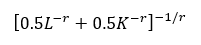
What does that have to do with the fur trade’s dominance and elasticity of substitution? Well, it could be that war affects industry differently. Lets look at isoquants for a second to see how that could be the case. Imagine a constant elasticity of substitution function of the following shape:

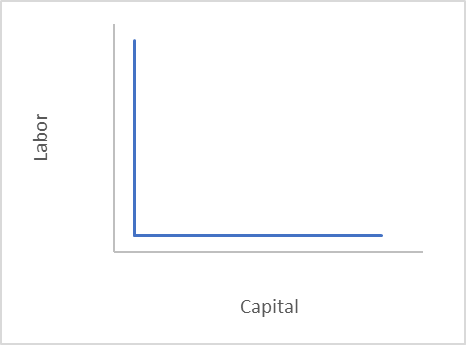
Where L and K are your usual terms for labor and capital and r is the elasticity. Now, for the sake of argument, let us imagine what happens to the isoquant of a production function as r tends to infinity. As it tends to infinity, the marginal rate of technical substitution between L and K approaches zero if L > K. This means that there is a form of pure complementarity between inputs and no substitution is possible to produce the same quantity of output. The isoquant looks like this.

As r tends to infinity

On the other hand, if r tends to -1, there is perfect substitutability between both L and K. The isoquant then looks like this.

As r tends to -1

What if the fur industry’s isoquant looked more like the latter case while other industries looked like the former? More precisely, what if wars affected the supply of one input more than another? With a simple element like our description of the production function above, we see that if wars did not evenly affected the supply of one input, then one industry would be forced to contract output more than another. In our case, this would be the timber, potash, cod and agricultural sectors versus the fur trade.

Does that fit with the historical evidence? We know that the fur industry frequently changed the inputs it used in trading with the First Nations of Canada to buy furs. Whatever was deemed most valued by the natives would be what would be used. It could be alcohol, clothing, firearms, furnishings, silverware, tobacco, spices, salt, etc. This we get clearly from the work of Ann Carlos and Frank Lewis (a book linked to above). There was great ability to substitute. In contrast, other industries could not shift as easily. Take the timber industry which needed to import axes, saws, hoops, iron and nails from France or the United Kingdom for most of the 18th century. If wars disrupted the supply of these capital goods from Europe, there was very little substitution available which meant that the timber industry would have to contract output considerably to reflect the higher cost of these items. The same thing applies to the cod fishing industry whose key input was salt. No salt, no drying of the cod for preservation and export, thus no cod exports. And salt needed to be imported. In wartime, salt prices tended to jump much faster than other goods because its supply was entirely imported. Thus, wartime meant that the cod industry had to contract its output quite importantly.

The cod fishing industry is an amazing example of this if you take the American revolutionary war. During the war, the colony of Quebec (which represented 85% + of Canada’s population at the time) was invaded by the Americans and the French’s alliance with the Americans jeopardized trade between Quebec and Britain (its mother country at that point). The result was that salt prices jumped rapidly compared to all other goods and the output of the cod industry contracted. In contrast, the fur trade sector was barely affected. Look at this graph of the exports of beaver skins and codfish. Codfish output collapses whereas beaver skins barely show any sign of a major military conflagration.

In a longer-run perspective, its easy now to understand why the industry was dominant. It was the only industry that was robust to wartime shocks. All other industries would have had quite large shifts in factor prices causing them to contract and expand output in a very volatile manner. Now you may think this is just a trivial re-arranging of the argument. It is not because it invalidates the idea that the colony was poor or developed slowly because of the dominance of the fur industry. Rather, it shifts the burden on wartime shocks. Wars, not the dominance of the fur trade itself, meant that the economy was heavily mono-industrial.

A simple tool, the elasticity of substitution (which we can derive from the marginal rate of technical substitution), changes the entire interpretation of Canadian economic history. Can you see what I mean by the claim that simple tools combined with simple empirical observations can lead to powerful explanations? I hope you do! 

How Many Semiconductor Chips Are There in a Car?

I recently read a statement that there is something like 1400 individual semiconductor chips in a typical modern car.  I wondered, “Can that be correct?”   1400 is a lot of anything.  I have torn apart whole PCs and found only a few dozen chips.

Chips in cars have big economic significance. As called out on a post back in March, COVID shutdowns of semiconductor plants and other factors meant a shortage of critical chips for cars. This has led to extensive shutdowns of car and truck assembly lines in 2021, affecting employment and auto maker profits.  It is estimated that the world lost 11.3 million units of production in 2021 due to the chip shortage, and may lose another 7 million units in 2022.

But back to 1400  chips…I did not find the One True Pronouncement of chips in cars (a promising N Y Times article lay tantalizingly behind a paywall). But I found a number of statements that corroborated that order of magnitude, and also fleshed out the many uses for such chips.

This picture is worth maybe 1400 words:

Source

Here is an even more detailed diagram (sorry, hard to read):

Source

Cars and trucks have something like 100 distinct electronics modules, and each module has multiple chips. Wiring in cars is expensive and vulnerable, so it is better to distribute the information processing rather than run a bunch of wires back to one central processor.

The chip supply situation should sort itself out by 2024, if all goes well. Meanwhile, electronics has become the tail that wags the automotive dog – – electronics have gone from being just 18% of a car’s cost in 2000, to being 40% of its cost in 2020 , and projected to be 45% by 2030:

When is it rational to give up on Covid?

Omicron is highly contagious, but has far lower rates of associated hospitalization and death. By one estimate it is essentially 3 times deadlier than the standard flu, which is bad, but modest compared to previous variants of Covid-19. The vaccines, especially the mRNA vaccines, appear to help a lot towards further mitigating the cost of infection. That all said, there’s no reason to yet be confident it precludes one from “long Covid” symptoms, many of which are moderately terrifying to a relatively healthy person such as myself.

But, after being vaccinated and begging everyone in your life to get vaccinated, is there anything else we can do at this point? There is a cost-benefit analysis happening in all of our heads now, and many of us who were stridently in the “isolate at home and wait until the vaccine miracle arrives” camp got our miracle, only to find out other people were…less enthusiastic. Then Omicron showed up and it started to feel like the only options are to either return to home isolation (perhaps even more strictly than before) or just accept that you’re going to get it.

I don’t know the answer to this question, but as I sit here, wondering if any body ache or cough is the beginning of “my turn” with Covid, there isn’t the fear or rage I would have previously expected. Just a quiet resignation, a hope that my to-do-list doesn’t grow to unmanageable proportions while I am down, and a gratitude that my entire family (in the broadest possible definition) is vaccinated and boosted.

The road here has been long and dumb, but it also might be near the end. Not because we won, but because we’ve arrived at a point where more people will survive their bad decision-making while imposing a far smaller cost on the rest of us than before. Which is fine, I guess.

But is it? Or have we just let the experience of the last two years beat down our expectations to the point where we’ll willing to accept an endemic version of mild Covid and move on with our lives? You’d think the main take away would be that mankind has arrived at a point where we can make a bespoke vaccine in 18 months (it probably should be), but in all honesty I find our incredible innovation less shocking than how easily grotesque anti-science fictions have become not just limits on public health, but bonafide popular campaign strategies, rigid spines capable of supporting functioning political coalitions. Angry, dangerous people have found each other, found community, and many very ambitious people have figured out how to speak directly to them. I don’t see any way that isn’t a problem going forward.

I remain more optimistic than pessimistic with regards to our global future, but I can’t shake the feeling that this particular denouement to the pandemic should be viewed cautiously in how it portends for the near future.