Ten Years Gone: Temple University’s Economics PhD

Last weekend brought me back to Temple University, ten years after graduating, for a conference of econ PhD alums. I had so many reactions:

  1. Mixing a research conference with what is effectively a reunion or homecoming is a great idea for a PhD program, and more schools should do it. It brought together alumni from all different years, but it especially felt like a reunion to me since it’s been ten years since I graduated (not that I really know about reunions; I’ve never been to a high school or college one).
  2. Philadelphia in general and Temple University in particular have gotten much nicer (though still gritty). Some of this I expected; the country is getting steadily richer, and it seems like every college is always on a building spree. But as with New Orleans, it is a city still well below its peak population that I first got to know in the aftermath of the great recession. Unemployment in Philly is now well under half what it was the whole time I lived there, and it shows.
  3. Life is short. I was saddened, but not shocked, to hear that one of my professors had died. I was saddened and shocked to hear that one of my fellow students had.
  4. As a kid, whenever I went back to one of my old schools, I usually felt nostalgia mixed with the feeling that everything seemed small. Then I thought this smallness was only about me having grown taller, but now I wonder. At Temple the economics department has changed buildings, but when I went back to the old building everything seemed small, despite me being the same size I was in grad school. But at the time the building loomed so large in my mind; I was so focused on the things that happened there, the classes and tests, the study sessions and writing in the computer lab, what the professors thought, and everything that it all represented. All that apparently made the rooms seem physically larger in a way they now don’t once I have graduated and the professors moved.
  5. Temple PhDs are much more successful than I would have guessed at the time. It was hard for students attending what was then a bottom-ranked program during the Great Recession to be optimistic about our job prospects, especially when we worried we might fail out of the program (a valid concern when, afaik, only 4 of the 11 students in my year finished their PhDs). But things turned out great; just in the past 10 years from a small program there are many people who are tenured or tenure track at decent schools, who have research or important supervisory positions at the Fed, or who are making a name for themselves in the private sector (like Adam Ozimek).
  6. Why have we so exceeded our low expectations? The improving economy helped. Economics PhDs from anywhere turned out to be a valuable degree. Perhaps our training was stronger than we gave it credit for at the time. I see two main tracks for success coming out of a lower-ranked program, where the school’s name alone might not open doors:
    • publish a lot (my strategy), or
    • find some way to get your foot in the door of a major institution like the Fed system or a major bank, then work your way up. The initial way in could be something less competitive, like an internship or a job you don’t necessarily need a PhD for. But once you are in you will be judged mostly on your performance within the institution, not your credentials. In a panel on non-academic jobs, several alums emphasized that conditional on having enough technical skills to get hired, at the margin people/communication skills are much more important to advancement than further technical skills.
  7. Temple’s economics PhD program paused admissions back in 2020, but is aiming to restart with a redesigned program in 2025.

Highlights from #EconTwitterIRL

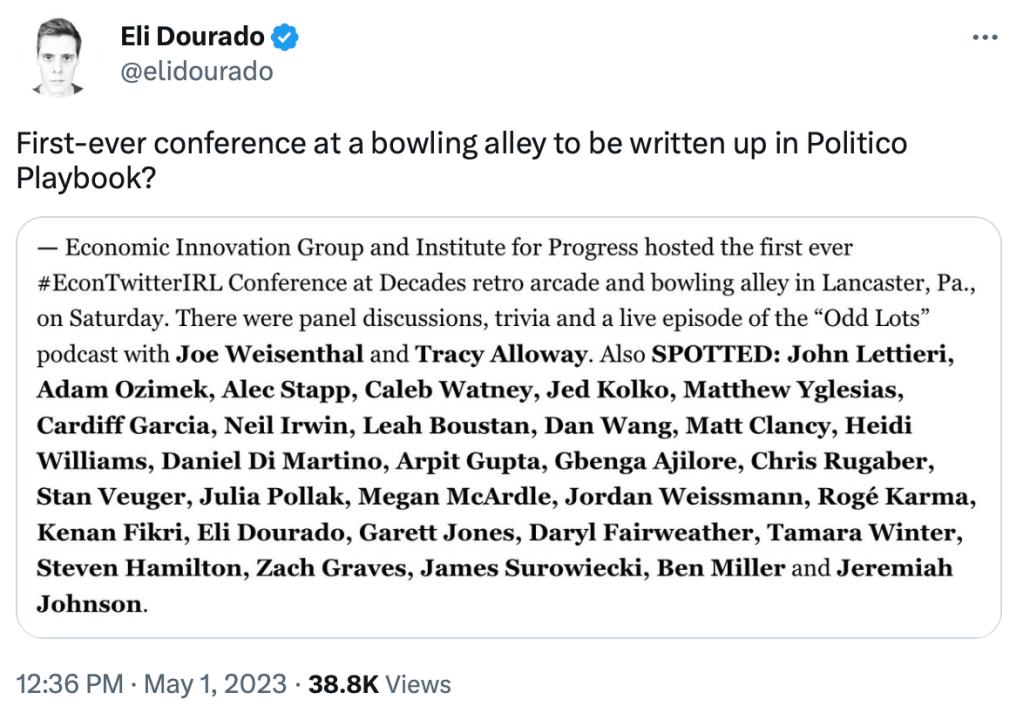
Last weekend fellow Temple University economics PhD Adam Ozimek hosted the inaugural #EconTwitterIRL conference. He managed to get 100+ people, including many big names, to come to his bowling alley / arcade in Lancaster, PA.

The overall demographic of Econ Twitter people appears to be youngish professionals, mostly male, surprisingly social and normal-looking (surprising to me because I retain the ’90s-era stereotype that people who write a lot online are nerds who don’t want to talk to anyone IRL).

Adam opened with a history of EconTwitter, which to him is not just about Twitter, but is anywhere where communities of people write about economics online. This starts with the comment sections of the earliest blogs, like Brad DeLong’s, in the early 2000’s. Then in the late 2000’s many commenters start their own blogs, like Karl Smith at Modeled Behavior. In the 2010’s Econ Twitter comes into its own. It may persist or a new forum might take over, but either way the discussion and community will live on.

While it was cool to see a live recording of Odd Lots, and a panel on innovation with MacArthur Genius Heidi Williams, my favorite panel was the one on immigration, because it saw the most serious disagreement. Garett Jones and Daniel Di Martino argued for reforms to the immigration system that would move it away from a focus on family reunification and toward a focus on skills and other indications (like country of origin) that immigrants would benefit the US economy. In contrast, Leah Boustan argued that the current system has worked well, including for assimilation and economic growth, and we should be wary of making big changes to it. Moderator Cardiff Garcia pointed out the oddity of the economists from George Mason and the Manhattan Institute arguing for a “socialist” system where the government determines what the economy needs when it comes to immigration, while the Princeton economist argues against. Garett Jones noted that the rest of his department at Mason disagree with him, but he’s glad to have the freedom to disagree.

While the panel saw intense disagreement about what the ideal system looks like, all panelists shared a frustration with parts of the current system that seem to pointlessly slow or prevent high-skill immigration. Some of this is bureaucracy slowing the process for immigrants who are legally allowed already. Some is politicians refusing to make the smallest, simplest, most common-sense fixes unless they are part of a comprehensive immigration reform that hits their big priority. The big priorities differ by party, but the commitment to holding simple fixes hostage is bipartisan.

Hopefully discussions like this can start to change things. That might sound naive or idealistic, but on an earlier panel Matt Yglesias noted that we should be both impressed and slightly scared of how aware Capitol Hill staffers are about the opinions of Econ Twitter.

Source. Got 2nd at trivia as part of team Acemoglu et al (actual Acemoglu not included).

The magic of all this is that you never know what can come from a post. You might make a friend, make an enemy, get a job, lose a job, influence public policy, get a job in the White House… even make (or lose) a million dollars. So we keep poasting, and once in a while see the results IRL.

Cars Are Likely to Stay Expensive for Years

Yesterday Jeremy discussed what spiking car prices mean for overall inflation.

Today I’ll discuss the outlook for car prices themselves, based on what I heard at the Philly Fed’s conference on auto lending yesterday. Some (approximate) quotes:

The used market is red hot

Used prices are likely to stay elevated for a few years

Because used prices are so high, “If you can find the car you are looking for new right now, there’s a good chance it makes sense to buy it instead of going used.” But it could be hard to find that new car you want because inventories are so low, and even then you probably won’t be able to bargain the price down like you normally would- “75% of new cars now sell for MSRP or above, vs 36% last year”

The average new car now sells for $40k, partly because SUVs are increasingly popular, and partly to bother those who care about financial responsibility, like fellow Temple Econ PhD Adam Ozimek:

https://platform.twitter.com/widgets.js

Because of manufacturing disruptions from Covid and the chip shortage, “We’re at least a year out before we start to restock to normal dealer inventory levels” in the new market. Supply in the used market could stay low for 4-5 years because of the lower production of new cars and lower turnover of existing ones. Normally cars coming off lease & out of rental car fleets are a big sources of used cars for sale, but fleet purchases & leases are down from 40% of new car purchases to 25%. Reposessions, another source of used cars, actually decreased slightly through Covid despite the huge spike in unemployment.

All in all, its a good time to own a car and a bad time to try to buy one, and this state of affairs could persist for years absent an unexpected drop in demand or spike in supply.

Electric cars, though, seemed poised to take over much more of the market- the forecast was about 1/3 of new sales by 2030, driven by improvements in the technology, continued subsidies to new EV purchases & EV infrastructure, and car companies offering electric models in popular categories like SUVs and trucks where they are currently rare.