Bitcoin’s Dramatic Comeback: Resurrection or Dead Cat Bounce?

In the past year, one cryptocurrency firm after another has gone bust, culminating in the grand implosion of the FTX exchange. The crypto vortex also contributed to some of the recent banking failures.

The prices of cryptocurrencies shot up in 2021, probably fueled by pandemic stimulus money sloshing around in the bank accounts of restless 20- and 30-somethings. All this came crashing back to earth in 2022, giving ample scope for skeptics to say, “I told you this was all foolishness.” Last rites were said, and crypto was left for dead.

But wait… in 2023, when no one was looking, the lid of the crypto coffin started to rattle, a bony hand reached out, and…crypto is back!!

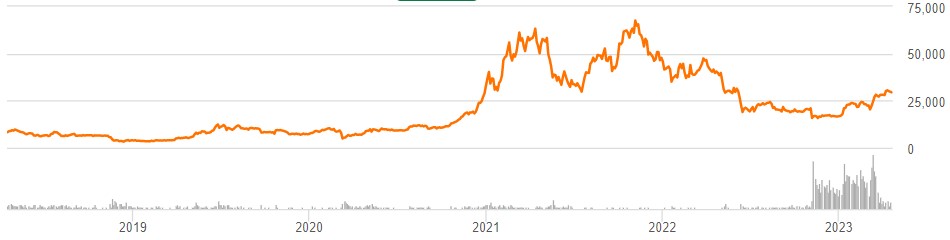
Well, sort of. Here is a five-year chart of Bitcoin from Seeking Alpha, in U.S. dollars:
And here is the past six months:

We can see that Bitcoin took its final big leg down in November, 2022, with the FTX collapse. Its price stayed fairly plateaued down there (with heavy trading volume) until January. Since then, it has nearly doubled.

What has triggered this rise in 2023? Observers such as Michael Grothaus at Fast Company suggests some four factors:

( a ) A shift to “risk-on” with the prospect of the Fed easing off with interest rate hikes this year.

( b ) A flight to alternative assets in the wake of the turbulence in the banking sector. Also, since the total amount of bitcoin is programmed to never increase over a certain number, Bitcoin should be a hedge against inflation. (Many observers believe that the Fed will live with 3-4 % inflation indefinitely, to help inflate away the gigantic debt that the federal government incurred with pandemic relief).

( c ) Buying of Bitcoin by traders who were short, and now need to cover their positions.

( d ) The usual rise in Bitcoin values as a bitcoin “halving” event is on the horizon. (About every four years, with the next time scheduled for May 2024, the rewards for mining new bitcoins drops by 50%).

Will the rise in Bitcoin prices continue? Is this truly a resurrection from the dead, or just a “dead cat bounce”? [1] Nobody knows. But this latest, sustained rally seems to have helped it recover some luster of legitimacy as an asset class. Here is a list of some popular crypto exchanges that are still in operation.

My personal take: I hold a sliver of the Bitcoin fund GBTC, just to have some skin in the game. I have been too lazy to learn about and activate an actual crypto wallet. I think Bitcoin in particular is an intriguing entity. Many other cryptos at some level depend on some centralized administration, but Bitcoin embodies the ideal of a decentralized, power-to-the-people form of something like money.

[1] From Wikipedia: In finance, a dead cat bounce is a small, brief recovery in the price of a declining stock.  Derived from the idea that “even a dead cat will bounce if it falls from a great height”, the phrase is also popularly applied to any case where a subject experiences a brief resurgence during or following a severe decline. This may also be known as a “sucker rally”.

China Cracks Down on Cryptocurrencies

The Chinese Communist Party (CCP) is all about control. In the well-known words of Chairman Mao:

Every Communist must grasp the truth, “Political power grows out of the barrel of a gun.” Our principle is that the Party commands the gun, and the gun must never be allowed to command the Party.

These days political power is linked to economic power and control of information, as well as raw military firepower. Cryptocurrencies have assumed financial importance and they entail information processing and tracking.

On the other hand, a key driver for cryptocurrencies is precisely to escape from the domination of big central authorities, such as the CCP. Proponents of crypto revel in the fact that anyone with a PC can get in on “mining” and that the crypto universe does indeed operate on the web as a largely democratized enterprise. Anybody can transact large sums with anybody, with a moderate degree of anonymity.

These two different visions of life collided on Sept. 28 when the Chinese government banned nearly all crypto-related transactions:

China’s central bank said on Friday that all cryptocurrency-related transactions are illegal in the country and they must be banned, citing concerns around national security and “safety of people’s assets.” The world’s most populated nation also said that foreign exchanges are banned from providing services to users in the country.

In a joint statement, 10 Chinese government agencies vowed to work closely to maintain a “high pressure” crackdown on trading of cryptocurrencies in the nation. The People’s Bank of China separately ordered internet, financial and payment companies from facilitating cryptocurrency trading on their platforms.

The central bank said cryptocurrencies, including Bitcoin and Tether, cannot be circulated in the market as they are not fiat currency. The surge in usage of cryptocurrencies has disrupted “economic and financial order,” and prompted a proliferation of “money laundering, illegal fund-raising, fraud, pyramid schemes and other illegal and criminal activities,” it said.

Offenders, the central bank warned, will be “investigated for criminal liability in accordance with the law.”

The Chinese government will “resolutely clamp down on virtual currency speculation, and related financial activities and misbehaviour in order to safeguard people’s properties and maintain economic, financial and social order,” the People’s Bank of China said in a statement.

Well, those are the bare facts. It’s good to know the CCP is so diligently safeguarding people’s assets and public order. And as noted, Mao’s successors would not naturally favor systems that allow people to just do what they want to do, free from guidance from the Party. But inquiring minds want to know or at least speculate further regarding the reasons for this move and its consequences.

Brian Liu and Raquel Leslie highlighted two other motivations for this crackdown. One motivation  concerns China’s desire to launch its own state-controlled digital currency. This will give the government heightened ability to track every single transaction by every single user. It would also provide China with a new means of exerting influence over other nations and corporations:

The ban comes as the People’s Bank of China (PBOC), China’s central bank, is piloting its own digital currency, the eCNY or “digital yuan.” Unlike private cryptocurrencies, the eCNY is issued directly by the central government and is being designed to provide the PBOC with near-real-time financial data on user transactions. Some observers fear that the eCNY will be used as a tool to strengthen the Chinese Communist Party’s domestic surveillance. Others worry that the eCNY will be used to retaliate against international companies that speak out on human rights issues. Fan Yifei, a deputy governor of the PBOC, announced last week that the eCNY has entered a “sprint stage” ahead of the February 2022 Winter Olympics in Beijing.

Another motivation may be to help prevent wealthy Chinese from taking their money abroad:

The crypto ban may also be intended to deter capital flight. Despite past crypto crackdowns and strict capital controls, wealthy Chinese have used cryptocurrencies to funnel more than $50 billion overseas in 2020. As China is in the middle of an economic slowdown that has been exacerbated by other regulatory crackdowns on the tech and education sectors, China may be redoubling its efforts to ward off skittish entrepreneurs from exporting their money overseas.

Will this crackdown fully succeed? Many observers doubt it. They think that people will find ways to do what they want to do, using platforms that are hosted outside China.

As for the digital yuan, well, it kind of goes against most of the reasons people have gravitated to crypto. It represents a move back to government control and surveillance. It is not really a “crypto” currency at all, but simply another form of regular money.  It could get traction, however, in international trade among countries who have reasons to try to escape from the current U.S. dollar dominance. Also, China could hand out its digital currency like candy to impoverished nations, to get them on board. Millions, maybe billions of people live without regular banking access, and so a medium of exchange and store of value that requires only a cell phone to move funds around town or around the world could be attractive. At any rate, count on China to make the digital yuan a big “thing” for international visitors due at the February 2022 Olympics.

The price of Bitcoin took this news in stride. It continues to bounce around in the same $40,000-$50,000 range that it has been in for the past three months. And being banned by China is not a death-knell for a financial entity.  Indeed, it could be a contrarian indicator. Consider that China has also banned Youtube, Facebook, Google, Instagram, Pinterest, and even (because of his uncanny resemblance to President Xi) Winnie the Pooh.

The Rise and Fall (?) of Bitcoin Price

Well, it has been a fun party. Here is a chart of Bitcoin prices over the last year or so. Folks that bought in before December were up X4 or more by April. Woo-hoo! But prices have dropped by half in the past two months. Many articles were published over the winter justifying ever greater heights for Bitcoin. It was to be the digital equivalent of gold as a store of value. Also, it is touted as being decentralized and free of government manipulation – – a global, privatized people’s currency. What happened?

Source: Seeking Alpha
Continue reading

Cryptocurrencies 3. Blockchain: The Ingenious Basis of Bitcoin

Most of our financial transactions are managed by centralized institutions like banks and credit card companies. We trust that these companies will properly manage transactions, so no one can spend the same dollar twice. In other words, if you have $300 in your checking account, you can’t use your debit card to buy a $300 message chair, and then quickly purchase a $300 patio furniture set before the first purchase clears.

Satoshi Nakamoto, the enigmatic inventor of Bitcoin, wanted to set up a digital currency which would not be controlled by or dependent on any central institution. Rather, there would be a big network of thousands of independent computing nodes, which collectively would record and vet financial transactions. A big problem he faced was how to prevent the sort of double-spending described above. With a decentralized system, it was possible that one node, or a couple of nodes in cahoots, could quickly enter two transactions which would spend the same chunk of digital currency twice, before the rest of the nodes could catch the error. And without a central authority, who would have the authority to correct such errors?  

Nakamoto’s solution was the blockchain. He defined and implemented it specifically for Bitcoin, but the concept is so elegant and powerful that hundreds of other digital coins were quickly set up also using blockchains. This in turn has spawned a whole multi-billion dollar “decentralized finance” industry around these blockchain based currencies.

Continue reading

Cryptocurrencies 2. How Hashing Puts the Crypto in “Cryptocurrency”

There are several conceptual pieces that are put together to make the working Bitcoin digital currency. The data which defines Bitcoin transactions is stored in a data structure called a blockchain.  A key feature of blockchains involves cryptographic “hashing”. That is the focus of today’s post.

A hash function is any function that can be used to map initial data of arbitrary size to fixed-size values. The initial data may be called the key or the message.  The values returned by a hash function are called hash values, hash codes, digests, or simply “hashes”. A common use for hashing in the past has been to do large-scale data storage and retrieval more efficiently, as described in Wikipedia. That link also discusses how some actual hashing calculations are done.

Here we will focus on cryptographic applications of hashing. For this purpose, hash functions are chosen which are for all practical purposes one-way. It is straightforward to start with the “message” and compute the hash. But it is not feasible to start with the hash and back-calculate the initial message, even if you know the algorithm used for the hash function. Typically the only way to find the message is to run a brute-force search of all possible inputs until you find a match to the output hash.

Continue reading

Cryptocurrencies, 1: What Exactly Is Bitcoin?

Everybody knows that Bitcoin is a “digital currency”. But what does that really mean, and what is Bitcoin really good for? Who developed it? Turns out, oddly, that we don’t actually know. Can you buy a pizza with it? Turns out that perhaps the most famous pizza purchase of all time was made with Bitcoin.

Continue reading