In March and April of this year, I moaned and groaned here in blogland, chronicling my attempts to recover my funds from an interest-bearing account at crypto firm BlockFi.
Back in 2021, interest rates had been so low for so long that that seemed to be the new normal. Yields on stable assets like money market funds were around 0.3% (essentially zero, and well below inflation), as I recall. As a yield addict, I scratched around for a way to earn higher interest, while sticking with an asset where (unlike bonds) the dollar value would stay fairly stable.
It was an era of crypto flourishing, and so I latched onto the notion of decentralized finance (DeFi) lending. I found what seemed to be a reputable, honest company called BlockFi, where I could buy stablecoin (constant dollar value) crypto assets which would sit on their platform. They would lend them out into the crypto world, and pay me something like 9 % interest. That was really, really good money back then, compared to 0.3%.
On this blog, I chronicled some of my steps in this journal. First, in signing up for BlockFi, I had to allow the intermediary company Plaid complete access to my bank account. Seriously, I had to give them my username and password, so they could log in as me, and not only be able to withdraw all my funds, but see all my banking transactions and history. That felt really violating, so I ended up setting up a small auxiliary bank account for Plaid to use and snoop to their heart’s content.
BlockFi assured me that they only loaned my assets out to “Trusted institutional counterparties” with a generous margin of collateral. What could possibly go wrong??
What went wrong is that BlockFi as a company got into some close relationship with Sam Bankman-Fried’s company, FTX. Back in 2021-2022, twenty-something billionaire Sam Bankman-Fried (“SBF”) was the whiz kid, the visionary genius, the white knight savior of the crypto universe. In several cases, when some crypto enterprise was tottering, he would step in and invest funds to stabilize things. This reminded some of the role that J. P. Morgan had played in staving off the financial panics of 1893 and 1907. SBF was feted and lauded and quoted endlessly.
For reasons I never understood, BlockFi as a company was having a hard time turning a profit, so I think the plan was for FTX to acquire them. That process was partway along, when the great expose’ of SBF as a self-serving fraudster occurred at the end of 2022. FTX quickly declared bankruptcy, which forced BlockFi to go BK as well. SBF was eventually locked up, but so were the funds I had put into BlockFi. The amount was not enough to threaten my lifestyle, but it was enough to be annoying.
BlockFi Assets Begin to Thaw
I got emails from BlockFi every few months, assuring customers that they would do what they could to return our assets. Their bankruptcy proceedings kept things locked, but eventually they started to return some money.
As I noted in a blog post, in April, 2024, I was able to recover about 27% of my account. At the time, there was no clear prospect of getting the rest. Along the way, I clicked on a well-camouflaged scam email link, which gave me some heartburn but fortunately no harm came of it.
And now, hooray, they have finally returned it all, following their successful claw-back of assets from SBF’s organization(s). This vindicates my sense that the BlockFi management was/is fundamentally honest and good-willed, and was just a victim of SBF’s machinations.
Some personal takeaways from all this:
Keep allocations smallish to outlier investments
Sell out at the first serious signs of trouble
Triple-check before clicking on any link in an email
Having been forced to engage in opening crypto wallets and transferring coins, I have a better feel for the world of crypto which had seemed like a black box. It does not draw me like it does some folks, but if circumstances ever require me to deal in crypto (relocate to Honduras?), I could do it.
Last week I laid out my own expectations for what economic policy would look like in a Trump or Harris presidency. Now after yesterday’s market reaction, we can infer what market participants as a whole expect by roughly doubling the size of yesterday’s market moves. Prediction markets had a 50-60% change of Trump winning as of Tuesday morning’s market close, which moved to a 99+% chance by Wednesday morning. Look at how other markets moved over the same time, multiply it by 2-2.5x, and you get the expected effect of a Trump presidency relative to a Harris presidency. So what do we see?
Stocks Up Overall: S&P 500 up 2%, Dow up 3%, Russell 2000 (small caps) up 6%. My guess this is mostly about avoiding tax increases- the odds that most of the Tax Cuts and Jobs Act gets renewed when it expires in 2025 just went way up. Lower corporate taxes boost corporate earnings directly, while lower taxes on households mean that they have more money to spend on their stocks and their products. Lower regulation and looser antitrust rules are also likely to boost corporate earnings.
Bond Prices Down (Yields Up): 10yr Treasury yields rose from 4.29% to 4.4%. This is the flip side of the tax cuts- they need to be paid for, and markets expect they will be paid for through deficits rather than cutting spending. The government will issue more bonds to borrow the money, lowering the value of existing bonds.
Dollar Up: The US dollar is up 2% against a basket of foreign currencies. I think this is mostly about the expected tariffs. People like the sound of the phrase “strong dollar” but it isn’t necessarily a good thing; it makes it cheaper to vacation abroad, but makes it harder to export, even before we consider potential retaliatory tariffs.
Crypto Way Up: Bitcoin went up 7% overnight, Ethereum is now 15% up since Tuesday. Crypto exchange Coinbase was up 31%. Markets anticipate friendlier regulation of crypto, along with a potential ‘strategic Bitcoin reserve’.
Single Stock Moves: Private prison stocks are up 30%+. Tesla is up 15%, mostly due to Elon Musk’s ties to Trump, but also due to tariffs. Foreign car companies were way down on the expectation of tariffs- Mercedes-Benz down 8%, BMW down 10%, Honda down 8%.
Sector Moves: Steel stocks are up on the expectation of tariffs, while solar stocks (which can’t catch a break, doing poorly under Biden despite big subsidies and big revenue increases) were down 12% in the expectation of falling subsidies. Bank stocks did especially well, with one bank ETF up 12%. This gives us one hint on what to me is now the biggest question about the second Trump administration- who will staff it? I could see Trump appointing free-market types, or wall-streeters in the mold of Steve Mnuchin, or dirigiste nationalist conservatives in the JD Vance / Heritage Foundation mold, or an eclectic mix of political backers like Elon Musk and RFK Jr, or a combination of all of the above. The fact that bank stocks are way up tells me that markets expect the free-marketers and/or the Wall-Street types to mostly win out.
Just Ask Prediction Markets: If you want to know what markets expect from a Presidency, you can do what I just did, look at moves the big traditional markets like stocks and bonds and try to guess what is driving them. But increasingly you can skip this step and just ask prediction markets directly- the same markets that just had a very goodelection night. Kalshi now has markets on both who Trump will nominate to cabinet posts, as well as the fate of specific policies like ‘no tax on tips‘
Well, it’s finally over. As noted in previous blog posts, back when interest rates were essentially zero, I started an account with cryptocurrency investing firm BlockFi. They paid me a hefty 9% per year for lending out my crypto coin to “trusted institutional counterparties”, backed by large collateral. However, when Sam Bankman-Fried’s FTX exchange went belly up, it took BlockFi with it. (Bankman-Fried, the former rock-star white knight of the crypto world, is now in prison for fraud). My funds at BlockFi disappeared into the black hole of bankruptcy proceedings for about a year and a half.
Last month, a judge finally allowed a settlement for clients to withdraw their assets from their interest-bearing accounts. There were two wrinkles. First, you get far less than 100% of your funds. Most of my money got chewed up in the corporate bankruptcy itself, and then was eaten by the law firm (Kroll) processing the bankruptcy and the client reimbursement process. So, I’m only getting about 27% percent of my money back.
As an aside, Kroll got hacked about a year ago, leaking the names and email addresses of us BlockFi clients, and so some scammer sent out a very well-crafted email that a number of people, including me (briefly) were taken in by, as I wrote earlier. if you responded to that scam email, you ended up connecting your wallet to a scam application, which could then suck everything out of your wallet. Fortunately, I had almost nothing in my wallet for the short time I had it connected, but other victims lost considerable sums. I guess the reason why criminals continue to run crypto scams is because they are profitable, like the legendary bank robber Willie Sutton who robbed banks because “that’s where the money is.”
The other wrinkle In the BlockFi reimbursement is that they will only reimburse you with the actual cryptocurrency coin that you held, not with its dollar value. So, I had to set up a cryptocurrency wallet (I used Trust wallet) to receive my crypto, which was all in the form of the stablecoin USDC.
I had to do considerable background work to make this happen. In order to test that that wallet worked to receive USDC, I had to also set up a cryptocurrency exchange account, which I did with Coinbase (which seemed to be the most solid crypto exchange). I had to connect that account with my bank, put some money into the Coinbase exchange, buy some USDC, and send it to my crypto wallet to make sure that it all worked.
As of a week ago, after some fairly intrusive ID verification, the reimbursement machinery did finally deposit the measly remnants of my USDC into my wallet. OK, I thought, I’ll just transfer that to my Coinbase exchange account, turn the USDC into cash and be done with it all.
But not so fast… Because USDC is transferred over the Ethereum network, I had to have enough ETH coin in my Trust wallet to pay for the transfer. The network transfer cost, called the gas fee, was about eight dollars at midday, going down to about three dollars by 10 o’clock at night.
So, I had to go into my Coinbase account, convert some USDC there into ETH (incurring a $1.49 fee for that), and then send some ETH to my Wallet, incurring yet another a transfer fee there. Then I could use that ETH in my wallet to pay for the transfer of the USDC to my Coinbase exchange. Then at long last I was able to convert my USDC to cash and transfer it to my bank account, to finally put this whole BlockFi drama to rest.
Looking on the bright side of all this uproar, I now have a functioning cryptocurrency exchange account and wallet, and am familiar with elementary crypto operations. This might prove handy if I ever want to dabble more in this area or if some other need arises. For now, however, I have had enough of crypto.
ADDENDUM: Finally got all my BlockFi funds back as of November, 2024. BlockFi was able to claw back its assets from FTX, and fully reimburse its customers. Yay! This post describes the process:
In the past year, one cryptocurrency firm after another has gone bust, culminating in the grand implosion of the FTX exchange. The crypto vortex also contributed to some of the recent banking failures.
The prices of cryptocurrencies shot up in 2021, probably fueled by pandemic stimulus money sloshing around in the bank accounts of restless 20- and 30-somethings. All this came crashing back to earth in 2022, giving ample scope for skeptics to say, “I told you this was all foolishness.” Last rites were said, and crypto was left for dead.
But wait… in 2023, when no one was looking, the lid of the crypto coffin started to rattle, a bony hand reached out, and…crypto is back!!
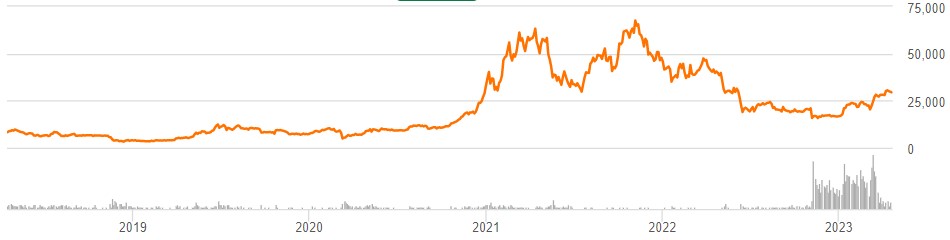
Well, sort of. Here is a five-year chart of Bitcoin from Seeking Alpha, in U.S. dollars:
And here is the past six months:
We can see that Bitcoin took its final big leg down in November, 2022, with the FTX collapse. Its price stayed fairly plateaued down there (with heavy trading volume) until January. Since then, it has nearly doubled.
What has triggered this rise in 2023? Observers such as Michael Grothaus at Fast Company suggests some four factors:
( a ) A shift to “risk-on” with the prospect of the Fed easing off with interest rate hikes this year.
( b ) A flight to alternative assets in the wake of the turbulence in the banking sector. Also, since the total amount of bitcoin is programmed to never increase over a certain number, Bitcoin should be a hedge against inflation. (Many observers believe that the Fed will live with 3-4 % inflation indefinitely, to help inflate away the gigantic debt that the federal government incurred with pandemic relief).
( c ) Buying of Bitcoin by traders who were short, and now need to cover their positions.
( d ) The usual rise in Bitcoin values as a bitcoin “halving” event is on the horizon. (About every four years, with the next time scheduled for May 2024, the rewards for mining new bitcoins drops by 50%).
Will the rise in Bitcoin prices continue? Is this truly a resurrection from the dead, or just a “dead cat bounce”? [1] Nobody knows. But this latest, sustained rally seems to have helped it recover some luster of legitimacy as an asset class. Here is a list of some popular crypto exchanges that are still in operation.
My personal take: I hold a sliver of the Bitcoin fund GBTC, just to have some skin in the game. I have been too lazy to learn about and activate an actual crypto wallet. I think Bitcoin in particular is an intriguing entity. Many other cryptos at some level depend on some centralized administration, but Bitcoin embodies the ideal of a decentralized, power-to-the-people form of something like money.
[1] From Wikipedia: In finance, a dead cat bounce is a small, brief recovery in the price of a declining stock. Derived from the idea that “even a dead cat will bounce if it falls from a great height”, the phrase is also popularly applied to any case where a subject experiences a brief resurgence during or following a severe decline. This may also be known as a “sucker rally”.
About a year ago, I posted some articles touting the use of BlockFi as an alternative checking account. It paid around 9% interest (this was back when interest rates were essentially zero on regular savings accounts), and allowed withdrawal or deposit of funds at any time. Nice. BlockFi is associated with respected firm Gemini, and (unlike many crypto operations) is U.S. based, with consistent formal auditing. They earned interest on my crypto by lending it out to “trusted counter-parties”, always backed by extra collateral. What could possibly go wrong?
In July I wrote about a big cryptocurrency meltdown, in which a number of medium-sized players went bust. At that time, BlockFi assured its customers that its sound business practices put it above the fray, no problemo. They did make it through that juncture OK. But I withdrew a third of my funds, just to be on the safe side.
The huge news in crypto this past week has been the sudden, total implosion of major exchange FTX (more on that below). FTX is a major business partner with BlockFi. No worries, though, as of Tuesday of last week, BlockFi COO Flori Marquez tweeted that “All BlockFi products are fully operational”. Then the hammer dropped: On Thursday (11/10), BlockFi froze withdrawals, due to complications with FTX. My remaining crypto is stranded, most likely for years of legal proceedings, and I may never get it all back. I’m not going to starve, but the amount is enough to hurt.
In this case, I don’t really blame BlockFi – by all accounts, they have been trying to run an honest, responsible business. Before last week, nobody had much reason to think that FTX was totally rotten. My bad for not connecting the FTX-BlockFi dots earlier, and pulling out more funds when I had the chance.
The Great FTX Debacle
The star of this show is Sam Bankman-Fried, the (former) head of FTX:
James Bailey posted here on EWED on the FTX crash last week. CoinDesk author David Morris summarized the downfall of Bankman-Fried’s crypto empire:
FTX and Bankman-Fried are unique in the stature they achieved before self-immolating. Over the past three years, FTX has come to be widely regarded as a reputable exchange, despite not submitting to U.S. regulation. Bankman-Fried has himself become globally influential, thanks to his thoughts on cryptocurrency regulation and his financial support for U.S. electoral candidates – not necessarily in that order.
… Facts first uncovered by CoinDesk played a major role in the events of the past week. On Nov. 2, reporter Ian Allison published findings that roughly $5.8 billion out of $14.6 billion of assets on the balance sheet at Alameda Research, based on then-current valuations, were linked to FTX’s exchange token, FTT.
This finding, based on leaked internal documents, was explosive because of the very close relationship between Alameda and FTX. Both were founded by Bankman-Fried, and there has been significant anxiety about the extent and nature of their fraternal dealings. The FTT token was essentially created from thin air by FTX, inviting questions about the real-world, open-market value of FTT tokens held in reserve by affiliated entities.
Negative speculation about a financial institution can be a self-fulfilling prophecy, triggering withdrawals out of a sense of uncertainty and leading to the very liquidity problems that were feared.
Customers started a “run on the bank”, withdrawing billions of dollars of assets, leading to total insolvency of FTX:
The Financial Times reported that FTX held approximately $900 million in liquid crypto and $5.4 in illiquid venture capital investments against $9 billion in liabilities the day before it filed for bankruptcy.
If FTX had been run as an honest exchange, this withdrawal should not have been too much of a problem – – just give customers back the coins they had deposited with FTX. Apparently, though, FTX had taken customer assets and transferred them over to a sister company, Alameda, to trade with. The valuable customer crypto assets left the FTX balance sheet, and were largely replaced by the self-generated (and now nearly worthless) FTT token:
It remains worryingly unclear, though, exactly why even such a dramatic rush for the exits would have led FTX to seek its own bailout. The exchange promised users that it would not speculate with cryptocurrencies held in their accounts. But if that policy was followed, there should have been no pause to withdrawals, nor any balance sheet gap to fill. One possible explanation comes from Coinmetrics analyst Lucas Nuzzi, who has presented what he says is evidence that FTX transferred funds to Alameda in September, perhaps as a loan to backstop Alameda’s losses.
It doesn’t help that on Friday (11/11) some $477 million was outright stolen from FTX wallets. (The Kraken exchange said it has identified the thief and are working with law enforcement).
Where does the FTX saga go from here? There seems little in the way of assets left for the bankruptcy judge to distribute to former customers and creditors. In the case of BlockFi, they are dependent on a $400 million line of credit extended to them by FTX back in June, to keep operating. And who knows how much of BlockFi assets were stored with FTX – – since FTX was to be their white knight, BlockFi would not be in a position to withdraw deposits from FTX like other customers did.
I predict that nothing really bad will happen to Bankman-Fried and his buddies who ran this thing. Although its operation was apparently dishonest, it is not clear how much is subject to U.S. federal or state legal jurisdiction. Bankman-Fried and friends ran their empire from a big apartment suite in the Bahamas. Plus, he is pretty well-connected. Beside his massive campaign contributions, his business and sometimes romantic partner Caroline Ellison (she is CEO of Alameda) is the daughter of MIT professor Glenn Ellison, the former boss (as colleagues at MIT) of the U.S. Securities and Exchange Commission chair Gary Gensler. These relations were captured in an impish tweet by Elon Musk:
Ah, the delicious crypto bubble of 2021. Major cryptocurrencies like Bitcoin and Ethereum more than tripled in value. Every week, some new coin would get minted, letting early adopters 10X their money in a month. Decentralized finance (DeFi) based on blockchain technology was The Next Big Thing. Move over, stodgy old Bank of America.
That was then, this is now. The chart below of Bitcoin price serves as a proxy for the fortunes of the whole sector:
This has the smell of a bubble bursting. First, why did crypto soar in 2021? I think COVID gets some credit for that. Most adults in the developed world sat home for many months in 2020-2021, and in countries like the U.S. were handed thousands of dollars of stimulus money, in addition to giant unemployment checks. Much of that money went to buying “stuff” on Amazon, but much of it went into financial assets like stocks and crypto. Something like half of men in the United States between the ages of 18 and 49 dabbled in crypto. As you saw your friends making money effortlessly, classic tulip bulb FOMO set it.
All bubbles end eventually. Crypto has imploded from a $ 3 trillion market to a $ 1 trillion dollar market in just a few months. That is two trillion (with a “t”) gone. If Bitcoin were the only significant factor in the crypto universe, the latest bust would be a fairly trivial matter. Since Bitcoin goes up and Bitcoin goes down, that is nothing new. But part of the hype of 2021 was all the breathless commentary on how DeFi would sweep the world and Change Everything. No more centralized banking controlled by old men in suits – – power to the people! And in fact, a whole industry of lending and borrowing in the crypto world has sprung up. That is where some more consequential problems have shown up.
Warren Buffet is known for the saying, “When the tide goes out, you find out who is swimming naked.” The rapid fall in crypto valuations has set off a cascade of failures in DeFi. A key event was the implosion of the Luna/Terra (un!)stablecoin, in April-May 2022, which we wrote about here. A more widespread problem has been the unwinding of the crypto lending/borrowing system. Various firms loaned out the coin holdings of their customers to parties that wanted to trade (speculate) with them, and who were willing to pay something like 4-9% interest for get ahold of these coins. The parties doing the lending thought they were keeping themselves safe by requiring excess collateral for these loans.
Oversimplified example: I will lend you $100 (real dollars) if you deposit $140 of Dogecoin with me. If Dogecoin falls in value to close to $100, I would require more collateral from you within say ten days, or else I would sell your Dogecoin into the market and get my $100 back (and you eat the $40 loss). The big problem comes if Dogecoin falls so fast that by the contracted grace period ends, its value is down to $80. Now I as well as you realize losses, and widespread panic ensues. Now, if I have been lending out your Dogecoin to yet more parties who (it turns out) can’t pay me back in full, I am doubly hosed. And now the solid customers start withdrawing their funds/coins from these firms, and we have an old-fashioned bank run. It doesn’t help that Celsius Network froze customers’ accounts last month, so they could not withdraw the coins they had deposited. That sort of thing really gets clients nervous.
And so a number of significant DeFi firms are going bust, and calls get louder for more government regulation, which is largely antithetical to the whole DeFi enterprise. I will paste below a summary of this carnage, and then in the interests of full disclosure, tell how it has affected me personally:
The crypto and the DeFi industry boomed over the past few years but the recent crypto crash has plundered the fortunes of several crypto companies. The following crypto companies have recently encountered financial difficulties:
Vauld
Business Today broke the news on Monday that Vauld, the Singapore-based crypto lending and investment firm operating in India announced that it has halted withdrawals and deposits for its more than 8,00,000 clients. Vauld’s CEO Darshan Bathija said in a blog post that unstable market circumstances had created “financial challenges” for the company. The CEO also announced that investors had withdrawn over $197 million in the past few months.
Terraform Labs
Terraform Labs was the company that had triggered the recent crypto crash. They created the algorithmic stablecoin TerraUSD which de-pegged from the US Dollar and led to the crash of Terra Luna another token of the ecosystem causing massive panic and sell off in the crypto markets.
Terra co-founder Do Kwon announced a “recovery plan” in May that included infusion of additional funding and the rebuilding of TerraUSD so that it is backed by reserves rather than depending on an algorithm to maintain its 1:1 dollar peg.
Voyager Digital
On July 6, the American crypto lender disclosed that it had filed for bankruptcy. In its Chapter 11 bankruptcy petition, Voyager stated that it had over 1,00,000 creditors, assets between $1 billion and $10 billion in value, and liabilities in the same range.
Three Arrows Capital (3AC)
The Singapore-based cryptocurrency hedge firm went bankrupt on June 29, just two days after receiving a notice of default on a crypto loan from lender Voyager Digital for failing to make payments on an approximately $650 million crypto loan. The company filed a petition for protection from its creditors under Chapter 15 of the United States’ bankruptcy code on July 1. This section of the code permits overseas debtors to safeguard their U.S.-based assets.
Celsius Network
Celsius Network also suspended withdrawals and transfers last month due to “extreme” market conditions. They also hired consultants in preparation for a future bankruptcy filing. The American-Israeli business reportedly disclosed on July 4 that a quarter of its workers had been let go.
Babel Finance
The Hong Kong-based cryptocurrency lender stated on June 17 that it had temporarily halted crypto-asset withdrawals as it scrambled to reimburse consumers. According to the company, “Babel Finance is suffering unprecedented liquidity issues due to the current market situation,” emphasising the severe volatility of the market for cryptocurrencies.
CoinFLEX
In a blog post published on Thursday, CoinFLEX’s CEO Mark Lamb announced that the company would temporarily halt withdrawals due to “extreme market conditions” and uncertainty about a certain counterparty. The company is facing serious financial troubles and there seems to be no way out.
My Confessions
Briefly — I bought into Bitcoin and Ethereum in the form of the funds GBTC and ETHE towards the end of 2020. As crypto started to unwind this year, I sold out of ETHE to de-risk, coming out a little ahead there. I decided to hang in with the Bitcoin fund, riding it up, and now down, down, down. I am so far in the red on this one that I am just going to hold it indefinitely, hoping for some recovery someday.
I bought into Voyager (see above, it has recently crashed and burned) and sold half after it doubled, and the rest at about breakeven price, so came out ahead there. Another, similar firm, Galaxy Digital, I bought has also plummeted to near zero. I got out of that, but waited too long and lost about 30% there.
Readers with exquisite memories might recall that I wrote an article some months back here on EWED touting the DeFi model as a great way to earn interest to keep up with inflation: “Earning Steady 9% Interest in My New Crypto Account.” I chose BlockFi rather than Celsius Network to put my funds in for this, since Celsius (an offshore enterprise) seemed a little shady, whereas BlockFi made a point of being audited and compliant with U.S. regulations. Good choice, in light of Celsius’ recent freeze on customer withdrawals.
Now, even solid firms like BlockFi are hurting. Customers spooked by all the other crypto drama are withdrawing assets “just to be on the safe side.” BlockFi is seeking cash infusions from white knight Sam Bankman-Fried to stay afloat. The 30-year old crypto billionaire looks to be able to acquire the firm for pennies on the dollar, wiping out the initial (private) investors in BlockFi. I am one of these BlockFi customers withdrawing funds (half of my deposit there) – – just to be on the safe side.
Crypto is a lot of things- a store of value, a means of payment, a building block for other tools on the web. But while much of its value as a tool is yet to be realized, one big effect we see already is that it has made a lot of nerds very rich very young, even by the standards of tech and finance generally. These newly minted millionaires and billionaires have started giving their money away in very different ways than the traditional older philanthropists.
The latest, and I believe biggest example is the FTX Future Fund. It plans to give away at least $100 million this year, funded primarily by 30-year-old Sam Bankman-Fried, the CEO of crypto exchange FTX. I recommend that everyone read their full list of the 35 types of projects that they’d like to fund, but I’ll highlight a few you wouldn’t see from older foundations:
Demonstrate the ability to rapidly scale food production in the case of nuclear winter
Biorisk and Recovery from Catastrophe
In addition to quickly killing hundreds of millions of people, a nuclear war could cause nuclear winter and stunt agricultural production due to blocking sunlight for years. We’re interested in funding demonstration projects that are part of an end-to-end operational plan for scaling backup food production and feed the world in the event of such a catastrophe. Thanks to Dave Denkenberger and ALLFED for inspiring this idea
Prediction markets
Epistemic Institutions
We’re excited about new prediction market platforms that can acquire regulatory approval and widespread usage. We’re especially keen if these platforms include key questions relevant to our priority areas, such as questions about the future trajectory of AI development.
Critiquing our approach
Research That Can Help Us Improve
We’d love to fund research that changes our worldview—for example, by highlighting a billion-dollar cause area we are missing—or significantly narrows down our range of uncertainty. We’d also be excited to fund research that tries to identify mistakes in our reasoning or approach, or in the reasoning or approach of effective altruism or longtermism more generally.
They also seem to be borrowing some of Tyler Cowen’s approach to Fast Grants and Emergent Ventures- the application is relatively short and simple, and they promise response times that will be measured in weeks, rather than the months or years typical of large funders.
But they expect applicants to be fast too- this fund was just announced a few days ago, and applications are due March 21st. Economists will be natural fits for some of their project ideas, since their areas of interest include “economic growth” and “epistemic institutions”. I’ll be applying with my book project on why US health care spending is so high. But they are clearly casting a wide net to find the best ideas, so I encourage everyone to check it out and consider applying.




 Economist Writing Every Day