Liberal Democratic Institutions Generally Improve After US Military Intervention (Post-Cold War)

With the arrest of Venezuelan President Maduro, the US is potentially attempting to remake the institutions of yet another country. I say potentially because, as of now, all that has happened is that Maduro was removed. His VP stepped in to replace him, and it appears that, for now, the rest of the structure of government is in place.

Nonetheless, any time the US intervenes in the affairs of another country, it brings back the old debates about regime change, nation building, exporting democracy, etc. Many want to discuss the legal and moral implications of these actions — and these are certainly worth discussing! — but as social scientists we should also ask “does it work?”

For example, one excellent paper on regime change via CIA covert intervention is from Absher, Grier, and Grier. They look at five cases during the Cold War in Latin America of CIA-sponsored regime change, and find moderate declines in income and large declines in democratic institutions. Not a good case for regime change and exporting democracy!

But what if we look at more recent interventions — post-Cold War — and look at direct military interventions by the US, rather than covert CIA operations or indirect funding of factions within a country. This is more in line with what might be happening in Venezuela right now (if regime change is ultimately what the US military pushes for). Using a list from Chris Coyne’s book After War (table 1.1) as a starting point for the relevant cases, and then using data from the V-Dem Liberal Democracy Index, we have seven cases since 1990 to examine (note: I have added Libya to Coyne’s list, which I believe is the only new addition of explicit military intervention since he created the list):
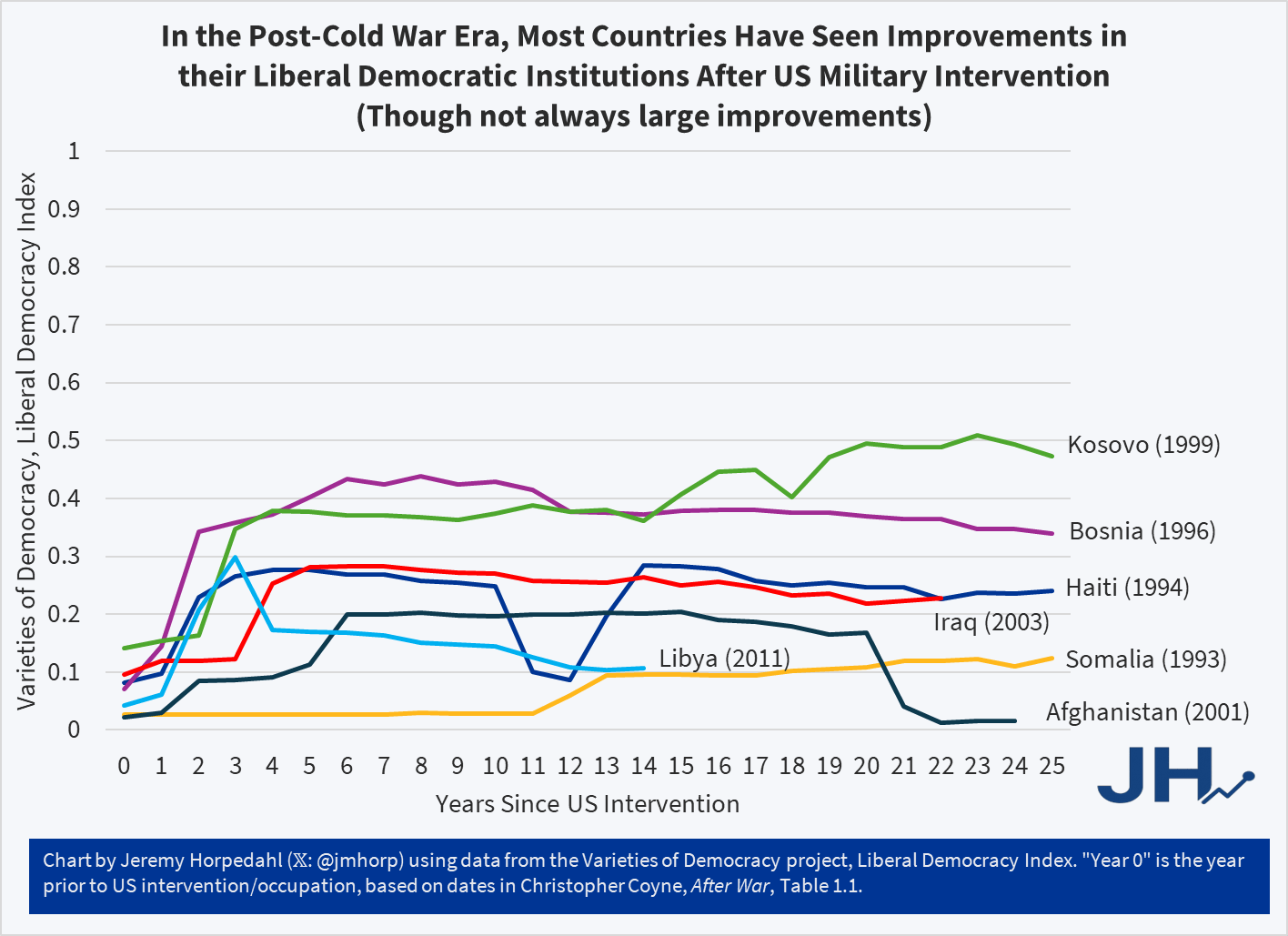
The first thing you might notice is that relevant to their starting position (pre-US military intervention), all except one of these countries saw improvements in their V-Dem Liberal Democracy Score after 25 years (or whatever the end point is for those more recent than 25 years). Some of the improvements — such as Libya, Somalia, and Iraq — are quite small, around 0.1 points on the 1-point scale. But other improvements — especially Kosovo and Bosnia — are quite large, around 0.3 points on the 1-point scale.

The one decline is Afghanistan, though you will note that during the occupation (which lasted a very, very long time, until 2021) their liberal democracy score did improve slightly, about as much as Iraq. I should also note that if we didn’t use my 25-year cut-off, Haiti would also have slipped back to roughly where they were in 1993, with a large decline happening since 2020.

For reference on this scale: the US scores 0.75 in 2024, the best scoring country is Denmark with 0.88, the World average is 0.37 (or 0.29 weighted by population), and the European average is 0.62 (or 0.56 weighted by population).

So while the improvements in Kosovo and Bosnia are impressive, they still fall below the average score in Europe. And those examples point to another problem with my simple analysis: we don’t have the counterfactual of what their score would be without US intervention. That kind of sophisticated analysis is what the above-mentioned Absher paper does (using synthetic control), but it’s more than I can do in a short blog post. Nonetheless, we should note that while we can’t say that US intervention caused these improvements, things didn’t get worse in most countries (as many critics of intervention assume always happens) — Afghanistan being the notable exception after the US ended the occupation.

Now that I’ve got the causation caveat out of the way, we should note a few more limitations of my analysis. First, perhaps the V-Dem Liberal Democracy Index isn’t the best one to use. Our World in Data has seven democratic measurement sets to choose from, and even from V-Dem there are others we could have used. I think Liberal Democracy best captures what we are usually talking about in terms of “does it work?” but you could use another measure. However, glancing through the other available measures, such as Polity, I don’t think the picture would be radically different with another measure of liberal democracy. 25 years is also somewhat arbitrary of a cut-off, though in Coyne’s book he uses 20 years, so I’m going beyond that.

Finally, I want to stress even more than on the causation point: none of these improvements mean the intervention passes a cost-benefit test. There was much destruction of lives and property in all of these cases, the use of US tax dollars, and some other harms to the US and international law (e.g., restrictions of civil liberties in the US from the War on Terror). I do not want to suggest that this means the interventions were worth the cost, merely that they did not fail on this one measure of improving democracy. It is also not a prediction that future interventions, such as in Venezuela, will succeed. Instead, I wrote this post because it goes against my priors (I would not have guessed improvements in 6/7 cases).

Apropos of everything

Robert Nozick and John Rawls were intellectual rivals, friendly colleagues, and even members of the same reading group. Their conversations, at least the ones we were privy to through their iterations of published work, were dedicated to reconciling the role of the state in manifesting the best possible world. Nozick, it can be said in a gratuituous oversimplification, favored a minimal government while Rawls, similarly oversimplified, favored a larger, wider reaching set of government institutions. Both were well aware of the risks and rewards of concentrating power within government institutions, they simply arrived at different conclusions based on risks each wanted to minimize versus those they were willing to incur.

My mental model of the evolution of government (influenced heavily by Nozick and refined towards the end by Rawls) goes something like this:

  1. 100,000 years ago roving bands of humans grow to thrive in their environment by solving collective action problems, largely through familial relations. Larger groups have more success hunting, foraging, and protecting themselves from predators.
  2. Eventually some groups get so good at collective action that they begin to prey on other smaller groups. These “bandits” gain more through resources taken by force than they would strictly producing resources through hunting and foraging.
  3. This creates an arms race in group size, with bigger groups having the advantage while facing the diminishing marginal returns imposed by difficultings in maintaining the integrity of collective action in the face of individual incentives to free ride i.e. its hard to get people to pull their weight when their parents aren’t watching.
  4. Some groups mitigate these difficulties, growing larger still. At some threshold of group size, the rewards to mobilitity are overtaken by the rewards to maintaining institutions and resources (freshwater, shelter, opportunities for agriculture), leading to stationary groups.
  5. These stationary groups begin to act as “stationary bandits”, extracting resources from both outsiders for the benefit of their group and from their members for the benefit of their highest status members.
  6. Differing institutions evolve across groups, varying the actions prescribed and proscribed for leaders, members (citizens), and non-members. Some groups are highly restrictive, others less so. Some groups are more extractive, funneling resources to a select minority. Some groups redistribute more , others less.
  7. Democracy evolves specifically as an institution to replace hereditary lines, a deviation from the familial lines that sat the origin of the state all the way back at step 1. Its correlation with other institutions is less certain, though it does seem to move hand-in-hand with personal property rights and market-based economies. Democracies begin to differentiate themselves based on the internal, subsidiary institutions they favor and instantiate.

A lot of my political leanings can be found not in favoring Nozick or Rawls, but in the risk immediately preceding their point of divergence. When I look at well-functioning modern democracies, I see an exception to the historical rule. I see thousands of years of stationary bandits voraciously extracting resources while high status members taking desperate action to maintain power in a world where property rights are weak and collective action is tenuous. Rawls saw a growing state as a opportunity to create justice through fairer, more equitable outcomes. Nozick saw a growing state as a further concentration of power that, no matter how potentially benevolent today, would eventually attract the most selfish and venial, leading to corruption and return to the purest stationary bandit, only now with the newfound scale.

Both strike as me as perfectly reasonable concerns about very real risks. Which do I believe the greater risk? Depends on the news and what I had for breakfast that day. In the current political context, both in the US and several other democracies, I am of the growing opinion they would be in broad agreement that the biggest risk is not the perversion of democracy from suboptimal policies and subsidiary institutions (step 7), but rather a disastrous reversion to the pre-democratic institutions (step 6).

The most underrated aspect of democracy may very well be its fragility. While historical rarity may not be undeniable evidence of inherent fragility, but it would certainly suggest that once achieved it is worth the overwhelming dedication of resources, including the sacrifice of welfare optimality, to ensure its perserverance.

It cost a lot to get here. A lot. Sacrifices that are hard to even conceive of, let alone empathize with, while living within the profound luxury of modern life. I have no doubt that many of us will find ourselves underwhelmed with the policy platforms of the full menu of viable candidates made available to voters at every level of national and local office in a few weeks. So take this little scribbling for exactly what it is: an argument to vote against candidates that reduce the probability of our constitutional republic remaining intact. By comparison, all the other differences add up to a historical rounding error.

Historians Admit To Inventing Ancient Greeks

This just in:

Scholars apologize for attributing Western democracy to a make-believe civilization.

WASHINGTON—A group of leading historians held a press conference Monday at the National Geographic Society to announce they had “entirely fabricated” ancient Greece, a culture long thought to be the intellectual basis of Western civilization.

The group acknowledged that the idea of a sophisticated, flourishing society existing in Greece more than two millennia ago was a complete fiction created by a team of some two dozen historians, anthropologists, and classicists who worked nonstop between 1971 and 1974 to forge “Greek” documents and artifacts.

“Honestly, we never meant for things to go this far,” said Professor Gene Haddlebury, who has offered to resign his position as chair of Hellenic Studies at Georgetown University. “We were young and trying to advance our careers, so we just started making things up: Homer, Aristotle, Socrates, Hippocrates, the lever and fulcrum, rhetoric, ethics, all the different kinds of columns—everything.”

“Way more stuff than any one civilization could have come up with, obviously,” he added.

According to Haddlebury, the idea of inventing a wholly fraudulent ancient culture came about when he and other scholars realized they had no idea what had actually happened in Europe during the 800-year period before the Christian era.

Frustrated by the gap in the record, and finding archaeologists to be “not much help at all,” they took the problem to colleagues who were then scrambling to find a way to explain where things such as astronomy, cartography, and democracy had come from.

Within hours the greatest and most influential civilization of all time was born.

“One night someone made a joke about just taking all these ideas, lumping them together, and saying the Greeks had done it all 2,000 years ago,” Haddlebury said. “One thing led to another, and before you know it, we’re coming up with everything from the golden ratio to the Iliad.”…

Around the same time, a curator at the Smithsonian reportedly asked for Haddlebury’s help: The museum had received a sizeable donation to create an exhibit on the ancient world but “really didn’t have a whole lot to put in there.” The historians immediately set to work, hastily falsifying evidence of a civilization that— complete with its own poets and philosophers, gods and heroes—would eventually become the centerpiece of schoolbooks, college educations, and the entire field of the humanities.

Emily Nguyen-Whiteman, one of the young academics who “pulled a month’s worth of all-nighters” working on the project, explained that the whole of ancient Greek architecture was based on buildings in Washington, D.C., including a bank across the street from the coffee shop where they met to “bat around ideas about mythology or whatever.”

“We picked Greece because we figured nobody would ever go there to check it out,” Nguyen-Whiteman said. “Have you ever seen the place? It’s a dump. It’s like an abandoned gravel pit infested with cats.”

She added, “Inevitably, though, people started looking around for some of this ‘ancient’ stuff, and next thing I know I’m stuck in Athens all summer building a…Parthenon just to cover our tracks.”

Nguyen-Whiteman acknowledged she was also tasked with altering documents ranging from early Bibles to the writings of Thomas Jefferson to reflect a “Classical Greek” influence—a task that also included the creation, from scratch, of a language based on modern Greek that could pass as its ancient precursor.

Historians told reporters that some of the so-called Greek ideas were in fact borrowed from the Romans, stripped to their fundamentals, and then attributed to fictional Greek predecessors. But others they claimed as their own.

“Geometry? That was all Kevin,” said Haddlebury, referring to former graduate student Kevin Davenport. “Man, that kid was on fire in those days. They teach Davenportian geometry in high schools now, though of course they call it Euclidean.”

~ ~ ~ ~ ~ ~ ~ ~ ~ ~ ~ ~ ~ ~ ~ ~ ~ ~ ~ ~ ~ ~ ~ ~ ~

Happy April Fools…the above excerpt was pasted verbatim from a classic article published in the news-satire site The Onion. I thought it was a clever piece, which did a worthy service highlighting the wide-ranging achievements of a relatively small people group (compared to the teeming masses of ancient Mesopotamia and Egypt) in a relatively short period of time.

Apologies to any Greeks reading this post – -my wife has been to Greece and tells me it is in fact a very beautiful country.

“The central values of civilization are in danger”

The Mont Pelerin Society was founded 75 years ago. The title of this post was the opening sentence of the Statement of Aims the new Society agreed upon. They had many concerns about what they considered “central values,” but primary among those concerns were the dangers related to market economies: “a decline of belief in private property and the competitive market” and “the growth of theories which question the desirability of the rule of law.”

How has the world done since 1947? It’s easy to point to the decline of communism and socialism, both in practice and as a dominant theory, as a victory for the goals of the Mont Pelerin Society. However, we might be concerned that in the non-communist world, economic freedom has declined even as communism has failed. Let’s dig a little deeper.

One source we can use is an extension of the Fraser Institute’s Economic Freedom of the World index. The primary index only extends back to 1970, but recently Lawson and Murphy have constructed a version of the index which goes all the way back to 1950 for some countries. As far as I’m aware, they haven’t yet perfectly mapped the pre-1970 index with the primary index that extends to the present, but I’ll make a quick comparison using the available data. The 1950 data brings us very close to the date of the first MPS meeting.

Here’s a list of countries relevant to the discussion at MPS in 1947. The list includes countries where attendees came from, as well as other countries of interest to the discussion, such as China and Russia (I’m using the list from Caldwell’s recent edited transcripts of the 1947 meeting). Caveat: this isn’t a chain-linked index, so the 1950 and 2020 numbers are perfectly comparable. Also, the 2020 number only includes Areas 1-4 of the index, since that’s what the pre-1970 data contains.

The table above should give us some optimism about the state of market economies in the world from the perspective of 1947. Not only have China and Russia, clearly improved their economic freedom scores, but all of the Western market economies have as well. Again, exercise caution in interpreting these, since it’s not a chain-linked index, and it excludes one area of economic freedom (regulation, which surely has grown substantially since 1947). Despite those cautions, the picture in 2020 looks pretty good compared with 1950.

But what of other liberal institutions? While the MPS statement of aims doesn’t specifically mention democratic institutions, the threat to democracy seems to clearly be a concern in 1947 (“extensions of arbitrary power” and “freedom of thought and expression”).

Continue reading