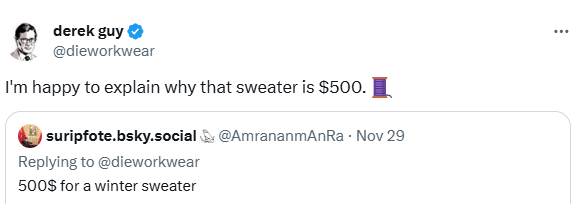
If you spend any time on Twitter/X, you must know the suit guy, Derek. Given my interest in the economics of fast fashion, I read his new thread about expensive craft sweaters.
He explains that some clothes on this earth are still made by hand. Artisan sweaters cost a lot because of the labor. Supporting that art or tradition is fine, if you have $500 on hand.
The comments on the thread are interesting as well. (Caveat, a good number of anonymous accounts are trolls bent on your destruction – read accordingly always.)
One comment, presumably by an amateur knitter in a rich country: “As a knitter, I know how much work would go into hand making sweaters like these. That’s not even taking into account the cost of a good wool yarn. If anything, they are underpriced.”
Not a lot of people want to spend $500 on a sweater. I really loved this reply about thrift stores. We don’t all have to buy the sweater new.
My related posts on fast fashion (a.k.a. factory-made sweaters cost $5):
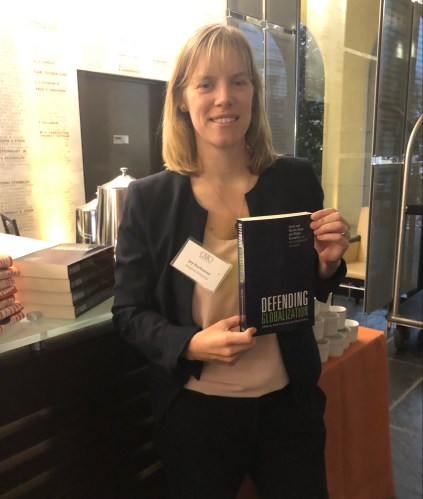
Cato Globalization book out in paperback – my most optimistic take on this is that AI will facilitate the sharing part of the sharing economy, which will help justify the cost of high-quality new garments.
The COVID-19 pandemic, war in Ukraine, simmering US-China tensions, and rising global populism have led to globalization facing renewed attention-and criticism-from politicians and pundits across the political spectrum. Like any market phenomenon, the free movement of people, things, money, and ideas across natural or political borders is imperfect and often disruptive. But it has also produced undeniable benefits-for the United States and the world-that no other system can match. And it’s been going on since the dawn of recorded history.
The original essays compiled in this volume offer a diverse range of perspectives on globalization-what it is, what it has produced, what its alternatives are, and what people think about it-and offer a strong, proactive case for more global integration in the years ahead. Covering the basic economic and political ideas and historical facts underlying globalization, rebutting the most common arguments against globalization today, and educating readers on the intersection of globalization and our societies and cultures-from where we live to what clothes we wear and what foods we eat-Defending Globalization demonstrates the essential humanity of international trade and migration, and why the United States and the rest of the world need more of it.
It takes all of us to be rich. We need “a great multitude that no one could count, from every nation, tribe, people and language,” so to speak.
Two years ago, on Twitter, I summarized my contribution as follows, in the form of a dialogue:
Person from the Past: “So, how is it with 8 billion people?”
Me Today: “It’s bad. We have too many clothes.”
Person from the Past: “Right. With 8 billion you wouldn’t have enough clothes for everyone.”
Me Today: “Too many.”
I made it to the book launch event in D.C. near the Capitol.
Some people still have not heard of “fast fashion.” Maybe you heard it here first: New legislation is likely coming to regulate the clothing industry. It might start at the state level, in progressive places like California or Seattle. Demands include making information about supply chains more transparent and taxing the clothing companies in order to pay for trash disposal. For example, you can read about the New York Fashion Act. Similar to the way the food companies have to provide clear information about calories, clothing retailers might have to provide more information about chemicals, labor, and disposal issues.
Plastic fibers making new clothing cheap. I sometimes hate the flood of cheap products that American families are drowning in. Plastic products are so cheap to stamp out and give to kids. Some days you’ll find me grumpy about the latest bag of plastic swag and candy my kids came home with. There are some negative externalities to consuming tons of plastic items and tossing them out.
It’s a privilege to have this problem. Perhaps we are overindulging in clothing abundance and need some modern solutions to modern problems. We also need to figure out how to stop getting obese off of food abundance. (Hello, Ozempic.) But let’s still be grateful for the abundance, on this Thanksgiving week. My controversial take is that it’s good for the cost of clothing to be low. We don’t want to regress. We don’t want to make clothing scarce again.
If you were to want to cite my work on fashion and globalization, then you could use something like this:
Buchanan, Joy. “Fast Fashion, Global Trade, and Sustainable Abundance” (2024) In S. Lincicome, & C. Packard (Eds.), Defending Globalization: Facts and Myths about the Global Economy and Its Fundamental Humanity, Cato Institute, (pp. 367 – 380).
Imagine trying to explain the world today to a person who time traveled forward from 300 years ago. How could someone who lived in France in the year 1600 understand our modern problems?
Person from the Past: So, how is it with 8 billion people?
Me Today: It’s bad. We have too many clothes.
PftP: Right. With 8 billion you wouldn’t have enough clothes for everyone.
MT: Too many.
PftP: Not enough?
MT: I said we have TOO MANY clothes. Not even the poorest people in the world want them. Shirts pile up on the beaches and pollute the ocean.
PftP: …
My article highlights the fact that we live in an era of unprecedented clothing abundance. First, that was not always true.
Most of human history has been characterized by privation and low‐productivity toil. As one American sharecropper exclaimed in John Steinbeck’s Depression‐era novel The Grapes of Wrath, “We got no clothes, torn an’ ragged. If all the neighbors weren’t the same, we’d be ashamed to go to meeting.”
The United Nations Economic Commission for Europe called the fashion industry an “environmental and social emergency” because clothing production has roughly doubled since the year 2000. Their main concerns are fast fashion’s environmental impact and working conditions.
Some of my article is a response to the critics of modern low-cost mass production.
Thirdly, I explain how we could keep most of the benefits of cheap clothes with less litter in the environment. The item I am most optimistic about is using our new artificial intelligence tools to re-sort the world’s junk. We would produce and throw away fewer clothes if we had a better system for rearranging the stock of goods that we already have. The problem I see today is that I have “perfectly good” clothes in my house that I don’t really want; however, attention and time are so scarce that no one will pay me for them. Even if I donate them, I worry that half will end up in the trash. Someone on this earth could use them but identifying that someone and making the trade still has high prohibitively high transaction costs. Very smart AI could come to my house and scan my stuff and pay me for it because very smart AI could get it to someone with a positive value for it.
Every sentence in this article is fascinating, since I have been writing about fast fashion.* Anything I put in quote form comes from The Guardian.
The word “revolution” in the title of this article is minor clickbait. Perhaps it would be more accurate to say: “Clothes repaired in workshop, 19 people employed” That wouldn’t get any clicks. However, I am an idealist, and I am going to stay a bit on board with the revolution. I, too, have pondered and grieved over the amount of waste heading into landfills. There could be some kind of revolution ahead, whether it is of the repair type or not.
The communal garden and bespoke textile art lend a creative startup feel, and the slogan “repair is the new cool” appears everywhere. But what’s happening here is far from ordinary startup stuff. At United Repair Centre (URC), newcomers to the Netherlands from across the world, many of them former refugees, are using their tailoring skills to mend clothes on behalf of some of the world’s biggest brands.
Immigrants are sewing, but no Dickensian horrors here. This place “has a laid-back Dutch vibe.”
Ambrose, who greets me, mans the front desk. He’s a 20-year-old Palestinian fashion fan, who was born in Syria and lived in Abu Dhabi before moving to the Netherlands in May; he is working in parallel with studying for a fashion and design diploma. Ambrose started at URC in May and loves it: the way he gets to work in collaboration with the tailors, giving advice and learning from their years of experience. “It’s really easy, fun, chill … “
Repair might be cool, but is it new? Consider Jo March from “Little Women” who was an American bouncing around between rich and poor status in the 1860s. American GPD per capita in 1860s was less than $3,000. That would be considered very poor today. Since manufactured goods were expensive and Jo March had a low opportunity cost of time, she spent lots of time mending clothes. Her passion was writing but she had no choice – that was how she contributed to her household production. Very few families at that time, even in the upper class, could afford to regularly buy new clothes from a shop.
Don Boudreaux explained that even modern rich people “recycle” clothes when it’s in one’s selfish interest. Washing and “re-use” of clothes, typically, is beneficial enough to outweigh the cost of maintaining and storing them. Sometimes we go above and beyond by donating them or maintaining them specifically because we are trying not to “waste” something, but that comes at an individual cost to us.
The author of the article writes:
I take a taxi from the station to URC because I’m running late, but I’m taken aback when en route the driver points out the many conveniently located stations and tram stops I could use for my return journey.
This is a perfect encapsulation of why rich people do not repair clothes. They are zipping around to high-productivity work meetings. The opportunity cost of time has gone up. Taking the bus is costly in terms of time, the scarcest resource of the rich.
Where I see hope for the repair “revolution” is in artificial intelligence (AI). AI can make up for our scarce time and attention. If AI can make repairs less costly in terms of time, then rich people might do it. If it doesn’t make economic sense, then it won’t scale the way the author is hoping.
Currently, the “revolution” is employing 19 people full-time. By the year 2027, all they are hoping for is to expand to 140 tailors. Hardly a revolution on the jobs front. But that’s the hopeful scenario. If it’s labor-intensive, then it won’t work. (See my ADAMSMITHWORKS post on cloth production and labor.)
Is repair reaching a tipping point?
There’s one unlikely scenario in which expensive repairs will get paid for. What rich people resoundingly want is kitchen renovations and new clothes, partly because it confers status. Could it become cool to live with those outdated cabinets and wear that repaired Patagonia vest for the next two decades? … could it? Vision: “Wow. I see that you guys have outdated ugly countertops. Nice. You resisted the desire to renovate your kitchen even though it’s within your budget.”
Even changing status markers are unlikely to tip the scale in the case of broken equipment or torn clothes. AI might allow us to repair a refrigerator instead of trash it.
URC tracks repairs using software initially developed by Patagonia, which it has built on and uses for the other brands involved.
There it is. Software makes the dream work.
Shein and the like are out there, churning out, in dizzying volumes, fast fashion that can’t be repaired.
In my conversations with Americans, many do not know what “fast fashion” is. That’s fast fashion. The 19-140 tailors are currently no match for Shein.
There isn’t always much common language – operational manager Hans says they resort to Google Translate quite a bit – but there’s plenty of laughter.
The AI, again! We are living in the globalized AI-powered future.
Lastly, the article was brought to my attention on Twitter (X) by Bronwyn Williams and Anna Gat.
The author of Secondhand, Adam Minter, simultaneously appreciates the value created by large “impersonal” markets and also paints colorful pictures of the individual people involved. He has respect for individuals in the system who, using local knowledge, extract all the value out of what rich people consider to be trash. Minter sits in the seat of Adam Smith.
But it is not the popular movement, but the travelling of the minds of men who sit in the seat of Adam Smith that is really serious and worthy of attention.
Lord Acton, Letter of Lord Acton to Mary Gladstone
Another piece about clothes from AdamSmithWorks is: “WHO ARE YOU WEARING?” FASHION PRODUCTION IN THE AGE OF ADAM SMITH. This article does “the pin factory” for clothes. The global supply chain is incredible, just looking at manufacturing alone. Minter takes it further by following goods all the way from their first consumer to their very last user.
There is some good news about how the world is getting better as the average person gets richer, but trash does also cause problems as we consume more stuff. Does Minter write about the environmental concerns of the “fast fashion” camp? He has a different idea than what others have proposed like taxing by volume or banning some commercial activity. In terms of practical advice, Minter advocates for labeling consumer goods by how long they are expected to last. It’s tragic when someone spends $20 on a good that will wear out after 1 year when they should have spent $30 on a good that will last 10 years. There are some “dollar bills on the ground” here because consumers don’t accurately assessing quality at the time of purchasing. The power of brands to signal quality helps with this problem, but if you don’t want washing machines piling up in landfills then you might want stores to put a greater emphasis on durability at the point of sale. We do something like that with nutrition labels, so it is possible.
I don’t agree with Elizabeth L. Cline on everything, but she’s written a reasonable book for Americans today. The Conscious Closet has some good advice for everyone.
A decade ago, Cline wrote Overdressed: The Shockingly High Cost of Cheap Fashion which investigated the environmental toll of clothes and the labor controversies. Since then, she has been working on what consumers can do differently.
Not every American household has practical knowledge of laundry and sewing anymore. Cline offers suggestions on how to economically maintain clothes longer by making sensible home repairs or washing them less. (Don’t wash a pair of jeans after just one wear. I don’t.) The Conscious Closet came out in 2019, so it’s up-to-date concerning chemicals and certifications and websites that operate today.
The way we wash and dry our clothes uses a lot of water and energy. If a person was looking for a way to lower their environmental footprint, then a marginal reduction of laundry loads might be a relatively easy way to do it. Since almost every American has an electric dryer, we have lost the tacit knowledge of how to air dry clothes. She gives the practical reminder, for example, that dark color clothes will fade if exposed to extended sunlight.
I feel like Cline could be even more conscious about the opportunity cost of time. She does explicitly acknowledge that in her chapter about re-selling your unwanted clothes.
I’m writing an article about fast-fashion, so I’m reading Fashionopolis by Dana Thomas.
This paragraph is from the intro chapter:
Since the invention of the mechanical loom nearly two and a half centuries ago, fashion has been a dirty, unscrupulous business that has exploited humans and Earth alike to harvest bountiful profits. Slavery, child labor, and prison labor have all been integral parts of the supply chain at one time or another – including today. On occasion, society righted the wrongs, through legislation or labor union pressure. But trade deals, globalization, and greed have undercut those good works.
She invokes religion with “good works.” Thomas and I are of different opinions concerning globalization and “greed” and legislation. My instinct is to rip this paragraph apart. Has legislation never been motivated by greed? Has globalization not improved the lives of children? Has the mechanical loom not improved the lives of women who used to spend hours spinning and weaving by hand?
I am also reading pastor Tim Keller’s biography right now, so I’m having a What Would TK Do moment.
With his gifts (smart, funny, articulate…), Keller could have made a fortune by taking a side. He could have picked the Right or the Left. He could have expertly appealed to a Side, convincing them that they were good-smart and the Other is evil-stupid. Instead, Keller relentlessly stayed in the center. One of his books is actually called Center Church.
It’s teen girls who care about what they wear, and rough military men do not even think about it. Right? Wrong.
Up Front is a book depicting WWII soldiers by cartoonist Bill Mauldin. Around page 135, Mauldin describes how men dressed who were close to the front lines but not actually in combat. Mauldin coined the term garritrooper (a portmanteau of garrison and paratrooper). I thank Prof. Mike Munger for the pointer.
The garritroopers are able to look like combat men or like the rear soldiers, depending on the current fashion trend. When the infantry was unpublicized and the Air Forces were receiving much attention, the emphasis was on beauty… [The garritroopers] would not wear ordinary GI trousers and shoes, but went in for sun glasses, civilian oxfords, and officers’ forest-green clothing. This burned up many decidedly unglamorous airplane mechanics who worked for a living and didn’t look at all like the Air Force men the garritrooper saw in the magazines.
We are all trying to look like the celebrities in magazines, even if we don’t all agree on who is a celebrity and which magazine to read.
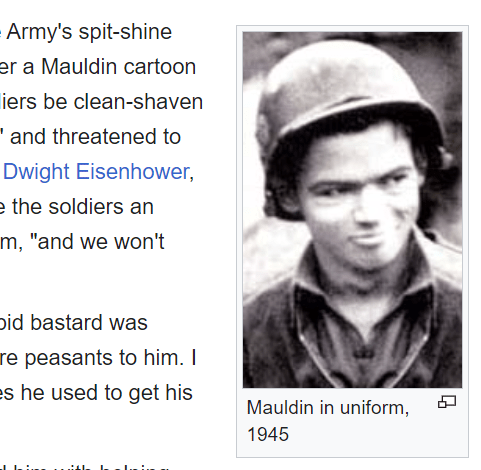
Look at that smirk, found on the Wikipedia page. Bill Mauldin is temporarily my new favorite writer.




 Economist Writing Every Day