John Bogle, the founder of Vanguard, wrote a short book in 2006 that explains his investment philosophy. I can sum it up at much less than book length: the best investment advice for almost everyone is to buy and hold a diversified, low-fee fund that tracks an index like the S&P 500.
Of course, a strategy that is simple to state may still take time to understand and effort to stick to. So the book helps to build intuition for why this strategy makes sense. I think Bogle makes his case well, though the book is getting a bit dated- the charts and examples end in 2006, and he sets up mutual funds as the big foil, when today it might be high-fee index funds or picking your own stocks.
The silver lining of any dated investing book is that we can check up on how its predictions have fared. In chapter 8, Bogle compared the performance of the 355 equity mutual funds that existed in 1970 to that of the S&P over the 1970-2006 period. He notes that 223 of the funds had gone out of business by 2006, and even most of the surviving funds underperformed the S&P. But he identifies 3 funds that outperformed the S&P significantly (over 2% per year) on a sustained basis (consistently good performance, not just high returns at the beginning when they were small): Davis New York Venture, Fidelity Contrafund, and Franklin Mutual Shares. But how have they done since the book came out?
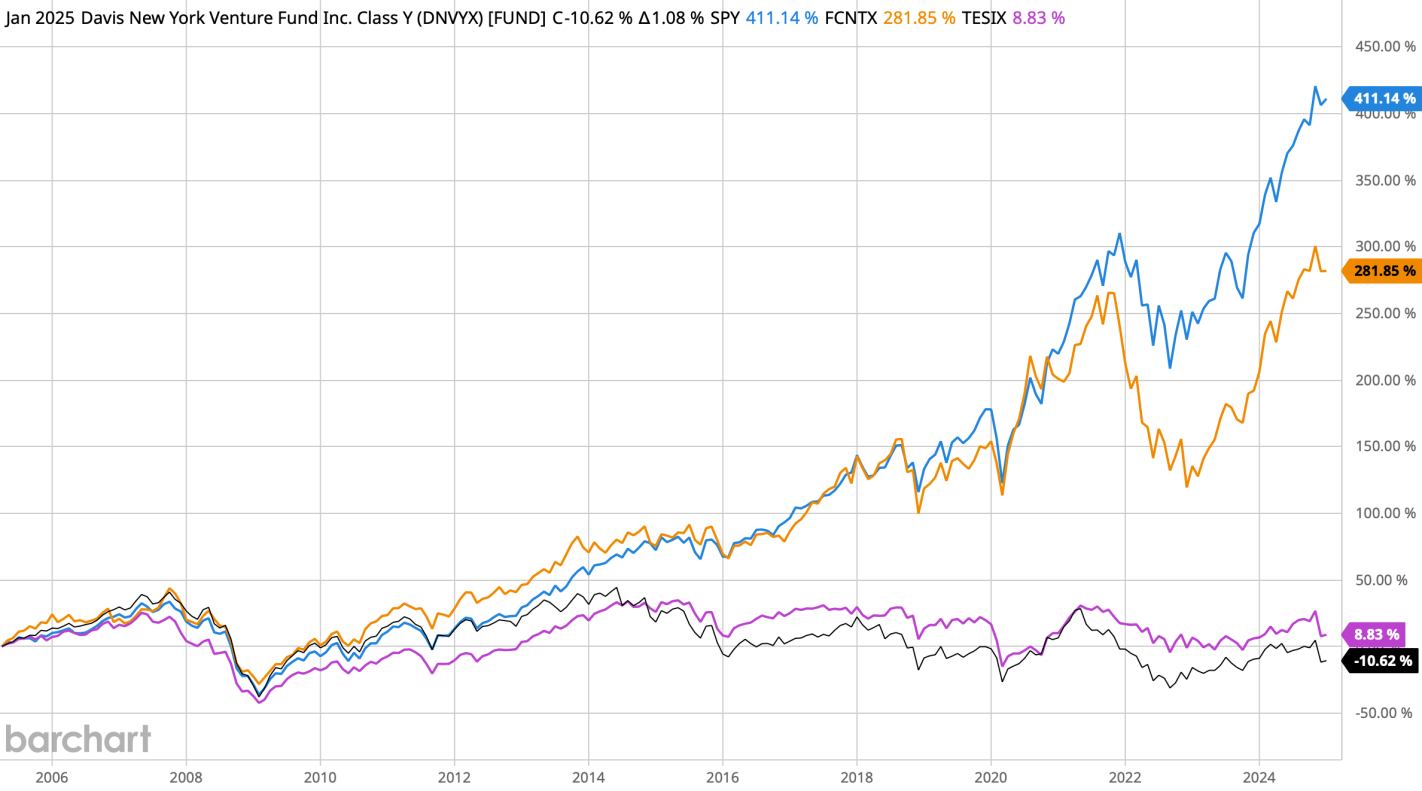
It is a huge victory for the S&P (in blue). Franklin Mutual Shares is basically flat over the past 20 years, while Davis New York Fund actually lost money. Fidelity Contrafund returned a respectable 281% (about 7% per year), and matched the S&P as recently as 2020. But as of 2025 the S&P is the clear winner, up 411% in 20 years (over 8% per year). Score one for Bogle.
But I still have to wonder if there is a way to beat the S&P- and I think one of Bogle’s warnings is really an idea in disguise. He warns repeatedly about “performance chasing”:
But whatever returns each sector ETF may earn, the investors in those very ETFs will likely, if not certainly, earn returns that fall well behind them. There is abundant evidence that the most popular sector funds of the day are those that have recently enjoyed the most spectacular recent performance, and that such “after-the-fact” popularity is a recipe for unsuccessful investing.
The claim is that investors pile into funds that did well over the past 1-3 years, but these funds subsequently underperform. But if this is true, could you succeed by reversing the strategy, buying into the unpopular sectors that have recently underperformed? I’ve been wondering about this, though I have yet to try seriously backtesting the idea. I was surprised to see Mr. Index Fund himself support such attempts to beat the market toward the end of his book:
Building an investment portfolio can be exciting…. If you crave excitement, I would encourage you to do exactly that. Life is short. If you want to enjoy the fun, enjoy! But not with one penny more than 5 percent of your investment assets.
He goes on to say that even for the fun 5% of the portfolio he still doesn’t recommend hedge funds, commodity funds, or closet indexers. But go ahead and try buying individual stocks, or actively managed mutual funds “if they are run buy managers who own their own firms, who follow distinctive philosophies, and who invest for the long term, without benchmark hugging.”
 Economist Writing Every Day