The Poverty Line is Not $140,000

UPDATE: Michael Green has written a follow-up post which essentially agrees that $140,000 is not a good national poverty line, but he still has concerns. I have written a new response to his post.

A recent essay by Michael W. Green makes a very bold claim that the poverty line should not be where it is currently set — about $31,200 for a family of four — but should be much higher. He suggests somewhere around $140,000. The essay was originally posted on his Substack, but has now gone somewhat viral and has been reposted at the Free Press. (Note: that actual poverty threshold for a family of four with two kids is $31,812 — a minor difference from Mr. Green’s figure, so not worth dwelling on much, but this is a constant frustration in his essay: he rarely tells us where his numbers come from.)

I think there are at least three major errors Mr. Green makes in the essay:

  1. He drastically underestimates how much income American families have.
  2. He drastically overstates how much spending is necessary to support a family, because he uses average spending figures and treats them as minimum amounts.
  3. He obsesses over the Official Poverty Measure, since it was originally based on the cost of food in the 1960s, and ignores that Census already has a new poverty measure which takes into account food, shelter, clothing, and utility costs: the Supplement Poverty Measure.

I won’t go into great detail about the Official Poverty Measure, as I would recommend you read Scott Winship on this topic. Needless to say, today the OPM (or some multiple of it) is primarily used today for anti-poverty program qualification, not to actually measure how well families are doing today. If we really bumped the Poverty Line about to $140,000, tons of Americans would now qualify for things like Medicaid, SNAP, and federal housing assistance. Does Mr. Green really want 2/3 of Americans to qualify for these programs? I doubt it. Instead, he seems to be interested in measuring how well-off American families are today. So am I.

Let’s dive into the numbers.

Continue reading

Housing is More Expensive Today, But Not Because the US Left the Gold Standard

Housing is certainly more expensive than in the past. I have written about this several times, including a post from last year showing that between about 2017 and 2022 housing started to get really expensive almost everywhere in the US, not just on the West Coast and Northeast (as had previously been the case). I don’t think the housing affordability crisis is in serious doubt anymore, and it can’t be explained over the past few years by increasing size and amenities, since those haven’t changed much since 2017 (though it is relevant when comparing housing prices to the 1970s).

But why did this happen? Knowing why is crucial, not merely to blame the causes, but because the policy solution is almost certainly related to the causes. I and many others have argued that supply-side restrictions, such as zoning laws, are the primary culprit. The policy solution is to reduce those restrictions. But a recent op-ed titled “Why your parents could afford a house on one salary – but you can’t on two,” the authors place the blame for housing prices (as well as the stagnation of living standards generally) on a different factor: Nixon’s 1971 “severing the dollar’s link to gold.” The authors have a book on this topic too, which I have not yet read, but they provide most of the relevant data in this short op-ed.

Does their explanation make sense? I am skeptical. Here’s why.

Continue reading

Montana’s New Property Tax System

SPOILER ALERT if you are watching the TV Series Yellowstone: at the start of Season 5, John Dutton (played by Kevin Costner) is sworn in as Governor of Montana. One of his first proposals in his inaugural address is that the state legislature “double property taxes for non-residents” who have been buying up vacation homes in the state, and contributing to the increase in property values in the state (a fact which drives many plotlines throughout the series). This episode aired in November 2022.

This week, the real governor of Montana signed a pair of bills which effectively did what the fictional governor John Dutton proposed: significantly increasing property taxes on non-residents. Starting in tax year 2026, the property taxes for non-primary residences (which will include non-Montana residents and Montanans who own vacation homes) will be based on 1.9% of market value, while Montana residents will pay a graduated rate structure for their primary residence: 0.76% for property up to the state median (currently about $340,000), 0.9% up to two times the state median, 1.1% for the value between 2 and 4 times the state median, and 1.9% (the same as non-residents) for the value of homes above 4 times the state median ($1.36 million currently). Currently residential property is taxed at 1.35% of market value, meaning that while the rate hasn’t fully doubled for non-residents, most non-residents will be paying twice or more in property taxes than Montana residents.

I was a non-resident member of the Montana Property Tax Task Force, and served on the “Tax Fairness” subcommittee where the plan for HB 231 originated, so I have somewhat of a unique perspective on these changes to property tax rates. I will offer a few thoughts, some of which are critical, but let me first say that it was a great honor to be asked to serve on the Task Force by Montana’s Governor. Also, everyone on the Task Force was very friendly and receptive to ideas from outsiders (I was one of three non-Montanans on the Task Force), and so my comments here are not critical of the Task Force process nor anyone on it. As I did when I served on the Task Force, my goal in this post is to try, as best as I can, to objectively analyze how this proposal (now law) will impact Montana.

Continue reading

Go East, Young Man

Americans have moved westward in every decade of our history. But after over 200 years, that trend may finally be ending.

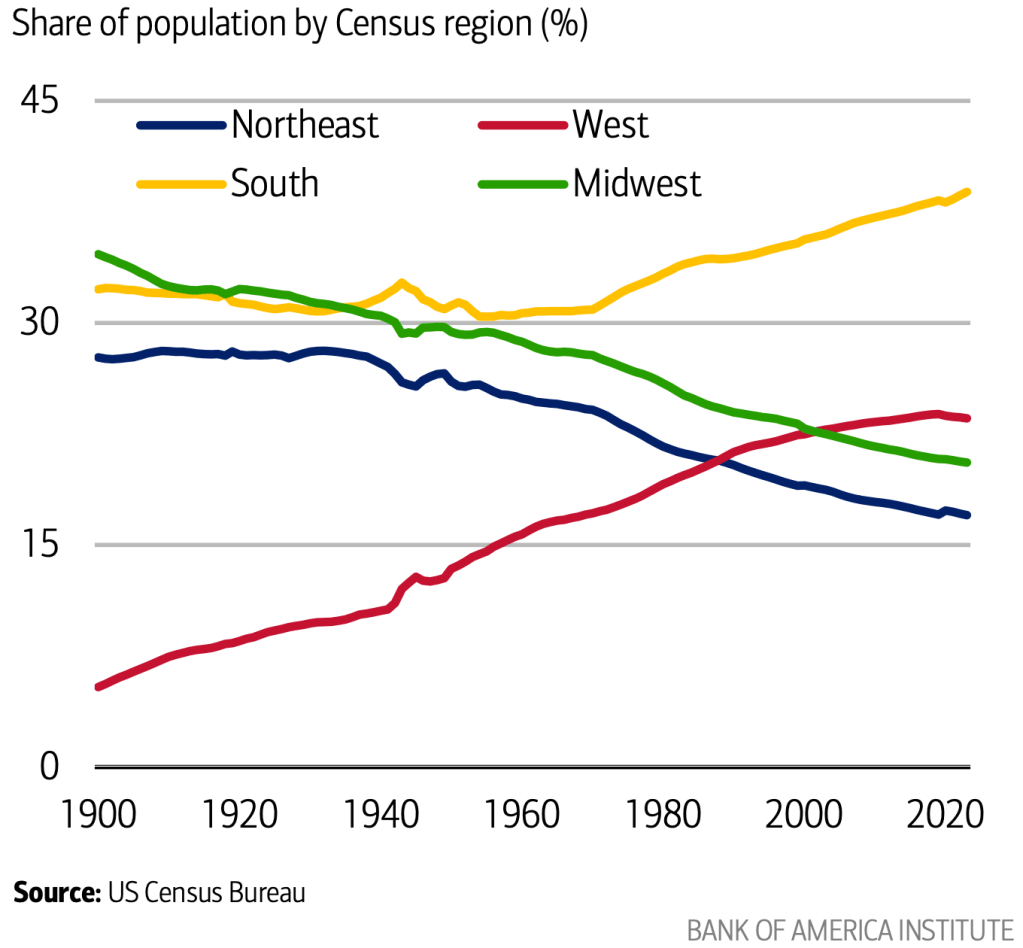
A new report from Bank of America notes that the share of Americans who live in the West has been falling since 2020:

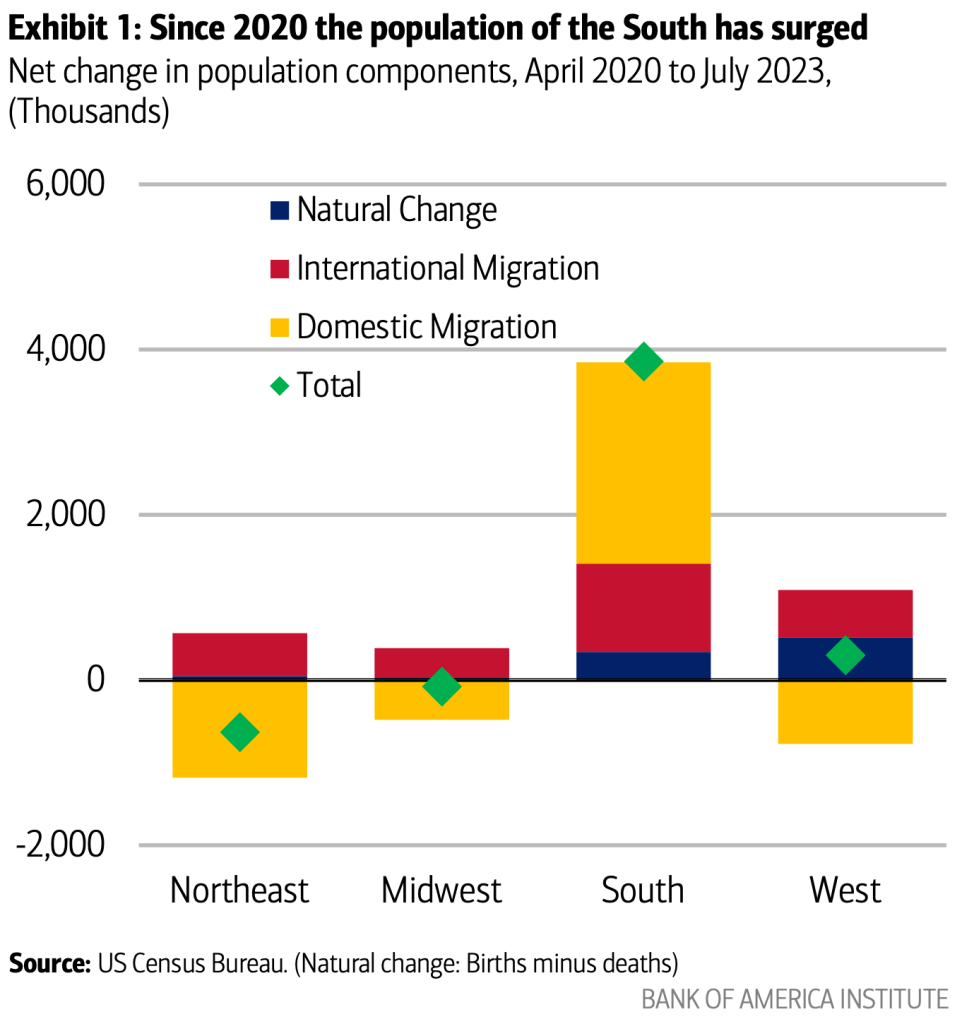
The absolute population of the West is still growing slightly, but the Southeast is growing so quickly that it makes every other region of the country a smaller share by comparison:

I think this has a lot to do with the decline in housing affordability that Jeremy discussed yesterday. Americans always went West for free land, or cheap land, or cheap housing. Or in more recent decades on the Pacific coast, they went for nice weather and good jobs with non-insane housing prices. But now all that is gone, and if anything housing prices are pushing people East.

I see some green shoots of zoning reform with the potential to lower housing costs in the West. But I worry that this is too little too late, and that 2030 will confirm that our long national trek Westward has finally been defeated by our own poor housing policy.