There seems to be something of a generational divide as to how important is your personal privacy. Folks under, say, age 40, have lived such a large fraction of their lives with Facebook and Amazon and Google and Twitter logging and analyzing and reselling information on what they view and listen to and say and buy, that they seem rather numb to the issue of internet privacy. Install an Alexa that ships out every sound in your home and a smart doorbell that transmits every coming and going to some corporate server, fine, what could possibly be the objection? So what if your automobile, in addition to tracking and reporting your location, feeds all your personal phone text messages to the vehicle manufacturer?
For us older folks whose brain pathways were largely shaped in a time when communication meant talking in person or on a (presumably untapped) phone, this seems just creepy. Polls show that a majority of Americans are uneasy about the amount of data on them being collected, but “do not think it is possible to go about daily life without corporate and government entities collecting data about them.”
There are substantive concerns that can be raised about the uses to which all this information may be put, and about its security. Per VPNOverview:
Over 1,800 data leaks took place last year in the US alone, according to Statista. These breaches compromised the records of over 420 million people.” . With smartwatches having access to so much sensitive information, here’s what kind of data can fall into the wrong hands in case of a data leak:
- Your personal information, including name, address, and sometimes even Social Security Number
- Sensitive health information collected by the smartwatch
- Login credentials to all the online platforms connected to your smartwatch
- Credit card and other payment information
- Digital identifiers like your IP address, device ID, or browser fingerprint
- Remote access information to smart home devices
Several times a year now, I get notices from a doctor’s office or finance company or on-line business noting blandly that their computer systems have been hacked and bad guys now have my name, address, birthdate, social security number, medical records, etc., etc. (They generously offer me a year of free ID fraud monitoring. )
The Internet of Things (IoT) promises to ramp up the snooping to a whole new level. I took note four years ago when Google acquired Fitbit. At one gulp, the internet giant gained access to a whole world of activity and health data on, well, you. The use of medical and other sensors, routed through the internet, keeps growing. One family member uses a CPAP machine for breathing (avoid sleep apnea) at night; the company wanted the machine to be connected on the internet for them to monitor and presumably profit from tracking your sleep habits and your very breath. And of course when you don a smart watch, your every movement, as well as your heartbeat, are being sent off into the ether. (I wonder if the next sensor to be put into a smart watch will be galvanic skin response, so Big Tech can log when you are lying).
According to a senior systems architect: “The IoT is inevitable, like getting to the Pacific Ocean was inevitable. It’s manifest destiny. Ninety eight percent of the things in the world are not connected. So we’re gonna connect them. It could be a moisture sensor that sits in the ground. It could be your liver. That’s your IoT. The next step is what we do with the data. We’ll visualize it, make sense of it, and monetize it. That’s our IoT.”
When my kids were little, we let them use cassette tape players to play Winnie the Pooh stories. With my grandkids, the comparable device is a Yoto player. This also plays stories (which is good, better than screens), but it only operates in connection with the internet. The default is that the Yoto makers collect and sell personal information on usage by you and your child (which would include time of day as well as choice of stories). You can opt out, if you are willing to take the trouble to write to their legal team (thanks, guys).
There are cities in the world, in China but also some European cities, where there are monitoring cameras (IoT) everywhere. Individuals can be recognized by facial features and even by the way they walk; governmental authorities compile and track this information. These surveillance systems are being sold to the public with the promise of increased “security.” Whether it really makes we the people more secure is heavily dependent on the benevolence and impartiality of the state powers. Supposing a department of the federal government with access to surveillance data became politicized and then harassed members of the opposing party?
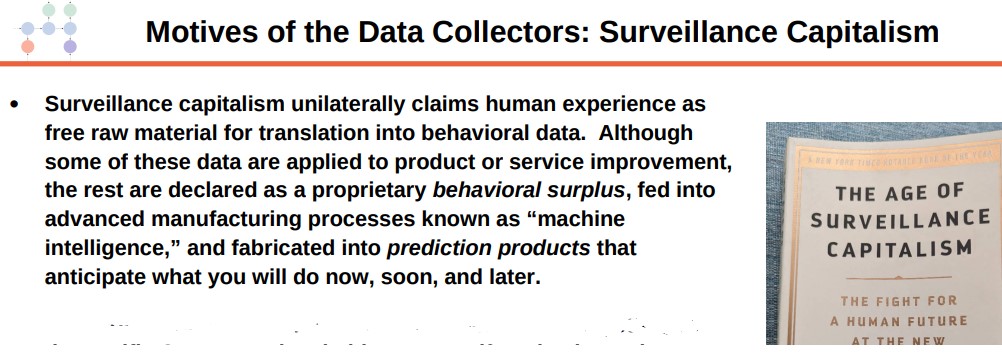
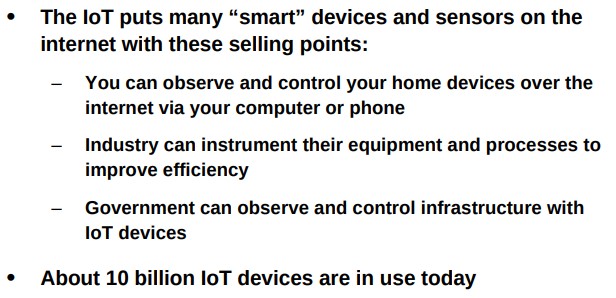
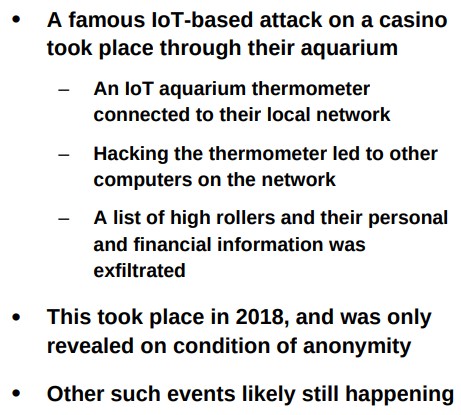
I’ll conclude with several slides from Timothy Wallace’s 2023 presentation on the Internet of things:


The dystopian novel 1984 by George Orwell was published in 1949. It describes a repressive totalitarian state, headed by Big Brother, which was characterized by pervasive surveillance. Ubiquitous posters reminded citizens, “Big Brother is watching you.” Presumably the various cameras and microphones used in the mass surveillance there were paid for and installed by the eavesdropping authorities. It is perhaps ironic that so many Americans now purchase and install devices that allow some corporate or governmental entity to snoop them more intimately than Orwell could have imagined.


 Economist Writing Every Day