Leveraged Bullion and Mining Funds to Cash in on the Gold Bonanza

Stocks (e.g., S&P 500) are up 12.5 % year to date. That is pretty good for 9.5 months. But gold has been way better, up 40%:
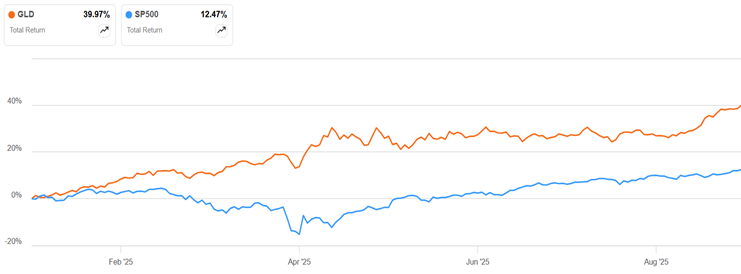
Fans of gold cite various reasons for why its price should and must keep going up (out of control federal debt and associated money-printing, de-dollarization by non-Western nations, buying by central banks, etc.). I have no idea if that is true. But if it is, that raises the question in my mind:  for the limited amount of funds I have to invest in gold, can I get more bang for my investing bucks, assuming gold continues to rise?

It turns out the answer is yes.  A straightforward way is to buy into a fund which is 2X or 3X leveraged to the price of gold. If gold goes up 10%, then such a fund will go up 20% or 30%. Let’s see how two such funds have done this year, UGL (a large 2X gold fund) and a newer, smaller 3X fund, SHNY:
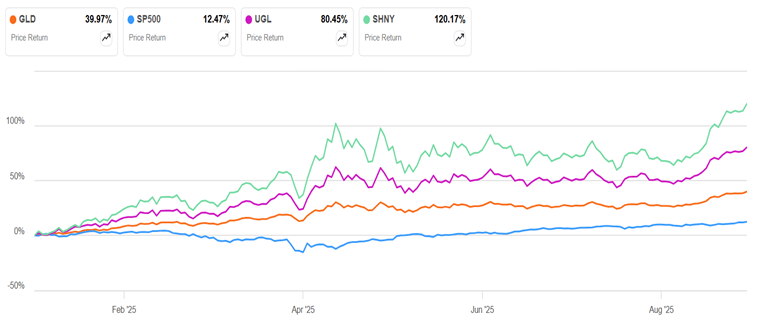
Holy derivatives, Batman, that leverage really works! With GLD (1X gold) up 40%, UGL was up 80% year to date, and 3X SHNY is up 120%. So, your $10,000 would have turned into $24,000. The mighty S&P500 (blue line) looks rather pitiful in comparison.

But wait, there’s more. Let’s consider gold “streamers”, like WPM (Wheaton Precious Metals) or FNV. They give money to mines in return for a share of the production at fixed, discounted prices, so their cash flow soars when gold prices rise. Year to date, FNV is up 73%, while WPM is up 91%.

And then there are the gold miners themselves. They tend to have fairly fixed breakeven costs of production, currently around $1200-1400/oz.  Again, their profit margin rockets upward when gold prices get far above their breakeven:
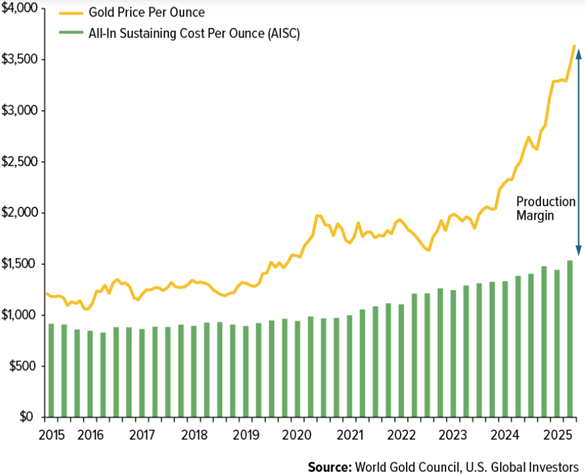
Source

GDX is a large fund of representative mining stocks. For icing on the cake, there are funds that are 2X (NUGT) or 3X (GDXU) leveraged to the price changes in mining stocks. The final chart here displays their year-to-date performance in all their glory:
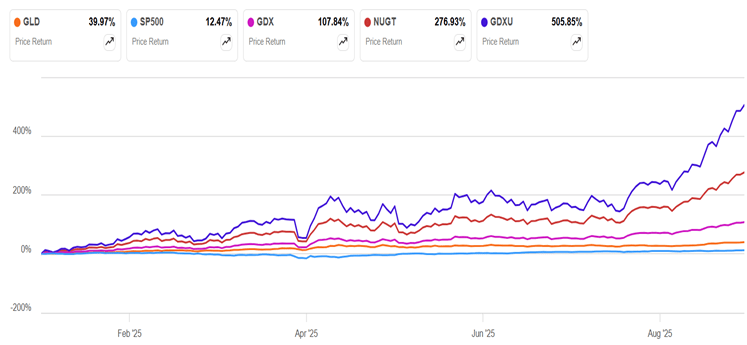
The blue S&P 500 line is lost in the noise, and even the orange 40% GLD line is left in the dust. The 1X miner fund was up 108%, the 2X fund NUGT was up 276%, and the 3X GDXU was up 506%. Your $10,000 would have turned into $51,000.

Of course, what goes up fast will also come down fast, since leverage works both ways. For instance, from Oct 21 to Dec 30, 2024, gold was down a mere 4%, but WPM was down 15%, the 1X gold miner GDX was down 20%, and 3X GDXU down an eye-watering 54%. That means that your $10,000 turned into $4,600 in two months. Imagine watching that unfold, and not panic-selling at the bottom. Gold fell by more than half between 2011 and 2015. If it fell by even 20% (i.e., gave up half of this year’s gains), I could see a 3X miner fund losing over 90% of its value (just a guess).

One more twist to mention here is the “stacked” fund GDMN, which uses derivatives to be long 1X gold PLUS 1X gold miners. It is up 151% this year, which is nearly four times as much as gold. This fund seems to have a nice combination of decent leverage with moderate volatility. It has on average kept pace with the 2X miner fund NUGT, with shallower dips. NUGT has surged way ahead in the past two months as miner stock prices have gone nuts, but that is somewhat exceptional.

Disclaimer: As usual, nothing here should be considered advice to buy or sell any security.

Learnings From Trading Short Volatility Funds, 2. Use Leveraged Stock Funds Instead

In last week’s post, I described how short volatility funds work. They are short (as opposed to long) near-term VIX futures. This means that when a market panic hits and VIX (as measure of volatility) spikes, the prices of these short vol funds plunge, along with stock prices. But as optimism returns to the markets, prices of short vol funds start to recover, as do stocks.

Thus, both short vol funds and general stock funds are reasonable ways to play a market panic. If (!!!) you manage to call the bottom and buy there, you can hold for maybe a couple of weeks until prices recover, and then sell at a profit.  I tried to do just that with the market meltdown last month in the wake of the president’s tariff ultimatums: I bought some short vol funds (SVXY, which is a moderate -0.5X VIX fund, and the more aggressive -1X fund SVIX), and also some leveraged stock funds. I discussed leveraged funds here.

I chose to buy into SSO, a 2X leveraged S&P 500 stock fund, whose daily price moves up (or down) by twice the percentage as does the S&P. Obviously, if you think stocks will go up say 10% in the next month, you will make more money by buying a fund that will go up 20% instead, which is why I bought a 2X fund rather than a plain vanilla (1X) stock fund. A related fund, which I did not buy this time, is UPRO, which is a 3X stock fund.

Things are always clear in hindsight. After the smoke of battle clears, you can see right where the bottom was. But it is not clear when you are in the thick of it. I erred by committing much of my dry powder trading funds too early, maybe halfway through the big drop. C’est la vie. It’s hard to improve on that for next time. But a significant learning, that I will act on during the next panic, was how differently short vol versus leveraged stocks recovered from the crash. They both plunged and recovered, but leveraged stocks recovered much better.

It turns out that much of the time, the price movements over say a six-month period of SVXY and SSO largely match each other, so these are useful for comparisons for trading short vol versus leveraged stocks. For instance, below is a chart of SVXY (orange line) and SSO (green line) over the past six months or so. The blue arrow notes the April crash, which bottomed roughly April 8. For November through early April, the price movements of the two funds roughly matched. By April 8, both had plunged to a level some 35% lower than their starting prices. However, by May 12, SSO had recovered to -10% (relative to starting), which is about where it was in late March (green level line drawn in). SVXY, however, remained 21% below its start.

Chart of SVXY ( -0.5X VIX ETF, Orange line) and SSO (2X Stock fund, green line), Nov 2024-May 2024. Blue arrow marks April 2025 volatility spike/stock crash. Chart from Seeking Alpha.

Thus, from its nadir (-35%) to its recovery as of Tuesday, May 12, SSO gained by 38% (i.e., ratioing 0.90/0.65), whereas SVXY gained only 21% (from ratioing 0.79/0.65). Also, it looks like SVXY will not regain its earlier price levels any time soon. So SSO looks like the winner here.

We can do a similar comparison between the -1X VIX fund SVIX and the 3X stock fund UPRO. These two funds are plotted below, along with a plain (1X) S&P 500 stock fund, SPY (in blue). SVIX (orange) and UPRO (green) trend pretty closely for October through March. When the April crash came, SVIX dropped much harder, down to a heart-stopping -59%, compared to -44% for UPRO. SPY dropped only to -15%.  SPY comes to a full recovery (0%) by May 12, while UPRO recovers only to -13% [1].    SVIX has recovered only to -21%. If you managed to buy each of these funds on April 8, and sold them today, you would have made the following gains:

SPY 17% ; UPRO 55%;  SVIX  43%.    Clearly the winner here in short term trading of the April crash is the 3X stock fund UPRO.

Chart of SVIX ( -1X VIX ETF, Orange line), UPRO ( 3X Stock fund, green line), and SPY (1X Stock fund, blue line), Oct 2024-May 2024. Chart from Seeking Alpha.

As a cross check, below is a plot of SVXY (orange) and SSO (green) covering the August, 2024 volatility spike. This was a peculiar event, discussed here, where volatility went crazy for a couple of days, while stock prices experienced only a moderate drop. If (!!!) you timed it just right, and bought at the bottom and sold a week or so later, you could have made good money on SVXY. But zooming out to the larger picture, SVXY never came close to recovering its old highs, whereas SSO just kept going up and up (green arrow). So SSO seems like a safer trading vehicle: it is a reasonable buy-and-hold, whereas SVXY may be hazardous to your portfolio’s health if you don’t get the timing perfect.

Chart of SVXY ( -0.5X VIX ETF, Orange line) and SSO ( 2X Stock fund, green line), Oct 2023-Oct 2024. Blue arrow marks early August 2024 volatility spike. Chart from Seeking Alpha.

Over certain longer (say one-year) periods, there are regimes where short vol could out-perform leveraged stocks (discussed earlier), but that is the exception, rather than the rule.

Disclaimer: Nothing here should be considered advice to buy or sell any security.

ENDNOTE

 [1] While UPRO changes X3 the change of SPY on a daily basis, for reasons discussed earlier, the longer-term performance of UPRO diverges from a simple X3 relationship with SPY. In volatile times, UPRO tends to fall well below a 3X performance over say a six-month period.

How to Roughly Double Your Investing Returns 1. 2X (or 3X) Leveraged Funds

Most years, stocks go up, by something like 9%. Wouldn’t it be nice to invest in a fund that went up double those amounts? Such funds exist. They use futures or other derivatives to move up (or down!) by double, or even triple, the percentage that the underlying stock or index moves, on a daily basis.

For instance, a common unleveraged fund (ETF) is SPY that roughly tracks the S&P 500 index of large U.S. stocks is SPY. SSO is a 2X fund, which gives double the returns of SPY, on a daily basis. UPRO is a 3X fund, giving triple the returns. 2X funds exist for many different asset classes, including semiconductor stocks, treasury bill, and crude oil – see here. And similarly for 3X funds.

Since all the action in stocks these days seems to be in large tech companies, I will focus on the NASDAQ 100 index universe. The leading unleveraged fund there is QQQ. The 2X version is QLD, and the 3X is TQQQ. Let’s look at how these three funds performed over the past twelve months:

QQQ is up a respectable 36%, but QLD is up by 70%, and TQQQ by a mouth-watering 106%. You could have doubled your money in the past twelve months simply by investing in a 3X fund instead of holding boring 1X QQQ. 

These leveraged funds can be utilized in more than one way. One approach is to just put the monies you have allocated for stocks into such funds, and hope for higher returns. Another approach is to put, say half of your speculative funds into a 2X fund (to get roughly the same stock exposure as putting all of it into a 1X fund), and then use the remaining half to put into other investments, or to keep as dry powder to give you the option to buy more equities if the market crashes.

What’s not to like about these funds? It turns out that a year of daily doubling of returns does not necessarily add up to doubling of yearly returns. There is “volatility drag” associated with all the exaggerated moves up and down. As an illustration of how this works, suppose you held a stock that went down by 50% one day, say from a price of $100 to $50. The next day, it went back up by 50%. But this would only get you back to $75, not $100.

It turns out that with these leveraged funds, as long as stocks are generally going up, the yearly returns can match or even exceed the 2X or 3X targets. But in a period with a lot of volatility, the yearly returns can fall far short. And in a down year, the combination of the leverage and the volatility drag lead to truly horrific losses. For instance, here is what 2022 looked like for these funds:

QQQ was down by 31%, which is bad enough. But imagine your $10,000 in TQQQ melting down to $3,300 that year.

And here is the chart from January 2022 to the present:

QQQ is up 27% in the past 2.5 years, 2X QLD is up only 16%, while 3X TQQQ is actually down by 6%, as it could not recovery from 2022.

This was a kind of a worst-case scenario, since 2022 was an exceptionally bad year for QQQ, coming off a fabulous 2021. A chart of the past five years, which includes the 2020 Covid crash and recovery, and the 2022 crash and subsequent recovery still shows the leveraged funds coming out ahead over the long term:

The net returns on QLD (321%) were about double QQQ (158%), while the more volatile TQQQ return (386%) was plenty high, but fell well short of three times QQQ.

In my personal investing, I hold some QLD as a means to free up funds for other investments I like. But if I smell major market trouble coming, I plan to swap back into plain QQQ until the storm clouds pass.

There are some other ways to get roughly double returns, which suffer less from volatility drag than these 2X funds. I will address those in subsequent posts.

Disclaimer: As usual, nothing here should be considered advice to buy or sell any investment.