Benefit Cliff Data

I said years ago on my Ideas Page that we need data and research on Benefit Cliffs:

Benefits Cliffs: Implicit marginal tax rates sometimes go over 100% when you consider lost subsidies as well as higher taxes. This could be trapping many people in poverty, but we don’t have a good idea of how many, because so many of the relevant subsidies operate at the state and local level. Descriptive work cataloging where all these “benefits cliffs” are and how many people they effect would be hugely valuable. You could also study how people react to benefits cliffs using the data we do have.

But it turns out* that the Atlanta Fed has now done the big project I’d hoped some big institution would take on and put together the data on benefits cliffs. They even share it with an easy-to-use tool that lets you see how this applies to your own family. Based on your family’s location, size, ages, assets, and expenses, you can see how the amount of public assistance you are eligible for varies with your income:
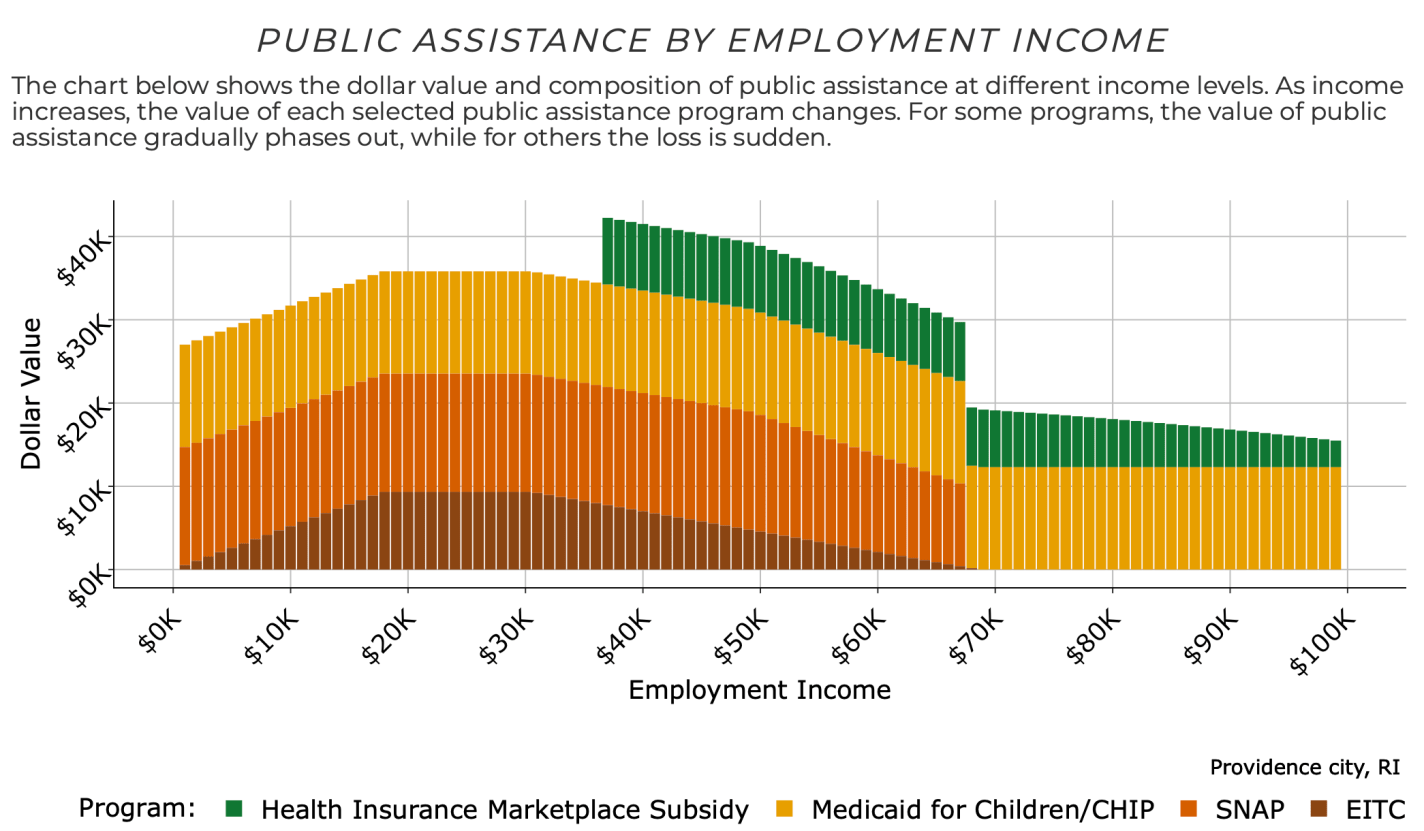
Then see how your labor income plus public assistance changes how well off you are in terms of real resources as your labor income rises:

For a family like mine with 3 kids and 2 married adults in Providence, Rhode Island, it shows a benefit cliff at $67,000 per year. The family suddenly loses access to SNAP benefits as their labor income goes over $67k, making them worse off than before their raise unless their labor income goes up to at least $83,000 per year.

I’ve long been concerned that cliffs like this in poorly designed welfare programs will trap people in (or near) poverty, where they avoid taking a job, or working more hours, or going for a promotion, or getting married, in order to protect their benefits. This makes economic sense for them over a 1-year horizon but could keep them from climbing to independence and the middle-class in the longer run. You can certainly find anecdotes to this effect, but it has been hard to measure how important the problem is overall given the complex interconnections between federal, state, and local programs and family circumstances.

I look forward to seeing the research that will be enabled by the full database that the Atlanta Fed has put together, and I’m updating my ideas page to reflect this.

*I found out about this database from Jeremy’s post yesterday. Mentioning it again today might seem redundant, but I didn’t want this amazing tool to get overlooked for being shared toward the bottom of a long post that is mainly about why another blogger is wrong. I do love Jeremy’s original post, it takes me back to the 2010-era glory days of the blogosphere that often featured long back-and-forth debates. Jeremy is obviously right on the numbers, but if there is value in Green’s post, it is highlighting the importance of what he calls the “Valley of Death” and what we call benefit cliffs. The valley may not be as wide as Green says it is and it may be old news to professional tax economists, but I still think it is a major problem, and one that could be fixed with smarter benefit designs if it became recognized as such.

The Laboratory of the States: Regulatory Reform Edition

The US Federal government has been considering major reforms like the REINS Act, which would require Congressional approval of major regulations proposed by executive branch agencies, or bringing back the “two in one out” rule from the first Trump administration. What would these do?

Right now it’s hard to say much for sure. But similar reforms have already been implemented in the states; as usual, the states provide a laboratory for investigating how policies work and whether they deserve broader adoption. It’s especially valuable to inform the debate over reforms like the REINS act that are still being considered at the federal level. Even for federal reforms that have already happened, it can be easier to evaluate the state version, since states make better control groups for each other than other countries do for the US.

But so far we’ve mostly been ignoring our laboratory results from recent state regulatory reforms. For instance, Broughel, Baugus, and Bose (2022) released a dataset that could be used to evaluate state regulatory reforms, but it has only been cited 3 times. This is why I’m adding this to my ideas page as a good subject for future academic research.  Do state REINS or Red Tape Reduction Acts actually reduce either the stock or flow of regulation? If so, which types of regulations are affected, and does this have any effect on downstream measures like economic growth or new business formation?

Any research along these lines could help inform policy debates in the states, as well as for a new Presidential administration coming in with hopes of boosting economic growth through deregulation.

HT: Adam Millsap

More Ideas Pages

I’ve written here about my ideas page of economics papers I’d like to see.

After that post I heard from others who maintain similar pages. David Friedman has a small page here with research ideas, along with larger pages of short story ideas and product ideas.

HiveReview is a site where one can post or comment on both completed papers and paper ideas. The site does many things at once, but one use case is to post ideas in search of collaborators or to search for projects where someone wants a collaborator for their idea.

I learned today that Gwern Branwen maintains a large page of “Questions“, some of which could be research ideas, mostly outside of economics. He also has pages of research ideas and startup ideas. Some examples of Questions:

Given the crucial role of trust and shared interests in success stories like Xerox PARC or the Apollo Project or creative collaborations in general, why are there so few extremely successful pairs of identical twins?

Nicotine alternatives or analogues: there seem to be none, but why not?

Nicotine is one of the best stimulants on the market: legal, cheap, effective, relatively safe, with a half-life less than 6 hours. It also affects one of the most important and well-studied receptors. Why are there no attempts to develop analogues or replacements for nicotine which improve on it eg. by making it somewhat longer-lasting or less blood-pressure-raising, when there are so many variants on other stimulants like amphetamines or modafinil or caffeine?

Steal My Paper Ideas!

Since early in graduate school I’ve kept a running list of ideas for economics papers I’d like to write and publish some day. I’ve written many of the papers I planned to, and been scooped on others, but the list just keeps growing. As I begin to change my priorities post-tenure, I decided it was time to publicly share many of my ideas to see if anyone else wants to run with them. So I added an ideas page to my website:

Steal My Paper Ideas! I have more ideas than time. The real problem is that publishing papers makes the list bigger, not smaller; each paper I do gives me the idea for more than one new paper. I also don’t have my own PhD students to give them to, and don’t especially need credit for more publications. So feel free to take these and run with them, just put me in the acknowledgements, and let me know when you publish so I can take the idea off this page.

Here’s one set of example ideas:

State Health Insurance Mandates: Most of my early work was on these laws, but many questions remain unanswered. States have passed over a hundred different types of mandated benefits, but the vast majority have zero papers focused on them. Many likely effects of the laws have also never been studied for any mandate or combination of mandates. Do they actually reduce uncompensated hospital care, as Summers (1989) predicts? Do mandates cause higher deductibles and copays, less coverage of non-mandated care, or narrower networks? How do mandates affect the income and employment of relevant providers? Can mandates be used as an instrument to determine the effectiveness of a treatment? On the identification side, redoing older papers using a dataset like MEPS-IC where self-insured firms can be used as a control would be a major advance.

You can find more ideas on the full page; I plan to update to add more ideas as I have them and to remove ideas once someone writes the paper.

Thanks to a conversation with Jojo Lee for the idea of publicly posting my paper ideas. I especially encourage people to share this list with early-stage PhD students. It would also be great to see other tenured professors post the ideas they have no immediate plans to work on; I’m sure plenty of people are sitting on better ideas than mine with no plans to actually act on them.