Salty SALT in the OBBB

The Republicans hold a majority in both chambers of congress and they are the party of the president. They want to use that opportunity to pass substantial legislation that addresses their priorities. Hence, the One, Big, Beautiful Bill (OBBB). But, just like the Democratic party, Republican congressmen are a coalition with various and sometimes divergent policy agendas. There are ‘Trump’ Republicans, who want tariffs, executive orders, and deportations. There are more liberal members who want more free markets. You can also find the odd ‘crypto bro’, blue-state representatives, and deficit hawks. Given the slim majority in the House of Representatives, they all have to get something out of the legislation. Put them together, and what have you got?* You get a signature piece of legislation that no one is happy about but everyone touts.

One example of such compromise is the State and Local Tax federal income tax deduction, or SALT deduction. The idea behind it is that income shouldn’t be taxed twice. If you pay a part of your income to your state government in the form of taxes, then the argument goes that you shouldn’t be taxed on that part of your income because you never actually saw it in your bank account. The state took it and effectively lowered your income. The state and local taxes get deducted from the taxable income that you report to the federal government.  The reasoning is that you shouldn’t need to pay taxes on your taxes.

Paying taxes on your taxes sounds bad. And plenty of people don’t like one tax, much less two. The Tax Foundation has done a lot of good work to cut through the chaff and has published many pieces on the SALT deduction over the years.**

Cut and Dry SALT Deduction Facts:

  • It’s a tax cut
  • It reduces federal tax revenue
  • It adds tax code complication
  • It is used by people who itemize rather than take the standard income tax deduction
  • Prior to the 2017 Tax & Jobs Act, there was no limit on the SALT deduction. After, the limit was $10k.
  • The current OBBB increases the SALT deduction.

Those are the basics. Everything else is analysis. The Grover Norquist Republicans never see a tax cut that looks bad, so they’d like to see the SALT limit raised or disappear. Tax think tanks that like simplicity don’t like the SALT deduction because it adds complication. Plenty of others say they don’t like complication, but often change their mind when it comes to the details (much like cutting government waste). Think tanks tend to be a bit lonely on this point.

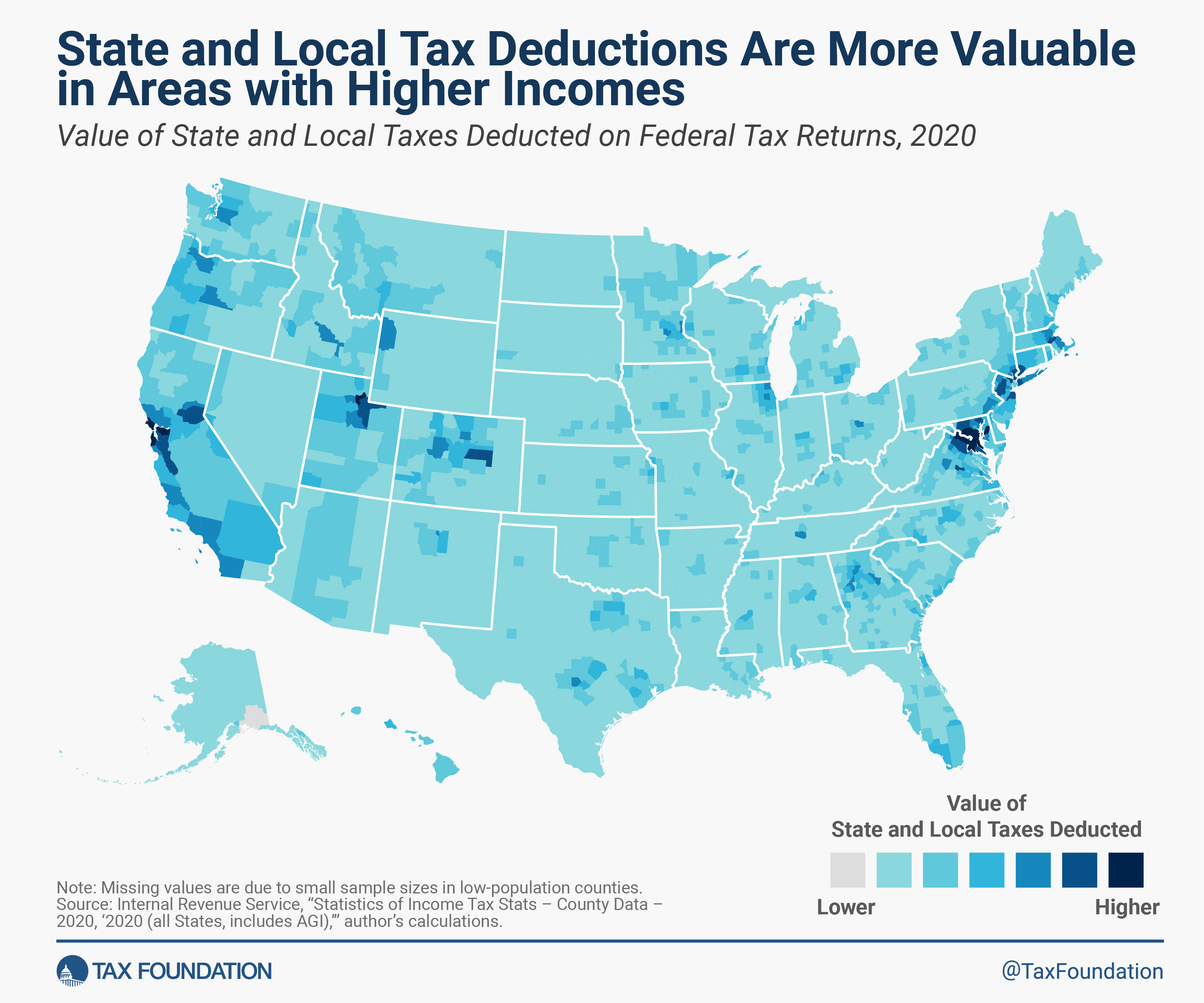
People mostly care about the SALT deduction due to the distributional effects. Who ends up benefiting from the deduction? The short answer is people who 1) itemize & 2) have heavy state and local tax bills. Who is that? Rich people of course! They have high incomes and lots of wealth and real estate – on which they pay taxes. But not all rich people pay loads of state taxes. So the SALT deduction is a tax cut that primarily benefits rich people who live in high tax districts. Where’s that? See the below.
Continue reading

The Dietary Salt Wars

For many years, it has been stated as settled science that Americans need to cut back their sodium intake from the current averages of about 3400 mg/day to less than  2400 mg sodium (about 1 teaspoon of table salt). The 2400 mg figure is endorsed by the National Academies, as described in the 164-page (we’re from the government and we’re here to help) booklet Dietary Guidelines for Americans published by USDA and HHS. The reason given is that supposedly there is a roughly linear relationship between salt intake and blood pressure, with higher blood pressure correlating to heart disease. The World Health Organization (WHO) recommends less than 2000 mg.

The dietary salt boat has been rocked in the past several years by studies claiming that cutting sodium below about 3400 mg does not help with heart disease (except for patients who already incline toward hypertension), and that cutting it much below 2400 mg is actually harmful.

The medical establishment has come out swinging to attack these newer studies. A 2018 article (Salt and heart disease: a second round of “bad science”? ) in the premier British medical journal The Lancet acknowledged this controversy:

2 years ago, Andrew Mente and colleagues, after studying more than 130000 people from 49 different countries, concluded that salt restriction reduced the risk of heart disease, stroke, or death only in patients who had high blood pressure, and that salt restriction could be harmful if salt intake became too low. The reaction of the scientific community was swift. “Disbelief” was voiced that “such bad science” should be published by The Lancet.  The American Heart Association (AHA) refuted the findings of the study, stating that they were not valid, despite the AHA for many years endorsing products that contain markedly more salt than it recommends as being “heart healthy”.

This article went on to note that, “with an average lifespan of 87·3 years, women in Hong Kong top life expectancy worldwide despite consuming on average 8–9 g of salt per day, more than twice the amount recommended by the AHA recommendation. A cursory look at 24 h urinary sodium excretion in 2010 and the 2012 UN healthy life expectancy at birth in 182 countries, ignoring potential confounders, such as gross domestic product, does not seem to indicate that salt intake, except possibly when very high, curtails lifespan.”

A more recent (2020) article by salt libertarians, Salt and cardiovascular disease: insufficient evidence to recommend low sodium intake, stated in its introduction:

In 2013, an independent review of the evidence by the National Academy of Medicine (NAM) concluded there to be insufficient evidence to support a recommendation of low sodium intake for cardiovascular prevention. However, in 2019, a re-constituted panel provided a strong recommendation for low sodium intake, despite the absence of any new evidence to support low sodium intake for cardiovascular prevention, and substantially more data, e.g. on 100 000 people from Prospective Urban Rural Epidemiology (PURE) study and 300 000 people from the UK-Biobank study, suggesting that the range of sodium intake between 2.3 and 4.6 g/day is more likely to be optimal.

… In this review, we examine whether the recommendation for low sodium intake, reached by current guideline panels, is supported by robust evidence. Our review provides a counterpoint to the current recommendation for low sodium intake. We suggest that a specific low sodium intake target (e.g. <2.3 g/day) for individuals may be unfeasible, have uncertain consequences for other dietary factors, and have unproven effectiveness in reducing cardiovascular disease. We contend that current evidence, despite methodological limitations, suggests that most of the world’s population consume a moderate range of dietary sodium (1–2 teaspoons of salt) that is not associated with increased cardiovascular risk, and that the risk of cardiovascular disease increases when sodium intakes exceed 5 g/day.

The keepers of orthodoxy fired back the following year in an article with an ugly title Sodium and Health: Old Myths and a Controversy Based on Denial  and making ugly accusations:

Some researchers have propagated a myth that reducing sodium does not consistently reduce CVD but rather that lower sodium might increase the risk of CVD. These claims are not well-founded and support some food and beverage industry’s vested interests in the use of excessive amounts of salt to preserve food, enhance taste, and increase thirst. Nevertheless, some researchers, often with funding from the food industry, continue to publish such claims without addressing the numerous objections.

Ouch.

I don’t have the expertise to dig down and make a ruling on who is right here. But I do feel better about eating my tasty salty chips, knowing I have at least some scholarly support for my habit.