Coming In to Land

And I twisted it wrong just to make it right
Had to leave myself behind
And I’ve been flying high all night
So come pick me up, I’ve landed

-Fed Chair Ben Folds on the Covid inflation

The Fed has now almost landed the plane, bringing us down from 9% inflation during the Covid era to something approaching their 2% target today. But it is not yet clear how hard the landing will be. Back in March I thought recurrent inflation was still the big risk; now I see the risk of inflation and recession as balanced. This is because inflation risks are slightly down, while recession risk is up.

Inflation remains somewhat above target: over the last year it was 3.3% using CPI, 2.7% by PCE, and 2.8% by core PCE. It is predicted to stay slightly above target: Kalshi estimates CPI will finish the year up 2.9%; the TIPS spread implies 2.2% average inflation over the next 5 years; the Fed’s own projections say that PCE will finish the year up 2.6%, not falling to 2.0% until 2026. The labels on Kalshi imply that markets are starting to think the Fed’s real target isn’t 2.0%, but instead 2.0-2.9%:
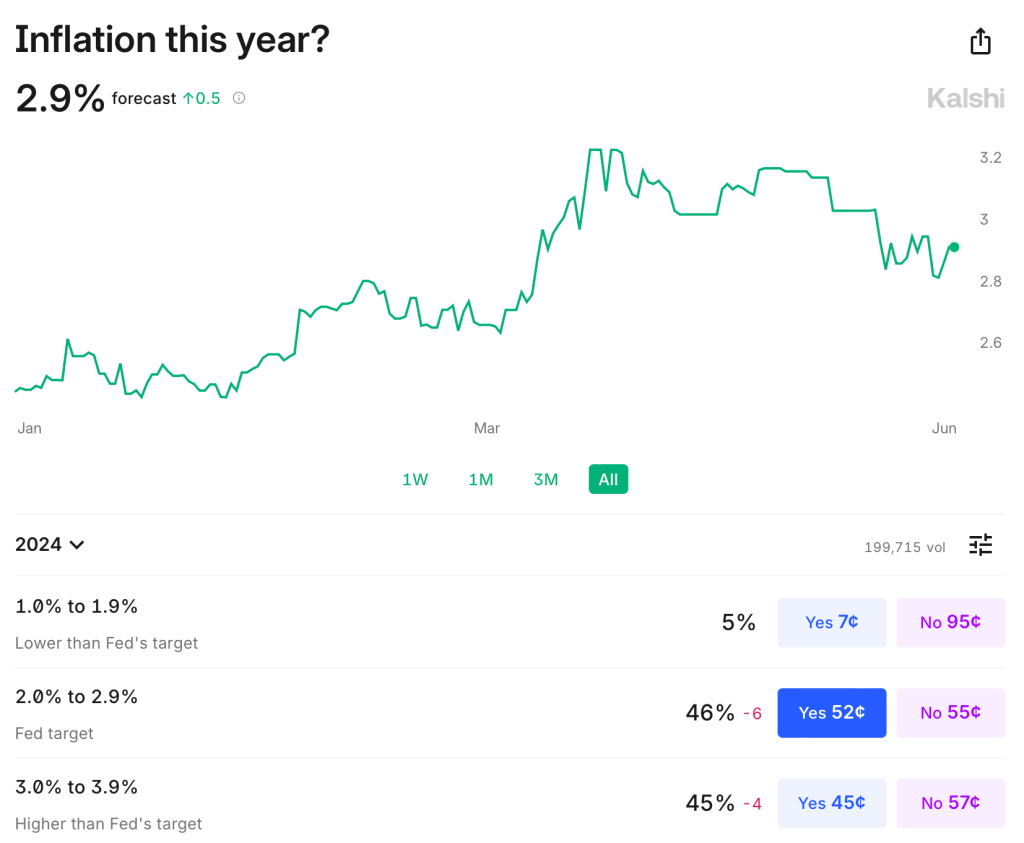
The Fed’s own projections suggest this to be the somewhat the case- they plan to start cutting over a year before they expect inflation to hit 2.0%, though they still expect a long run rate of 2.0%. In short, I think there is a strong “risk” that inflation stays a bit elevated the next year or two, but the risk that it goes back over 4% is low and falling. M2 is basically flat over the last year, though still above the pre-Covid trend. PPI is also flat. The further we get from the big price hikes of ’21-’22 with no more signs of acceleration, the better.

But I would no longer say the labor market is “quite tight”. Payrolls remain strong but unemployment is up to 4.0%. This is still low in absolute terms, but it’s the highest since January 2022, and the increase is close to triggering the Sahm rule (which would predict a recession). Prime-age EPOP remains strong though. The yield curve remains inverted, which is supposed to predict recessions, but it has been inverted for so long now without one that the rule may no longer hold.

Looking through this data I think the Fed is close to on target, though if I had to pick I’d say the bigger risk is still that things are too hot/inflationary given the state of fiscal policy. But things are getting close enough to balanced that it will be easy for anyone to find data to argue for the side that they prefer based on their temperament or politics.

To me the big wild card is the stock market. The S&P500 is up 25% over the past year, driven by the AI boom, and to some extent it pulls the economy along with it. The Conference Board’s leading economic indicators are negative but improving overall this year; recently their financial indicators are flat while non-financial indicators are worsening.

Overall things remind me a lot of the late ’90s: the real economy running a bit hot with inflation around 3% and unemployment around 4%; the Fed Funds rate around 5%; and a booming stock market driven by new computing technologies. Naturally I wonder if things will end the same way: irrational exuberance in the stock market giving way to a tech-driven stock market crash, which in turn pushes the real economy into a mild recession.

Of course there is no reason this AI boom has to end the same way as the late-90’s internet boom/bubble. There are certainly differences: the Federal government is running a big deficit instead of a surplus; there are barely a tenth as many companies doing IPOs; many unprofitable tech stocks already got shaken out in 2022, while the big AI stocks are soaring on real profits today, not just expectations. Still, to the extent that there are any rules in predicting stock crashes, the signs are worrying. Today’s Shiller CAPE is below only the internet and Covid meme-stock bubble peaks:
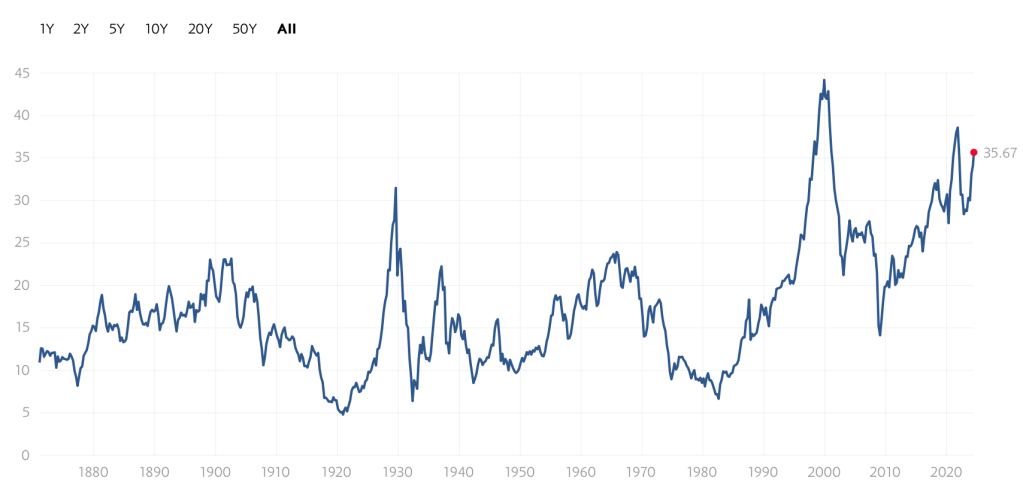
Again, this doesn’t mean that stocks have to crash, or especially that they have to do it soon; the CAPE reached current levels in early 1998, but then stocks kept booming for almost two years. I’m not short the market. But the macro risk it poses is real.
US Stocks Are Expensive, These Countries Are Not

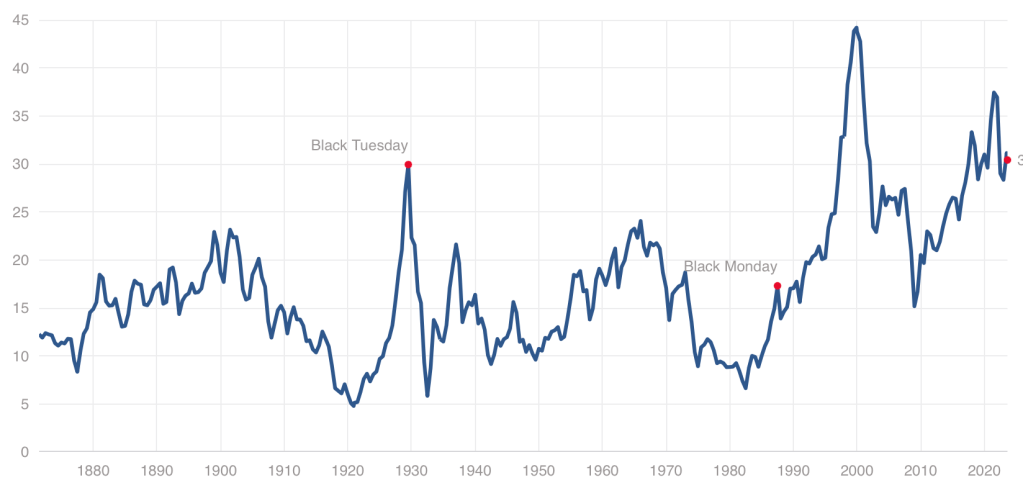
While we have stepped back from the meme stock craziness of 2021, US stocks remain quite expensive by historical standards, with our Cyclically Adjusted Price to Earnings (CAPE) ratio at almost twice its long-run average:

Source

Even at a high price, US stocks could still be worth it, and I certainly hold plenty. But I also think it it a good time to consider the alternatives. US Treasury bond yields are the highest they’ve been since 2007. But there are also many countries where stocks are dramatically cheaper than the US- and not just high-risk basket-cases, but stable “investable” countries.

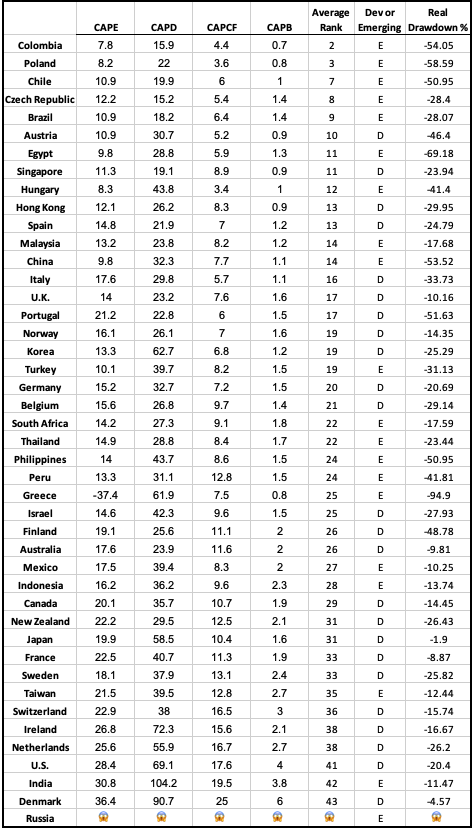
There are several reasonable ways to measure what counts as “expensive” for stocks in addition to the CAPE ratio I mention above. The Idea Farm averages out four such measures to determine how expensive different “investable” (large, stable) country stock markets are. Here is their latest update:

MSCI Investable Market Indices:

Source: The Idea Farm Global Valuation Update

You can see that US stocks are expensive not only relative to our own history, but also relative to other countries, lagging only India and Denmark. That means that much of the world looks like a relative bargain, with the cheapest countries being Colombia, Poland, Chile, Czech Republic, and Brazil.

Of course, sometimes stocks, just like regular goods and services, are cheap for a reason: they just aren’t that good. They might be cheap because investors expect slow growth, or a recession, or political risk. But if you don’t share these expectations about a cheap stock (or country), that’s when to really take a look. I certainly did well buying Poland after I saw they were the cheapest in last year’s global valuation update and thought there was no good reason for them to stay that cheap.

I like that the chart above provides a simple ranking of investable markets. But if you wish it included more valuation measures, or small frontier markets, you can find that from Aswath Damodaran here. Some day I hope to provide a data-based, rather than vibes-based, analysis of which countries are “cheap/expensive for a reason” vs “cheap/expensive for no good reason”, featuring measures like industry composition, population growth, predictors of economic growth, and economic freedom. For now you just get my uninformed impression that Poland and Colombia seem like fine countries to me.

Disclosure: I’m long stocks or indices in several countries mentioned, including EPOL, FRDM, PBR.A, CIB, and SMIN. Not investment advice.

Continue reading

Unfashionable Investing

Investors such as mutual funds, index funds, and hedge funds tend to pick a particular strategy or asset type and stick with it. It’s what they know, it’s what they’re known for, and making major changes would often create legal difficulties; something marketed as a bond fund can’t suddenly switch to stocks even if they think stocks would do much better. Other types of investors like pension funds, endowments and individuals have more flexibility to change their strategies. These investors tend to chase performance, allocating to types of investments that have performed well recently. This can create fashions, types of investment strategies that become more popular for a few years.

These strategies might involve focus on a certain asset class (stocks / bonds / commodities / private equity / real estate / et c), a certain sector or region within an asset class, a certain factor (value, growth, momentum), et c. It seems like institutional incentives, trend chasing, and FOMO lead people and institutions to over-allocate to strategies that have been successful the last 1-5 years and under-allocate to those that haven’t. Everyone sees something has recently been successful, so they pile into it, which drives up prices and makes it look even more successful for a while; but eventually this drives things to be so clearly over-valued that there’s a crash, and the crash scares people away for years until it becomes clearly undervalued. Most recently 2020-2021 saw people pile into growth/tech stocks and alternatives like SPACs/crypto, but the beginning of Fed rate hikes was the signal that the party is over and people (over?)react by pulling out.

Given this, the ideal strategy is to show up right before the party starts, then leave right at the peak; but no one can time it that well. The possibly realistic alternative is to show up early when no one’s there, then leave right when the party’s getting good (Punchbowl Capital?). Timing and identifying which strategies are too hot and which cold enough (Glacier Capital? Cryo Capital?) is the biggest practical question in how to pull this off. The simplest/dumbest way to do it is to avoid timing decisions entirely and just invest fixed proportions into all strategies; when they’re over-valued your fixed investment doesn’t buy many shares, when they’re under-valued it buys lots. This actually sounds like a decent way to go, but its more buying into the Efficient Market Hypothesis than beating it, can we do better? Here are the types of meta-strategies I’m planning to look into:

  • How variable is the timing of strategy boom/busts? Could you possibly just use fixed numbers of months/years- if a strategy’s been hot this long get out, if its been cold this long get in?
  • Use market share numbers, get in when something gets below a certain % of the market and out when it gets above
  • Use valuation numbers like P/E ratios (seems to work well for the overall stock market, may be harder to measure for some strategies/classes)
  • Flow of funds- is there a rate of change that works as a trigger?
  • Proportion of major institutions allocating to each strategy
  • What looks promising right now along these lines (May 2022)? Without looking at the numbers, the perennial strategies that have been out-of-favor a few years seem like value, emerging markets, and commodities (though commodities might be too hot again just now). These (along with real estate; right now homes seem expensive but homebuilders are cheap and I think commercial is too) all did well after the 2000 tech crash

I’m obviously not the first person to think along these lines; the concepts of the commodity cycle and Shiller’s CAPE are related, and Global Macro and Multistrategy funds do some of this. In the latest AER: Insights, Xiao Yan and Zhang echo Robert Shiller and Paul Samuelson that predicting big things like this is actually easier than predicting little things like the valuation of a specific stock:

Samuelson’s Dictum refers to the conjecture that there is more informational inefficiency at the aggregate stock market level than at the individual stock level. Our paper recasts it in a global setup: there should be more informational inefficiency at the global level than at the country level. We find that sovereign CDS spreads can predict future stock market index returns, GDP, and PMI of their underlying countries. Consistent with the global version of Samuelson’s Dictum, the predictive power for both stock returns and macro variables is almost entirely from the global, rather than country-specific, information from the sovereign CDS market

Ungated version here

But I haven’t actually heard of any fund focused on “unfashionable investing” that considers all asset classes and strategies like this. What institution out there would be capable of saying in 2021 “growth stocks are at bubbly levels, we’re switching to commodities”, or saying in 2022 “commodities are high and growth stocks crashed, we’re switching back”? Please let me know if such an institution does exist, or what else to read along these lines.