GLIF Social Media Memes

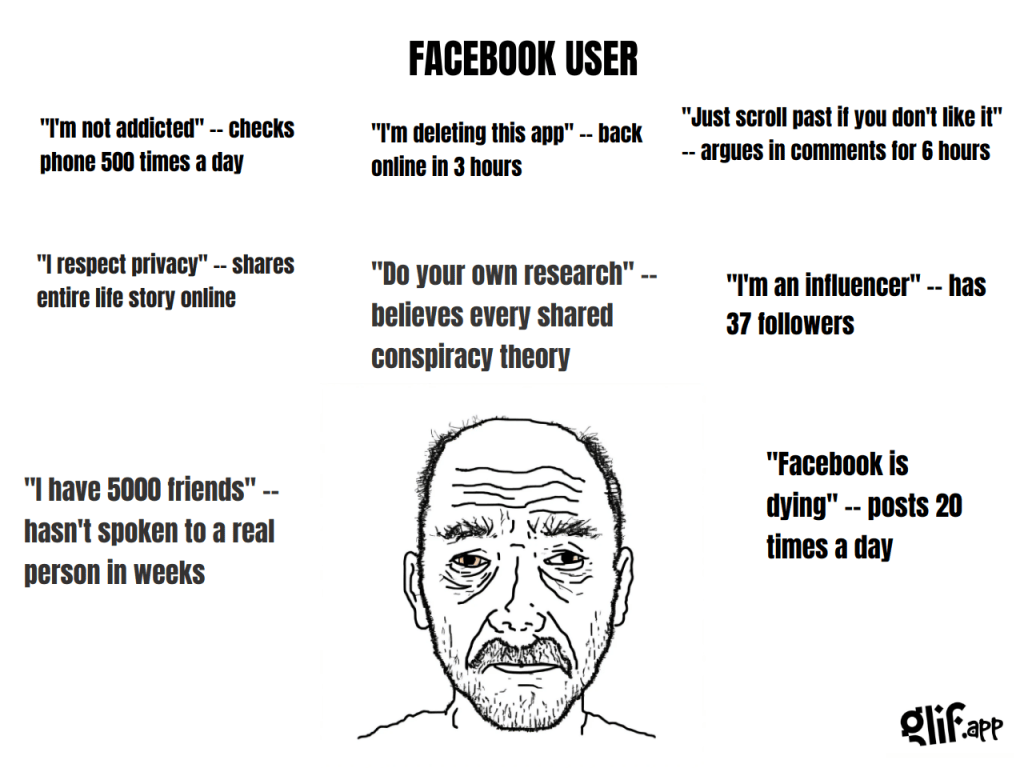
Wojak Meme Generator from Glif will build you a funny meme from a short phrase or single word prompt. Note that it is built to be derogatory, cruel for sport, and may hallucinate up falsehoods. (see tweet announcement)

I am fascinated by this from the angle of modern anthropology. The AI has learned all of this by studying what we write online. Someone can build an AI to make jokes and call out hypocrisy.

Here are GLIFs of the different social media user stereotypes as of 2024. Most of our current readers probably don’t need any captions to these memes, but I’ll provide a bit of sincere explanation to help everyone understand the jokes.

Twitter user: Person who posts short messages and follows others on the microblogging platform.

Facebook user: Individual with a profile on the social network for connecting with friends and sharing content.

Bluesky user: Early adopter of a decentralized social media platform focused on user control.

Continue reading

Social Media, Mental Health, and Young People

What’s the connection between social media use and mental health, especially among young people? You’ve probably heard a lot about this recently, in the media, by politicians, and among friends chatting about their kids. Lots of assertions are made, but there is also a bit of research on this topic. As someone who frequently uses social media myself, as well as a parent of young children, and a teacher that works every week with young college students, I am particularly interested in this topic.

Jonathan Haidt and various co-authors have been trying to catalog all the research on the topic and figure out if there is a connection between the decline in teenage mental health and the rise of social media use. Haidt also has a new book on this topic, as well as the decline of “free play” among kids, which I have not yet read but I’ve looked through his documents that contain all of the underlying and summaries of the research he is citing. I’ll read the book soon, as I’m certainly part of the intended audience (see the last sentence of the above paragraph). And while this research is very much outside of my area of expertise, my training as an economist has taught me how to read academic papers and to be convinced by evidence, so once again I’m very much the intended audience on this score as well.

Please read this post as my attempt to understand the evidence and start to form conclusions and/or critique what Haidt is saying. It’s a work in progress, and I’ll write more as I read and think more about it.

Continue reading

EconTwitter Platforms and Threads

There is a community called #EconTwitter. This agglomeration of not-anonymous accounts links together professional economists, academics, and independent intellectuals. Twitter.com is the home base and origin of #EconTwitter. Mike wrote about turmoil in EconTwitter in December 2022. Find me on Twitter at @aboutJoy

The #EconTwitter group has experimented with leaving Twitter to join new networks. For some people, getting away from the billionaire owner is the explicit goal. Others join the new platform to be where the people are.

Mastodon launched in 2016 but it was not until recently that #EconTwitter made a go at that.

Mastodon is also part of the Fediverse ensemble of computer servers, which use shared protocols allowing users to interact with other users on computers running compatible software packages such as PeerTube and Friendica. Mastodon is crowdfunded and does not contain ads.

https://en.wikipedia.org/wiki/Mastodon_(social_network)

Fediverse? Protocols? The average Twitter user does not want to be bothered with “computer servers”. That’s part of the problem. On Mastodon I am @JoyBuchanan@econtwitter.net

When I joined, I was not confident that it would build on the initial momentum. The reason that the move to Mastodon was large and sudden is that Paul Goldsmith-Pinkham volunteered to set up econtwitter.net It’s paid for out of his research budget and he serves as the monitor. He can ban anyone who violates his speech/civility rules. So there is a moderator but not one paid by Mastodon.

I wrote about “Content Moderation Strategy” back in April 2022 when Elon at Twitter was big news.

Elon Musk buying Twitter is the big news this week. He wants to enhance free speech on the site and, according to him, make it more open and fun. Some fans are hoping that he will make the content moderation and ban policy more transparent. 

me in April 2022

Some people thought Twitter would crash – as in go offline – because of Elon. That has not happened, but users and brands have been irked by his management and personal style.

EconTwitter at Mastodon is still going. As far as I can tell, most people have reverted to Twitter for their main feed because the audience is larger and writers want engagement. The level of engagement at Mastodon probably peaked about a month after Paul started the server for economists. One reason I think it never overtook real EconTwitter is that economists like having a big audience that includes journalists and sociologists. Silo-ing on an EconTwitter-dedicated server was less fun. People say they don’t want to have to deal with weird strangers online, but revealed preference indicates otherwise.

Another notable development was the launch of Bluesky. I’m there as @joybuchanan.bsky.social

Making a good handle at the beginning is easy and there is some upside if it turns out to attract a large community. A few “Twitter famous” people will join these new apps and commit to posting just in an attempt to unseat Twitter. This sort of works in the sense that both networks are still operating, however neither ever got close to the Twitter scale.

Threads, launched this week, might be different.

Mark Zuckerberg opened up Threads for anyone with an Instagram account, which most of us already have. Millions of people joined in just two days. If you already have an Insta, then you can download the free Threads app on your phone and port over your Insta account.

I’m @_Joy_Buchanan_ on Threads. The underscores might look awkward, but there is no “early adopter” phenomenon here, unless you were an early adopter of Instagram.

Brands and celebrities are comfortable on Threads, so it will be able to make money without asking users to pay for a Blue Check. I have no problem with Elon asking Twitter users to pay. Someone who is worried about free speech should want to be able to pay for service.

The Silicon Valley phrase is: “If you’re not paying for the product, you are the product.

That’s going to be true on Threads, since I’m not paying for the product.

Threads will not kill Twitter, but it is going to make a bigger dent than Bluesky and Mastodon did. Nothing is free and nothing is perfect. I know a lot of people are upset about Twitter. However, there are some people who got a voice through it. People stuck inside authoritarian countries had a way to send messages out to a global audience.

Here is my most bullish case for Threads: it might unite the “TikTok generation” that never joined Facebook or Twitter but had Instagram with the older people from Twitter who never joined TikTok. The Twitterers will stay if they get enough attention.

Thus, Threads might put a dent in TikTok, too. Zuckerberg is probably sophisticated enough to make a “TikTok person” feel engaged by sending them more food videos and less BLS update charts.

Continue reading

Content moderation strategy

Anyone can comment on this blog. We’d love to see more comments. Challenging our ideas is fine. Telling us that you like our work is encouraging.

If you are in the know, then you assume we have a comment moderation policy, because everyone needs one. If you have never run a website then you might think it is possible to simply have an open form that anyone could type into and get immediately published on the platform.

Comments come in every day, but most of them never get posted. We are not against free speech or silencing an opposition. Most of the comments, if you can even call them comments, are spam. Sometimes spammers try to get posted by saying that they love the site, and sometimes the text seems like AI-generated pornography. The words are not written by humans or at least not humans who have actually read our content.

I don’t think it’s smart to be 100% transparent about our “algorithm” for filtering out this spam. That would make it easier to for bad actors to accomplish what they want to accomplish.

To our human readers, please comment. Your comment will get posted, although sometimes it might take a minute or even hours to get through. We are not censoring ideas, yet we need a moderation policy or else this place would not be fun. People would not want to wade through spam.

Elon Musk buying Twitter is the big news this week. He wants to enhance free speech on the site and, according to him, make it more open and fun. Some fans are hoping that he will make the content moderation and ban policy more transparent. Maybe that’s possible. Maybe he can improve the site.

My point is that if you have not been on the admin side of an internet forum then you might not realize the challenge it presents. There are trade offs involved. I believe that there can be improvements to the current system at Twitter. However, if you want to be taken seriously be tech folk then ask for a system that is possible. A substantially better experience might be incompatible with the site being free to users.

In our case, we could improve our system at EWED. Real people who comment will not like the lag, and fixing that is a technical problem. More time and money could solve it, but this site makes no money.

The economics insight is that you get what you pay for. Studio executives make the movies they believe you will pay for. We get the politicians we bother to vote for. Journalists report what they get paid to write.

Twitter could create a paid user tier. Paid users would be entitled to speak to a human on staff at Twitter in the event that they get censored and have the option of an appeals process.

I am used to getting a lot of services for free online. New companies roll out a huge free initial offering to harvest users and data. I have spent most of my adult life in that roll out phase. Eventually the party stops and investors want to see a revenue stream. Maybe I should start paying for the internet services I value. Maybe part of the reason the conversation is so rancorous is that we are transitioning away from everything being free. Inventing social media is sort of like humans discovering fire and cocaine at the same time! We are still figuring out how to use these tools effectively and safely.

I think a bad scenario happens if we cannot transition over to a patronage model. Remaining trapped in a free stuff mentality would be worse in the long run. I hope Napster didn’t ruin me. In an ideal world, I would be willing to pay for social media and also never spend more than 2 hours a day scrolling on any open platform. We should try for that. We should supplement our online reading with content that has made it past a publisher. For now, one way to get around Twitter censorship is to buy and read books.