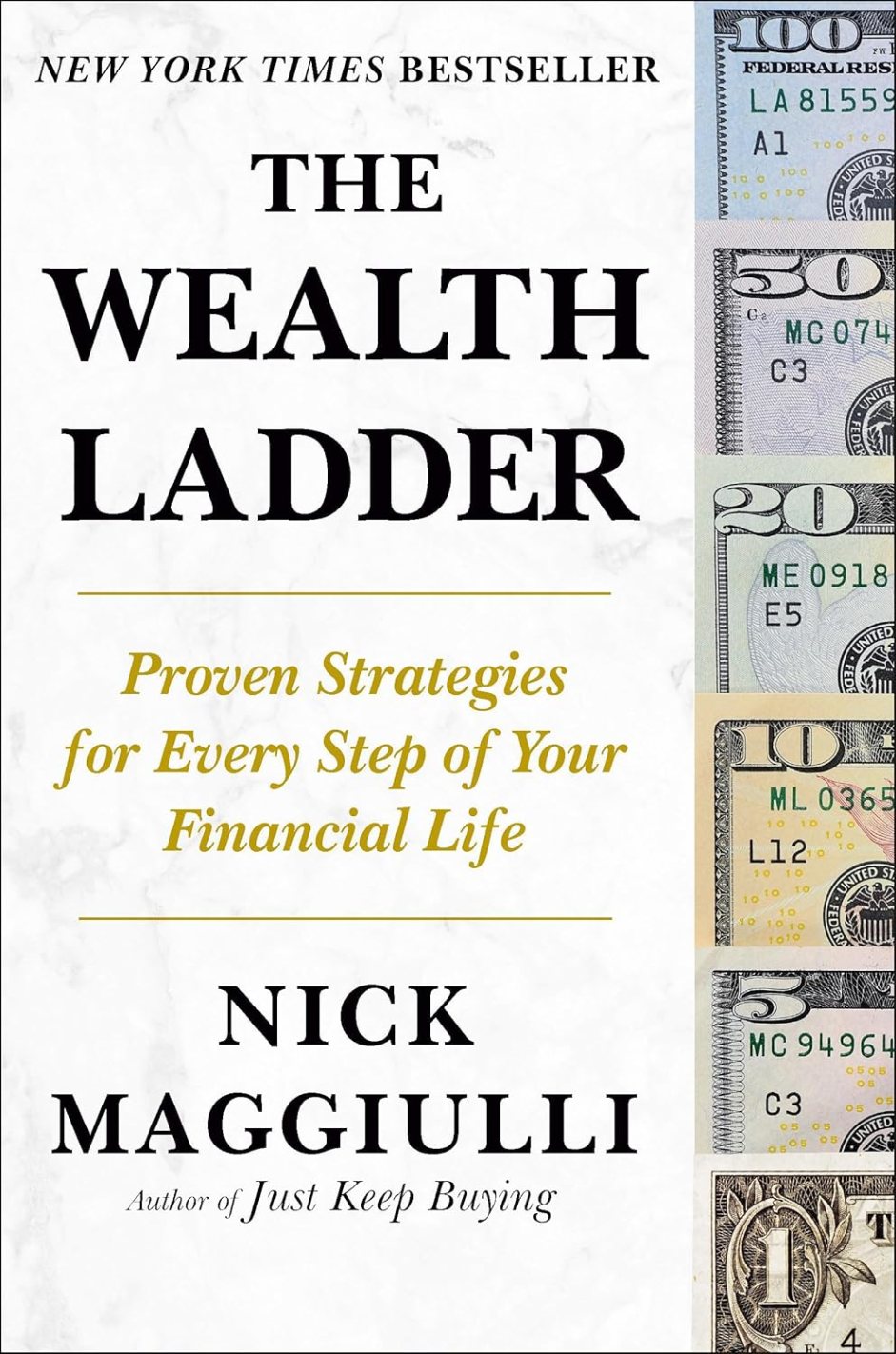
The Wealth Ladder is a 2025 personal finance book from data blogger Nick Maggiulli. The core idea is good: that the best financial strategies will be different based on your current wealth level. Maggiulli divides people into 6 net worth levels based on orders of magnitude, from less than $10K to over $100M. The middle of the book has separate chapters with advice for people in each level, so a book that is already a fairly quick and easy read as a whole could be even quicker if you skipped the chapters about levels other than your own.
The beginning of the book tries to develop some simple rules phrased in a way that they can apply across every level, because they are based on a percentage of your net worth. I like the idea but don’t think it really worked. His “1% Rule” says you should only accept an opportunity to earn money if it will increase your net worth by at least 1%. But in practice, whether an earning opportunity is worth your time depends less on how many absolute dollars in generates as a % of your net worth, and more on how many $ per hour it generates. The “0.01% Rule” (don’t worry about spending money on anything that costs less than 0.01% of your net worth) is better. But whether it is a good rule for you will depend on your age and income.
In short, while tailoring his advice in 6 different ways for the 6 wealth levels of his ladder is an improvement on one-size-fits all personal finance books, even this much tailoring isn’t enough. Having a $1 million net worth is normal for a household in their 60s but would be exceptional for one in their 20’s; and vice-versa for a household with under $10k net worth. Chapter 10 explains the data on this well, but it kind of undermines the ideas of the previous chapters. Households with the same net worth should be making very different decisions in their 20s vs 60s.
The strongest part of the book is the use of data from the Survey of Consumer Finances and the Panel Study of Income Dynamics to show how people differ by wealth level and how people move from one level to another. For instance, he shows that the poor have most of their wealth in cash and vehicles; the middle class in homes; the wealthy in retirement accounts and stocks; the very rich in private businesses. Americans tend to climb the wealth ladder slowly but steadily; over 10 years they are twice as likely to move up the ladder as to move down; over 20 years, 3 times as likely. The median person who made it to one of the top 3 rings (i.e. the median millionaire) is in their 60s.
If you get ahold of a copy of the book it’s definitely worthwhile to flip through all the tables and figures, but I won’t be adding to to my short list of the best personal finance books. The core metaphor of the ladder carriers the implicit assumption that everyone should be trying to get to the top of the ladder. But if someone is satisfied with less than $10 million, why should they take on lots of time and effort and risk to start a business for a small chance to go over $100 million?
Continue reading
 Economist Writing Every Day