Don’t worry, EWED is in the same place as always, but my personal website is moving.
Temple University has generously hosted my site long after my 2014 graduation. But next week they are moving to a more typical policy where alumni lose access to online university resources like web-hosting, email, and library datasets starting one year after graduation.
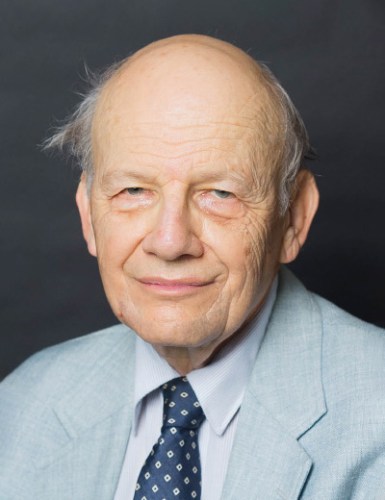
I’m told that Professor Erwin Blackstone died earlier this year, but I haven’t been able to find anything like an obituary online; consider this a personal memorial.
I knew Dr. Blackstone first as the professor of my Industrial Organization class at Temple University, where he taught since 1976. He was a model of how to take students seriously and treat them respectfully; he always called on us as “Mr./Ms. Last Name” and thought carefully about our questions.
Of course I learned all sorts of particular things about IO, especially US antitrust law and history- from Judge Learned Hand and baseball’s antitrust exemption to current merger guidelines and cases. I would later ask Dr. Blackstone to join my thesis committee, where he would heavily mark up my papers with comments and critiques.
He was a key part of how I was able to become a health economist despite the fact that Temple lacked a true health economist on the tenure-track economics faculty while I was there (as opposed to IO or labor economists who did some health). Blackstone’s coauthor Joseph Fuhr– a true health economist who also had Blackstone on the committee of his 1980 dissertation- came part-time to teach graduate health economics. Blackstone and Fuhr worked together to write the health economics field exam I took.
Finally, I learned from Blackstone by reading his papers. While he wrote many on health economics, my personal favorite was his work with Andrew Buck and Simon Hakim on foster care and adoption. It convincingly demonstrated the problems of having one fixed price in an area that most people don’t think about as a “price” at all- adoption fees. Having one fairly high fee for all children means the few seen as most desirable by adopting parents (typically younger, whiter, healthier) get adopted quickly, while those seen as less desirable by would-be adoptive parents linger in foster care for years. Like much of his work, it pairs a simple economic insight with a rich explanation of the relevant institutional details.
Academics hope to live on through our work- through our writing and the people we taught. Having taught many thousands of students at Cornell, Dartmouth, and Temple over 55 years, served on dozens of dissertation committees, and published over 50 papers and several books, I expect that it will be a long, long time before Erwin Blackstone is forgotten.
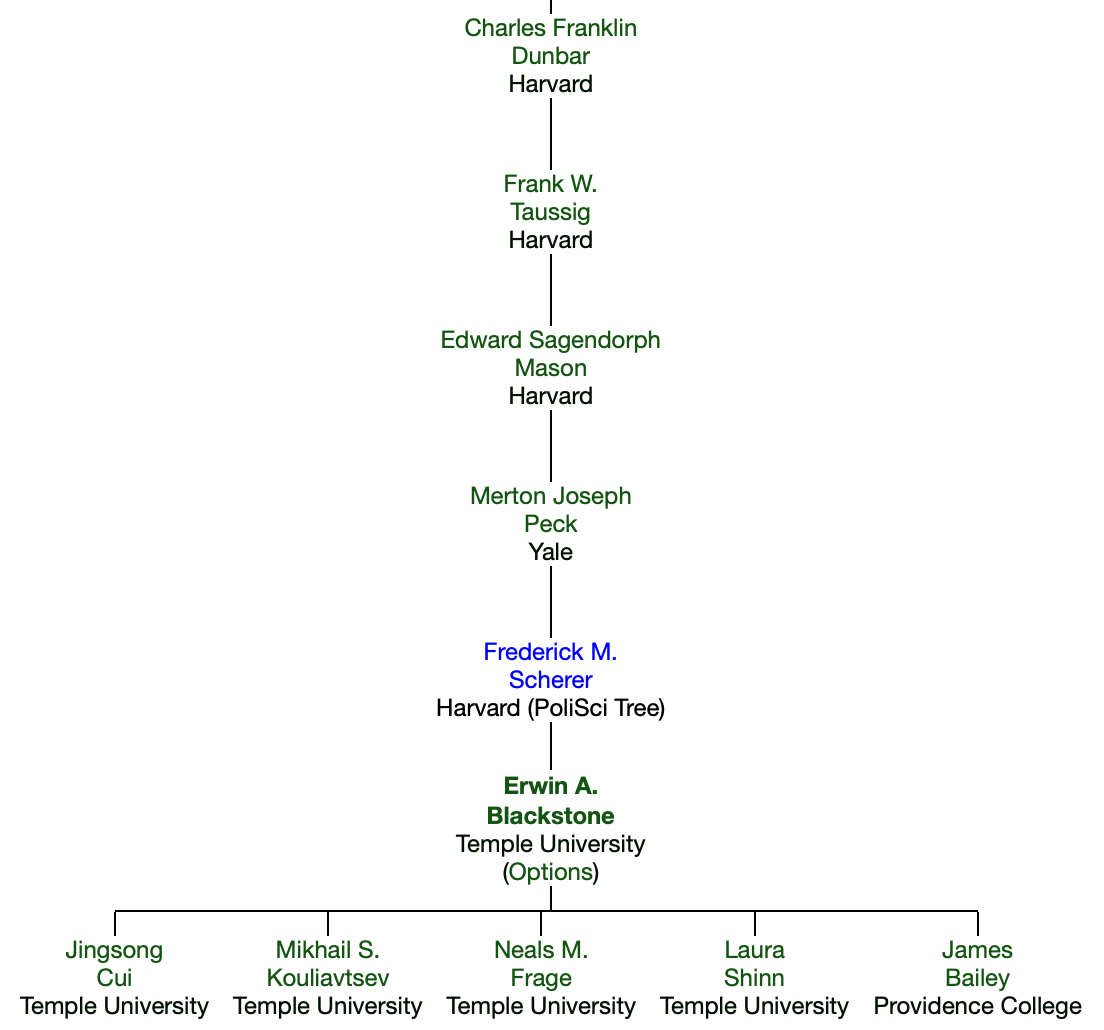
Source: Academic Tree. Charles Franklin Dunbar founded the Quarterly Journal of Economics in 1886.
Last weekend brought me back to Temple University, ten years after graduating, for a conference of econ PhD alums. I had so many reactions:
Mixing a research conference with what is effectively a reunion or homecoming is a great idea for a PhD program, and more schools should do it. It brought together alumni from all different years, but it especially felt like a reunion to me since it’s been ten years since I graduated (not that I really know about reunions; I’ve never been to a high school or college one).
Philadelphia in general and Temple University in particular have gotten much nicer (though still gritty). Some of this I expected; the country is getting steadily richer, and it seems like every college is always on a building spree. But as with New Orleans, it is a city still well below its peak population that I first got to know in the aftermath of the great recession. Unemployment in Philly is now well under half what it was the whole time I lived there, and it shows.
Life is short. I was saddened, but not shocked, to hear that one of my professors had died. I was saddened and shocked to hear that one of my fellow students had.
As a kid, whenever I went back to one of my old schools, I usually felt nostalgia mixed with the feeling that everything seemed small. Then I thought this smallness was only about me having grown taller, but now I wonder. At Temple the economics department has changed buildings, but when I went back to the old building everything seemed small, despite me being the same size I was in grad school. But at the time the building loomed so large in my mind; I was so focused on the things that happened there, the classes and tests, the study sessions and writing in the computer lab, what the professors thought, and everything that it all represented. All that apparently made the rooms seem physically larger in a way they now don’t once I have graduated and the professors moved.
Temple PhDs are much more successful than I would have guessed at the time. It was hard for students attending what was then a bottom-ranked program during the Great Recession to be optimistic about our job prospects, especially when we worried we might fail out of the program (a valid concern when, afaik, only 4 of the 11 students in my year finished their PhDs). But things turned out great; just in the past 10 years from a small program there are many people who are tenured or tenure track at decent schools, who have research or important supervisory positions at the Fed, or who are making a name for themselves in the private sector (like Adam Ozimek).
Why have we so exceeded our low expectations? The improving economy helped. Economics PhDs from anywhere turned out to be a valuable degree. Perhaps our training was stronger than we gave it credit for at the time. I see two main tracks for success coming out of a lower-ranked program, where the school’s name alone might not open doors:
find some way to get your foot in the door of a major institution like the Fed system or a major bank, then work your way up. The initial way in could be something less competitive, like an internship or a job you don’t necessarily need a PhD for. But once you are in you will be judged mostly on your performance within the institution, not your credentials. In a panel on non-academic jobs, several alums emphasized that conditional on having enough technical skills to get hired, at the margin people/communication skills are much more important to advancement than further technical skills.
Temple’s economics PhD program paused admissions back in 2020, but is aiming to restart with a redesigned program in 2025.

 Economist Writing Every Day