The Little Book of Active Investing

Wiley publishes a series of short books on investing called “Little Books, Big Profits“.

I previously reviewed Vanguard founder John Bogle’s entry in this series, the Little Book of Common Sense Investing:

I can sum it up at much less than book length: the best investment advice for almost everyone is to buy and hold a diversified, low-fee fund that tracks an index like the S&P 500.

You could call Bogle’s book the Little Book of Passive Investing; but most of the rest of the series could be the Little Books of Active Investing. That is certainly the case for Joel Greenblatt’s entry, The Little Book that Beats the Market (or its 2010 update, The Little Book that Still Beats the Market).

Greenblatt offers his own twist on value investing that emphasizes just two value metrics- earnings yield (basically P/E) and return on capital (return on assets). The idea is to blend them, finding the cheapest of the high-quality companies. The specific formula is to pick stocks with a return on assets of at least 25%, then select the ~30 stocks with the lowest P/E ratio among those (excluding utilities, financials, and foreign stocks), then hold them for a year before repeating the process. He shows that this idea performed very well from 1988 to 2010.

How has it done since? He still maintains the website, https://www.magicformulainvesting.com, that gives updated stock screens to implement his formula, which is nice. But the site doesn’t offer updated performance data, and his company (Gotham Capital) offers no ETF to implement the book’s strategy for you despite offering 3 other ETFs, which suggests that Greenblatt has lost confidence in the strategy. Here are the top current top stocks according to his site (using the default minimum market cap):
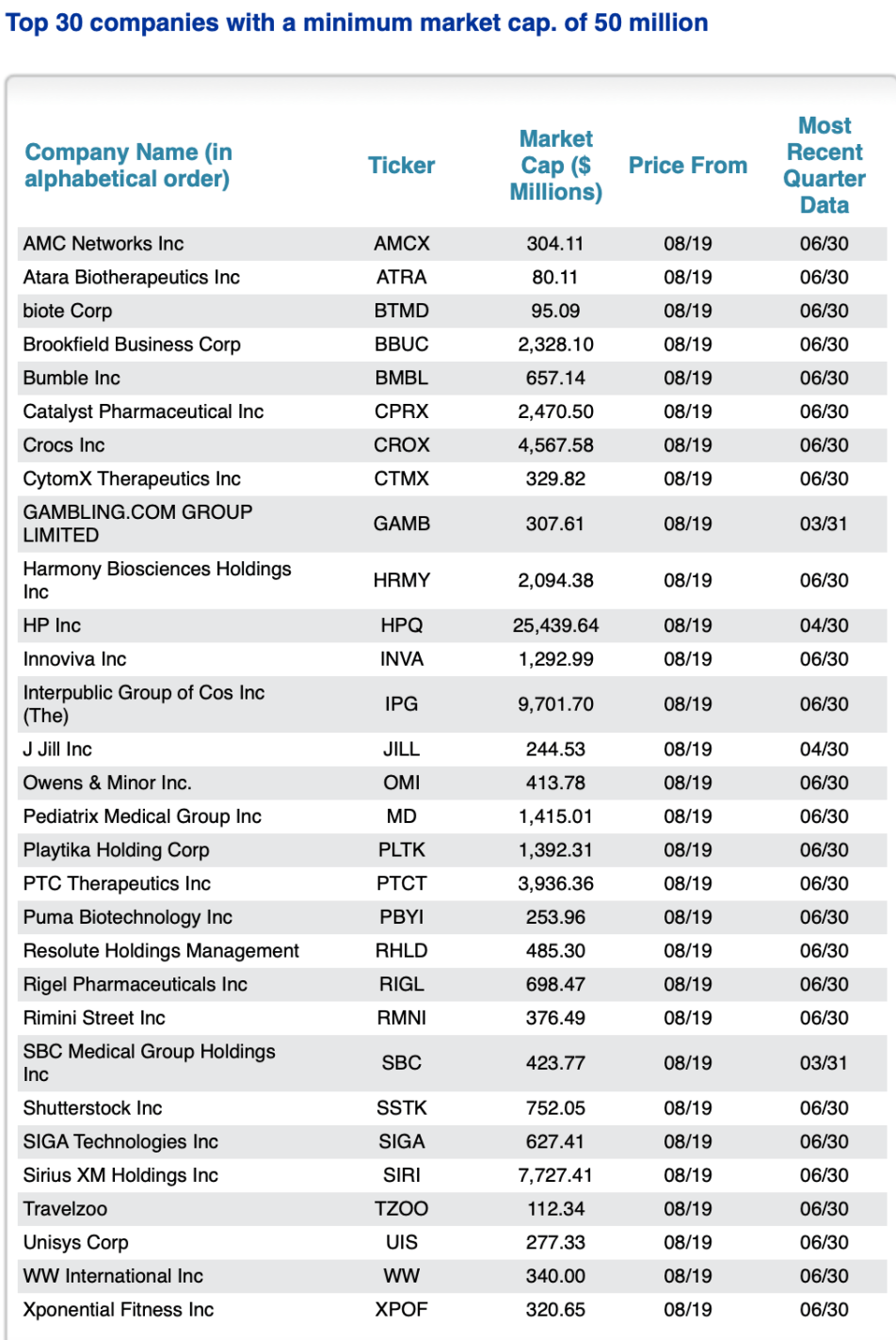
Perhaps this is worthwhile as an initial screen, but I wouldn’t simply buy these stocks even if you trust Greenblatt’s book. When I started looking them up, I found the very first two stocks I checked had negative GAAP earnings over the past year, meaning Greenblatt’s formula wouldn’t be picking them if it used correct data. The site does at least have a good disclaimer:

“Magic Formula” is a term used to describe the investment strategy explained in The Little Book That Beats the Market. There is nothing “magical” about the formula, and the use of the formula does not guarantee performance or investment success.

Greenblatt’s Little Book is a quick and easy way to learn a bit about value investing, but I think Bogle’s Little Book has the better advice.
The Little Book of Common Sense Investing

John Bogle, the founder of Vanguard, wrote a short book in 2006 that explains his investment philosophy. I can sum it up at much less than book length: the best investment advice for almost everyone is to buy and hold a diversified, low-fee fund that tracks an index like the S&P 500.

Of course, a strategy that is simple to state may still take time to understand and effort to stick to. So the book helps to build intuition for why this strategy makes sense. I think Bogle makes his case well, though the book is getting a bit dated- the charts and examples end in 2006, and he sets up mutual funds as the big foil, when today it might be high-fee index funds or picking your own stocks.

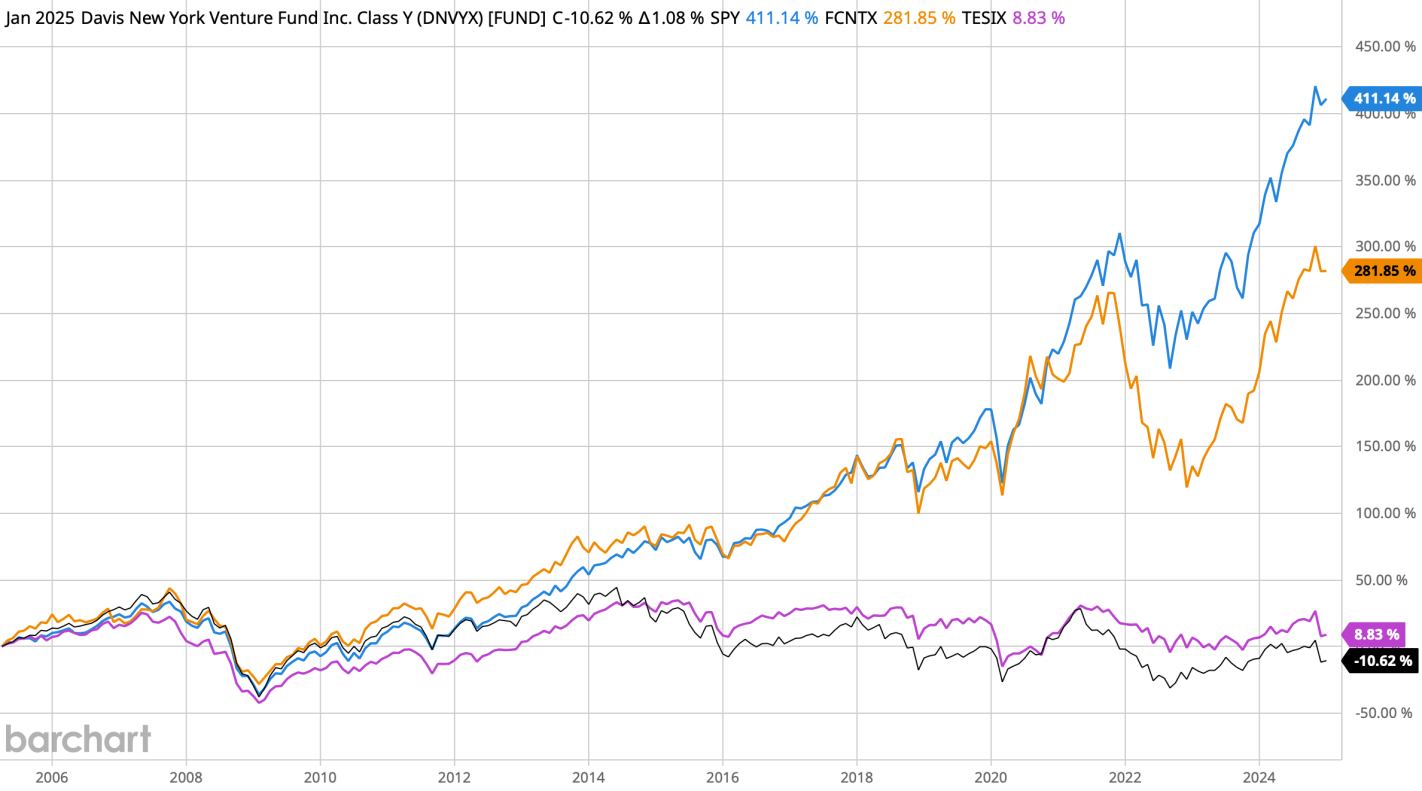
The silver lining of any dated investing book is that we can check up on how its predictions have fared. In chapter 8, Bogle compared the performance of the 355 equity mutual funds that existed in 1970 to that of the S&P over the 1970-2006 period. He notes that 223 of the funds had gone out of business by 2006, and even most of the surviving funds underperformed the S&P. But he identifies 3 funds that outperformed the S&P significantly (over 2% per year) on a sustained basis (consistently good performance, not just high returns at the beginning when they were small): Davis New York Venture, Fidelity Contrafund, and Franklin Mutual Shares. But how have they done since the book came out?

It is a huge victory for the S&P (in blue). Franklin Mutual Shares is basically flat over the past 20 years, while Davis New York Fund actually lost money. Fidelity Contrafund returned a respectable 281% (about 7% per year), and matched the S&P as recently as 2020. But as of 2025 the S&P is the clear winner, up 411% in 20 years (over 8% per year). Score one for Bogle.

But I still have to wonder if there is a way to beat the S&P- and I think one of Bogle’s warnings is really an idea in disguise. He warns repeatedly about “performance chasing”:

But whatever returns each sector ETF may earn, the investors in those very ETFs will likely, if not certainly, earn returns that fall well behind them. There is abundant evidence that the most popular sector funds of the day are those that have recently enjoyed the most spectacular recent performance, and that such “after-the-fact” popularity is a recipe for unsuccessful investing.

The claim is that investors pile into funds that did well over the past 1-3 years, but these funds subsequently underperform. But if this is true, could you succeed by reversing the strategy, buying into the unpopular sectors that have recently underperformed? I’ve been wondering about this, though I have yet to try seriously backtesting the idea. I was surprised to see Mr. Index Fund himself support such attempts to beat the market toward the end of his book:

Building an investment portfolio can be exciting…. If you crave excitement, I would encourage you to do exactly that. Life is short. If you want to enjoy the fun, enjoy! But not with one penny more than 5 percent of your investment assets.

He goes on to say that even for the fun 5% of the portfolio he still doesn’t recommend hedge funds, commodity funds, or closet indexers. But go ahead and try buying individual stocks, or actively managed mutual funds “if they are run buy managers who own their own firms, who follow distinctive philosophies, and who invest for the long term, without benchmark hugging.”