Hayek on The Volatility Pie

In the Road to Serfdom, Friedrich Hayek uses some basic quantitative logic to make an important point about employment and political economy.

Hayek starts by assuming that government jobs are stable relative to those in the private sector. This might seem obvious, but let’s just start by checking the premises. Below are the percent change in total compensation and total employment for government employees and for the private sector. From year to year, private employment and total compensation is more volatile. So, Hayek’s initial premise is correct.

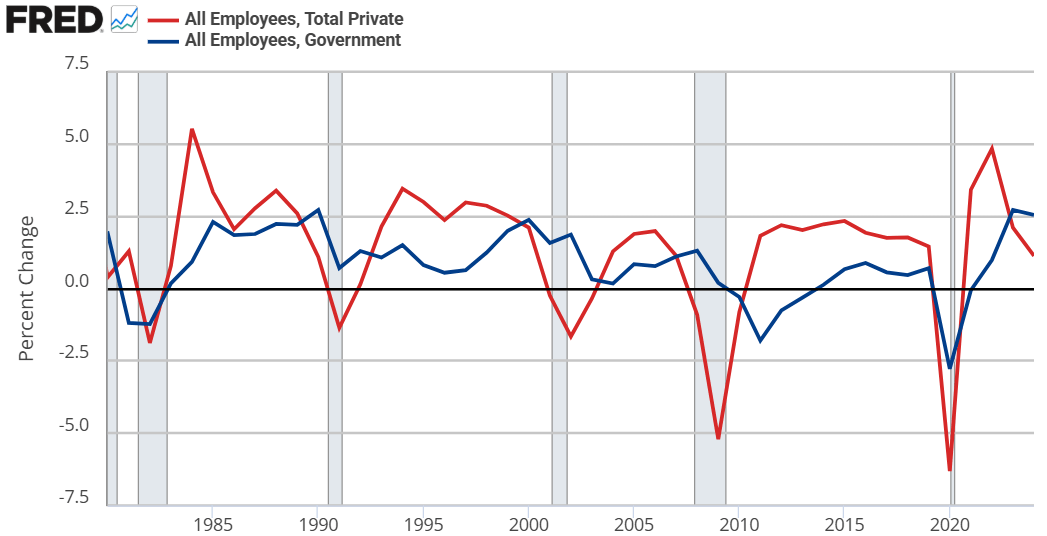
From there, he proceeds to say that if any part of income or employment is guaranteed or stabilized by the government, then the result must be that the risk and volatility is borne elsewhere in the economy. He reasons that if there is a decline in total spending, then stable government pay and employment implies that the private sector must have a deeper recession than the overall economy. Looking at the above graphs, both government employment and the total compensation are much less volatile.

But can’t governments intervene in macroeconomic stabilization policies effectively? Yes! They can and do stabilize the economy, especially with monetary policy. But Hayek is referring to individual stabilizations. For any individual to be guaranteed an income, all others must necessarily experience greater income volatility. How’s that?

Consider two individuals. Person #1 has an average income of $100. In any given year, his income might be $10 – or 10% – higher or lower than average. For the moment, person #2 is not employed and has income volatility of zero. If the government provides a job with a constant pay rate to person #2, then they still have zero income volatility. But instead of earning a consistent $0, person #2 earns a consistent $50. Nice.

Of course, person #2 gets his pay from somewhere. By one means or another, it comes from person #1. Let’s be generous and assume the tax on person #1 has no resulting behavioral effect. His new average income is $50, being $10 higher or lower in any given year. But now, that $10 deviation is over a base of $50 rather than $100. Person #1’s income varies by 20% relative to his new average!

Reasoning through this, we can consider that a person has a stable portion of their income and a volatile portion. If someone takes a part of your stable portion and leaves you with all of your volatile portion, then your remaining income is now more volatile on average. I think that this point is interesting enough all by itself.

IRL, many of our taxes are not lump sum. Rather, progressive taxation causes a negative incentive for production & earnings. The downside is that we produce less. The upside is that the government takes a higher proportion of our volatile income than of our stable income (because income changes are always on the margin and those marginal dollars are taxed at a higher rate). So, the government shares the income volatility of the private sector. By continuing to pay government employees a stable salary, the government is effectively absorbing some of that year-to-year income volatility on behalf of its employees.* The government is, in a sense, providing income insurance to a subgroup.

What does this have to do with The Road to Serfdom? Hayek argues that, as the government employs an increasing proportion of the population, the remaining private sector experiences increasing income and employment volatility. Such volatility increases private risk exposure so much that people begin to fawn over and increasingly compete for the stability found in government work. He gets anthropological and argues that the economic attraction to government jobs will introduce greater competition for those jobs and subsequently greater esteem and respect for those who are able to get them. This process makes the government jobs even more attractive.

My own two cents is that there is nothing internally unstable about this process. Total real income would fall compared to the alternative. However, such a state of affairs might be externally unstable as other governments/economies compete with the increasingly socialist one.


*An important analogue is that firms behave in a similar way. An individual may receive a relatively constant salary so long as they are employed. But the result must be that the firm bears more of the net-profit volatility. So, as more people want stable private sector jobs, the profit volatility of firms would increase and result in greater [seemingly windfall] profits and losses.

Learnings From Trading Short Volatility Funds, 2. Use Leveraged Stock Funds Instead

In last week’s post, I described how short volatility funds work. They are short (as opposed to long) near-term VIX futures. This means that when a market panic hits and VIX (as measure of volatility) spikes, the prices of these short vol funds plunge, along with stock prices. But as optimism returns to the markets, prices of short vol funds start to recover, as do stocks.

Thus, both short vol funds and general stock funds are reasonable ways to play a market panic. If (!!!) you manage to call the bottom and buy there, you can hold for maybe a couple of weeks until prices recover, and then sell at a profit.  I tried to do just that with the market meltdown last month in the wake of the president’s tariff ultimatums: I bought some short vol funds (SVXY, which is a moderate -0.5X VIX fund, and the more aggressive -1X fund SVIX), and also some leveraged stock funds. I discussed leveraged funds here.

I chose to buy into SSO, a 2X leveraged S&P 500 stock fund, whose daily price moves up (or down) by twice the percentage as does the S&P. Obviously, if you think stocks will go up say 10% in the next month, you will make more money by buying a fund that will go up 20% instead, which is why I bought a 2X fund rather than a plain vanilla (1X) stock fund. A related fund, which I did not buy this time, is UPRO, which is a 3X stock fund.

Things are always clear in hindsight. After the smoke of battle clears, you can see right where the bottom was. But it is not clear when you are in the thick of it. I erred by committing much of my dry powder trading funds too early, maybe halfway through the big drop. C’est la vie. It’s hard to improve on that for next time. But a significant learning, that I will act on during the next panic, was how differently short vol versus leveraged stocks recovered from the crash. They both plunged and recovered, but leveraged stocks recovered much better.

It turns out that much of the time, the price movements over say a six-month period of SVXY and SSO largely match each other, so these are useful for comparisons for trading short vol versus leveraged stocks. For instance, below is a chart of SVXY (orange line) and SSO (green line) over the past six months or so. The blue arrow notes the April crash, which bottomed roughly April 8. For November through early April, the price movements of the two funds roughly matched. By April 8, both had plunged to a level some 35% lower than their starting prices. However, by May 12, SSO had recovered to -10% (relative to starting), which is about where it was in late March (green level line drawn in). SVXY, however, remained 21% below its start.

Chart of SVXY ( -0.5X VIX ETF, Orange line) and SSO (2X Stock fund, green line), Nov 2024-May 2024. Blue arrow marks April 2025 volatility spike/stock crash. Chart from Seeking Alpha.

Thus, from its nadir (-35%) to its recovery as of Tuesday, May 12, SSO gained by 38% (i.e., ratioing 0.90/0.65), whereas SVXY gained only 21% (from ratioing 0.79/0.65). Also, it looks like SVXY will not regain its earlier price levels any time soon. So SSO looks like the winner here.

We can do a similar comparison between the -1X VIX fund SVIX and the 3X stock fund UPRO. These two funds are plotted below, along with a plain (1X) S&P 500 stock fund, SPY (in blue). SVIX (orange) and UPRO (green) trend pretty closely for October through March. When the April crash came, SVIX dropped much harder, down to a heart-stopping -59%, compared to -44% for UPRO. SPY dropped only to -15%.  SPY comes to a full recovery (0%) by May 12, while UPRO recovers only to -13% [1].    SVIX has recovered only to -21%. If you managed to buy each of these funds on April 8, and sold them today, you would have made the following gains:

SPY 17% ; UPRO 55%;  SVIX  43%.    Clearly the winner here in short term trading of the April crash is the 3X stock fund UPRO.

Chart of SVIX ( -1X VIX ETF, Orange line), UPRO ( 3X Stock fund, green line), and SPY (1X Stock fund, blue line), Oct 2024-May 2024. Chart from Seeking Alpha.

As a cross check, below is a plot of SVXY (orange) and SSO (green) covering the August, 2024 volatility spike. This was a peculiar event, discussed here, where volatility went crazy for a couple of days, while stock prices experienced only a moderate drop. If (!!!) you timed it just right, and bought at the bottom and sold a week or so later, you could have made good money on SVXY. But zooming out to the larger picture, SVXY never came close to recovering its old highs, whereas SSO just kept going up and up (green arrow). So SSO seems like a safer trading vehicle: it is a reasonable buy-and-hold, whereas SVXY may be hazardous to your portfolio’s health if you don’t get the timing perfect.

Chart of SVXY ( -0.5X VIX ETF, Orange line) and SSO ( 2X Stock fund, green line), Oct 2023-Oct 2024. Blue arrow marks early August 2024 volatility spike. Chart from Seeking Alpha.

Over certain longer (say one-year) periods, there are regimes where short vol could out-perform leveraged stocks (discussed earlier), but that is the exception, rather than the rule.

Disclaimer: Nothing here should be considered advice to buy or sell any security.

ENDNOTE

 [1] While UPRO changes X3 the change of SPY on a daily basis, for reasons discussed earlier, the longer-term performance of UPRO diverges from a simple X3 relationship with SPY. In volatile times, UPRO tends to fall well below a 3X performance over say a six-month period.

Learnings From Trading Short Volatility Funds, 1. The Tantalizing Promise of Quick Riches

The VIX is a calculated measure of stock market volatility, based on the prices of stock options. It spikes up when there is a market upset, then seemingly always settles back down again after a few days or weeks. So, it seems simple to make a quick profit from this behavior: short the VIX when it spikes, and then close your trade when it comes back down. What could possibly go wrong?

VIX Index, May 2024-April 2025. From Seeking Alpha.

It’s a bit more nuanced than that, since you can’t directly buy or sell the VIX. It is just a calculated number, not a “thing.” However, there is a market for VIX futures. The value of these futures is based on expectations for what VIX will be on some specific date. The values of these futures go up and down as the VIX goes up and down, though there is not an exact 1:1 relationship. There are funds that short VIX futures, which are a proxy for shorting the VIX futures yourself.  So, the individual investor could buy them after the VIX spikes (which would drive down the short VIX fund price), then sell them when VIX declines (and the short VIX fund goes back up).

The chart below shows the VIX (% change, orange curve) in the past twelve months prior to May 1.   There were three episodes (Aug 2024, Dec 2024, Apr 2025) where VIX spiked up. These episodes are marked with green arrows. As expected, when VIX spikes up, the short volatility fund SVIX (purple line) drops down. In August and December, if you were clever enough to buy SVIX at its low, you could turn around and sell in a week later for a good profit. The movements of SVIX are dwarfed this plot by the gyrations of VIX in this chart, but a couple of short red horizontal lines are drawn at the bottoming values for SVIX, to show the subsequent rise. A 3x leveraged S&P 500 fund, UPRO, is shown in blue.

There are important nuances with these funds. One is that a long or short VIX futures fund, at the end of the trading day, must buy and sell some futures shares to meet their performance mandate. As of say May 1, the -1X VIX fund SVIX was short 14,311 May VIX futures contracts (expiring 5/20/2025), and short 10,222 June futures (exp. 6/17/2025). To keep its exposure centered at on one month out from the present date, the fund must buy back some near month (here, May) contracts each day, and short some additional next month (June), at the close of every trading day. If the market value of the near month VIX futures contract is lower than the next month contract (being in “contango”), as it generally is during periods of low volatility, this rolling process makes money every day, to the tune of maybe 5% per month. That compounds big time over time, to over a 60% gain in twelve months. That’s the good side. The VIXcentral site shows current and historical VIX futures prices for the next several months out.

A bad side of these short funds is that the day-to-day inverse movements can rachet the fund value down and down, as VIX goes up and down. So even if the VIX ends up in six months at the same value as it is today, it is possible for a short VIX fund to be lower or higher. This can lead to a more or less permanent step down in fund value. Also, in volatile times, the near futures price is higher than the next month out, and so the daily roll works against you.

There is a term that trading pros use for amateurs who jump into volatility funds without really knowing what they are doing: “volatility tourists”. These hapless investors sometimes hear of big profits that have been made recently in vol, and then buy in, often at what turns out to be the wrong time. Then market storms arise, things don’t go the way they expected, and they get shipwrecked.

Such was the case in 2018. SVXY at that time was a fund that moved inversely to volatility futures, on a -1X daily basis. This short vol trade made insane profits in 2H 2016 and in 2017, far outpacing stocks. Someone who bought into SVXY at the start of 2017 would have quintupled their money by the end of the year. (See chart below, orange line).

However, February 5, 2018 is a day that will live in volatility infamy. Because of the roaring success of short VIX in the previous two years, investors had piled into short VIX ETFs. The VIX suddenly doubled that day, and the short vol funds could not do the daily futures trades they needed, and so their value was decimated. This event is known as Volmageddon. The chart below shows the rise (and fall) of the -1X VIX fund SVXY in orange, compared to a stodgy S&P 500 fund SPY (in green).

Folks who bought SVXY looked like geniuses, until Feb 5. Then they lost it all, more or less. The tourists licked their wounds and moved on, and short vol went clean out of fashion for a while. One short VIX fund, XIV, actually an exchange traded note (ETN), went to zero and closed. SVXY itself lost over 90% of its value. After this near-death experience in 2018, SVXY contritely modified its charter from being -1X VIX futures to being -0.5X. That reduces its exposure to vol shocks. That modification served it well in March, 2020 when the world shut down and VIX shot to the moon and stayed there for some time. SVXY lost something like 70% of its value then, but it lived to trade another day, and slowly clawed its way back.

However, short vol has made a comeback in recent years. The -0.5X SVXY was joined in mid-2022 with a new -1X VIX fund, SVIX (for investors who don’t remember what happened to -1X funds in 2018! ). Short vol actually had a very good run in 2022, 2023, and first half of 2024:

The chart above shows SVIX ( -1X, purple) and SVXY (-0.5X, blue), along with the S&P500 (stodgy orange line) over the past three years. The two inverse vol funds totally smoked the S&P through July, 2024. Investors in SVIX were up over 300%, compared to 35% in stocks. Even the more conservative vol fund SVXY was up 165%. Yee-haw!

The volatility tourists poured in, and then came August 5, 2024, with a short, sharp, unexpected spike in volatility. As we noted earlier, it was not so much that stocks cratered, but there was a hiccup in the global financial system, mainly around unwinding of the yen carry trade. The values of the short vol funds got decimated. Then the recent brouhaha over tariffs in April 2025 whacked them again. This drove the value of SVIX below the three-year rise in stocks, although SVXY still outpaces stocks (57% vs 35% rise).

There were dips in SVIX and SVXY in March 2023 (Silicon Valley Bank blowup), October 2023 (Yom Kippur attacks on Israel by Hamas), and April, 2024, corresponding to spikes in VIX. In those cases, it worked great to buy the dip, since within a few months SVIX and SVXY churned to new highs. Many were the articles in the investing world on the wonderful virtues of the daily VIX futures roll. But then August 2024 and April 2025 hit, where there was no complete, rapid recovery from the huge price drops.

What to take away from all this? What comes to my mind are well-worn truisms like:

If it looks too good to be true, it’s probably not true; There is no free lunch on Wall Street; It’s not different this time.

The reason I know this much about these trading products is that I got sucked in a bit by the lure of monster returns. Fortunately, I kept my positions small, and backstopped some trades by using options, so all in all I have probably roughly broken even. That is not great, considering how much attention and nail-biting I have put into short vol trading in the past twelve months.

In an upcoming post, I will report on an alternative way to trade volatility spikes, which has worked out much better.

Disclaimer: Nothing here should be considered advice to buy or sell any security.

Trump’s Economic Policy Uncertainty

I was on a panel of economists last night at an event titled “The Economic Consequences of President Trump”. We each gave a 5-minute summary from our area of expertise and then opened up the floor for questions.  This is a truncated summary of my talk. Since the panel included an investor, two industry economists, and another macro economist, I wanted to discuss something that was distinct from their topics. I’ve published a paper and refereed many articles concerning economic policy uncertainty (EPU) and asset volatility. I wanted to look at the data concerning President Trump – especially in contrast to Presidents Obama and Biden.

EPU matters because uncertainty can cause firms and individuals to delay investment and hiring decisions. Greater uncertainty can also cause divergent views concerning forecasted firm profitability. The result is that asset prices tend to become more volatile when EPU rises. One difficulty is that uncertainty occurs in our heads and concerns our beliefs, making it hard to measure. We try to get at it by measuring how often news media articles include the terms related to uncertainty, policy, and the economy. Since news content tends to report what is interesting, relevant, or salient to customers, there’s good reason to think that the EPU index is a decent proxy.

Using the Obama years as a baseline, the figure below simply charts out EPU. It was relatively low during Trump’s first term and then it was higher during Biden’s term – even after accounting for the Covid spike. The sharp increase toward the end is after Trump won the 2024 election. The EPU series conflicts with my perception of social media and media generally. My experience was that the media was far more attentive to the uncertainty that Trump caused. But, it may just be that the media outlets had plenty to report on rather than it being particularly indicative of EPU. After all, if the president exercises his power, then there is a certain swift decisiveness to it.

But if we look at a couple of particular policy areas, Trump’s administration faired worse. Specifically, Trump caused a ruckus concerning trade policy and immigration. Remember when Biden continued the aggressive trade policy that Trump had adopted? That’s consistent with lower EPU. Similarly, Biden made the immigration process much easier and faster while Trump’s deportation haranguing results in a somewhat stochastic means by which people are deported.  Again, that spike at the end is after Trump won the 2024 election.

Continue reading