WW II Key Initiatives 3: Kurt Tank Gives Germany a Superior Fighter Plane, the Focke-Wulf 190

This is the third in a series of occasional blog posts on individual initiatives that made a strategic (not just tactical) difference in the course of the second world war.

World War II was not only the biggest, bloodiest conflict, in human history. It played a definitive role in giving us the world we have today. Everyone can find something to complain about in the current state of affairs, but think for a moment what the world would be like if the Axis powers had prevailed.

Having control of the air became crucial in the second world war. It meant you could drop bombs on enemy soldiers, ships, tanks, cities, factories, etc., etc. The Germans showed early on how important that can be. Their terror bombing of the Dutch city of Rotterdam compelled the Netherlands to surrender to spare other cities from being likewise bombed, even though the Dutch armed forces could have held out for some time longer. The German breakthrough in their invasion of France in 1940 was facilitated by a concentrated Stuka dive bombing attack on a key sector of the French front lines. The 1940 Battle of Britain was an air war, where the Germans hoped to whittle the British Air Force capability down enough to permit them to invade across the English Channel. And so on.

The main German fighter plane at first was the Messerschmidt Me 109. It was a good plane, although by 1941 the British Spitfire had become a match for it. Both the Me 109 and the Spitfire were designed around in-line engines, where the cylinders were arranged in two long rows in the engine block. That gave a narrow engine, and hence a skinny profile to the airplane, which tended to reduce wind resistance and make for higher speeds. A weak point of all in-line engines is that they need to have a circulating coolant system, going through a radiator, to cool down the engine block from the heat of the internal combustion. This makes for more complicated maintenance and is very vulnerable to being damaged by enemy fire,

Just when the Brits were starting to wrest air superiority back from the Germans, the FW 190 appeared in the skies over France. Allied pilots were shocked. The new German fighter could out-climb, out-roll, and in many cases out-fight the current Spitfire models. This so-called “butcher bird” gave air superiority back to the Germans.

Its remarkable performance was the result of one man’s engineering philosophy and persistence: Kurt Tank, chief designer at the German aircraft manufacturer Focke-Wulf. Tank was a pilot as well as an engineer, with long and varied prior military experience. He chose a radial engine for his plane, to make it more rugged and easy to maintain. With a radial engine, the individual cylinders all stick out from a central crankcase; airflow past the fins on the cylinders cools the engine. Hence, no vulnerable cooling system and radiator. The conventional thinking was that a radial engine was so fat that an airplane using it would have a wide, draggy profile. His ingenious design features allowed him to make a fast, agile plane. However, was an uphill job for Tank to sell his concept to the German military establishment. Eventually, his results spoke for themselves and the Fw 190 was produced. With its critical spots armored, the Fw 190 was hard to kill. Tank deliberately gave a wide stance and long travel to the landing gear, to allow deployment in rough frontline airfields.

The Fw 190 was a superb low-medium altitude fighter, and was also widely pressed into service (due to its rugged design) as a precision bomber on the front lines. Around 20,000 Fw 190s were produced. They shot down many thousands of Allied planes, killed untold thousands of Allied airmen and soldiers, and destroyed thousands of Allied vehicles, mainly on the Eastern Front. It was not enough to change the ultimate outcome of the war, but Tank stretched it out appreciably, by (largely single-handedly) giving the Germans such a versatile and deadly weapon.
WW II Key Initiatives 2: “Thatch Weave” Tactic to Counter More-Agile Japanese Fighter Planes

This is the second of a series of occasional posts on observations of how some individual initiatives made strategic impacts on World War II operations and outcome.  While there were innumerable acts of initiative and heroism that occurred during this conflict, I will focus on actions that shifted the entire capabilities of their side.

It’s the summer of 1941. The war in Europe between mainly Germany and Britain had been grinding on for around two years, with Hitler in control of nearly all of Europe. The Germans then attacked the Soviet Union, and quickly conquered enormous stretches of territory. It looked like the Nazis were winning. Relations with Japan, which aimed to take over the eastern Pacific region were uneasy. The Japanese had already conquered Korea and coastal China, and were eyeing the resource-rich lands of Southeast Asia and Indonesia. It was a tense time.

The Japanese military had been building up for decades, preparing for a war with the United States for control of the eastern Pacific. They developed cutting edge military hardware, including the world’s biggest battleships, superior torpedoes and a large, well-trained aircraft carrier force. They also produced a new fighter plane, dubbed the “Zero” by Western observers.

Intelligence reports started to trickle in that the Zero was incredibly agile: it could outrun and out-climb and out-turn anything the U.S. could put in the air, and it packed a wallop with twin machine cannons. Its designers achieved this performance with a modestly-powered engine by making the airframe supremely light.

As I understand it, the U.S. military establishment’s response to this intel was fairly anemic. It was such awful news, that seemingly they buried their heads in the sand and just hoped it wasn’t true. Why was this so disastrous? Well, since the days of the Red Baron in World War I, the way you shot down your opponent in a dogfight was to turn in a narrower circle than him, or climb faster and roll, to get behind him. Get him in your gunsights, burst of incendiary machine-gun bullets to ignite his gasoline fuel tanks, and down he goes. If the Zero really was that agile, then it could easily shoot down any U.S. plane with impunity. Even if you started to line up behind a Zero for a shot, he could execute a tight turning maneuver, and end up on your tail, every time. Ouch.

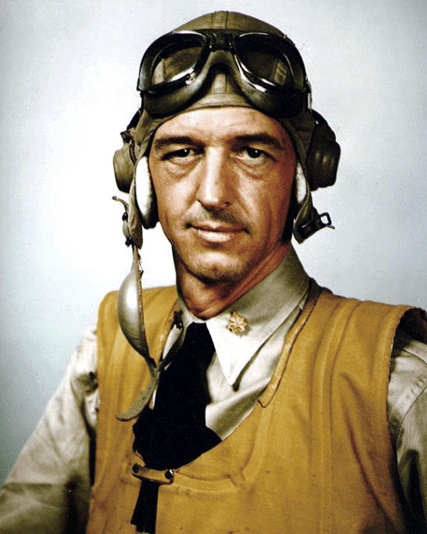
A U.S. Navy aviator named John Thatch from Pine Bluff, Arkansas did take these reports on the Zero seriously. He racked his brains, trying to figure out a way for the clunky American Wildcat fighters to take on the Zeros. He knew the American pilots were well-trained and were good shots, if only they could get some crucial four-second (?) windows of time to line up on the enemy planes.

So, he spent night after night that summer, using matchsticks on his kitchen table, trying to invent tactics that would neutralize the advantages of the Japanese fighters. He found that the standard three-plane section (one leader, two wingmen) was too clumsy for rapid maneuvering. He settled on having two sections of two planes each.   The two sections would fly parallel, several hundred yards apart. If one section got attacked, the two sections would immediately make sharp turns towards each other, and cross paths. The planes of the non-attacked section could then take a head-on shot at the enemy plane(s) that were tailing the attacked section.

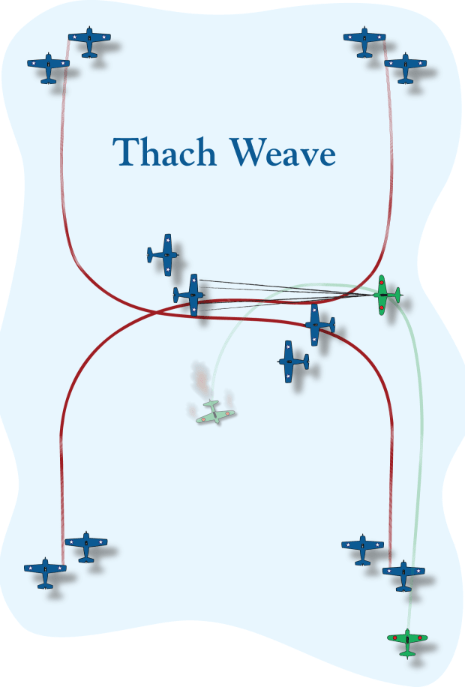
Here is a diagram of how this works:

Source: U. S. Naval Institute

The blue planes are the good guys, with a section on the left and on the right. At the bottom of the diagram, an enemy plane (green) gets on the tail of a blue plane on the right. The left and the right blue sections then make sudden 90 degree turns towards one another. The green plane follows his target around the turn, whereupon he is suddenly face-to-face with a plane from the other section, which (rat-a-tat-tat) shoots him down. In a head-to-head shootout, the Wildcat was likely to prevail, since it was more substantial than the flimsy Zero. Afterwards, the two sections continue flying parallel, ready to repeat the maneuver if attacked again. And of course, they don’t just fly along hoping to be attacked, they can make offensive runs at enemy planes as well, as a unified formation. This technique was later dubbed the “Thatch weave”.

Thatch faced opposition to his unorthodox tactics from the legendary inertia of the pre-war U.S. military establishment. Finally, he and his trained team submitted to a test: their four-plane formation went into mock combat against another four planes (all Wildcats), but his planes had their throttles restricted to maximum half power. Normally that would have made them toast, but in fact, with their weaving, they frustrated every attempt of the other planes to line up on them. This demonstration won over many of the actual pilots in the carrier air force, though the brass on the whole did not endorse it.

By some measures the most pivotal battle in the Pacific was the battle of Midway in June, 1942. The Japanese planned to wipe out the American carrier force by luring them into battle with a huge Japanese fleet assembled to invade the American-held island of Midway. If they had succeeded, WWII would have been much harder for the U.S. and its allies to win.

The way that battle unfolded, the U.S. carriers launched their torpedo planes well before their dive bombers. The Japanese probably feared the torpedo planes the most, and so they focused their Zeros on them. Effectively only Thatch and two other of his Wildcats were the only American fighter protection for the slow, poorly-armored torpedo bombers by the time they got to their targets. Using his weave maneuver for the first time in combat, he managed to shoot down three Zeros while not getting shot down himself. This vigorous, unexpectedly effective defense by a handful of Wildcats crucially helped to divert the Japanese fighters and kept them at low altitudes, just in time for the American dive bombers to arrive and attack unmolested from high altitude.

In the end, four Japanese fleet carriers were sunk by the dive-bombers at Midway, at a cost of one U.S. carrier. That victory helped the U.S. to hang on in the Pacific until its new carriers started arriving in 1943. Thatch’s tactic made a material difference in that battle, and was quickly promulgated throughout the rest of the U.S. carrier force. It was not a complete panacea, of course, since the once the enemy knew what you were about to do, they might be able to counter it. However, it did give U.S. fighters a crucial tool for confronting a more-agile opponent, at a critical time in the war. Thatch went on to train other pilots, and eventually became an admiral in the U.S. Navy.

Source: Wikipedia

WW II Key Initiatives 1: FDR Prodded the Navy To Convert Cruisers to Carriers, Just in Time

This is the first of a series of occasional posts on observations of how some individual initiatives made strategic impacts on World War II.  Most major decisions were made by teams of qualified engineers or military staff or whatever. But there were cases where one person’s visionary action made a material difference. There were, of course, many thousands of individual acts of initiative and heroism that went into the outcome of any given battle. However, I will focus on actions that shifted the entire capabilities of their side.

In this regard, I recently read how the intervention of President Roosevelt helped to give the U.S. nine additional aircraft carriers in the Pacific at a time when they were critically needed. As of U.S. entry into WWII in December, 1941, America had a total of 7 carriers, while Japan had 11.

It had been clear for a while that the U.S. needed more carriers, but (pre-Pearl Harbor), the Navy was more focused on building battleships; for centuries, big ships carrying big cannons were the vessels that ruled the seas. Navy brass had run studies of carrier sizing, and decided they would rather have fewer, larger carriers, due to operational efficiencies. A problem was these large carriers took years to construct.

Thus, as of 1940 the projections were that the U.S. Navy would receive no new carriers before 1944. As a naval war with Japan looked more and more likely, the President got concerned. FDR had been Assistant Secretary of the Navy during World War I, and maintained an interest in naval affairs, so he had informed judgement here. In October, 1940, Roosevelt sent a letter to the Chief of Naval Operations,  expressing interest in converting merchant ships into carriers for secondary duties such as convoy escort, antisubmarine warfare, aircraft transport, and air support of landing beaches. The Navy’s response was lukewarm. In 1941, FDR proposed that some of the many cruisers under construction could be converted to small carriers. The Navy considered this, and on 13 October 1941, the General Board of the United States Navy replied that such a conversion showed too many compromises to be effective: such carriers would be less stable platforms than the big carriers, and carry less than half the number of planes per ship.

I think most presidents would have given up at this point, but not FDR. He immediately ordered another study (I assume with the implicit message, “…and this time give the boss the answer he wants”). Lo and behold, on 25 October 1941, the Navy’s Bureau of Ships reported that aircraft carriers could in fact be converted from cruiser hulls. They would be of lesser capability, but fast enough for fleet action, and available much sooner than large carriers.

The December 7, 1941 attack on Pearl Harbor changed everything. That ninety-minute raid showed that aircraft carriers were by far the most critical warships. A carrier could reach out a hundred miles and easily sink any battleship with torpedo bombers, as Japan showed on that “day of infamy” and further demonstrated by sinking British battleships near Singapore, and chasing the British navy largely out of both the Pacific and the eastern Indian Oceans. (If the brass had been paying attention, the British Navy had already used carrier-based torpedo bombers to cripple battleships at the Taranto raid and with sinking the Bismarck, well before Pearl Harbor).

The U.S. did end up converting some (slow) merchant ships to carriers, and built a huge number of small, slow, fragile “escort” carriers for transporting planes and for shore bombardment. But there was still an immediate need for better-protected small “fleet” carriers which were fast enough to keep up with the big carriers and which could survive being hit by a bomb. Japanese leaders knew they could not prevail in a long drawn-out war, so their strategy was to inflict so much damage on American military and territorial assets in the first year of conflict that the U.S. would sue for peace under Japanese terms. Japan, like Germany, was very successful at first. The Japanese overran nearly all of Southeast Asia, including the Philippines (an American possession), the Dutch East Indies (a source of rubber, petroleum, and minerals) and the British stronghold at Singapore. They came perilously close to invading Australia. So the first year or so was critical: the Allies needed to survive the onslaught from a better-prepared opponent until American mobilization took full effect.

The Navy settled on repurposing a suite of nine Cleveland class light cruisers which were under construction. These new “light carriers” could carry about 30 planes apiece, compared to a complement of around 60 planes on the full-sized ships. The smaller carriers carried fewer spares, rolled more in heavy seas, and had smaller flight decks which led to more accidents. Nevertheless, they provided a boost to U.S. naval air power at a critical time.

The U.S. entered the war with seven fleet carriers, of which six were assigned to the Pacific. In the course of 1942, four of those six fleet carriers were sunk, and the other two were severely damaged from bombs and torpedoes. Thus, there was a time in October, 1942 that the U.S. had not a single operational carrier in the Pacific, while Japan was fielding around six. That was dire.

No new U.S. carriers were commissioned until the last day of 1942 (U.S.S. Essex). That was a long dry spell. Finally, in the first six months of 1943 eight fleet carriers commissioned. Of these, three were full-sized ships, while five were the cruiser-based light carriers. That finally gave the U.S. some breathing room, which allowed it to defend its assets and pursue offensive operations. These “Independence-class” light carriers fought in many battles, sometimes providing around a quarter of the fleet airpower.

Thereafter, the astonishing mid-century American industrial capacity took over. From mid-1943 through mid-1945 another 17 fleet carriers (including four more Independence-class light carriers in the second half of 1943) poured out of U.S. shipyards, along with some 60 “escort” carriers. By late 1944, this gigantic fleet had utterly overwhelmed Japan’s navy.

But it was largely Roosevelt’s vision and repeated poking of the stodgy Navy staff that produced the first batch of light carriers which helped tipped the balance of forces during the critical first eighteen months of the war.