Subtle ways to sneak in rationality

Generally, when you do your microeconomics class you get to see isoquants. I mean, I hope you get to see them (some principles class dont introduce them and are left to intermediate classes). But when you do, they look like this:

Its a pretty conventional approach. However, there is a neat article in History of Political Economy by Peter Lloyd (2012) titled “the discovery of the isoquant“. The paper assigns the original idea, rather than to the usual suspect of Abba Lerner in 1933, to W.E. Johnson in 1913 as A.L. Bowley was referring to his “isoquant” in a work dated from 1924 (from which the image is drawn). But what is more interesting that the originator of the idea is how the idea has morphed from another of its early formulations. In the 1920s and 1930s, Ragnar Frisch was teaching his price theory classes in Norway and depicted isoquants in the following manner in his lectures notes.

Do you notice something different about Frisch’s 1929 (or 1930) lectures relative to the usual isoquants we know and love today? Watch the end of each isoquant. They seem to “arc” do they not? How could an isoquant have such a bent? Most economists are probably so used to using isoquants that do not bend (except for perfect complements) that it will take a minute to answer. Well, here is the answer: its because Frisch was assuming that the production function from which the isoquant is derived had a maximum which means that the marginal product of an input could become negative. This is in stark contrast with our usual way to assume production functions as smoothly declining (but never negative) marginal products. This is why Frisch includes an arc to this shape (a backward bend).

Why did we move away from Frisch’s depiction? Well think about the economic meaning of a negative meaning marginal product. It means that a firm would be better off scaling down production regardless of anything else. Its a straightforward proposition to understand why in all settings, a firm would automatically from such an “uneconomic” zone. In other words, we should never expect firms to continually operate in a zone of negative marginal product. Ergo, the “bend”/”arc” is economically trivial or irrelevant. Removing it simplifies the discussion and formulation but also does something subtle — it sneaks in a claim rationality of behavior from firmowners and operators.

This is a good setup for a question to ask your students in an advanced microeconomics class that isnt just about the mathematics but about what the mathematical formulations mean economically!

The War on Ukraine

1. Read this letter from a young woman inside of Russia. Her despair is not sadder than the Kindergarten getting bombed, but it helps explain why people are resisting Russian rule. Ukrainians’ lives would be like hers except worse.

2. ‘My city’s being shelled, but mum won’t believe me’ With loyalty like this, I don’t understand why Russian state TV is bothering to cover up the shelling. Mum’s personal loyalty to Putin already transcends her love of her own daughter. Is lying itself a flex and a form of psychological warfare against the opposition within Russia?

3. Read on the End of History, and my blog about circular history.

4. Social media changes sieges.

5. President Putin speaks his truth, embraces his identity, and blocks his haters. With a trifecta like that, I have no doubt that he practices self-care. And now people are upset that they can’t get through to rattle him. Now people wonder: why can’t we reason together anymore? Yet, this is what Americans are encouraging each other to do. We are out of practice when it comes to discovering and debating The truth.

Previously I wrote about Americans blocking each other on social media. Now when we want to get through to someone on the other side, we have less channels of communication open. Americans don’t get enough practice seeing the world through someone else’s eyes. We have gotten into a bad habit of curating our sources of information to insulate ourselves from the facts and opinions that would force us to learn or argue with someone who holds a different point of view.

Also, we are seeing many people cut ties with Russians. I understand, initially, why there was a blitz on all Russian people, as we tried to get through the news of what was happening with urgency. However, this next week might be an opportunity to reach out to an economist on the inside of Russia, if you know one. Should they be protesting on the street, instead of checking emails? At this point they have already made their decision. You could start a research project with them about some banal uncontroversial topic. They are going to suffer, regardless of whether they have a foreigner to talk to or not. This opens a channel.

(The faculty at Kyiv School of Economics is probably getting behind on their research. They would probably love it if you would look up their previously published papers. )

The percent of Russians who don’t agree with the war should be a concern to the Kremlin. Most of them will not openly say what they think within the borders of Russia, so it creates uncertainty. On paper, Russia is favored to be able to inflict more casualties, but this aspect of Russian society makes the future hard to model. Any young men who are sent to the front lines will learn what is actually happening from the Russian speakers in Ukraine. How will that affect them?

Two Decades of Real Estate Data

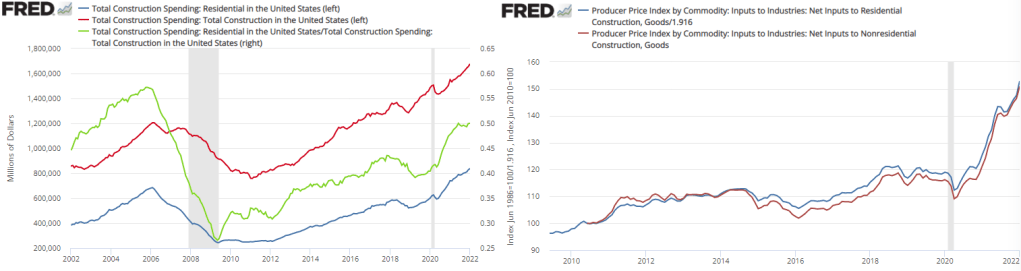
Total spending on real estate construction has been rising since 2011. By 2016 it had reached its previous 2006 peak. However, total spending on *residential* real estate construction didn’t reach its previous 2006 peak until November of 2020. The graph below also includes the proportion of residential construction spending (Green). It has been rising since 2009. In and of itself, nothing is good or bad about this figure. We might be spending less on non-residential construction because we are getting better at using less land per unit of good or service produced. Or, it could be that our real investment in future production is falling relative to our current residential consumption.  Regardless, the share of residential construction hasn’t been at this level since 2003.

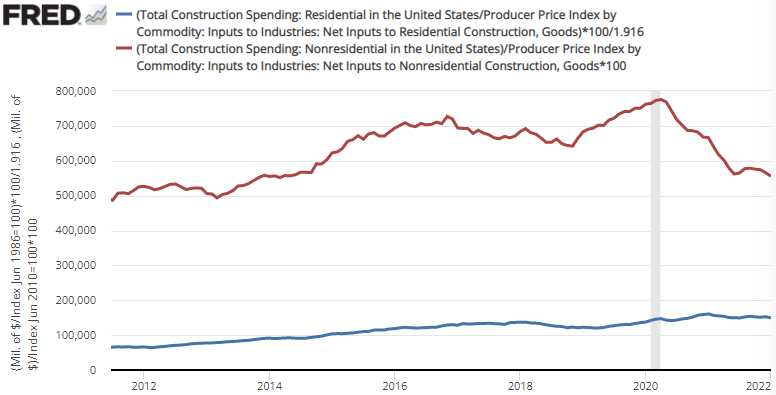
Importantly, the difference in spending has not been driven by different construction costs. Both residential and non-residential construction costs have moved in tandem since 2010. Therefore, the rise in residential construction spending is not merely nominal – a greater proportion of resources are being consumed by residential construction. Indeed, real residential construction is up about 25% from 2019. The figure below illustrates real residential and nonresidential construction.

That figure requires a double-take.

Continue reading

Lessons from a Failed Merger

The two largest hospital systems in Rhode Island, Lifespan and Care New England, wanted to merge. I wrote previously that:

Basic economics tells us that if a company with 50% market share buys a company with 25% market share in the same industry, they have strong market power and are likely to use this monopoly position to raise prices…. I think the Federal Trade Commission will almost certainly challenge the merger, and that they will likely succeed in doing so

It turns out I was right about the FTC challenge, but wrong that it would be necessary. The same day that the FTC challenged the merger, Rhode Island Attorney General Neronha blocked it. The law in Rhode Island is such that he doesn’t need to convince a judge like the FTC would; the merger was done unless the parties tried to appeal. But today they gave up and officially terminated the merger.

I was surprised by the AG’s move because the merging parties have so much political clout in the state, and many politicians like Senator (and former RI AG) Whitehouse had expressed support for the merger. I expected that even if state leaders didn’t like the merger, they would approve it with the expectation that the FTC would step in and be the bad guy for them. So AG Neronha blocking the merger was a pleasant surprise.

I also said previously that the FTC might challenge the merger for creating a monopsony (predominant employer of health care workers) as well as a monopoly (predominant provider of hospital services). This turned out to be one vote short of true. The FTC voted 4-0 to challenge the merger, but released two concurring statements explaining why. The two Democratic commissioners wanted to challenge the merger on both monopoly and monopsony grounds, while the two Republican commissioners thought it would only be a monopoly. This didn’t matter for this case, since they all thought it would be a monopoly, and since the AG blocked it. It was also odd that the Democratic FTC commissioners were more worried about labor than the actual unions involved. But it may be a sign of more monopsony challenges to come, particularly once the vacant spot gets filled and a 3rd Democrat is breaking the ties.

This was the first big political / economic issue I’ve got involved in since moving to Rhode Island, and I have to admit I was worried about making enemies. But despite speaking against the merger at the same forum as its most powerful proponents, speaking to several journalists, and at the AG’s public forum, I didn’t hear a single angry response; if anything I made friends.

One final surprise in all this is that the two hospitals systems are reported to have spent $28 million pursuing the merger. Apparently money can’t buy everything. But what a lot to spend on something that so many of us thought was clearly destined to fail.

The Taxman Comes for Homer

Last week I wrote about the Simpsons’ mortgage payment. In short, I found that using a reasonable assumption of Homer’s income, the median housing price, and the rate of interest, the Simpsons are likely paying less of their household budget on housing today than in the 1990s.

But what about the family’s taxes? Are they getting squeezed by the taxman? Taxes are referenced throughout The Simpsons series. Here’s an article that collects a lot of the references. And that makes sense: the Simpsons are a normal American family, and normal American families love to complain about taxes.

Using the same reasonable assumption about Homer’s income from last week’s post (that Homer earns a constant percentage of a single-earner family, rather than merely adjusting for inflation), we can calculate the family’s average tax rate and how it has changed over the year. Conveniently, “average tax rate” is just economist speak for “how much of your family’s budget goes to the government.”

First, let’s just look at the federal income tax, since this is where most of the changes happen. Don’t worry, I’ll add in payroll taxes below, though this is a constant percent of the family’s budget since it is a flat tax on income!

The chart below shows the average tax rate the Simpsons paid for their federal income taxes. I didn’t go through every year, because: a) it’s a lot of work (I’m doing each year manually); and b) it’s more interesting to look at years right after or before major changes in the tax code. So no cherry picking here — the years selected are picked to tell a mostly complete story.

I’ll now briefly explain each of the years chosen, and what changes in the tax code impacted the Simpsons. But as you can see, just like their mortgage payment, the Simpsons are now spending less of their household income on federal income taxes (don’t worry, the trend is similar with payroll taxes included). In fact, they are now getting a net rebate from the federal government, and have been since the late 1990s!

Continue reading

How Volodymyr Zelenskyy Went from Playing the Ukrainian President in A Sitcom to Actually Being the Ukrainian President

The man of the hour is Volodymyr Zelenskyy. Russia underestimated the amount of resistance they would face in their invasion of Ukraine, and Zelensky is the heart and face of that resistance. The usual pattern in countries like Ukraine with a history of corrupt leadership is that when hostile armies close in on the capital, the leaders stuff money and jewels into suitcases and disappear to some safe haven (think: Afghanistan). Zelensky has chosen to stay and fight against Vladimir Putin, a man with a fearsome reputation for brutal military tactics (see: Chechnya and Syria) and for political assassinations.

Where did Zelenskyy come from? American politicians are nearly all lawyers or businessmen. Zelenskyy was a professional comedian. He did get a law degree, but then went into stage and film comedy. He starred in a number of lightweight films such as Love in the Big City,  Office Romance, and the zany Rzhevsky Versus Napoleon:

In 2015 the actor created, produced and starred in a comedic television series, Servant of the People:

In this political satire, a young high school teacher happens to let loose with a rant about corruption in Ukraine. One of his students captures this rant on his phone and puts it out on the internet. That YouTube video goes viral, and (to his complete surprise) the teacher gets elected president of Ukraine. He then proceeds to govern honorably, amidst various comedic situations.

In a case of life-mimics-art, the real Zelenskyy ran for the presidency of the country in 2019. Fueled by the popularity of the TV series, Zelenskyy’s campaign was almost entirely virtual. It succeeded in unseating the incumbent candidate, with Zelenskyy receiving a landslide 73% of the vote.

Although his Ukrainian presidency began on a whimsical note, it has turned into a global epic. However, it is difficult to envisage an ending to this epic that is not tragic. Drawing on his acting skills, Zelenskyy has been a master of internet communications in the present crisis, but there is only so much that can be done in the face of hard military realities. While the images of Ukrainian resistance are inspiring, the Russians have far greater military might and have the will to employ it as needed. And as long as Europe continues to fund Russia by guzzling Russian natural gas, sanctions can only bite moderately hard.

Putin vs. the Cost Disease of Better Lives

The Ukraine is as of this writing holding its ground and cities against the invading Russian army. There are a host of reasons, from incredible Ukrainian bravery, unmatched global sanctions clamping down on the Russian economy, to tactical and military failure on the part of Russia. There is nothing I can contribute beyond the linked sources or the constant flow of information coming out in real time. What I would like to add is one bit of broad economic context.

Baumol’s famous “cost disease” idea works like this: as a society gets richer the opportunity cost of everyone’s time increases. This makes certain services, like getting a haircut, more expensive because there is no substitute for a person’s time, no technology to increase labor efficiency, when it comes to cutting hair. Economists never stop speaking of the opportunity cost of time, but I sometimes think we undersell the importance of the concept. Lives are finite, time is the only thing that matters. To say that the opportunity cost of time has increased is to say that lives have been made better. Baumol’s cost disease restated: Anything that improves a person’s life makes claims on their time more dear.

The same logic applies to risk and to armies. Military technology continues to advance, but there as yet remains no substitute for soldiers, particularly if you want to occupy territory (there are plenty of superior substitutes if you just want to take lives and scorch the earth, but thats a different story). While the “labor productivity” of soldiers as occupying forces has remained relatively stagnant, the lives of the soldiers themselves has improved with everyone else’s. As their lives improve, the bar for what they are willing to risk their lives (and their conscience) for gets higher. For Ukrainians defending their homes and families from invaders, the risk is more than worth it and they are awing the world with their bravery everyday. Russian soldiers, on the other hand, are surrendering, scrolling Tinder, and abandoning tanks.

When historians point to generals making the mistake of fighting the “previous war”, they are usually referring to the obsolescence of tactics by new military technology. What I would like to consider is the possibility of Putin trying to fight a war with the previous soldiers. The last time the Russian army marched into a country prepared to offer significant resistance was the Soviet invasion of Afghanistan (Crimea, to my understanding, was never in a position to offer significant miltary resistance). Russian soldiers and their families today have very different lives. Only a quarter are conscripts, and none are facing a life without options outside of the army. The state is not the sole means of earning a living. The Russian market may be fractured and corrupted by a kleptocratic regime, but it’s still a market, one which has led to tremendous improvements in the quality of life enjoyed by citizens. These aren’t men and women enlisted into a religious or philosophical crusade, let alone ordinary men and women fighting to keep their homeland. Soldiers have lives they don’t just hold dear for the sake of survival – they have lives in the modern world they actively enjoy.

There have been no shortage of pundits who, in the form of cliched memes and cosplay masculinity, have speculated that nations of the developed world would not sufficiently come to the aid the Ukraine, or any country invaded by a foreign power, for the simple reason that we have, in our modern decadence, grown soft. What they consistently fail to appreciate is that this is a great outcome. People holding their lives with greater value is the very definition of progress. What is most perplexing, however, is why this idea of softness born of wealth is not applicable to Russians. (As for the theory that the Ukraine would fold overnight because it doesn’t make enough babies, that theory looks less viable, even if Russia achieves any of their goals.)

Working down the supply chain

Now, let’s be clear: soldiers are soldiers, and they are still more likely than not to obey orders and carry out their duties, if nothing else then out of a sense of obligation to one another. The opportunity cost effects of improved private lives are no doubt dampened. But armies depend on a lot more than just soldiers.

Russia remains, relative to the West, a poorer country in terms of GDP per capita, but nonetheless a modern economy where individuals enjoy the luxuries of a developed economy: mobile phones, heat in the winter, food security, transportation, etc. History is filled with stories of wars won and lost because of lack for boots, gasoline, and coats. In the Soviet Union, the army may have been underprovisioned relative to their counterparts from wealthier market economies, but they weren’t beholden to the rules of a market economy. Exclusion from a global system of payments wouldn’t be able to immediately choke off resources. Even if the soldiers marching are entirely severed from their lives in the private market, the supply chains they depend on are not, and the civilians in that supply chain expect to get paid.

Did Putin expect that supplies would arrive while the Ruble plummeted? Did he expect middlemen to incur losses as the entire economy was frozen by global sanctions? Did he expect reliable logistical support from soldiers and civilians while their spouses lined up at ATMs during bank runs? You know what? Maybe he did. Or at least, maybe he thought that the Ukraine would capitulate before sanctions could become salient to the supplying of his army. I have no idea. What I want us to consider is that modern armies depend on more than soldiers to function. Without a monopoly on means for supporting a family or an omnipresent threat of the Gulag, armies depend on citizens who can look at the physical and economic risk they are taking on, and coming to the conclusion that “this is worth it.” I have a hard time believing any Russian citizen, wage earner or oligarch, is looking at what is already an economy-enveloping sinkhole borne of greed for historical infamy, and thinking this is worth it for anyone but Putin himself.

This context of war in a time of better lives places economic sanctions as a geopolitical tool in a new light. Most countries cannot hope to put together an irresistible military force without the resources of a modern developed economy. A modern developed economy will invariably lead to wealthier citizens with a greater opportunity cost of time and risking their lives. The military will, in turn, become more dependent on private citizens to provision their armies. Sanctions in this new world don’t just punish citizens and encourage some form of open revolt, they actually choke off the military from the economies they remain entirely coupled to and dependent on.

If Putin is repelled, it will more than anything be because of the bravery of 44 million Ukrainians who stood their ground and protected their homes. But the military lesson, the historical lesson, may very well be that men and women with good lives make for poor invaders. The best, most peaceful future might just be one where we all have too much too lose.


Brief Addenum: How this “cost disease” effect would impact the probability of a nuclear strike is complex and in no way clear to me. On the one hand, if Putin believes that he has no possibility of victory without a credible threat of a strike, then it raises the possibility of war, if only through greater chance of error admidst readiness. On the other hand, it’s not like there are no middlemen between Putin and “the button.” Each link in that chain may be more likely to be insubordinate if they view their modern life as too great a sacrifice. I just don’t know.

“Using word analysis to track the evolution of emotional well-being in nineteenth-century industrializing Britain”

This is the title to a paper in Historical Methods that I believe should convince you of two things. The first, and this applies to scholars in economic history, is that the journal Historical Methods is a highly interesting one. It tends to publish new and original work by economists, historians, sociologists and anthropologists who are well-versed in statistical analysis and data construction. The articles that get published there often offer a chance to discover solutions to longstanding problems through both interactions of different fields and the creation of new data.

The second is that it is becoming increasingly harder to hold the view that the industrial revolution was “a wash”. I described elsewhere this view of the industrial revolution as a wash as believing one or more of the following claims: “living standards did not increase for the poor; only the rich got richer; the cities were dirty and the poor suffered from ill-health; the artisans were crowded out; the infernal machines of the Revolution dumbed down workers”. Since the 1960s, many articles and books have confirmed that the industrial revolution was marked by rising wages and incomes as well as long-run improvements in terms of nutrition, mortality and education. The debates that persist focus on the pace of these improvements and the timing of the sustained rise that is commonly observed (i.e. when did it start)

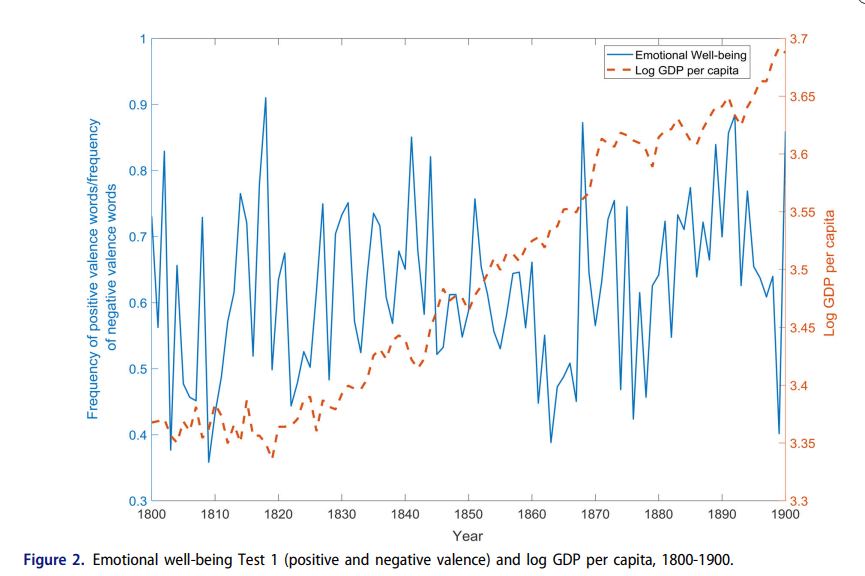
The new paper in Historical Methods that I am mentioning here suggests that these many articles and books are correct. The author, Pierre Lack, takes all the 19th century pamphlets published in Britain and available online to analyze the vocabulary contained within them. Lack’s idea is to use the fact that books became immensely cheap (books were becoming more affordable through both falling prices and rising incomes — see table above) to evaluate emotional well-being by the words contained in them. What Lack finds is that there were no improvements in emotional well-being as proxied by the types of words in those pamphlets.

But how could this be positively tied to the industrial revolution as not being a wash? This is because, if you believe that there is such a thing as a hedonic treadmill (i.e. more income only allows us to actualize upward our preferences so that the income has no impact on happiness), you cannot hold many of the beliefs associated with the industrial revolution being a wash. For example, if you think that living standards for the poor did not rise while other dimensions of their well-being (e.g., health, environment of the city, working conditions) fell, then there the graph produced by Lack should have exhibited a downward trend!

This is not the only belief associated with the “industrial revolution was a wash” view that cannot withstand Lack’s new paper. One frequently advanced factor that purportedly affects emotional wellbeing is inequality. Because we care about our relative position (e.g., I am happier if my neighbor have a worse car than me), rising inequality should be associated with falling emotional well-being (that was for example the case that the Spirit Level of Wilkinson and Pickett tried to advance). However, if you believe that Britain enjoyed rising inequality (it did at first and it then fell according to Jeffrey Williamson who shows that inequality rose to 1860 and fell to 1913), then Lack’s data should show falling emotional well-being. It does not which means that it is quite hard to hold the view that the revolution was a wash.

This is probably my favorite paper at Historical Methods and I hope you will like it too. I also hope that you will add it to your list of articles to inform your own research.

How to Set Working Directory in R for Replication Packages

The AEA Data Editor kicked it all off with this tweet:

“Please stop using “cd” (in Stata) or “setwd()” (in R) all over the place. Once (maybe, not really), that’s enough.”

Replies proliferated on #EconTwitter this week. In this blog post I am collecting solutions for R.   These days you might share the code used to generate your results for an empirical paper. That code would ideally be easy for other people to run on their own computers. File paths are hard (as I blogged previously).

A project for a single paper might have multiple code files. The code interacts with data stored somewhere. Part of the task of the code is to point the statistical program to the data set. It is frustrating if an outsider is trying to replicate a result and must alter the code in multiple places to point to their own location of the data.

Here is a concise summary of good practice, for any code language: “cd and setwd() specify the directory. When you share code and run on a different computer, they don’t work. Therefore, good practice to only specify once, at the beginning”

Continue reading

Inflation Empirics

Way back in the late 1970s and early 80s, Kydland and Prescott proposed rational expectations theory. This line of research arose, in part, because the Phillips curve ceased to describe reality well. Amid increasing inflation, people began to anticipate higher prices to a relatively correct degree when making labor, supply chain, and pricing decisions. Kydland and Prescott argued that individuals understand the rules of the game or how the world works – at least on average.

An increase in the money supply would increase total national spending, and increase demand for goods. However, firms also experienced increasing revenues and demanded more inputs such as commodities, capital, and intermediate goods. Because there were no greater productivity earlier in the supply chain, price roses. Firms began to understand that greater demand would eventually find its way to causing greater costs. Therefore, firms began raising prices before the cost of resources rose, increasing their willingness to pay for inputs and, ironically, hastening the increase in input prices. As a result, increases in the money supply began having substantial short-run price effects and negligible output effects.

However, assuming that people understand the rules of our economic system and ‘how the world works’ is hard to swallow. It is not at all clear that the typical economist understands monetary theory, much less clear that the typical person has a good understanding. Fortunately, another theory of expectations can help carry some of the load and achieve similar results.

Adaptive Expectations

Continue reading