Secondhand for AdamSmithWorks

Last month, I blogged about the book Secondhand. This week, I wrote a piece about it for AdamSmithWorks: THE INVISIBLE THREADS: ADAM SMITH AND THE GLOBAL SECOND-HAND CLOTHING TRADE

The author of Secondhand, Adam Minter, simultaneously appreciates the value created by large “impersonal” markets and also paints colorful pictures of the individual people involved. He has respect for individuals in the system who, using local knowledge, extract all the value out of what rich people consider to be trash. Minter sits in the seat of Adam Smith.

But it is not the popular movement, but the travelling of the minds of men who sit in the seat of Adam Smith that is really serious and worthy of attention.

Lord Acton, Letter of Lord Acton to Mary Gladstone

Another piece about clothes from AdamSmithWorks is: “WHO ARE YOU WEARING?” FASHION PRODUCTION IN THE AGE OF ADAM SMITH. This article does “the pin factory” for clothes. The global supply chain is incredible, just looking at manufacturing alone. Minter takes it further by following goods all the way from their first consumer to their very last user.

There is some good news about how the world is getting better as the average person gets richer, but trash does also cause problems as we consume more stuff. Does Minter write about the environmental concerns of the “fast fashion” camp? He has a different idea than what others have proposed like taxing by volume or banning some commercial activity. In terms of practical advice, Minter advocates for labeling consumer goods by how long they are expected to last. It’s tragic when someone spends $20 on a good that will wear out after 1 year when they should have spent $30 on a good that will last 10 years. There are some “dollar bills on the ground” here because consumers don’t accurately assessing quality at the time of purchasing. The power of brands to signal quality helps with this problem, but if you don’t want washing machines piling up in landfills then you might want stores to put a greater emphasis on durability at the point of sale. We do something like that with nutrition labels, so it is possible.

5 Easy Steps to Improve Your Course Evals.

Incentives matter. I’ve taught at both public and private universities, and students have given me both great course evaluations and less great student evaluations. The private university cared a lot more about them. Obviously, some parts of student evaluations of their instructors are beyond the instructor’s control. The instructor can’t control inalienables and may not be able to change their charisma. But what about the things that instructors can control? Regardless of your current evals, here are 5 policies that are guaranteed to improve your course evaluations.

1: Very Clear Expectations/Schedule

Have all deadlines determined by the time that the semester starts. Students are busy people and they appreciate the ability to optimally plan their time. Relatedly, students desire respect from their instructor. Having clear rubrics and deadlines helps students know your expectations and how to meet them – or at least understand how they failed to meet them. Students want to feel like they were told the rules of the game ahead of time. This means no arbitrary deductions or deadlines. The syllabus is a contract if you treat it like one.

2: Mid-Semester Evaluations

One of the absolute best ways to improve your evaluation is to ask your evaluators for a performance update. Make a copy of your end-of-semester course evaluation and issue it about halfway through the semester. Then, summarize the feedback and review it with your class. This achieves three goals. (1) It is an opportunity to clarify policy if there are misplaced complaints. You may also wish to explain why policy is what it is. Knowing a good reason makes students more amenable to policies that they otherwise don’t prefer.  (2) It provides voice to students who have things to say. Often, students want to be heard and acknowledged. It’s better that a student vents during the informal mid-semester survey than on the important one at the conclusion of the course. (3) If there are widespread issues with your course, then make changes. If you’re on the fence about something, then take a poll. And if you decide to make changes, then be graciously upfront about it. Unexplained or covert changes violate policy #1.

Continue reading

Knowing When To Sell: Portfolio Review

90 plus per cent of people, they spend all their time on the buy decision and then they figure it out as they go along on when to sell and we say that’s crazy. You need to establish sell criteria, even if it’s just rebalance, even if it’s a trailing stop, whatever it may be on all your public market positions, because otherwise it gets emotional and that creates huge problems.

Meb Faber

Last week I explained why I buy individual stocks. This week I’ll share how I think about when to sell individual stocks, as I go through my portfolio and decide what to hold and what to sell. This is the first time I’m doing this exercise, though I should have done it long ago; until now I’ve unfortunately been on the wrong side of the above Meb Faber quote.

I actually think that most people are correct not to put much thought into what to sell, because I still agree with Buffett and most economists that most people should just buy and hold diversified index funds. Thinking about selling too much might lead people to sell everything whenever they get worried, sit in cash, and miss out on years of gains. But the important truth in Faber’s point is that if you are buying stocks or active funds for any reason other than “its a great company/idea that I’d like to hold indefinitely”, it makes sense to put as much thought into when/whether to sell as when/whether to buy.

People buy stocks all the time based on short-term arguments like “this banking crisis is overblown”, or “I think the Fed is about to cut rates”, or “this IPO is going to pop”, or “I think the company will beat earnings expectations this quarter”. These might be good or bad arguments to buy but they are all arguments about why it makes sense to hold a certain stock for weeks or months, not for years or indefinitely.

But people often buy a stock for short-term reasons like these, then hold on to it long term- either out of inertia, or because they grow attached to it, or because it lost money and they want to hold until it “makes it back” (sunk cost fallacy). None of these reasons really make sense; they might work out because buying and holding often does, but at that point you might as well be in index funds. If you’re going to be actively trading based on ideas, it makes sense to sell once you know whether your idea worked or not (e.g., did the company you thought would beat earnings actually do it) to free up capital for the next idea (unless you genuinely have a good new idea about the same stock, or you think it makes sense to hold onto it a full year to hit long-term capital gains tax). Its also always fair to fight status quo bias and ask “would I buy this today if I didn’t already own it?” (especially if its in a non-taxable account).

Maybe this is obvious to you all, and writing it out it sounds obvious to me, but until now I haven’t actually done this. For instance, I bought Coinbase stock at their IPO because I thought it would trade up given the then-ongoing crypto / meme stock mania. I was correct in that the $250 IPO started trading over $300 immediately; but then I just held on for years while it fell, fell, fell to below $100. The key difference I’m trying to get at here is the one between ideas and execution: its not that I thought Coinbase had such good fundamentals that it was a good long term buy at $250 and my idea was wrong; instead I had a correct short-term idea of what would happen after the IPO, but incorrectly executed it as if it were a long-term idea (mostly through inertia, not paying attention, and not putting in an immediate limit sell order at a target price after buying).

So if you buy stocks for short- or medium-term reasons, it makes sense to periodically think about which to sell. I’ll show how I I think about this by going through some examples from my own current portfolio below (after the jump because I think the general point above is much more important that my thinking on any specific stock, which by the way is definitely not investment advice):

Continue reading

Answer: No, We Were Not in a Recession

About one year ago, I wrote a post with the title “Are We in A Recession?” At the time there was much talk, both in the popular media and among economists, about whether we were in a recession or not, and what “technically” counts as a recession. Now with hindsight, I think we can pretty clearly say that we were not in a recession last summer, nor at any point in 2022.

One thing is true: GDP did decline for two quarters in the first half of 2022. In fact, even the more nuanced “real average of GDP and GDI” declined for two quarters. But as I explained in that July 2022 post, that’s not how the NBER defines a recession. It often coincides with their defined recession, but they used a separate set of indicators. And while some economics textbooks do use the two quarters of declining GDP definition, as I explained in a follow-up post, that’s not the most common textbook definition.

The first half of 2022 is a good candidate for a possible recession, but when we look at the NBER’s preferred 6 measures of economic activity, it seems pretty clear that this was not a recession. If you start the data in the last few months of 2021, you do have small declines in two measures through July 2022 (real personal income and real manufacturing sales), but this looks nothing like past recessions, which have large declines in all or most of the 6 measures.

OK, but that was then, this is now. Are we in a recession now or headed into one? You can find lots of models and surveys or different groups of economists out there. I’m not sure that any particular one is the best, so I won’t dive into those. But if we look at the average of GDP and GDI again, we do notice that 2022q4 was negative and 2023q1 was very weak. Maybe that was a recession?

Again, we can start the NBER indicators around that time to see. Starting from September 2022, we can indeed see that there is some weakness in a lot of the measures for the next 2-3 months. But when we look out 6 months or so from then, we once again only have 2 of the 6 indicators that are below the September 2022 level, and the declines are mild (less than 1 percent). You can play around with the start date a bit, but I think September is the best candidate for a peak, and it’s still pretty weak.

OK, OK, you say, but that’s still all the past. What about the future? Sorry dear reader, I don’t have a crystal ball or the economic equivalent (a model). All I can say is what the data shows right now (which is always backward looking), and as of right now most broad measures of the economy aren’t declining. Yet!

This doesn’t mean everything is great in the economy. Inflation is bad. Poverty is bad. Inequality is, often, bad. We always have these things. But are they getting better? Or are they getting worse? A recession is a particularly bad thing, and something that is often hard to precisely define and measure (for good reason: the economy is complex and hard to measure!). All indication of the available data is that, whatever other bad things are happening right now, a recession is probably not one of those things.

Solar Cookers: Save Money, Save Lives, Save the Planet by Cooking with the Sun’s Rays

The Case for Solar Cooking

We all know we ought to reduce our CO2 generation to mitigate global warming and to conserve limited fuel reserves. Without descending into a tussle over exactly how man-made it is or whether it is part of a natural cycle which may turn soon to plunge us into yet another ice age, it does seem clear that the earth is experiencing a warming trend with possible serious consequences, and it is obvious that fossil fuel reserves (oil, natural gas, coal) are finite.

Although domestic cooking in developed countries comprises only a tiny fraction of total energy consumption, this is not true in some regions. Some 2 billion people still cook over fires of wood, charcoal, or animal dung. It is usually the women doing the cooking over these fires, inhaling smoke with all its consequences. Also, it is again women who largely end up gathering the fuel. All this gathering and fire-tending consumes time which takes away from other tasks like raising food. Also, women are often assaulted in the forests while they are foraging for wood.

It is possible to construct devices which capture enough of the sun’s rays to cook food (more technical details below). Many NGOs try to help people in poor, mainly sunny/tropical regions and in refugee camps to purchase or construct solar cookers. It is possible to set up cottage industries for locally making and selling these devices at low cost. It is just a win-win-win.  Solar Cookers International specializes in this work, and has developed and shared some of the most useful technology here. They claim some four million solar cookers are in use, and present figures for how much CO2 emissions and money for fuel are saved.

Why is this relevant to us in the West? Well, if we care to help the lot of the less-fortunate, we can give money to support these solar cooking initiatives. As noted, they can help the well-being of people, especially women, in many ways. A less-obvious  impact of us using solar cookers in our own homes is that folks in other lands are aware of our life-styles. It turns out that a non-trivial barrier to wide-spread adoption of solar cooking is that they are suspicious of Western aid workers promoting a method of cooking that no one back in the developed countries uses. If solar cooking could be more visible in our lifestyles it would have a significant effect in lands where it is really needed.

And getting around to our more personal motivations – it is kind of intriguing and rewarding to cook directly from the sun. On a hot day, it can mean cooking a casserole without heating the oven/kitchen. You can do great projects with kids (your own or others), designing and making and using solar ovens. And of course, you can signal your virtue by reducing your CO2 footprint.

If you find yourself in some situation when you have no other means to cook, a solar cooker could be a life-saver. To temper this reality, however, in most  temperate regions there will be many days without sufficient sunshine to make these work. Also, they are often much slower to heat up and cook than conventional stoves, so you need to plan ahead. That said, if you have a sunny morning or afternoon, you can put your pot of rice or whatever out to cook in the sun, go about your business, and come back in 2-3 hours, knowing your “solar crock pot” will have simmered your dish without burning it.

Types of Solar Cookers

I find the technical details here fascinating, but I will skip the juicies here and just briefly describe how these things are made and how they work. In all cases, there are some mirrored reflecting surfaces which concentrate the sun’s rays onto a cooking pot. For reflecting surfaces, one can glue aluminum foil onto cardboard. However, the foil grows dull with time, so it is better to use some kind of aluminized plastic surface, such as car windshield reflectors, mirrored craft adhesive sheeting, or even the insides of potato chip bags. Usually, the pot is in some kind of enclosure which is transparent to let the sunlight in but traps heat around the pot.  

There are a number of configurations that work. A description of various designs, with illustrations, is here  and here.

Perhaps the most minimalistic solar cooker is the panel cooker. Here, the pot is enclosed in a clear  oven bag or within two glass bowls. Segmented or curved reflective panels are arranged to reflect the sun on the pot from multiple angles. Solar Cookers International’s Cookit ($50) is said to be the most widely produced solar cooker, and it is of this design. There are many DIY designs floating around, including ones made from bent car windshield sun screens. A high-end, high-performance panel solar cooker is the Haines 2 ($100). These panel cookers lose effectiveness in cold, windy conditions, due to excessive heat loss.

Another design that people make a lot at home (see the internet) is a box solar cooker. Typically, you use a smaller cardboard box within a larger box, with the spaces between the two boxes filled with some kind on insulation (e.g., crumpled newspaper). A hinged glass lid and some reflecting panels on top of the box complete the device. A very expensive ($450) but very effective box-type solar cooker is the All-American Sun-Oven. This can function year-round, but takes up a lot of space in storage.

In tropical regions with the sun high overhead, there is some use of a plain, large parabolic mirror which can focus a very hot spot of sunlight onto the bottom of a pot or pan suspended above the mirror.

A more recent, high-tech approach is the line of solar cookers from Go-Sun. These feature smallish parabolic reflectors that focus the rays on a long, skinny cooking tube inserted in a double-walled glass tube with vacuum insulation. These cookers have only medium size capacity, but cook food really hot, really fast (e.g., can bake biscuits) and are not affected by cold weather. So, they are the most convenient and versatile cookers in many ways, although they do best with relatively solid foods like hot dogs or breads or cut-up meat or vegetables, not with liquidy loads like stew or soup or simmering beans. (Full disclosure: I caved in to my itch for one of these things, and have put it on my birthday list).

Guidance counselors are good

A new paper, “Beyond Teachers: Estimating Individual Guidance Counselors’ Effects
on Educational Attainment
” by Christine Mulhern observes significant contributions from guidance counselors to student outcomes:

It’s the last bit that rings truest to me: that counselors are most salient to low-achieving and low-income students because they lack other resources, specifically information. As I’ve noted before, information deserts are real, particularly for potential first generation college students. As modern applied economists, we are obsessed with identification and causality, but don’t sleep on distribution of impacts observed. Her finding that “counselors vary substantially in their effectiveness” is worth consideration and further exploration. Where does that variation come from? The excellence of the best counselors or the negative impact of the very worst? I’ve only a handful of experiences interacting with counselors, but my expectation is that it is both. Given that counselors tend to be woefully paid, I expect that they frequently sort across schools on non-pecuniaries i.e. how pleasant it is to work somewhere, which seems like yet another channel through public school students in affluent neighborhoods will find themselve advantaged.

But that’s enough speculative extrapolating for one day. Read the paper.

Oppenheimer Film Thoughts

Even though I had already heard that it will disappoint high expectations, I wanted to be in on the conversation. I’m going to link the film to some other posts and ideas.

I haven’t seen Barbie, but I agree with Ross:

I can see why Tyler was disappointed. However, if you don’t go in with those high expectations, it still is a thoughtful period piece. It’s more interesting than the next Marvel installment.

Los Alamos National Laboratory, Attribution, via Wikimedia Commons

Though it almost drowns in the unwieldy plot, this is a movie about talent. Hitler was alienating and killing Jews in Germany, which affected the kind of talent mobilized on both sides of the war. There are several explicit references to antisemitism and motivation among physicists. Matt Yglesias observes, “They beat Heisenberg to the bomb — in part because Niels Bohr refuses to help the Nazis…”

I had written about talent and wars earlier, also concerning World War II but a different kind of doctor. “In 1939, Keynes had hired János Plesch, a Hungarian Jewish doctor who had relocated to London after fleeing Nazi persecution.”

How to manage talent becomes the challenge once brilliant scientists have been recruited to Los Alamos. The scientists did coordinate their activities enough to succeed in making the bomb, but some of the drama hinges on their rebellions against Oppenheimer. Now that machines are becoming smart, this ties into a previous post about managing artificial intelligence. “A question this raises is whether we can develop AGI that will be content to never self-actualize.”

Yet another theme of the film is the Communist movement in America in the 1930’s. I have studied this through the biographies and essays of Joy Davidman. Davidman was a committed member and then left the Party, as did several characters in the film.

And yet another tiny theme was women scientists on the project. There is a woman who complains that she was asked to be a typist even though she went to Harvard for science. Oppenheimer briskly puts her on one of the scientist teams. It goes by fast. I felt like the director was saying, “If you went to see Hidden Figures, here’s a 20 second recap of Hidden Figures for the people who like that, NEXT!” This is an example of hurrying everything in order to stuff 8 movies into 3 hours. The Advanced Placement Program® (AP) has a blog on “Women Scientists of the Manhattan Project” I know from my research on getting people to code, that women today study AP Computer Science at a considerable lower rate than male high school students.

Easy FRED Stata Data

Lot’s of economists use FRED – that’s Federal Reserve Economic Data for the uninitiated. It’s super easy to use for basic queries, data transformations, graphs, and even maps. Downloading a single data series or even the same series for multiple geographic locations is also easy. But downloading distinct data series can be a hassle.

I’ve written previously about how the Excel add-on makes getting data more convenient. One of the problems with the Excel add-on is that locating the appropriate series can be difficult – I recommend using the FRED website to query data and then use the Excel add-on to obtain it. One major flaw is how the data is formatted in excel. A separate column of dates is downloaded for each series and the same dates aren’t aligned with one another. Further, re-downloading the data with small changes is almost impossible.

Only recently have I realized that there is an alternative that is better still! Stata has access to the FRED API and can import data sets directly in to its memory. There are no redundant date variables and the observations are all aligned by date.

Continue reading

80% Efficient Markets: Why I Buy Individual Stocks

The conventional wisdom among economists is that large, liquid asset markets like the US stock market are incredibly informationally efficient. The Efficient Market Hypothesis (EMH) means that these markets near-instantly incorporate all publicly available information, making future prices essentially impossible to predict (a random walk with drift). As a result, economists’ investment advice is that you shouldn’t try to beat the market, because its impossible except through luck; instead you should aim to tie the market by owning most all of it via diversified low-fee index funds (e.g. SPY or VT).

This idea usually sounds crazy when people first hear it, but it works surprisingly well. You’d think that at least half of participants would beat the market average each year, but active strategies can generate such high fees that its actually much less than that. Further, people who beat the market one year aren’t more likely than average to beat it the next, suggesting that their winning year was luck rather than skill. Even Warren Buffet, who economists will sometimes concede is an exception to this rule, thinks that it is best for the vast majority of people to behave as if the EMH is true:

In 2008, Warren Buffett issued a challenge to the hedge fund industry, which in his view charged exorbitant fees that the funds’ performances couldn’t justify. Protégé Partners LLC accepted, and the two parties placed a million-dollar bet.

Buffett has won the bet, Ted Seides wrote in a Bloomberg op-ed in May. The Protégé co-founder, who left in the fund in 2015, conceded defeat ahead of the contest’s scheduled wrap-up on December 31, 2017, writing, “for all intents and purposes, the game is over. I lost.”

Buffett’s ultimately successful contention was that, including fees, costs and expenses, an S&P 500 index fund would outperform a hand-picked portfolio of hedge funds over 10 years. The bet pit two basic investing philosophies against each other: passive and active investing.

This has been the approach I’ve taken for most of my life, but over the last 3 years I’ve gone from ~99% believing in efficient markets to perhaps ~80%. Missing on crypto felt forgivable, since it was so new and unusual; I recognized that in the early days of a small, illiquid market the EMH might not apply, I just misjudged what counted as “early days” (I figured that by 2011 “everyone” knew about it because Bitcoin had been discussed on Econtalk; its up ~1000x since).

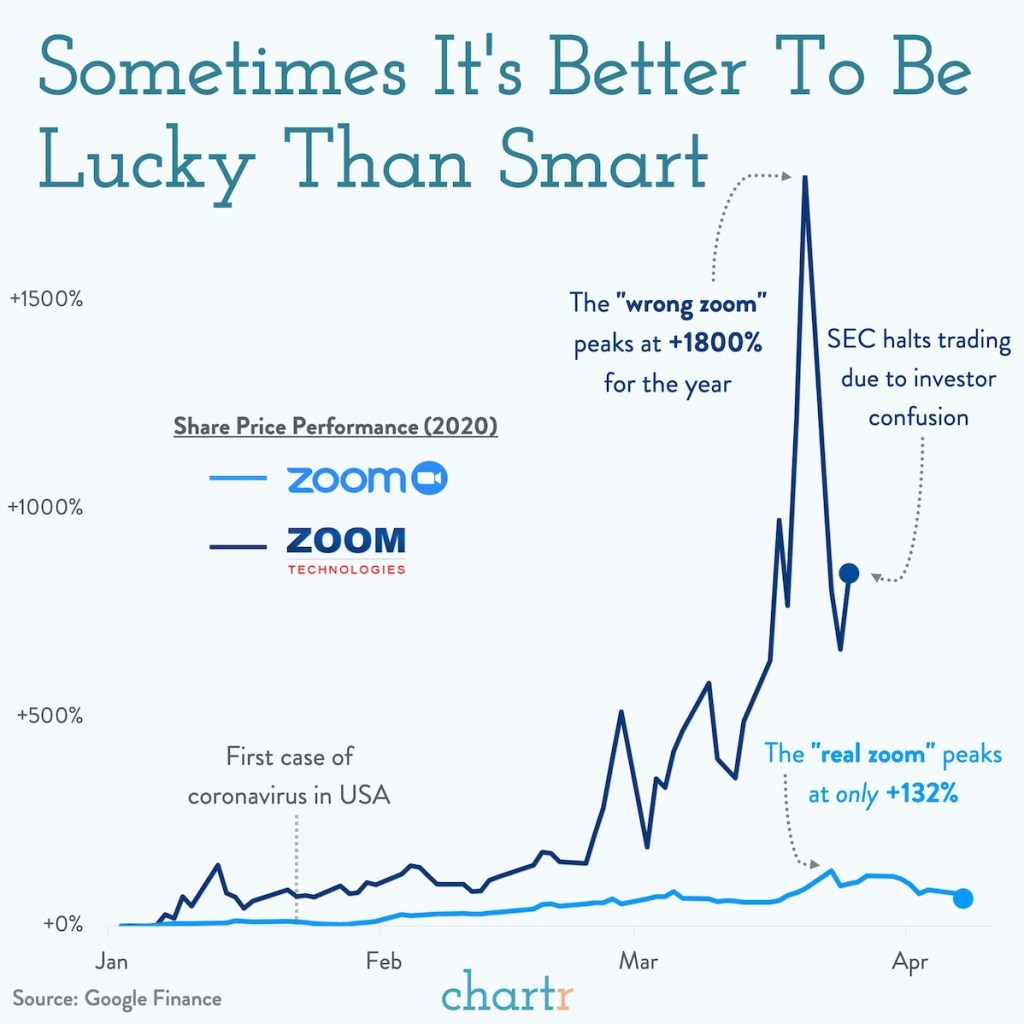
But with the Covid era the anomalies just kept piling up. All through February 2020, the smart people on Twitter were increasingly convincing me that this would be a huge pandemic; the main thing reassuring me was that stocks were up. But by late February they finally started crashing; instead of trusting the markets, I apparently should have trusted my own judgement and bought puts. Then investors starting buying the “wrong” Zoom instead of the one whose business benefitted from Covid:

Then we saw “meme stock mania” with many stocks spiking for reasons clearly unconnected with their fundamental value. Many at Wall Street Bets were clear that they were buying not because of business fundamentals, or even because they thought the price would go up, but because they liked the company, or wanted to be part of a movement, or wanted to send a message, or “own the shorts”.

Anecdotes got me to start taking some of the anti-EMH economics literature more seriously. For instance, Robert Shiller’s work showing that while it might be near-impossible to predict what a single stock will do tomorrow better than chance, predicting what the overall market will do over the longer run is often possible.

By revealed preference, is still mostly buy the EMH. About 80% of my net worth (not counting my home) is in diversified low-fee index funds. But that means 20% isn’t; its in individual stocks or actively traded ETFs with more-than-minimal fees. Why do this? I see 4 reasons buying individual stocks isn’t crazy:

  1. Free trading: Buying a bunch of individual stocks used to incur huge fees. Now, many brokerages offer free trading. Even if the EMH is true, buying a bunch of individual stocks won’t lose me money on average, just time.
  2. Still diversified: Buying into active funds instead of passive ones does tend to mean higher fees, and that is a real concern, but they do still tend to be quite diversified. Even buying individual stocks can leave you plenty diversified if you buy enough of them. Right now I hold about 45, with none representing more than 0.5% of my portfolio; one of them going bankrupt causes no problems. If anything I’m starting to feel over-diversified, and that I should concentrate more on my highest-conviction bets.
  3. Learning: Given the above, even if the EMH is 100% true, my monetary losses due to fees and under-diversification will be tiny. The more significant cost is to my time- time spent paying attention to markets and trading. This is a real cost, enough that I think anyone who finds this stuff boring or unpleasant really should take the conventional econ advice of putting their money in a diversified low-fee index fund and forgetting about it. But I’m starting to find financial markets interesting, and I think keeping up with markets is a great way to learn about the real economy- they always suggest questions about why some companies, sectors, factors, or countries are outperforming others. In some EMH models, the return to trading isn’t zero, but instead is just high enough to compensate traders for their time. In this case, people who find markets interesting have a comparative advantage in trading.
  4. Outperforming Through New Information: All but the strongest version of the EMH suggests that those with “private information” can outperform the market. Reading about the very top hedge funds I think they really are good rather than lucky, and the reason is that they have information that others don’t. Sometimes this is better models but often it is simply better data; Jim Simons got historical data on markets at a frequency that no one else had, and analyzed it with supercomputers no one else had. That’s a genuine information advantage, and I don’t think it’s a coincidence that he wound up with tens of billions of dollars. This should be incredibly encouraging to academics. We can’t all be Jim Simons (who was a math professor and codebreaker before starting Renaissance Technologies; Ed Thorpe was another math prof who got rich in markets), but discovering and creating private information is exactly what we do all day as researchers. My hard drive and my head are full of “private information” that others can’t trade on; of course right now most of it is about things like “how certificate of need laws affect self-employment” that have no obvious connection to asset prices, and there is a lot more competition from people trying to figure out markets than from people trying to figure out health economics. But discovering new information that no one else knows is not only possible, it is almost routine for academics, and its not crazy to think this can lead to outperforming the market.

Overall I think economists have gone a bit too far talking themselves and others out of the idea that they could possibly beat the market. I’ll discuss some more specific ideas in the next few weeks, but for now I leave you with 3 big ideas: you can’t win if you don’t try; winning is in fact possible; and if you are smart about it (avoid leverage, options, concentration) then defeat is not that costly.

Disclaimer: This is not investment advice. I say this both as a legal CYA, and because I don’t (yet?) have the track record to back up my big talk

A Pessimistic Take on Inflation

Last week I wrote an optimistic take on inflation. The rate of general price inflation has fallen a lot in recent months, and wage growth is now clearly outpacing inflation. That’s all good news.

Today, the Fed will announce their latest interest rate decision. Will the good news on inflation lead the Fed to stop raising interest rates? I’m not very good at making predictions, but today I’ll give a pessimistic take on inflation which suggests the Fed (and everyone else) should still be concerned about inflation.

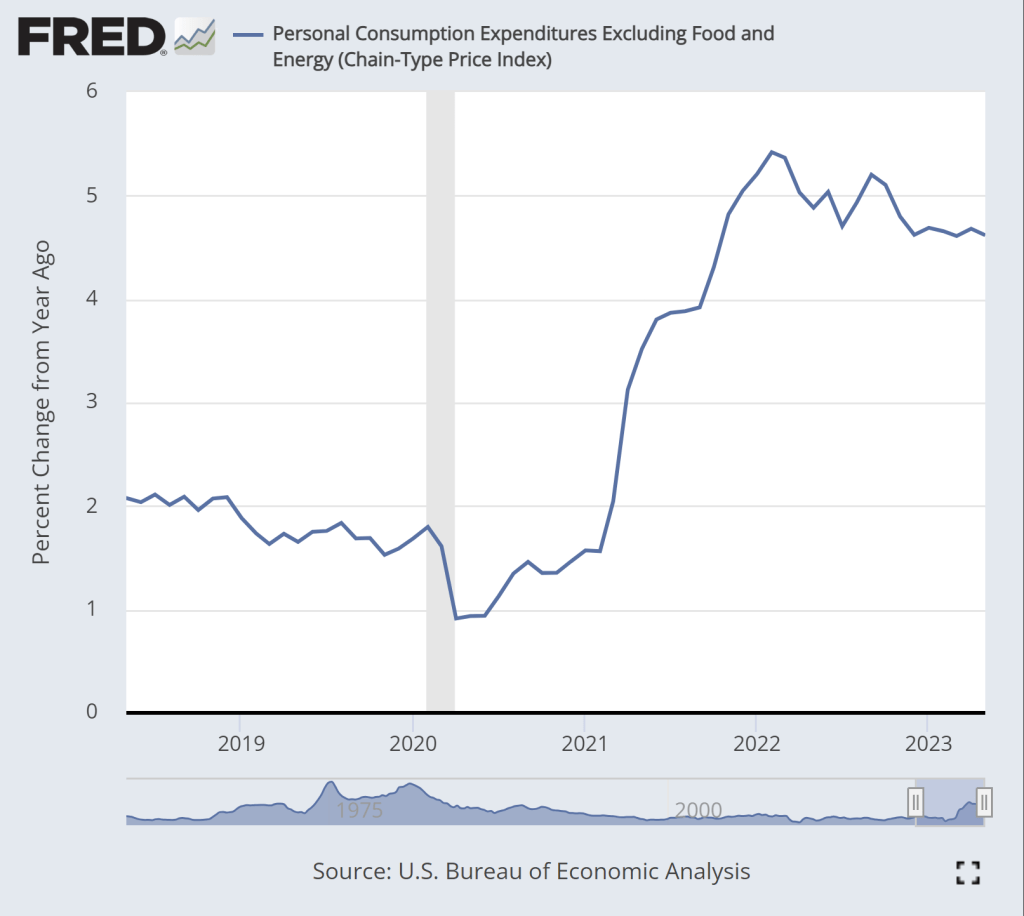
The pessimistic take can be summarized in two charts. First, this chart shows the year-over-year change in the core PCE inflation index. As most readers will know, core indexes take out food and energy prices. This is not a “cheat” to mask important goods, it’s done because these are particularly volatile categories of goods. If we want to see the true underlying trend in inflation, we should ignore price fluctuations that are driven largely by weather and geopolitics.

While there is some moderation in inflation in this chart, we don’t see anything like the dramatic decline in the CPI-U, which fell from about 9 to 3 percent over roughly the past year. True, there is some decline over the past year, but only about 1 percentage point, and it has been stuck at just over 4.6 percent for the past 6 months. This is not a return to normalcy, as this rate historically has stayed in the band of 1-2 percent.

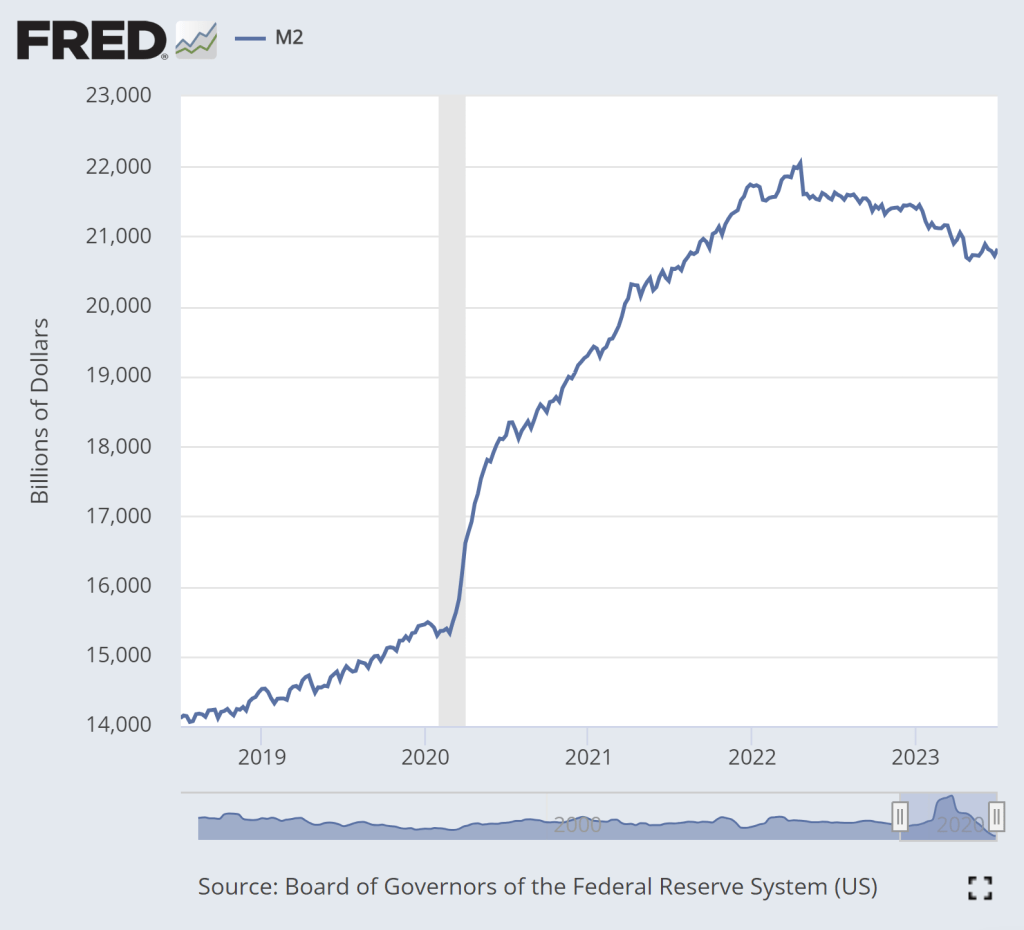
The second pessimistic chart is M2, a broad measure of the money supply.

The dramatic increase in M2 during 2020 is clear. That’s a big source of the inflation issues we’ve had over the past 2 years. There is some cause for optimism in this chart: M2 has clearly shrunk from the peak in Spring 2022. In fact, using a year-over-year percentage change, M2 has been negative since last November.

But if we look very recently, there is less cause for optimism. Since late April, M2 has stopped falling. In fact, it’s up a little bit. Is this a sign that the Fed doesn’t really have inflation under control? Perhaps. The increase isn’t huge, and there’s always some seasonality and noise to this data so we shouldn’t overanalyze this small deviation from the general decline in the past year plus. But we’ll need to continue watching this data.