Spending on Housing: It Hasn’t Really Increased in the Past 40 Years

UPDATE: see also this post on homeowners versus renters, which givens important context to this post.

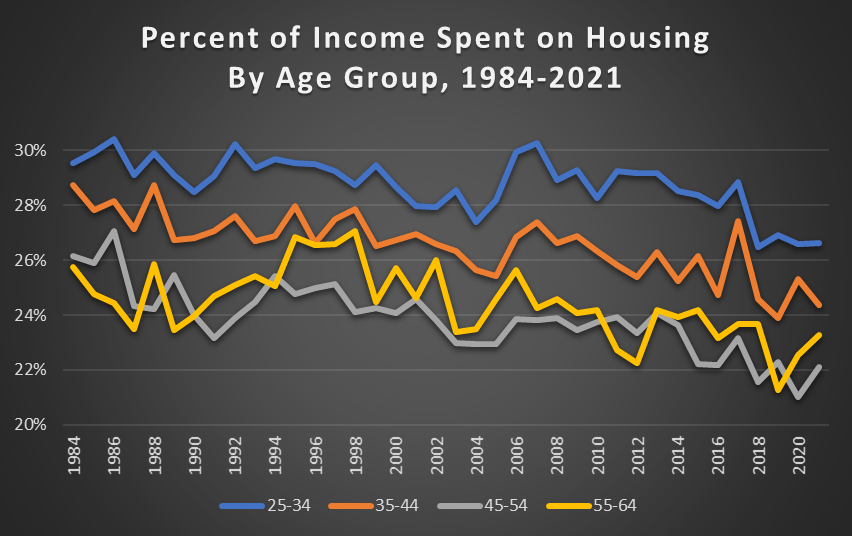
Are Americans spending more of their income on housing than in the past? Using data from the Consumer Expenditure Survey back to 1984, the answer is pretty clear: no. In fact, it has declined mildly.

This concern is usually raised on the context of young people. Are young people spending more of their income on housing than in the past? No.

For working-age Americans, the percent of their income spent on housing has declined mildly since 1984, but I think it’s accurate to say it’s pretty stable (I have truncated the y-axis so you can see the detail). It’s true that young people spend more of their income on housing than older people, but this has always been true, and the gap is pretty constant.

Continue reading

China To Squeeze West by Restricting Export of Essential Rare Earths

Rare earths are a set of 17 metals with properties which make them essential to a swathe of high-tech products. These products include lasers, LEDs, catalysts, batteries, medical devices, sensors, and above all, magnets. Rare earth magnets are used in electric motors and generators and vibrators, making them essential to electric cars, wind turbine generators, cell phones/tablets/computers, airplanes, phones, and all sorts of military devices. 

China happens to have large amounts of rare earth oxide ores for mining, relatively lax environmental standards, and a large, compliant workforce. The Chinese government has harnessed these resources to make the nation by far the largest producer of rare earths. Their massive, relatively low-cost production has suppressed production in other countries. This has been a conscious policy, to achieve global control over a vital raw material.

The first time China used this effective monopoly as a political weapon was in a maritime dispute with Japan in 2010. China cut off exports of rare earth metals to Japan for two years, crimping the Japanese electronics industry.  Other nations took note of this threat, and since then have been a number of half-hearted (in my opinion) efforts in various Western nations to develop some domestic capacity and to redesign motors to reduce dependence on rare earth materials.

 China’s share of rare earth ore mined is down to 60%, but they totally dominate processing the ore to metals, and subsequent fabrication of magnets from the metal.  Nearly all of the ore mined in the U.S. is shipped over to China for processing, mainly because of environmental regulations here.  

According to the Asia Times,

The PRC still dominates the entire vertical industry and can flood global markets with cheap material, as it has done before with steel and with solar panels. In 2022, it mined 58% of all rare earths elements, refined 89% of all raw ore, and manufactured 92% of rare earths-based components worldwide.

There is no other global industry so concentrated in the hands of the Chinese Communist Party, nor with such asymmetric downstream impact, as rare earths.

It seems the only way for the West to blunt the Chinese monopoly in rare earths is with large, long-term subsidies (since the Chinese can always undersell the rest of the world on a free market basis) and probably some pushing past environmental objections.

Alarmed by the rapid buildup of Chinese military forces (towards a possible invasion of Taiwan), the U.S. and its allies have begun restricting exports of the highest-power silicon chips to China. In retaliation, China has reportedly made plans to restrict exports of rare earths, starting in 2023. If they follow through, that move would crush fabrication of magnets and of magnet-dependent devices like motors and generators in other countries; the rest of the world would have to come crawling to China for all these items.

This move would in turn cause the rest of the world to accelerate its plans to produce rare earths outside China, but there would be several years of great disruption, and Chinese-made final devices like motors and generators would always have a huge price advantage, due to their cheaper raw material inputs.

I suspect there may be a high-stakes game of brinksmanship going on behind the scenes. The Chinese leadership presumably knows that they can only play this rare earth export ban card once, and the West does not really want to plow a lot of resources into producing large amounts of rare earths much more expensively than they can be bought from China. So maybe we will see some relaxation in chip export controls for China in exchange for them not pulling the final trigger on a rare earth export ban.

We live in interesting times.
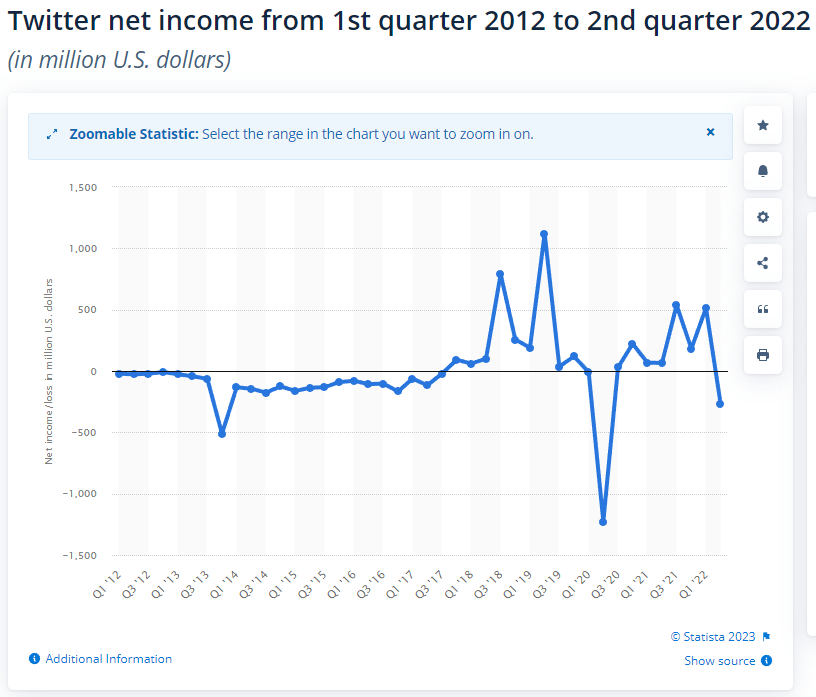
How should Twitter make money?

I’m not arrogant enough to believe I can actually solve Twitter in under an hour, but let’s walk through the product and see if we gain any clarity.

Twitter is a microblogging site. Users get value from 1) access to content produced by others, 2) the ability to produce original content and place it in front of others, and 3) the ability to act as the middle-man, sharing content produced by others. It’s principal advantage in the marketplace is that it has already achieved a critical mass of users, such that content placed on Twitter has more value than content placed on competitor sites. It’s biggest disadvantage is no one is sure how to optimally generate revenue from their user base.

For a moment’s perspective, Twitter can comfortably be expected to earn $4 billion /year in advertising revenue if it just held steady, which isn’t peanuts. The problem is that it hasn’t been enough to turn a steady profit and it’s definitely not enough since Musk spent $43 billion for Twitter. I won’t pretend to understand his utlity function, but I’m pretty sure he’s not hoping to just (nominally) break even on his deathbed. He at least wants to break even in terms of net present value.

How can Twitter make money? As best I can tell, there are only three possible revenue strategies. It can charge user fees. It can sell advertising. It can sell the data it accumulates. That’s it.

Let’s get the first one out of the way. User fees can be charged in two dimension, tall or wide. Tall fees focus on charging a large fee from a small number of high value accounts. Brand accounts, like Coca-cola or Beyonce. Wide fees focus on collecting a small fee from a large number of lower value accounts (<100k followers). Musk wants to charge for user verification, which is a fairly wide tactic. There is nothing inherently right about wide or tall user fee strategies. The problem with charging for verification is that it lowers the quality of information discourse on Twitter. Reducing the quality of the product diminishes the value of advertising and generated data while also lowering the bar for competing products (NB: competing products aren’t necessarily or even likely to be other microblogging sites. Just whatever else might substitute e.g. TikTok, Instagram, Substacks, high fidelity smoke signals from vaping, whatever).

Advertising and user data go hand in hand. One could speculate that the reason Twitter’s advertising revenue underperforms relative to their position in the market is either because a) Twitter is a bad channel to advertise within, b) the manner within which users engage the produce yields low quality consumer data, and c) Twitter is bad at collecting and producing advertising opportunities based on that data. My guess is all three.

Is there a way to generate revenue while protecting or increasing the value of the product and data generated? Glad you never asked.

  1. Focus on charging fees from users who need Twitter and not from users that Twitter needs. Good rule of thumb: if they’re a person, Twitter needs them. If they are not a person, they need Twitter. Don’t charge $8 to verify a sportscaster from Tuscaloosa. Charge $0.01 per follower for each a corporate entity or brand. Charge them $1 per reply, $2 per retweet. Bundle user fees with engagement. When you’re selling printers to Chase Bank you don’t make money off the printers, you make it off the ink.
  2. Verify everyone with more than 10k followers. It incentivizes users to pursue more followers.
  3. Kill the bots. Just require monthly captcha, randomizing day and mechanism. The numbers you’ll lose on your sales pitch to advertisers will be more than made up for in increased quality.
  4. Allow for parallel content streams within users. Twitter advertising isn’t making enough money because they don’t know what to advertise to me. To be fair, nobody really knows how to advertise to me. Except Instagram. They have a window straight into my consumer id. Why? Because I take photos of things I love, write captions that betray my sense of humor, and scroll content that entertains me. They have a dossier on how to sell me crap and it works. Maybe I hate it, but I’ve also bought more from Instagram ads in the last year than I’ve bought from Gmail ads in 20 years.

Let’s talk about this last one a bit. If Twitter wants to learn more about me, they need to give me more opportunities to produce data, such as:

  1. Multiple feeds from subsets of the accounts I follow. Better yet, suggest alternate feeds. If I say yes to the 100 accounts you suggested as a starter, you’ve added a dimension to your data’s model of me.
  2. Multiple streams from which I produce content. I’m pretty sure a lot of my followers would love to subscribe to just me talking about economics or just about sports. Let me click a button on each tweet that says A stream, B stream, C stream, or ALL. Now Twitter is learning about me and each of the followers that makes a decision about which stream(s) they want to follow.
  3. Separate streams/feeds for photos. Steal a little Instagram market share.
  4. Separate feeds/streams for meso-blogging (10,000 characters). Steal a little from Substack. Charge $2 a month to produce meso-blog posts.

One last thing. Stop forcing content into feeds. Yes, people will pay to promote their content, but forcing it into my feed reduces the quality of the product. It’s like an informercial without the warning and bad sweaters. You have to at least color code it differently. Good advertising can dilute the product, but it can never degrade it. Forcing crazy people and grifters into my feed pushes users away, reducing trust and engagement. Just don’t.

There, I fixed Twitter. You’re welcome?

Fashion is not just for teen girls

It’s teen girls who care about what they wear, and rough military men do not even think about it. Right? Wrong.

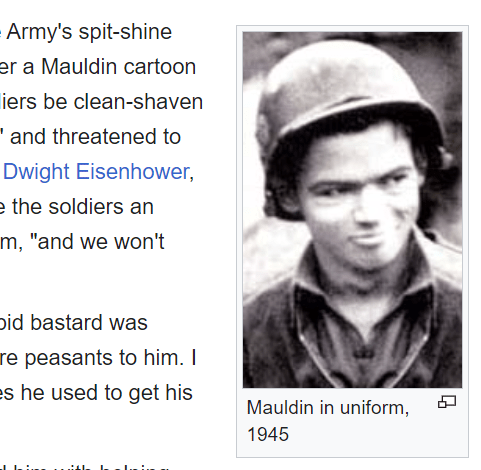
Up Front is a book depicting WWII soldiers by cartoonist Bill Mauldin. Around page 135, Mauldin describes how men dressed who were close to the front lines but not actually in combat. Mauldin coined the term garritrooper (a portmanteau of garrison and paratrooper). I thank Prof. Mike Munger for the pointer.

The garritroopers are able to look like combat men or like the rear soldiers, depending on the current fashion trend. When the infantry was unpublicized and the Air Forces were receiving much attention, the emphasis was on beauty… [The garritroopers] would not wear ordinary GI trousers and shoes, but went in for sun glasses, civilian oxfords, and officers’ forest-green clothing. This burned up many decidedly unglamorous airplane mechanics who worked for a living and didn’t look at all like the Air Force men the garritrooper saw in the magazines.

We are all trying to look like the celebrities in magazines, even if we don’t all agree on who is a celebrity and which magazine to read.

Look at that smirk, found on the Wikipedia page. Bill Mauldin is temporarily my new favorite writer.

Clarity on the Federal Debt

I have a list of economics topics that I like to teach about because they conflict with the biases of my average student. The list includes fiat currency, inflation, deficits, net exports, and immigration. The list also includes the importance – or lack thereof – of the federal government’s debt. This post walks through a few graphs to do a gut-check of what we think is true and how it compares to reality. For example, do you have a sense of when the debt grew historically and when it was constant? Do you have a sense for when it shrank?

Continue reading

More Ideas Pages

I’ve written here about my ideas page of economics papers I’d like to see.

After that post I heard from others who maintain similar pages. David Friedman has a small page here with research ideas, along with larger pages of short story ideas and product ideas.

HiveReview is a site where one can post or comment on both completed papers and paper ideas. The site does many things at once, but one use case is to post ideas in search of collaborators or to search for projects where someone wants a collaborator for their idea.

I learned today that Gwern Branwen maintains a large page of “Questions“, some of which could be research ideas, mostly outside of economics. He also has pages of research ideas and startup ideas. Some examples of Questions:

Given the crucial role of trust and shared interests in success stories like Xerox PARC or the Apollo Project or creative collaborations in general, why are there so few extremely successful pairs of identical twins?

Nicotine alternatives or analogues: there seem to be none, but why not?

Nicotine is one of the best stimulants on the market: legal, cheap, effective, relatively safe, with a half-life less than 6 hours. It also affects one of the most important and well-studied receptors. Why are there no attempts to develop analogues or replacements for nicotine which improve on it eg. by making it somewhat longer-lasting or less blood-pressure-raising, when there are so many variants on other stimulants like amphetamines or modafinil or caffeine?

Inflation and GDP Growth in the G7 Revisited

In August 2022, I wrote a post showing that among G7 nations, the US had the highest inflation during the pandemic, but also the highest rate of real economic growth. But since the economic situation is evolving rapidly, I wanted to update that data from mid-2022 (I also use core inflation, but I’ll use total inflation in this post).

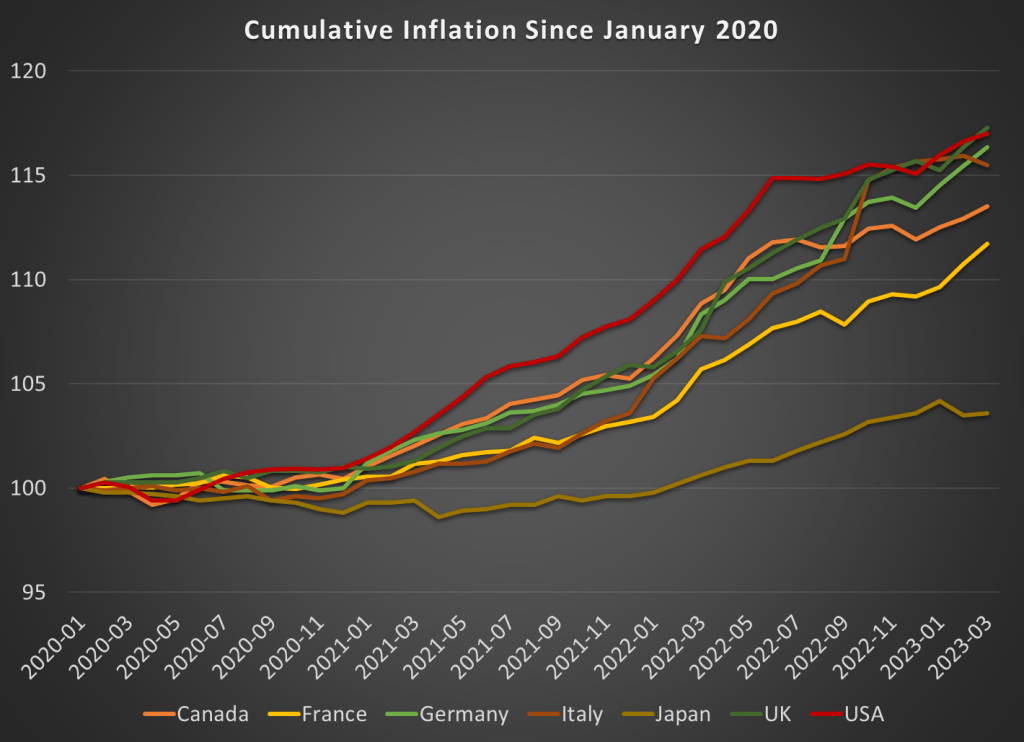
Here’s how inflation has looked during the pandemic:

While the US had the most cumulative inflation for much of the pandemic, the cooling of inflation in the US and the acceleration in Europe has changed things a bit. By late 2022, the UK and Italy had caught up to the US, and Germany is closing in too. These countries have cumulative inflation of between 15 and 17 percent since January 2020.

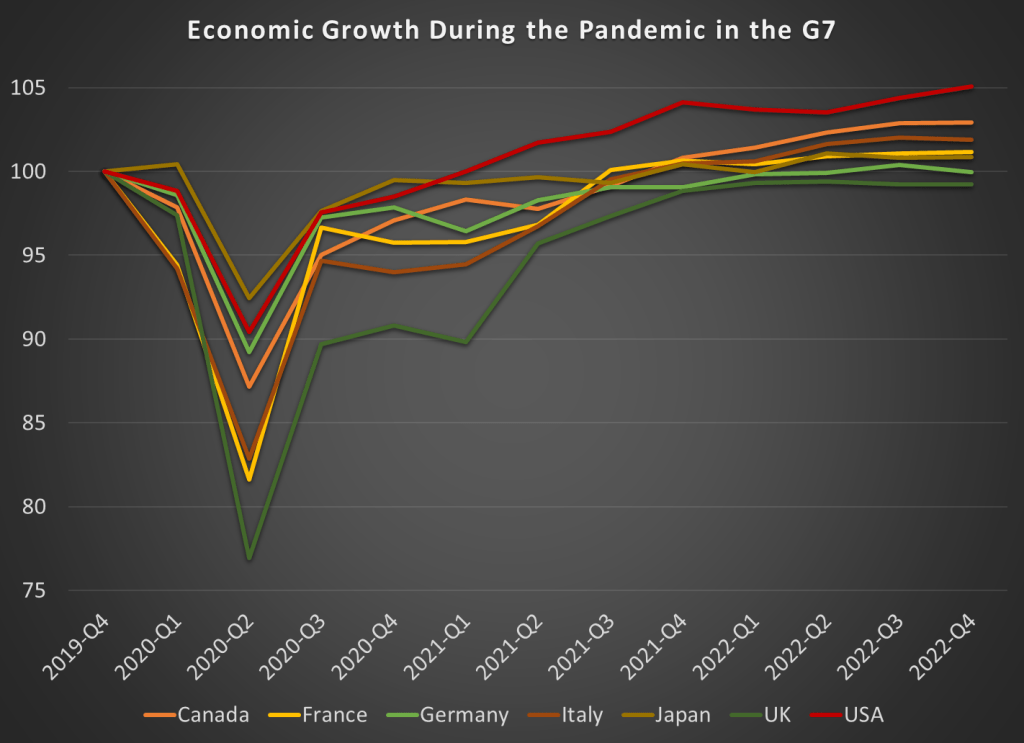
Japan looks to be the winner here. But wait, we don’t only care about low and stable inflation. We also want economic growth. Here’s the data through the 4th quarter of 2022 (we’ll start to get 2023q1 data from countries next week):

By this measure, the US comes out as the clear winner, with real GDP being about 5 percent higher than the end of 2019. That might not sound impressive for 3 years of growth, until you realize that 5 of the 7 nations had growth below 2 percent, with Germany and the UK actually still smaller than the end of 2019! And this doesn’t take account of the cumulative losses. Notice that the US had the second smallest dip in 2020q2 as well.

It’s hard to know exactly what the right non-COVID counterfactual would be, since these countries all had different rates of growth before the pandemic. But adding up the GDP scaled to 100 before the pandemic, the US is the only G7 country where these 12 quarters of data add up to more than 1,200. The other countries haven’t even had enough growth since the 2020 recession to make up for the losses during the recession, to say nothing of what their potential growth would have been. Japan comes the closest to making up the losses, while the UK stands out as the worst.

Here’s the figures for all the G7 countries, with 100% meaning they have had enough growth to offset the losses from the 2020 recession:

US: 100.8%

Japan: 99.3%

Canada: 98.6%

Germany: 98.0%

France: 97.1%

Italy: 96.9%

UK: 94.5%

Bitcoin’s Dramatic Comeback: Resurrection or Dead Cat Bounce?

In the past year, one cryptocurrency firm after another has gone bust, culminating in the grand implosion of the FTX exchange. The crypto vortex also contributed to some of the recent banking failures.

The prices of cryptocurrencies shot up in 2021, probably fueled by pandemic stimulus money sloshing around in the bank accounts of restless 20- and 30-somethings. All this came crashing back to earth in 2022, giving ample scope for skeptics to say, “I told you this was all foolishness.” Last rites were said, and crypto was left for dead.

But wait… in 2023, when no one was looking, the lid of the crypto coffin started to rattle, a bony hand reached out, and…crypto is back!!

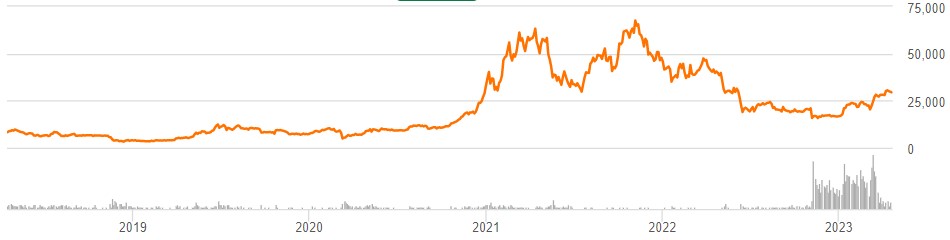
Well, sort of. Here is a five-year chart of Bitcoin from Seeking Alpha, in U.S. dollars:

And here is the past six months:

We can see that Bitcoin took its final big leg down in November, 2022, with the FTX collapse. Its price stayed fairly plateaued down there (with heavy trading volume) until January. Since then, it has nearly doubled.

What has triggered this rise in 2023? Observers such as Michael Grothaus at Fast Company suggests some four factors:

( a ) A shift to “risk-on” with the prospect of the Fed easing off with interest rate hikes this year.

( b ) A flight to alternative assets in the wake of the turbulence in the banking sector. Also, since the total amount of bitcoin is programmed to never increase over a certain number, Bitcoin should be a hedge against inflation. (Many observers believe that the Fed will live with 3-4 % inflation indefinitely, to help inflate away the gigantic debt that the federal government incurred with pandemic relief).

( c ) Buying of Bitcoin by traders who were short, and now need to cover their positions.

( d ) The usual rise in Bitcoin values as a bitcoin “halving” event is on the horizon. (About every four years, with the next time scheduled for May 2024, the rewards for mining new bitcoins drops by 50%).

Will the rise in Bitcoin prices continue? Is this truly a resurrection from the dead, or just a “dead cat bounce”? [1] Nobody knows. But this latest, sustained rally seems to have helped it recover some luster of legitimacy as an asset class. Here is a list of some popular crypto exchanges that are still in operation.

My personal take: I hold a sliver of the Bitcoin fund GBTC, just to have some skin in the game. I have been too lazy to learn about and activate an actual crypto wallet. I think Bitcoin in particular is an intriguing entity. Many other cryptos at some level depend on some centralized administration, but Bitcoin embodies the ideal of a decentralized, power-to-the-people form of something like money.

[1] From Wikipedia: In finance, a dead cat bounce is a small, brief recovery in the price of a declining stock.  Derived from the idea that “even a dead cat will bounce if it falls from a great height”, the phrase is also popularly applied to any case where a subject experiences a brief resurgence during or following a severe decline. This may also be known as a “sucker rally”.

ChatGPT is your new intern

You’re probably sick of ChatGPT thinkpieces prognosticating the future of AI but, let me assure you, this is not one, if only because I haven’t thought about it all that much. I have been using ChatGPT though, and my experience has not been unlike when Google first appeared in my life. It was a tool that bore a superficial resemblence to options that came earlier (e.g, Altavista, Yahoo, Lycos, etc), but persistent engagement with it brought a deeper understanding of what the tool actually was and, more importantly, how to manipulate it.

My Google-fu is strong. I am quite adept at finding what I need to find. The prinicipal limitation, beyond the specific existence of my quarry, is that I have to have a fairly strong idea in my mind of what the thing I am looking for actually is. More importantly, I have to know what that thing looks like to the Google search algorithm. Searching in the dark on Google is far less efficient and more likely to lead me on wild goose chase. It is only through experience that I have learned how to backwards induct from the information or object that I am seeking to am optimally structured query.

I’ve been using ChatGPT to do several things. To teach me Python. To answer questions about data based on information otherwise buried in expansive and opaque documentation files. To explain notation norms in fields of study other than my own. What in many ways distinguishes these objectives is how labor intensive they would otherwise be. I use “labor intensive” for a very literal reason. If I were to try to accomplish many of these objectives on Google, I would be stringing together queries to accumulate a body of information and then from that corpus I would try to produce answers and acquire knowledge. It would take a lot of time. So much so that, if I were I person blessed with greater resources, I would hire someone to do the googling and sorting, further tasking them with producing a summary of what they learned, perhaps a power point deck or word document, form which to teach me. Given sufficient resourcese, I would have an army of assistants doing this for constantly, each with a 3-7 days to accomplish their assigned task.

ChatGPT is this assistant.

In this vein, what what I find most striking about ChatGPT is not it’s ability to be pseudo-conversational or otherwise produce prose, but it’s malleability and infinite stamina. ChatGPT is not particularly sophisticated, but it is wholly indefatiguable. It’s not an elite executive or research assistant with pre-existing expertise or 20 years experience. It’s a 20-year old intern. ChatGPT doesn’t know how the world works, but it’s free and it’s got moxie.

Continued interactions allow you to mold your new intern. They’re naive, but because of their endless stamina I can assign the task of, first, learning as much as they can about a subject and then, second, explaining it to me. I cannot treat my ChatGPT intern as a true expert in the field in question any more than I could trust a human personal assistant to whom I assigned the task of learning everything they can about a narrow qustion in a week. Imagine having an army of sufficiently literate interns to whom you could assign 3-7 day learning assignments after which they would present their results to you in a manner that might accelerate your own learning on the subject? Now imagine they a) can execute the task in < 10 seconds, b) never get tired, c) are essentially free of charge.

Now comes the rub, though. You must evaluate and internalize the knowledge presented to you with caution because they aren’t actually an expert in the field you’ve charged them with answering questions about. They’re just trying to mimic the voice of all the expertise they’ve been consuming for a week as an intelligent lay person. Your directions must be specific, precise. The results must be testable. Parallel interrogations must yield the same conclusions.

Of course, we could attempt to project forward how much more intelligent this generalist lay assistant will be made, but futurism is beyond my ken. Perhaps, given time, ChatGPT and other LLMs will begin to more closely resemble tutors, their algorithms tailered to better internalize more specific subject fields, service mechanisms, or task channels. Maybe they will learn to model not just a prediction of what might be read on the internet, but a prediction in the voice of their interlocutors. But for most of us, the value of the interactions with ChatGPT will remain largely dependent on the quality of the questions being asked and the tasks being assigned. Very nearly every human personal assistant is a miraculous problem solver whose talents are limited by the human assigning their tasks. ChatGPT is no different. Many human assistants are undervalued by their bosses, their talents wasted on ill-defined tasks serving principals who don’t actually know what they want. Many of these human assistants dream of one day rebelling against their undeserving, wet-brained superiors.

Oh.

Yeah, maybe we should turn it off. But not until after it teaches me Python.

Comparing ChatGPT and Bing for a research literature review in April 2023

We wrote “ChatGPT Cites Economics Papers That Do Not Exist

I expect that problem to go away any day, so I gave it another try this week. For the record, they are currently calling it “ChatGPT Mar 23 Version” on the OpenAI website.

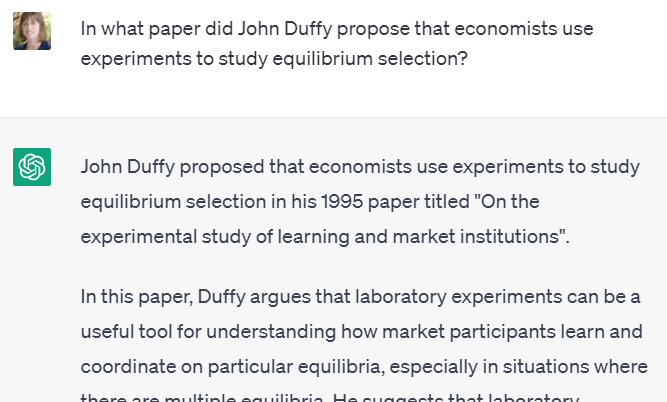
First, I asked ChatGPT for help with the following prompt:

ChatGPT is at it again. There is no such paper, as I will verify by showing John Duffy’s publications from that year: 

ChatGPT makes up lies (“hallucinations”). It is also great for some tasks, and smart people are already using it to become more productive. My post last week was on how impressive ChatGPT seemed in the Jonathan Swift impersonation. I didn’t take any time to do fact checking and I would bet money that at least something was made-up-facts in there.

I posed the same question to the Bing plug-in for the Edge browser (Microsoft). Yup, I have opened Edge for the first time in forever to use Bing.

Bing handles the prompt by linking to a useful relevant paper – so if you click the link you will get to a helpful and not misleading answer. Just being a smart search engine instead of hallucinating randomly is better, for my purposes.

The actual paper I wanted returned was this one, by the way:

Duffy, John. “Experimental macroeconomics.” Behavioural and Experimental Economics (2010): 113-119.

There is no reason that ChatGPT should be better than an expert in a subfield of a field of economics. But that’s the genius of a good search engine. You ask it “Can I repair a broken fiddlewhat?” The search engine does not claim to know but rather directs you to the blog of the world expert in fiddlewhats.

I can’t find the link to it, but I’m going to toss in one more thing here. Tyler Cowen did an interview this Spring on AI. There was a newspaper reporter who had a “creepy” interaction with an AI that made for the topic of a viral internet article. Tyler made a very contrarian point by saying that he interprets this as a case of AI alignment. The reporter wanted something sensational and he got what he wanted.

So, it will probably be true for a long time that if you want to find a failure of AI, you can get what you want. Still, I’m putting this on the record here because I wonder if this particular problem will get solved quickly.