Thanksgiving Links

Asked for its methodology, the White House pointed us to a Nov. 15 blog post by Jeremy Horpedahl, an associate economics professor at the University of Central Arkansas.

https://www.politifact.com/factchecks/2023/nov/21/karine-jean-pierre/fact-checking-karine-jean-pierre-on-this-years-tha

“When people ask what Civilization VI’s “cultural victory” condition would look like in the real world, this is it. Write it in the manual.”

And new from Cato: Food Globalization Puts the World on Your Plate

Growth of the Transfer State

I’ve written about government spending before. But not all spending is the same. Building a bridge, buying a stapler, and taking from Peter to pay Paul are all different types of spending. I want to illustrate that last category. Anytime that the government gives money to someone without purchasing a good or service or making an interest payment, it’s called a ‘transfer’. People get excited about transfers. Social security is a transfer and so is unemployment insurance benefits. Those nice covid checks? Also transfers.

Here I’ll focus on Federal transfers, though the data on all transfers is very similar if you include states in the analysis. Let’s start with the raw numbers. Below is data on GDP, Federal spending, and federal transfers. Suffice it to say that they are bigger than they used to be. They’ve all been growing geometrically and they all exhibit bumps near recessions.

Continue reading

Happy Thanksgiving from EWED

I am thankful for food abundance and for general prosperity.

Sometimes it’s easy to take for granted the good things you’ve always had; you don’t know what you’ve got till it’s gone.

In that spirit, after lacking it for much of the last month, I am extremely thankful for reliable indoor plumbing. Our clay sewer pipes that had lasted 100+ years finally started to crack, which made for a big mess and took $8000 to repair. But we’re now back in business, and thanks to the magic of pipe relining we didn’t have to dig through our deck to do it.

Hopefully this lets you all appreciate your plumbing too without having to go through the whole experience yourself.

Let’s Be Thankful for Food Abundance

Despite recent increases in prices of food, we should still all be very thankful this Thanksgiving for the abundance of affordable food available in the modern world. Looking back at my past few blog posts, I notice that I have been very food-centric in my choice of topics! And last week I also showed how the Thanksgiving meal this year will be the second cheapest ever (only behind 2019). While it’s absolutely true that food prices are up a lot in the past 2 and 4 years, they probably aren’t up as much as you have heard.

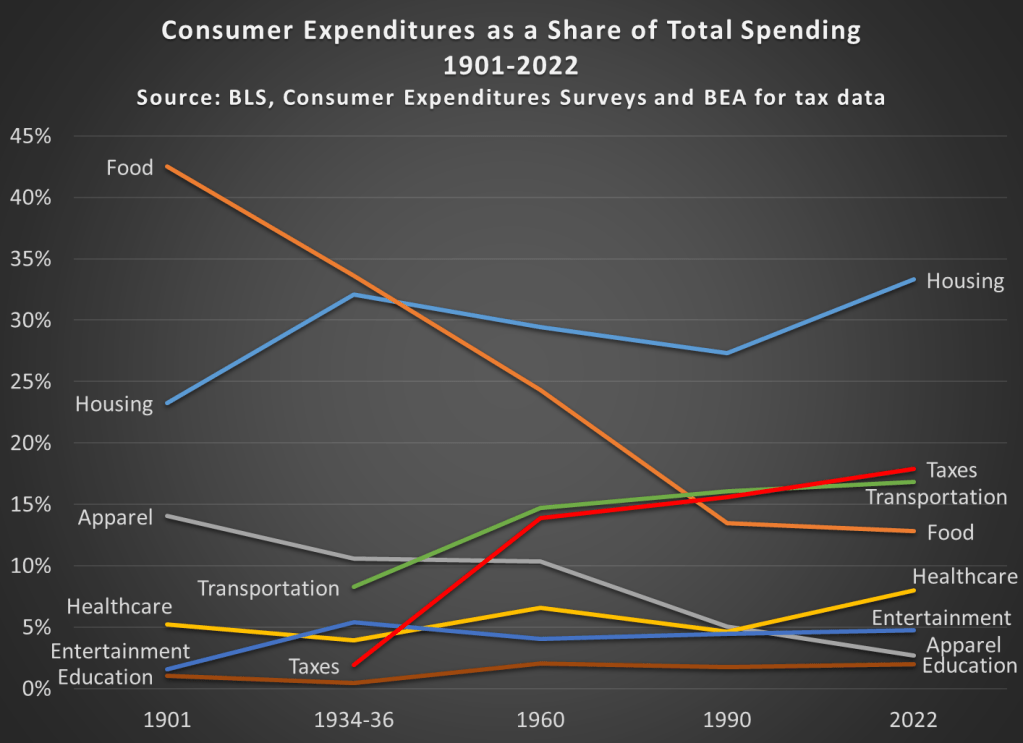
It’s always my preference to take as long-term perspective as possible when thinking about economic progress. So here’s the best way I’ve come up with to show how cheap and abundant food is today: food as a share of household spending fell dramatically in the 20th century.

Most of the data in this chart comes from the BLS Consumer Expenditure Surveys. This survey was done occasionally since 1901, and then annually since 1984. I also use BEA data to estimate personal taxes paid as a percent of spending (the CEX Surveys have some tax data, but it’s not reliable nor consistent). I picked as close to 30-year intervals as I could (with a preference for showing the earliest and latest years available), and I chose spending categories that are 90-100% of total expenditures in most of these years. Keep in mind also that these are consumer expenditures. As a nation, we spend a lot more on healthcare and education than this chart suggests, but most of that spending is not directly from households (of course, it is indirectly). Think of this chart as an average household budget.

I hope the thing that jumps out at you is that the amount money households spend on food has fallen dramatically since 1901, from over 42 percent to under 13 percent of household expenditures. To be clear, this data includes both spending on food at home and at restaurants (after 1984 we can track them separately, and groceries are pretty consistently about 60 percent of food spending). And you may be wondering about very recent trends too, such as before the pandemic. In 2022, household spent slightly less on food than they did in 2019, falling from 13.5 to 12.8%.

You may also notice that taxes have increased, though not much since 1960. Housing cost have been consistently high, and also a bit higher than 1990, going from 27 percent to 33 percent in 2022. And housing is now the single largest budget expenditure category, but for most of the first half of the 20th century, it was food that was the largest. And since people aren’t changing their housing situation more than once a year (if that), it would also have been food that dominated weekly and monthly budget decisions and worry about price fluctuations.

This year there will be lots of complaining about prices around the Thanksgiving table. And much of that is warranted! But let’s also be thankful on this food-intensive holiday for how cheap the food is.

And if some smart-aleck youngster tries to tell you that they learned on TikTok that things were better during the Great Depression (yes, people are really saying this!), have them watch this video by Christopher Clarke. Or show them that in the mid-1930s an average family spent one-third of their budget on food in my chart above, or how much labor it would have taken to buy that turkey in the 1930s (about 40 times as much time spent working as today).

Mutiny in Silicon Valley:  OpenAI Workforce May Quit and Join Microsoft If Board Does Not Resign and Bring Back Former CEO Sam Altman

The bombshell news in the tech world as of late Friday was that, in a sudden coup, the board of OpenAI fired CEO and tech entrepreneur Sam Altman, and demoted company cofounder and former president Greg Brockman. The exact grounds for their decision remain somewhat murky, but apparently Altman wanted to move faster with AI deployment and monetization than some board members were comfortable with.

The OpenAI organization burst on the scene in the past year with the release of advanced versions of ChatGPT. This “generative” AI technology can crank out computer code and human-like text articles and reports and images. Naturally, students have taken to employing ChatGPT to write their essays for them. And so, professors now use AI to detect whether their students’ essays were machine written or not.

Fellow blogger Joy Buchanan has addressed the rising problem of erroneous information (“hallucinations”) that can appear in AI generated material. There is a movement to slow down the development of AI, for fear it will lead to The End Of The World As We Know It (TEOTWAWKI).  (Interestingly, all of the business commentators I listened to today dismissed the alleged world-ending dangers of generative AI as largely deliberate hype on the part of AI developers, to create a buzz – which it has.)

Having hitched itself technically to OpenAI technology, and having poured something like $13 billion into funding OpenAI, giving it a 49% ownership stake in part of the business, Microsoft was obviously concerned about the effect of Altman’s dismissal on its own AI plans.  As it became clear that the board action would lead to substantial dysfunction at OpenAI, Microsoft carried out its own coup, by hiring Altman and Brockman to run a big in-house AI research initiative, and making it clear that anyone else who wanted to resign from open AI could have their old jobs back, under their old leaders, in Seattle.  And indeed, as of late Monday, nearly all of OpenAI’s employees had signed an open letter stating that unless the OpenAI board quits, they “may choose to resign from OpenAI and join the newly announced Microsoft subsidiary.”

Investors are still trying to figure out what all this means for Microsoft. A pessimistic take is that the corporation has to take a big write down on a $13 billion investment, if the OpenAI organization  (valued a month ago at $90 billion) loses its momentum. An optimistic take is that Microsoft may get the human capital crown jewels of this leading tech outfit for simply the cost of salaries (and signing bonuses), instead of shelling out to buy the enterprise as such. Also, having the technology all in-house would remove the vulnerability of Microsoft currently faces with having a key piece of its future in the hands of a separate organization. There is debate on how much the intellectual property held by OpenAI would inhibit Microsoft from forging ahead with its own version of ChatGPT.

According to Wikipedia:

Shares in Microsoft fell nearly three percent following the announcement.   According to CoinDesk, the value of Worldcoin, an iris biometric cryptocurrency co-founded by Altman, decreased twelve percent.   After hiring Altman, Microsoft’s stock price rose over two percent to an all-time high.  

According to The Information, Altman’s removal risks a share sale led by Thrive Capital valuing the company at US$86 billion.   A potential second tender offer for early-stage investors is also at risk.   Altman’s removal could benefit OpenAI’s competitors, such as Anthropic, Quora, Hugging FaceMeta Platforms, and GoogleThe Economist wrote that the removal could slow down the artificial intelligence industry as a whole.  Google DeepMind received an increase in applicants, according to The Information. Several investors considered writing down their OpenAI investments to zero, impacting the company’s ability to raise capital. Over one hundred companies using OpenAI contacted competing startup Anthropic according to The Information; others reached out to Google CloudCohere, and Microsoft Azure.

There is a slight possibility that the open AI board could take a big hit for the team, and bring back Altman and Brockman and then resign in order to keep the organization intact. If that happens, the deployment of generative AI would accelerate – – which might destroy the world.

THIS JUST IN: ALTMAN BACK IN CHARGE AT OPENAI

If there was a prize for “worst board decision of the year” it would have to go to the move late last week to fire Sam Altman. But just when you thought there was no more drama to be milked out of this scene, the news Wednesday is that the OpenAI board is out, and Altman is back in as CEO at OpenAI. Microsoft is presumably happy to have the organization intact, and it seems that those pesky timid souls who were trying to go slow on AI proliferation have been swept aside. TEOTWAWKI here we come…
Stop and Frisk was an Unmitigated Disaster

Sometimes we think things have been incontrovertibly been proven, but we really only know them. Other times we think we know them but we really only think them. It’s always interesting when we something we think becomes something we know. We share those beliefs a little more often with a little more confidence. We start trying to tilt the balance of common knowledge one conversation at a time. I’d argue, however, that we would often be better served to wait until something is proven, as much as something can be proven. Or, at the very least, that our conversational was weight shifted far more when truly compelling evidence hits the scene.

I already believed that New York City’s infamous “Stop and Frisk” program was bad. That the bad outweighed the good. I was always careful to soften my language, to hedge my claims, however, because I always suspected there had to be some margins on which the program yielded some benefit to someone, somewhere, in some context. Criminal deterrence is real, after all.

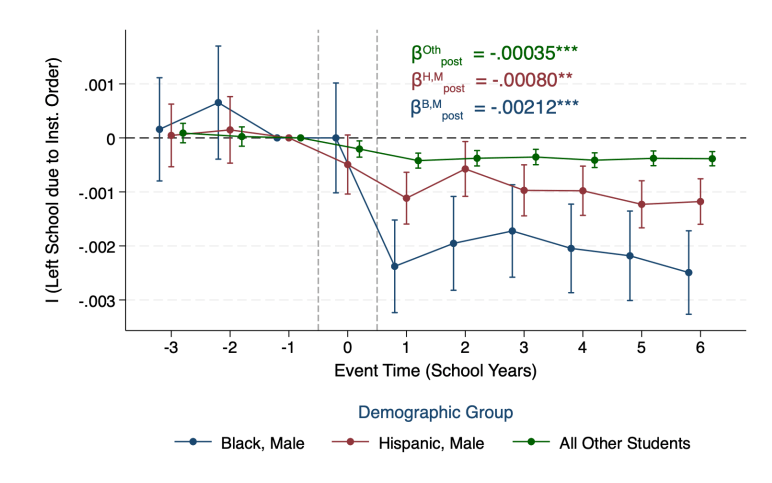
I no longer feel any need to soften my language or claims one iota. There are research papers that change your priors. There are also ones that harden them into granite. Jonathan Tebes and Jeffrey Fagan have a new working paper they are presenting at conferences and quietly circulating that provides the single most compelling research effort into the effects of Stop and Frisk I have come across to date, one which makes the case that Stop and Frisk had now measurable effect at the margin to deter crime while, at the same came, causing significant harm to the young Black men walking the streets of New York City.

Please go through the slides, but let me summarize. Using a credible and clever event study design around the end of Stop and Frisk, Tebes and Fagan are able to identify the effect of stops on crime, finding an impressively precise null effect. They then look the effect of these stops of neighborhood schooling outcomes, specifically interruptions to instruction, persistent absences, suspensions, and graduation. The result, again, is very clear: Stop and Frisk was a disaster for high school age Black Men.

I’m just going to leave it there. Read the slides, read the paper when they release it, update your priors. And when someone tries to tell you at Thanksgiving dinner this year that New York City is going straight to hell because they ended Stop and Frisk, have the confidence to vigorously attempt to update their priors. Will it work? I’ve never met your family…but probably not.

But you gotta try, right? It’s your duty. And then make yourself a drink or take an extra slice of pie knowing that you earned it.

The current alliance to counter digital piracy

U.S. Immigration and Customs Enforcement’s (ICE) Homeland Security Investigations (HSI) has joined forces with the Motion Picture Association (MPA) to launch a new initiative aimed at countering digital piracy and protecting a vital sector of the U.S economy.

The initiative is called Operation Intangibles.

Digital streaming services provide quick and easy access to creative works, such as music, television, movies. However, the growth of digital streaming services has presented new challenges when it comes to law enforcement’s ability to ensure vital copyright protection for the industry. This technology that has provided millions of people access to their favorite shows, has also enabled criminals to turn piracy into a crime that is no longer restricted to the hand-to-hand sale of illegally pirated media.

Digital piracy negatively impacts millions of jobs, results in less taxes being paid, and threatens innovation and creativity. Its effects are felt across multiple industries and includes the cost of corollary crimes on consumers such as the potential damage caused by hidden or embedded malware, as well as identity theft and financial crimes, such as credit card fraud.

There exists a National Intellectual Property Rights Coordination Center.

Recall, Napster was shut down in 2001. Limewire was shut down in 2010. Illicit downloading is happening through other channels.

According to this graph, people spent almost as much on vinyl records as they did on CDs in 2018. The Economist provided a nice chart (last updated in 2019) on the rise of streaming revenue and the collapse of traditional records sales.

Malinvestment Produces Knowledge

Austrian economists rightfully have some gripes about mainstream macroeconomics – specifically about aggregation. The conventional wisdom says that a fall in output can be prevented or remedied in the short-run by an expansion of total spending (via increasing the money supply). Total output is stabilized and the crisis is averted. Even if rising spending preceded the output decline, the standard prescription is the same.

The Austrian Business Cycle theory says that, actually, the prior expansion in spending resulted in yet-to-be-realized poor investments due to easy credit. The decline in output is self-inflicted by unsustainable endeavors, and the money supply expansion response prevents the correction. The consequence is more malinvestment. The Austrians say that the focus on gross investment is a misleading aggregation and commits the fallacy of composition that all investment is the same or the same on relevant margins.

Both schools of thought are on firm ground. I don’t see them as conflicting. They both make valid points and are correct about the world. The conventional wisdom is able to paper-over short-run hiccups, and the Austrians recognize that resources are suboptimally allocated. The two sides are talking past each other to some extent.

The market process of seeking profits and satisfying consumer demands is a messy process. Prices and profits (and losses) incentivize firms with information that they use to adjust their behavior. They innovate and reallocate resources from bad projects and toward money-making projects. When firms earn negative profits (a loss) they learn that their understanding of the world was wrong and that they malinvested their scarce resources. Therefore, malinvestment is a standard and *necessary* part of the market process of identifying and serving the changing and unknown demands of individuals. Without malinvestment we lack the necessary information to distinguish success from failure.

Mal-investment is harmful insofar as it represents resources that were invested such that future output did not rise as it could have otherwise. So, while malinvestment is necessary to the market process, a preponderance of it makes us poorer in the future. Luckily, firms have incentives and finite resources such that mal-investment remains somewhat tamed. Indeed, malinvestment is the cost that we bear for innovation and identifying what works.

The issue is that the above discussion is oriented to the long-run. The conventional wisdom is oriented toward resolving the short-run threats. The two meet one another when malinvestment realizations occur in a correlated manner. It’s not that policy causes malinvestment. Rather, depressed interest rates and easy credit prevent firms from identifying which of their projects turned out to be more or less productive. Firms persist in bad investments because they can’t discriminate between the failed and successful projects ex ante.

So, when interest rates suddenly rise, low or negative productivity projects are identified and resources are reallocated. The discovery and reallocation process takes time. And if many projects are found to be failures at once, then the result is a drop in economic activity that is detectable at the aggregate level. The problem is not that malinvestment exists. The problem is that malinvestment was permitted to persist and grow such that the eventual realization of losses is correlated and has macroeconomic effects. We observe spending, output, and employment declines. That’s the ‘business cycle’ part of the Austrian Business Cycle. Interest rates rising helps to identify the bad projects. That’s good. But policy that increases the popularity of bad projects is bad. It makes us poorer in the long-run and more vulnerable to declines in the short-run.

New Orleans Redux: SEA 2023

I’m heading to New Orleans tomorrow for the 2023 meeting of the Southern Economic Association, where I’ll present research on the labor market effects of Certificate of Need laws.

I’ll take this as an excuse to re-up two previous posts on New Orleans:

First, my travel guide post for anyone else heading there soon

Second, my bigger-picture take on how the city has changed over the last decade: Waxing Crescent: New Orleans 2013-2023

I recommend reading the whole thing, but here’s the conclusion:

As much as things have changed since 2013, my overall assessment of the city remains the same: its unlike anywhere else in America. It is unparalleled in both its strengths and its weaknesses. If you care about food, drink, music, and having a good time, its the place to be. If you’re more focused more on career, health, or safety, it isn’t. People who fled Katrina and stayed in other cities like Houston or Atlanta wound up richer and healthier. But not necessarily happier.

Hope to see some of you there!

Thanksgiving 2023 is the Second Cheapest Ever (Relative to Earnings)

Continuing my tradition of Thanksgiving posts, Farm Bureau released today the latest data on the cost of a traditional Thanksgiving meal. There is welcome news for consumers, as the nominal price of the dinner is slightly lower than last year: $61.17 vs. $64.05 in 2022. The big factor in this decline was the fall in the price of turkeys, though eight of the 12 items in this meal are lower than 2022. As they note in the press release, this is still significantly higher than 2019: about 25% higher.

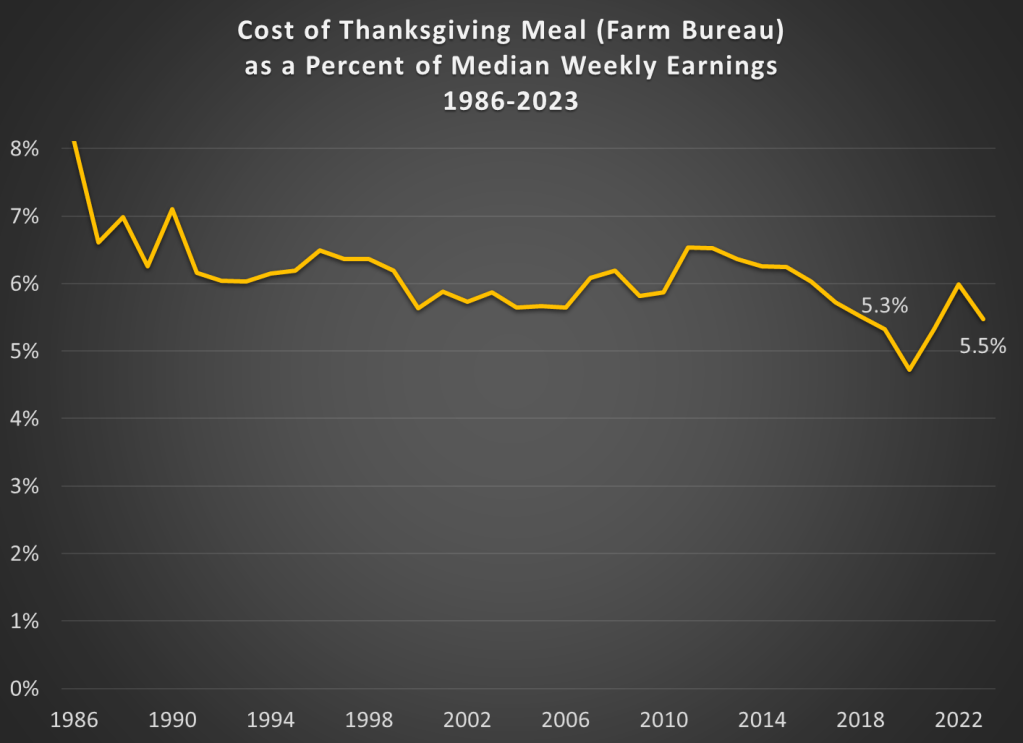
Regular readers will know what’s coming. Let’s compare those prices (and some historical prices) to earnings:

The Farm Bureau turkey dinner stands at about 5.5 percent of median weekly earnings from the third quarter of this year. That’s a touch higher than 2019, when it was 5.3 percent of weekly earnings. But notice that other than 2019, the figure for 2023 is the lowest ever! (Ignoring the weird years of the pandemic, when wage data is hard to interpret.) So we haven’t quite gotten back to 2019 levels, but we are at the same level as 2018. And lower than 2017. And all prior years too.

The last few Thanksgivings have been tough for Americans. This year, we can all be thankful for falling prices and rising wages.