The things that happen between people’s ears are difficult to study. Similarly, the actions that we take and the symbolic gestures that we communicate to the people around us are also difficult to study. We often and easily perceive the social signals of otherwise mundane activities, but they are nearly impossible to quantify systematically beyond 1st person accounts. And that’s me being generous. Part of the reason that these things are hard to study is that communication requires both a transmitter and a receiver. One person transmits a message and another person receives it. Sometimes, they’re on slightly or very different wavelengths and the message gets garbled or sent inadvertently and then conflict ensues.
Having common beliefs and understandings about the world help us to communicate more effectively. Those beliefs also tend to be relevant about the material world too. A small example is sunscreen. Because a parent rightly believes that sunscreen will protect their child from short-run pain and long-run sickness, they might lather it on. But, due to their belief, they also signal their love, compassion, and stewardship for their child. A spouse or another adult failing to apply sunscreen to a child signals the lack thereof and conflict can ensue even when the long-term impact of one-time and brief sun exposure is almost zero.
People cry both sad and happy tears because of how they interpret the actions of others – often apart from the other external effects. Therefore, beliefs imbue with costs and benefits even the behaviors that have seemingly immaterial consequences otherwise. We can argue all day about beliefs. And while beliefs might change with temporary changes in the technology, society, and the environment, core beliefs need to be durable over time. Therefore, if this economist were to recommend beliefs, then I would focus on the prerequisite of persistence before even trying to find a locally optimal set.
Here are three inexhaustive criteria for a durable beliefs:
Intergenerationally Transmissible
A set of beliefs must be self-sustaining. If a belief is difficult to spread or can’t be spread to others, then it will extinguish within a lifetime. If a belief encourages death prior to reproductive age or doesn’t foster the subsequent generation both materially and doctrinally, then it fizzles out. Similarly, if a set of beliefs achieves infertility at a large scale, then the belief will have eliminated the genes of the adherents in addition to the belief itself. I’m looking at you Shakers. Though some people may need to physically reproduce, others may spread their beliefs by adoption or otherwise teaching children or new adults.
Infectious and Chronic
One way to encourage a scale that aids intergenerational transmission is to achieve scale. Achieving scale requires a high rate of transmission, at least initially. A belief must be well-suited to a highly diverse set of people (or at least reproductive people, depending on the time scale). That is, beliefs requiring an IQ in the top 20% limit the population who can hold them. Apply the same reasoning to income, melanin, conscientiousness, size, conformity, and et cetera and you get a set of beliefs for which hardly anyone qualifies. Therefore, a wide variety of people must be able to hold a belief during a single lifetime as a prerequisite for intergenerational transmission.
Not only do beliefs need to persist across generations of people, but they also need to persist within an individual. If a belief imposes adequately high costs relative to the benefits, then a person will drop the belief altogether (I don’t mean to imply that it’s an easy thing to do). While a particularly infectious belief might result in widespread adoption, it’s only a flash in the pan if it doesn’t result in a chronic condition. Therefore, a doctrine must not impose relatively high material and psychological costs on an individual without compensation.
Productive
A belief must permit and even encourage material output. One can imagine a system of beliefs that is both individually and intergenerationally persistent in isolation, and is then shed once competition is introduced. Think of all the willing and unwilling converts to Christianity and Islam. The old beliefs were outcompeted by pen or by sword. A system of belief must have a means by which to confront other beliefs without being annihilated. So, a persistent belief must result in means with which to bump up against other beliefs and survive the encounter. Beliefs must encourage the command over resources and greater material discretion to a degree in order to compete.
The Venn Diagram
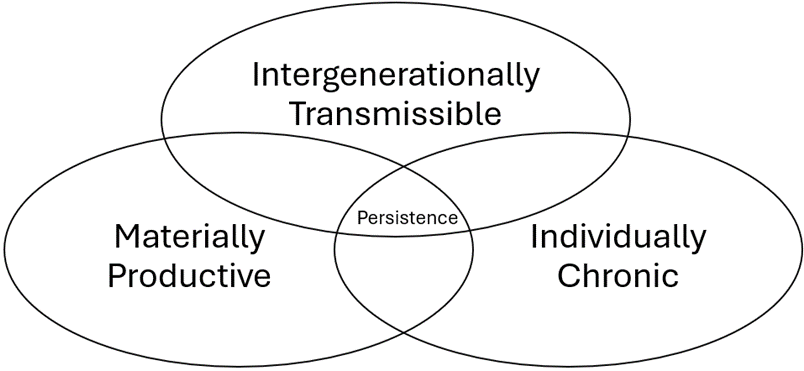
A belief that doesn’t encourage adequate material productivity fails the test of surviving encounters with alternative beliefs. If productivity is low enough, then belief and the people who hold them can fizzle out of their own accord even without competition from other beliefs.
A belief that is productive and intergenerationally transmissible but fails to be chronic results in lapses. There are lapsed evangelicals, Jews, Catholics, etc. If a belief is left at home with the parents once the next generation reaches adulthood and moves out, then that’s where it dies.
Finally, a belief that can’t be transmitted to the next generation is merely transitory. It might result in high incomes and strict adherence among individuals. But if the population declines without a countervailing force ultimately asserting itself, then the belief is not long for this world.
Persistent beliefs require all three.
*This analysis is also somewhat receptive to a transition matrix.
 Economist Writing Every Day