Claims that the middle class or working class has been “hollowed out” in the US have been made for years, or decades really. The latest claim is an essay in the Free Press by Joe Nocera. But these claims are usually lacking in data, while strong in anecdotes. Let’s look at the data.
One data point we might use is median weekly earnings for full-time workers with a high school diploma, but no college degree. That sounds like a reasonable definition of “working class.” Here’s what that data looks like adjusted for inflation with the PCE Price Index:

Notice that the latest data point is for 2024, which is the highest they have ever been in this data series, and likely higher than any point in the past. While many point to about the year 2000 as when troubles for the working class started (this is when manufacturing employment really fell off a cliff, and China joined the WTO in 2001), inflation-adjusted earnings have risen 11% for this group of workers since then. You might say that’s not a lot of growth — and you would be correct! But this group is better off economically than in the year 2000, which is a point that gets lost in so many discussions about this issue.
But that’s just a national number. Might some states that were especially hit by manufacturing job losses be worse off? Nocera mentions North Carolina and the Midwest. To answer this, we can use BLS OEWS data, which has not only median wages by state, but also the 10th percentile wage — the lowest of the working class. Here’s what median real wage growth (again inflation-adjusted with the PCEPI) since 2001 (the earliest year in this series with comparable data):

Notice that every single state had positive real median wage growth from 2001 to 2024. Every single one! North Carolina median wages beat inflation by 24%. The lowest is Michigan, just barely above inflation, one of the hardest hit states by manufacturing job losses — but even theirs is positive. And see what it looks like for the 10th percentile earners:
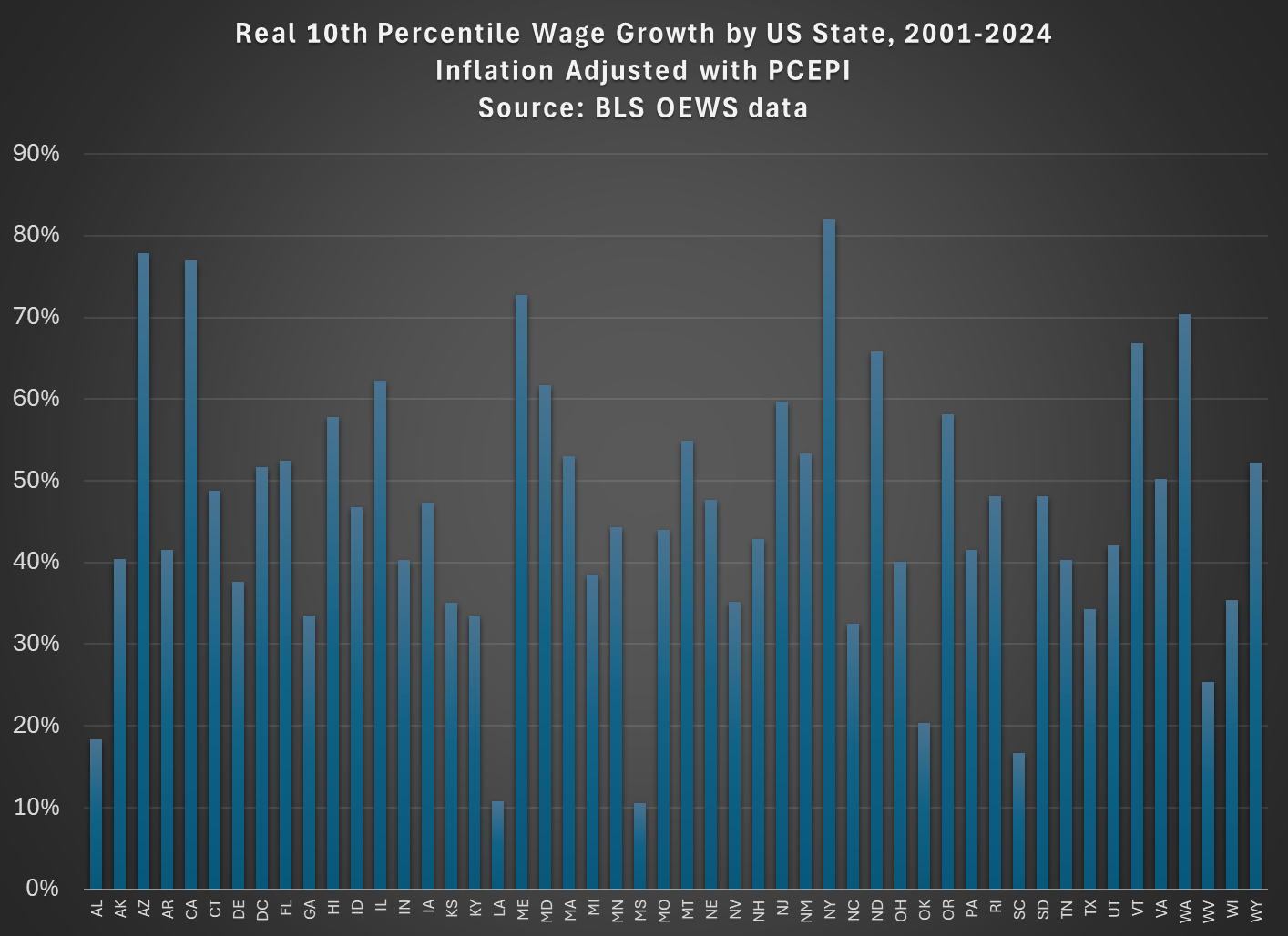
Again, every single state beat inflation at the 10th percentile. Michigan, the laggard at the median, looks much better here, beating inflation by 39% at the 10th percentile. Wow! North Carolina 10th percentile workers beat inflation by 33%, even better than their median workers. In fact, only 6 states had worse growth at the 10th percentile than at the median (AL, LA, MS, OK, SC, and WV), but all of these states still had positive, inflation-adjusted wage growth from 2001-2024.
Finally, we might get even more specific. The Nocera essay mentions two communities within these broader regions of North Carolina and the Midwest that were impacted: High Point, NC and Flint, MI. And very usefully, the BLS OEWS also has data at the MSA level.
Here’s what 10th percentile and median real wage growth looks like for those MSAs (note: the Greensboro-High Point MSA was combined with Winston-Salem in 2001, so I use that as the baseline, but these two MSAs are very similar in 2024 for these wage statistics):
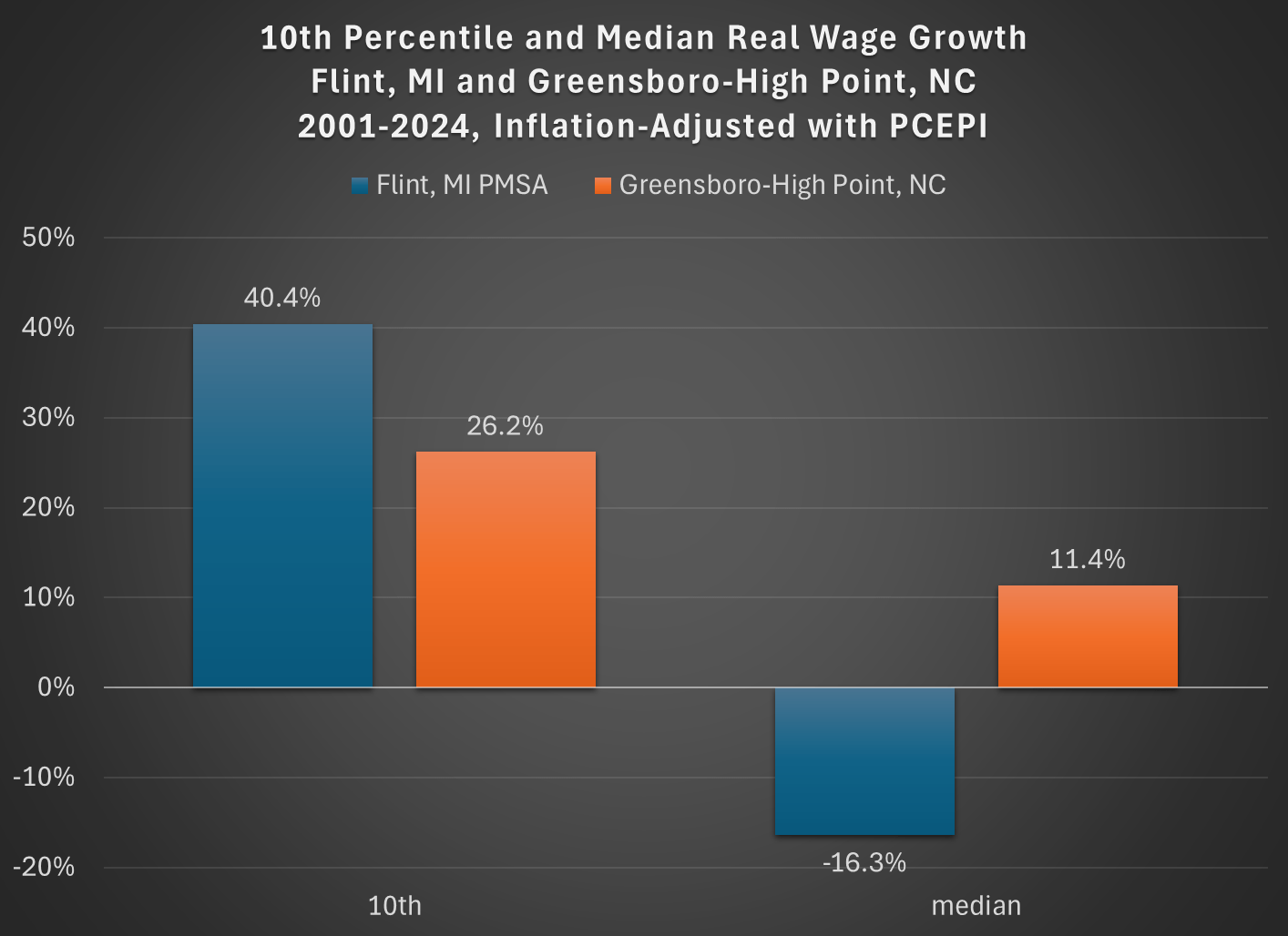
So here we have finally zoomed in enough that we can see one group of workers that clearly suffered real wage declines since 2001: median-wage workers in Flint, Michigan. This is worth exploring more, but keep in mind Flint’s decline predates both NAFTA in 1994 and China’s joining the WTO in 2001. Michael Moore’s famous Roger & Me documentary came out in 1989. By 1996, you already had university press books with titles like A Town Abandoned: Flint, Michigan, Confronts Deindustrialization (and this book was largely based on work the author did as a grad student in 1990-1992). Flint, Michigan may well be a victim of globalization, though it is also probably a result of the shift of automobile production to southern US states.
But Flint does not seem to be a good representative case. First, the timing does not like up with the usual culprits of NAFTA and China. And even in Flint, 10th percentile wages performed extremely well since 2001. The Piedmont Triad and other parts of North Carolina (and many other places) have found ways to adapt to the manufacturing job losses, as Scott Lincicome has pointed out.
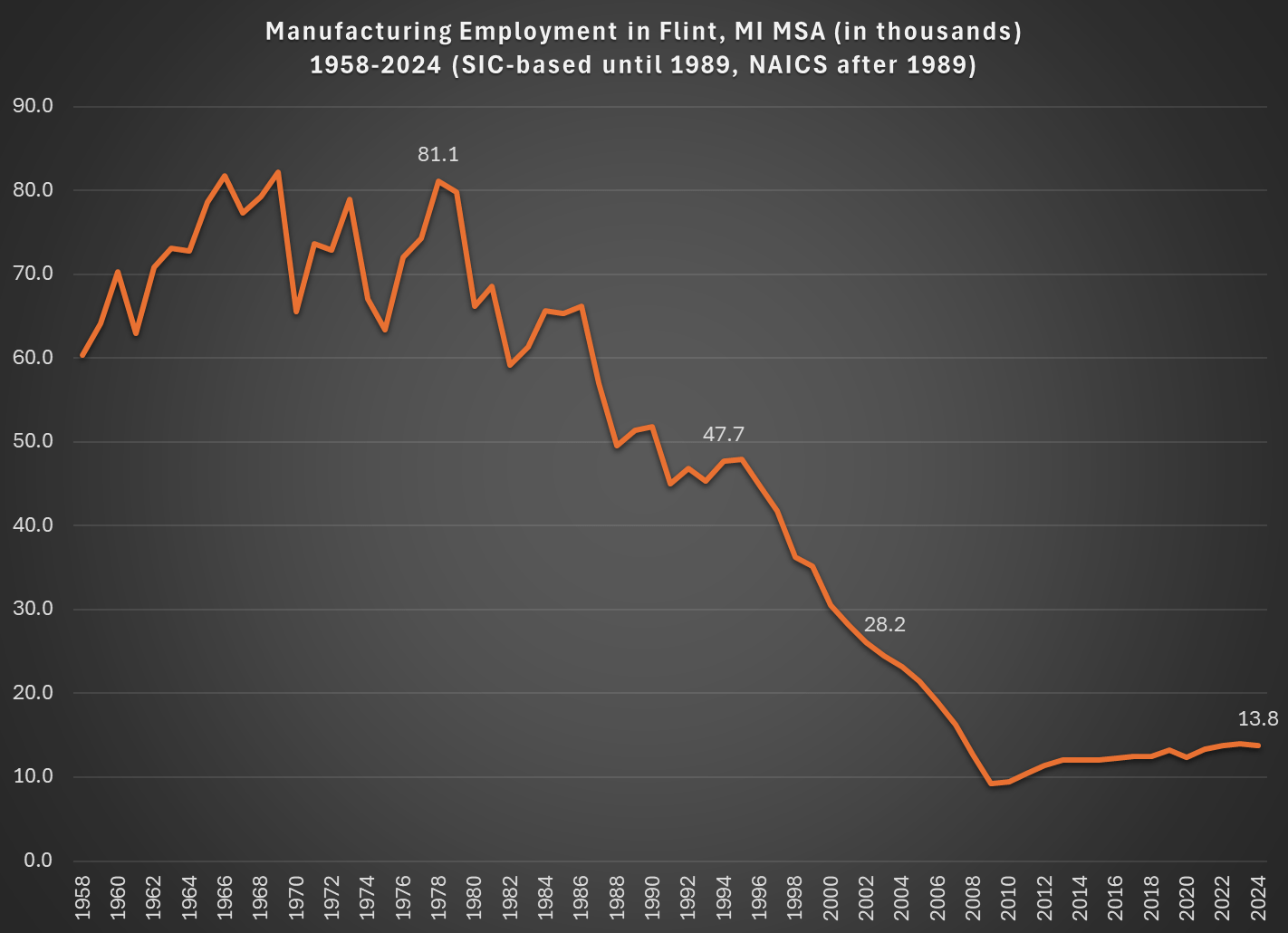
I’ll be honest that I don’t know what should be done about a town like Flint, but, thankfully, they seem to be the exception rather than the rule. Manufacturing employment in Flint had been declining since 1978, and doesn’t appear to be a victim of the more recent, post-NAFTA move towards globalization. They haven’t recovered from this in other sectors either, with total employment being just about three-fourths of what it was in the late 1970s.
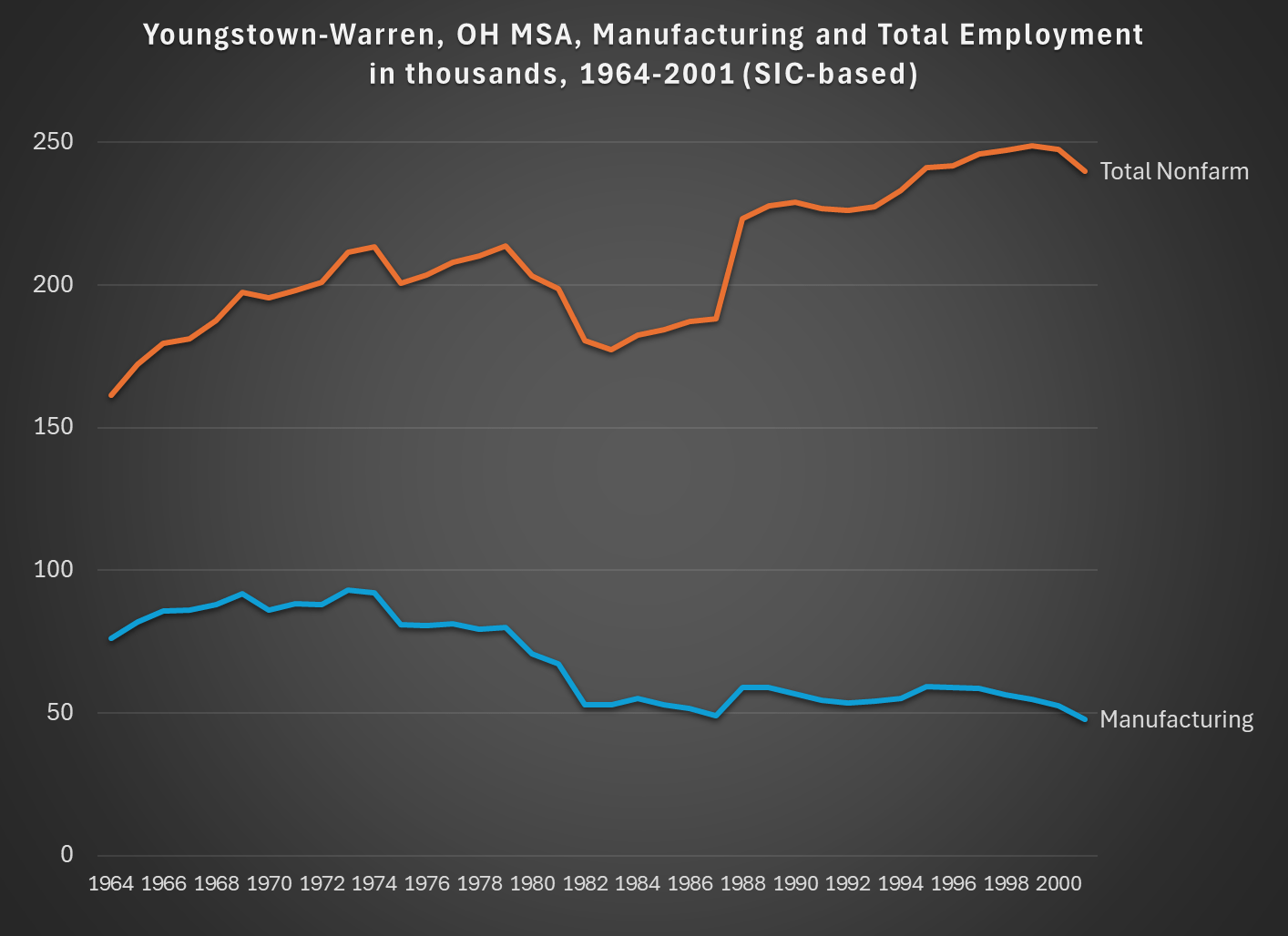
Greensboro-High Point, on the other hand, is roughly where they were in the late 1990s in total employment, even though manufacturing employment has shrunk dramatically. Yes, you can find other cities and small regions with similar stories as Flint — as Lincicome makes clear, some places like Youngstown, OH are still struggling — but the loss of manufacturing jobs is not a death sentence, either for a city or the working class. And in Youngstown, the loss of over 40,000 manufacturing jobs was more than offset by job gains in other sectors, unlike Flint. Also unlike Flint, Youngstown has seen real median wages grow since 2001, by 8% over inflation, and growth for the bottom 10% was just as strong as in Flint (39%).
 Economist Writing Every Day
Nice. But you still need to account for the possibility that the lowest wage earners dropped out of the market. That would contribute to hardship and perception of hardship even as the median wages rose.
LikeLike
Has anyone done a study looking at how media, and specifically the depiction of lifestyle, material wealth, and messaging in advertisements and television that relentlessly shows people what they don’t have and what they should want, has impacted the perception of the middle class that it has been hallowed out? It’s hard to square the relative material wealth that a typical middle class family has today in terms of the quality of electronics, clothing, white goods, homes, medicine, travel, automobiles, books, movies, compared to what similarly situated families may have had in the 70s and 80s with the notions of “hallowing out”. Could it be that popular culture has been so effective at telling people that they need more that “The Joneses” effect has become weaponized and people perceive that they are falling behind when, in fact, they are gaining?
LikeLike
Flint was doomed by UAW greed and GM mismanagement. Starting with the 1969 strike and subsequent labor agreement which paid workers the same take home pay whether they worked or were laid off, the clock began ticking on both Flint and GM. Auto jobs were crappy jobs that paid far beyond the value added by workers who demanded ever higher compensation to make up for the monotony. Hence, the rise of robots and the shrinking workforce. This was papered over by GM’s market share of nearly 50%, but doom was inevitable. The mismatch between compensation and value added was best summed up by the CEO of Delphi, the parts division spun off in the dying days of both the old GM and the soon to be bankrupt Delphi ” There is no alternative universe where a company can pay the fellow who mows the grass on the lawn in front of corporate headquarters $62/hour and survive”. Read the book “Rivethead” which describes both the inhumanity of assembly line jobs and the rampant featherbedding and theft by the workers at the Flint plants
LikeLike