A recent blog post from the St. Louis Fed claims that:
“Both younger and older workers withdrew from the labor force in large numbers during the pandemic: In fact, their participation rates plummeted. Yet, within two years, the younger workers had bounced back to their pre-pandemic participation rates. But the older workers have not.”
They include a chart which seems to back up that assertion:

However, if you look closely, you will see that the older workers’ age group is open-ended. It includes 55-year-olds, as well as 95-year-olds. Given that the US population is aging, this seems like a poor choice.
While not available currently in the FRED database, there is data from BLS available for older workers that is not open-ended. For example, we can look at workers ages 55-64, who are older but still young enough that they are mostly below traditional retirement age. I use that data and compare with the 25-54 age group (note: because the 55-64 data isn’t available seasonally adjusted, I use the non-adjusted data for both age groups, then use a 12-month average, so my chart doesn’t exactly replicate the chart above):
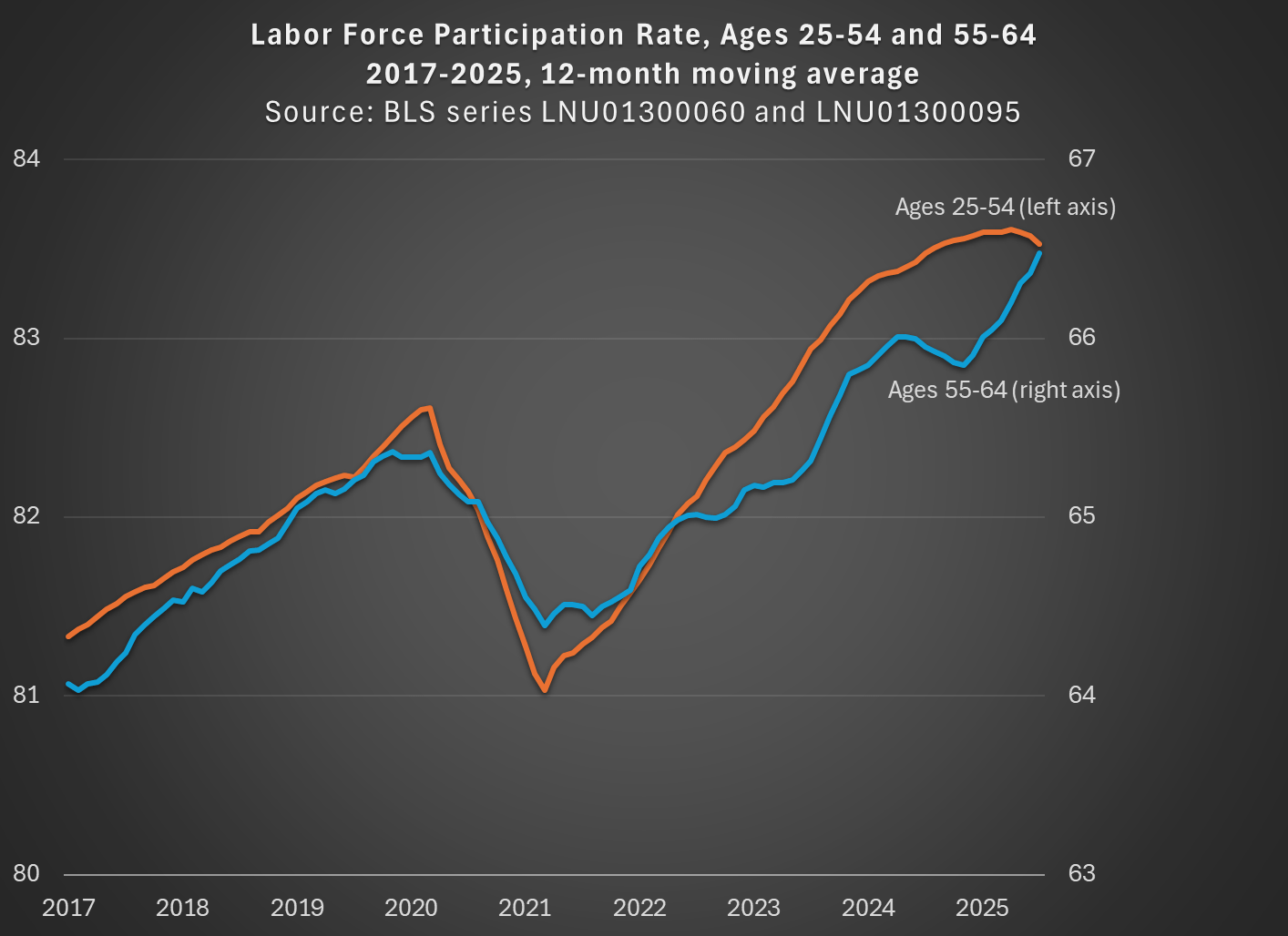
By using a closed-end age group for older workers, we see that labor force participation has not only recovered from the pandemic, but it exceeds the pre-pandemic peak for both prime-age and older workers, and had done so by the Spring of 2023. In fact, both are now about 1 percentage point above February 2020. If we want to go to the first decimal place, older workers have actually increased their labor force participation slightly more: 1.1 vs 0.9 percentage points. But these are close enough, given that this is survey data, to say the recovery has been roughly equal.
The St. Louis Fed blog concludes by saying that early workforce retirements “will continue to depress the labor force participation rate of workers aged 55 and older for the foreseeable future.” But it’s not true that the LFPR of older workers is depressed! Provided that we exclude those 65 and older.
 Economist Writing Every Day
Great. Then we can ask why the oldest people are working less in a way that is correlated with the timing of covid. Realizing that early retirement is pretty nice? Generally increasing living standards among the elderly alone doesn’t get us the discrete dip. Maybe lower labor supply do to a perceived/actual change in the risk of communicable disease?
LikeLike
Just an anecdotal observation – – in late 2021 or so, when formal social distancing restrictions had eased and people were travelling again, I stayed at a motel in western New England. I asked the proprietor how things were going. He said that all his service workers who had been in their mid sixties had taken advantage of the huge stimulus packages to retire earlier than planned, and he was having a hard time finding replacements. So the numbers for the age 65-70 cohort might show a big dip post Covid, even if those who were say 59 in 2020 and are now 64 were not positioned to retire 4-5 years ago.
LikeLike
Thanks. I examined it in my subsequent post. It turns out that the 65+ folks didn’t have a decline. They just have a lower rate generally and their proportion of the 55+ population increase. But I don’t account for the discrete jump.
LikeLike