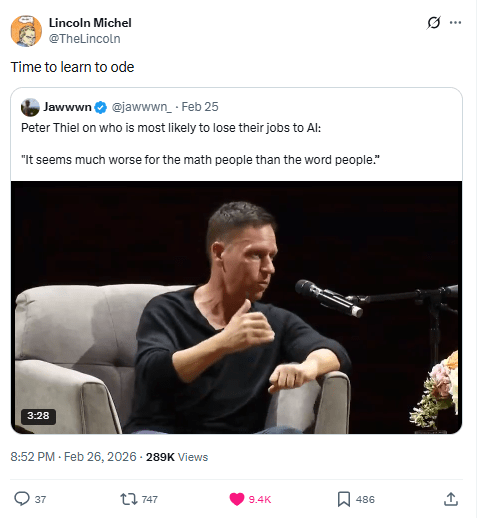
Joke: https://x.com/TheLincoln/status/2027215235103207693
Writing about the Citrini Research report on February 28 feels like a being 6 years behind (it was only 6 days ago).
“THE 2028 GLOBAL INTELLIGENCE CRISIS: A Thought Exercise in Financial History, from the Future”
Two things the white-collar chattering class fears is that their jobs will disappear or their stock portfolios will crash. The Citrini note put that feared scenario in a picture frame so we could stare at it, like Annie Jacobsen’s book on nuclear war. The post imagines a 2028 scenario: AI automates white-collar work, companies collapse, private credit blows up, mortgages default, unemployment hits 10%.
Brian Albrecht responded: “We don’t need to just make up fantasy stories: Using economics to read Citrini Research’s AI”
Tyler encouraged us to consider a response put out by Citadel “The 2026 Global Intelligence Crisis“
Even cognitive automation faces coordination frictions, liability constraints, and trust barriers. It seems more likely that AI will be a complement rather than a substitute for labor is many areas.
One barrier to AI taking all the white-collar jobs as quickly as 2028 is just physical scaling constraints.
Having done research on “learn to code” (Buchanan 2022), I always watch new developments with interest. In 2023, I told an auditorium full of students in Indiana to learn to code if they don’t hate the work too much. At that time I had forecast that AI tools would make coding less miserable but not eliminate the need for technical human workers. Even if that was good advice at the time, is it still good advice today? I wish I had time to put up a blog on this topic every week.
Adjustments can happen along the margin of price as well as quantity. Wages to programmers can come down from their previously exalted heights, which could help the market absorb some of the young professionals who listened to “learn to code” in 2023.
So, now that the value of coding skills is in question, people are turning back to the value of the maligned English degree. It has been true for a long time that employers felt soft skills were more scarce than STEM degrees. I might add that an economics degree conveys a highly marketable blend of hard and soft skills.
Buchanan, Joy (2022). “Willingness to be paid: Who trains for tech jobs?” Labour Economics,
79, Article 102267.
 Economist Writing Every Day
How I miss these on the back page of The Atlantic – An Ode to Odes
LikeLike