Americans like their food. Holidays are often known by the dishes that we serve. Thanksgiving is a bit unique in that most of us converge on turkey, though diversity obviously exists. What about Easter? There’s not really the same focus on a single food like there is for Thanksgiving. My impression is that people eat daytime or lunch foods that include ham, lamb, or just about anything. My family tends to make tacos.
What am I saying?! We eat candy! Solid or hollow chocolate bunnies, jellybeans, peeps, and on and on. We fill Easter eggs and keep candy around the office. We literally have baskets full of candy.
A Chocolate Bunny? In this economy?
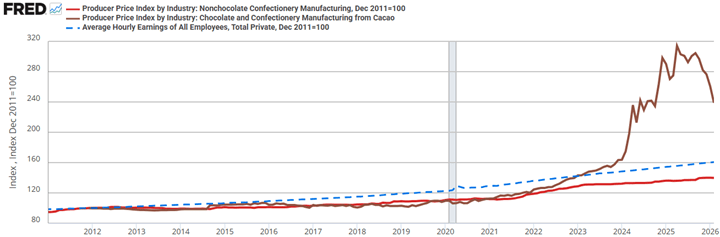
But have you seen the price of chocolate? Yeesh! The latest figures are from February and the prices for chocolate and cocoa bean products are down 11.7% year-over-year. That’s nice, you may think, our budgets can fit a bit more chocolate into our consumer – I mean Easter – baskets. Great news. The news seems a little less great when you realize that February’s price of chocolate was 90% higher than it was four years earlier in 2022. 90% higher is a lot like 100%, and 100% is double! In fact, the price had peaked at 142% higher by September of 2025, and now prices are quickly falling. See the chocolate-colored line in the graph below.
The PPI data for chocolate only goes back to December of 2011. If we index the average wages to the same month, then we can see that we could afford more chocolate for the next eleven or so years. It wasn’t until January of 2023 that consumers could afford less chocolate than in 2011.
The story is much nicer for the non-chocolate confectioneries. Wages have pretty consistently outpaced non-chocolate candy prices at least since 2011. February candy prices are up only 2.7% year-over-year and are only 16.9% higher than in 2022. That’s still an unfortunate 4% average annual rate of inflation, but it’s not sitting in the nosebleed section beside chocolate.
https://fred.stlouisfed.org/graph/?g=1Uqi6
Dividing the price indices makes the story a little clearer. See the graph below. The price of chocolate had started rising in 2020, but really sky-rocketed in 2024. That convex increase starts *before* the “liberation day” tariffs were announced. The increase in prices were still a lot. But, with some reasonable extrapolation, it appears that this Easter’s chocolate prices are lower than they were two years ago, again, relative to income. So that’s nice.
Not all of us are obsessed with chocolate, however. There’s plenty of other candy out there. Relative to the average income, the price of non-chocolate candy has fallen by 13% since 2011. Nice. The only time at which candy was more affordable was just after the pandemic.

https://fred.stlouisfed.org/graph/?g=1Uqja
Btw: the high chocolate prices are global, so the tariffs aren’t the main cause of the higher prices.
 Economist Writing Every Day