A recent viral Tweet shares a political cartoon from 1894, which shows a worker being squeezed by high rents and low wages. The Tweet claims “the problem has only gotten worse.”
Can this be true? Are workers today actually worse off than they were in 1894? At first blush, this seems obviously wrong. Here is a chart I created showing real (inflation-adjusted) wages since 1894. They are eight times higher today (I have combined two wage series and two price indices, so don’t take this as being perfect, but roughly accurate).
Figure 1

Whatever concerns we might have about high rents today, there must have been some other major improvements in the cost of living relative to wage increases since 1894, given that one hour of work can purchase about 8 times as many real goods and services today.
But is there a narrower case for the cartoon? What if we only focus on wages? We can do this by using a great new resource from the Philadelphia Fed, which provides some long-run data on housing prices in the US, for both purchasing a home and renters. The data series conveniently goes all the way back to 1890, so we can make the comparison with 1894 using the nominal rent index (it ends in 2006, but we can merge it with the modern CPI for rental housing). What if we compare this rental price series to the same wage series I used in the chart above?
Figure 2
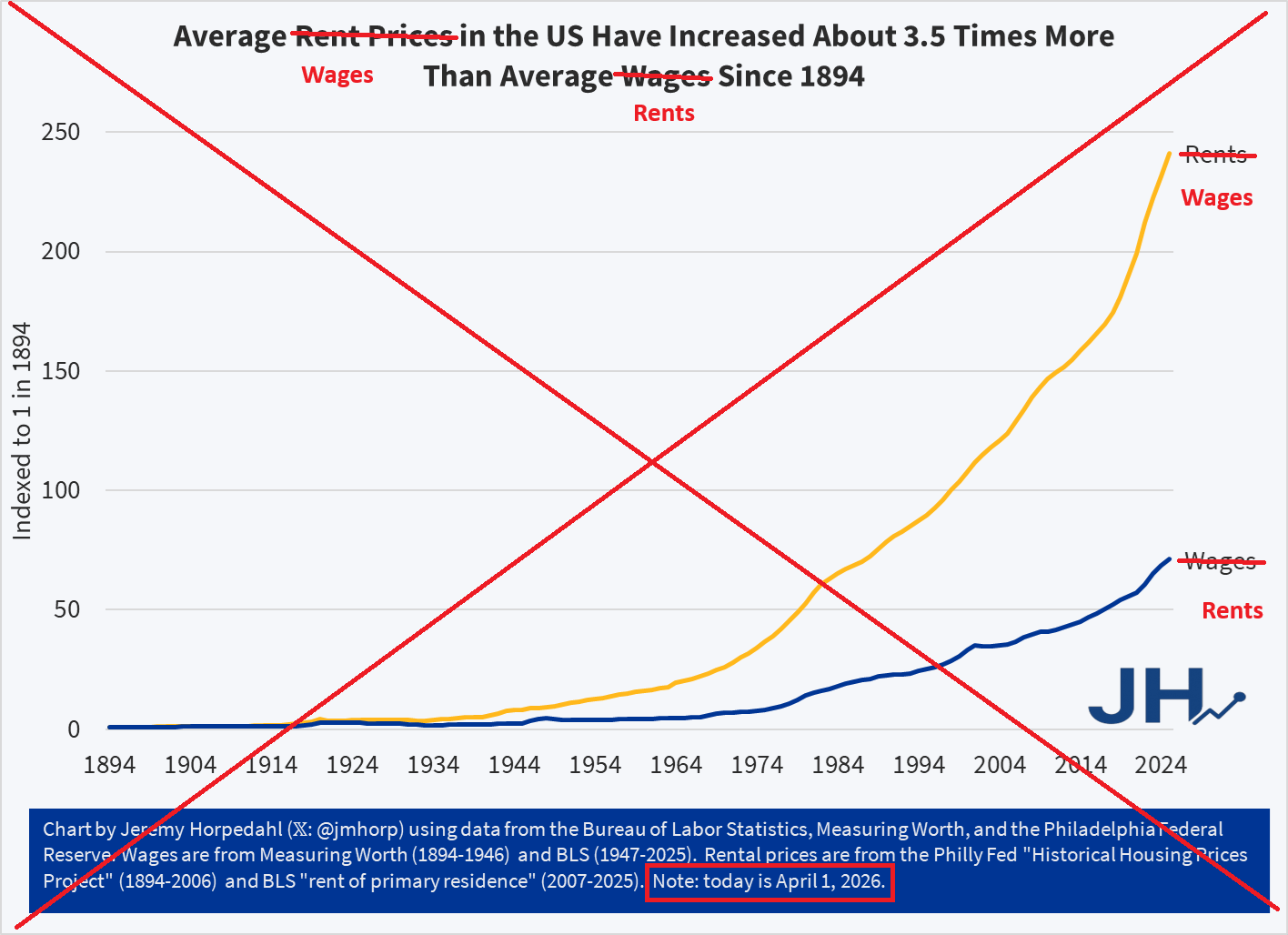
The trend in this second chart is very troubling. Rents have increased much faster than nominal wages. While other goods and services may be more affordable, rents — which consume around 24 percent of household income for renters — are rising relative to wages. Sure, we can talk all day about how the quality has improved — larger apartments, indoor plumbing, modern safety features that didn’t exist in 1894 — yet still, renters can only rent what is available. And today rental housing is much more expensive than on April 1, 1894.
APRIL FOOLS!
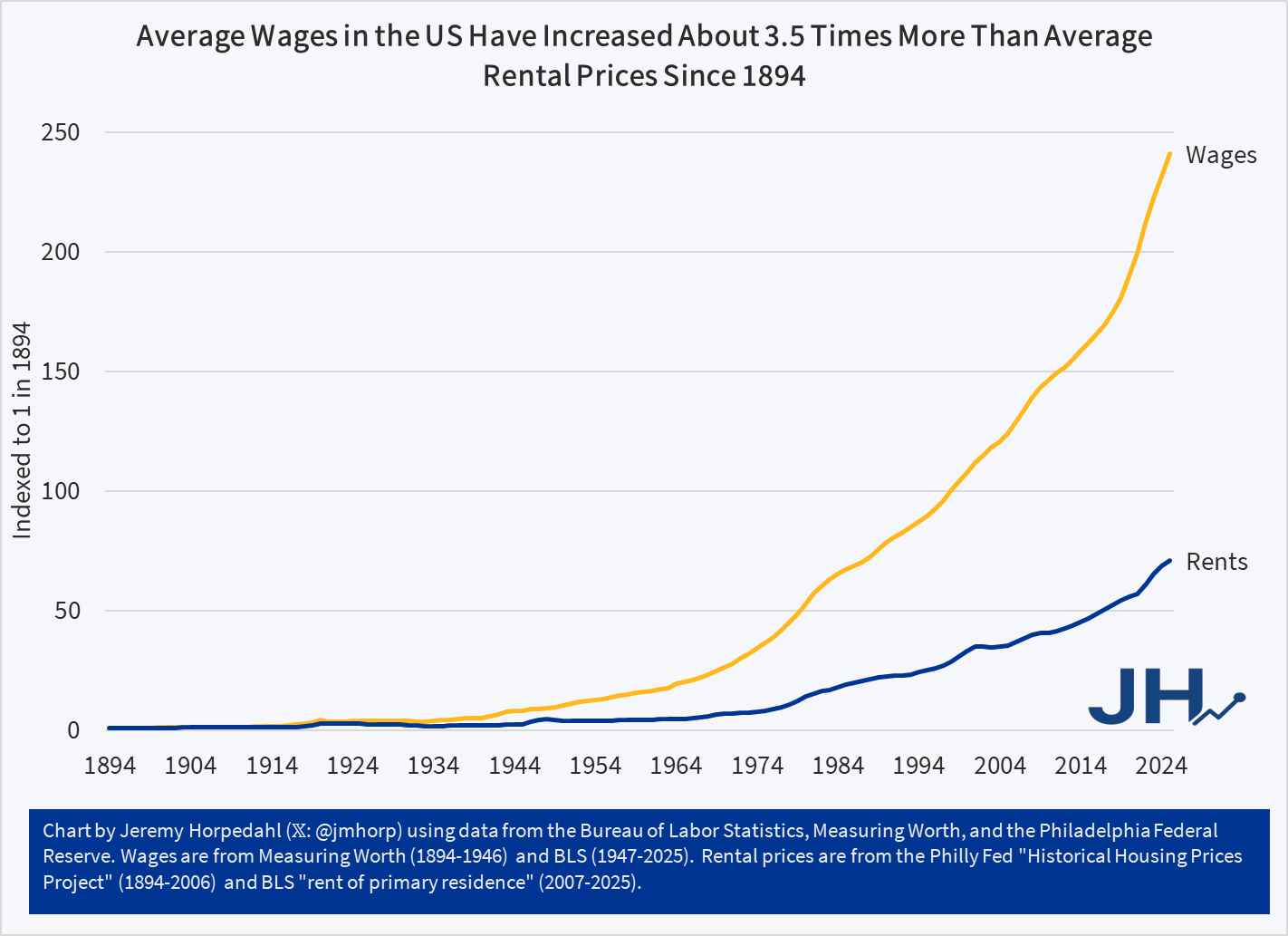
The data was all correct, other than the fact that I tricked you by swapping the wage and rent lines. Wages have actually increased much faster than rents since 1894 (though they have increased roughly equal rates in recent decades). Sorry for that little trick, I’m a little surprised no one noticed. Perhaps I am just too well-known for being a straight shooter with data. Here is the real chart:


Do you have the rent data on a per square foot basis? I’ve only looked at home purchases, not rents, but last I looked while the median home price had risen much more quickly than wages, the median home price per square foot had not; much of the change was related to the average home expanding quite a bit.
LikeLike
Do you have the rent data on a per square foot basis? I’ve only looked at home purchases, not rents, but last I looked while the median home price had risen much more quickly than wages, the median home price per square foot had not; much of the change was related to the average home expanding quite a bit.
LikeLike
Just looking at the inflation-adjusted wage chart….can you comment on why wages went up so fast c. 1964-1972, then trended DOWN till c. 1994, before taking off again? I understand there was an oil price shock in 1973 and in 1979, with high inflation and a (back then) manly Fed that cranked interest rates to the moon. But it seems like the malaise persisted well into the 1990s (till the internet bubble inflated??).
LikeLike
Real wage stagnation is pretty clear and widely acknowledged by economists in just about any wage series from about 1973-1994. There are many explanations, though as this recent Noah Smith post argued, none of the explanations is really satisfying!
https://www.noahpinion.blog/p/so-why-did-us-wages-stagnate-for?open=false
LikeLike
Now do median.
LikeLike
There is no long-run series of median wage data going back to 1894. In fact, it’s incredibly hard to find median wage data even for that single year. But Gemini Pro’s best guess is that there was even more wage inequality back then, and the mean wage was probably 1.6-1.8 times the median wage. Today it’s about 1.4-1.5 times. This suggests that median wage growth was even greater than the average wage growth I show in the chart!
LikeLike
By most measures rent burden today is roughly 30-33%. For wages to have increased 3.5 times rents, ceterus paribus, the rent burden would have to be 108% back then.
LikeLike
The rent index is quality adjusted. Household spending has pretty consistently been ~30% throughout the 20th century, but houses are larger and better than 1894.
LikeLike
I’m not sure how that deals with the inherent math. Were 1894 consumers of housing paying 108% their wages on average? By the way – are your wage indices controlled for the segment of population that rents (imputed or otherwise) vs. owns, and base unit of single-worker vs. household?
LikeLike
Because a quality-adjusted index attempts to tell you what it would cost to rent housing (or any good or service) that is of similar quality. The wage indices are for production and non-supervisory workers, so it is not just renters. Data of the specificity you are asking for simply does not exist for 1894.
LikeLike
You don’t seem to be getting the point. If rent burdens are 0.3ish now, at 3.5 times rent burdens would have had to be 1.1x back then.
LikeLike
Sorry, I don’t know how to explain quality adjustments any better. You are welcome to read the methodology paper behind the index: https://www.philadelphiafed.org/the-economy/regional-economics/the-price-of-housing-in-the-united-states-1890-2006
LikeLike
Okay so I have no idea what you’re arguing. Affordability of housing? Or can workers pay for housing in hedonic-quality units… a worker in 1920 can’t access housing in 2026? Otherwise I don’t see the point in superimposing those two time-series. Did you also adjust wages downwards for this massive increase in hedonic quality for workers ?
LikeLike
The wages are in nominal terms. The prices are quality adjusted. This is extremely standard for a price index: https://www.bls.gov/cpi/quality-adjustment/
LikeLike
yes but that’s not how rent burdens are computed for the reason that renters don’t pay “quality adjusted rents”
LikeLike
The quality of rental housing does not increase randomly. It increases based on what developers think renters demand and can afford (and sometimes due to government regulations). When housing quality improves, you need to take account of this in some way.
LikeLike
When you title a question “Are workers still getting squeezed by rent?” and you trot out a quality deflated index, it is disingenuous, because workers do not have access legally or practically to choose those “bottom tiers”. One can’t consume half a studio. Rent burdens are typically nominal over nominal for that reason.
LikeLike