Discuss AI Boom with Joy on May 12

I’m not just doing this to plug my own event. It’s also about the only thing on my mind after spending the week leading and moderating this timely discussion.

If you like to read and discuss with smart people, then you can make a free account in the Liberty Fund Portal. If you listen to this podcast over the weekend: Marc Andreessen on Why AI Will Save the World  (2023) you will be up to speed for our asynchronous virtual debate room on Monday May 12.

Keeping in mind the stark contrast between this and the doomers we discussed in the past week, here is Marc’s argument in a nutshell:

“The reason I’m so optimistic is because we know for a fact–as sort of one of the most subtle conclusions in all of science–we know for a fact that in human affairs, intelligence makes everything better. And, by “everything,” I mean basically every outcome of human welfare and life quality that essentially we can measure.”

When it’s put that way, it’s hard to disagree. Who would want less intelligence?

See more details on all readings and the final Zoom meeting in my previous post.

Another interesting bit by Marc:

“By the way, look: there’s lots of work happening that’s not being published in papers. And so, the other part of what we do is to actually talk to the practitioners.”

Even though it might seem strange to look to podcasts instead of published books and papers for cutting edge information, it really does seem like the story was told in human voices for the past 3 years. Dwarkesh was probably the best, but Tyler and Russ deserve credit as well for bringing these conversations out of the closed rooms and into the public domain.

Discuss AI Doom with Joy on May 5

If you like to read and discuss with smart people, then you can make a free account in the Liberty Fund Portal. If you listen to this podcast over the weekend: Eliezer Yudkowsky on the Dangers of AI (2023) you will be up to speed for our asynchronous virtual debate room on Monday May 5.

Russ Roberts sums up the doomer argument using the following metaphor:

The metaphor is primitive. Zinjanthropus man or some primitive form of pre-Homo sapiens sitting around a campfire and human being shows up and says, ‘Hey, I got a lot of stuff I can teach you.’ ‘Oh, yeah. Come on in,’ and pointing out that it’s probable that we are either destroyed directly by murder or maybe just by out-competing all the previous hominids that came before us, and that in general, you wouldn’t want to invite something smarter than you into the campfire.

What do you think of this metaphor? By incorporating AI agents into society, are we inviting a smarter being to our campfire? Is it likely to eventually kill us out of contempt or neglect? That will be what we are discussing over in the Portal this week.

Is your P(Doom) < 0.05? Great – that means you believe that the probability of AI turning us into paperclips is less than 5%. Come one come all. You can argue against doomers during the May 5-9 week of Doom and then you will love Week Two. On May 12-16, we will make the optimistic case for AI!

See more details on all readings and the final Zoom meeting in my previous post.

When Commitment Backfires: The Economics Behind Gang Tattoos and Changing Incentives

In economics, commitment devices are often seen as clever solutions to self-control problems—ways people can tie their future hands to avoid giving in to temptation. A smoker throws away their cigarettes, a dieter pays in advance for healthy meals, a student announces a deadline publicly so they can’t back out. The idea is that by limiting future choices, a person can force themselves to stick with a preferred long-term strategy. But commitment devices also show up in places far removed from personal productivity—and in some cases, they carry bad unintended consequences when the strategic landscape shifts.

Consider the case of gang tattoos, especially those associated with MS-13. For years, highly visible tattoos served as a powerful way to demonstrate loyalty to the group. These tattoos—sometimes covering the face, neck, or arms—weren’t just aesthetic. They signaled that the individual was fully committed to the gang. In economic terms, they functioned as a high-cost, hard-to-fake commitment device. By making oneself easily identifiable as a gang member, a person burned bridges to legitimate employment or life outside the gang. That might seem irrational at first glance, but it was often a rational decision in context. Within certain neighborhoods or prisons, that signal provided protection, status, and trust among peers. The visible commitment reduced the gang’s uncertainty about who was loyal and who might defect.

But the rules of the game changed. In March 2022, El Salvador launched an aggressive crackdown on gangs following a sharp spike in homicides. Under a sweeping “state of exception,” authorities suspended constitutional rights, arrested tens of thousands of people, and expanded prison capacity dramatically. Tattoos quickly became one of the easiest ways for police to identify and detain suspected gang members. News reports describe men being pulled from buses or homes not for current criminal activity, but simply because of the ink on their skin. In many cases, the tattoos were from years earlier—when the wearer had been young and immersed in a world where signaling loyalty felt necessary for survival. Now, those same signals serve as evidence in court or grounds for indefinite detention.

Continue reading

Understanding Inflation and Interest Rates

Anyone who teaches Macroeconomics knows that these concepts are hard for people to understand at first.

A clip about inflation has been making the rounds.

Transcripts provided by CNN show the following

CNN NewsNight with Abby Phillip
Aired April 17, 2025 – 22:00 ET

ABBY PHILLIP, CNN ANCHOR

BATYA UNGAR-SARGON, AUTHOR, HOW THE ELITES BETRAYED AMERICA’S WORKING MEN AND WOMEN

CHARLOTTE HOWARD, EXECUTIVE EDITOR, THE ECONOMIST

PHILLIP: Jerome Powell is the head of the Fed and has a mandate to keep inflation low and employment high. So if there are, you know, macroeconomic things that are happening in the economy that make it very difficult for him to do that, you don’t think he’s going to comment?

UNGAR-SARGON: Do you know what would have really helped? What would be a really good idea right now to help bring down inflation and make sure that things keep running smoothly? It’s dropping interest rates. Why doesn’t he do that?

PHILLIP: Why doesn’t he do that?

HOWARD: So interest rates, if you were to drop interest rates, you would stoke inflation.

GPT expands on Howard’s point: “Dropping interest rates would not lower inflation—in fact, it typically makes inflation worse.

Interest rates are a key tool the Federal Reserve uses to manage inflation. When rates are lowered, it becomes cheaper to borrow money. This encourages people and businesses to take out loans, spend more, and invest more, which increases demand for goods and services.

But when demand rises faster than supply can keep up, prices go up—that’s inflation.

So, in a time of high inflation, cutting interest rates would likely make the problem worse, not better. The Fed raises interest rates to make borrowing more expensive, which slows down spending and cools demand, helping to bring inflation under control.”

Recall that the United States achieved disinflation starting in 2022, largely due to the Federal Reserve’s aggressive interest rate hikes. Tyler calls the disinflation America’s triumph.

As for the commentariat, a diverse array of economists ranging from the Keynesian Paul Krugman to many conservative economists recognized that rate increases and disinflation were necessary and had to be done with promptness and fortitude. And so credibility reigned.

Research on Big Questions April 2025

I’m working on a new paper with Bart Wilson. We might have a draft to release soon.

  1. https://economistwritingeveryday.com/2023/03/25/discrepancy-in-views-about-music-pirating/  In that post, I pointed out that the estimates reported in journals for the effect of pirating on music revenues range from almost 0% to almost 100%. There is room for new empirical work. Not often is the range of the estimates that big.
  2. My coauthor Bart Wilson did an interesting podcast episode for the Curious Task in 2020.

https://thecurioustask.podbean.com/e/ep-64-bart-wilson-%e2%80%94-is-the-idea-of-property-universal/

Episode: Bart Wilson — Is The Idea of Property Universal? 

I’m providing a rough transcription of the part that stood out to me, because he identified a prime big unanswered question. This is around minute 7 of the episode.

Host: Why is [the Property Species] an interesting topic deserving of a book?

Bart Wilson: “So, I work with primatologists… and I would talk to them about what I’m working on with my laboratory experiments on property. They would say, ‘Oh yeah. Dolphins do that, too, or baboons. … scrub jays re-cache their food if another scrub jay is watching them so they are protecting themselves against theft… so property is all over the animal kingdom. And then I’m also working with my colleague in the English department. In the humanities, property is a very narrow thing, something Western European. It’s very modern. And, so, in one part of the academy property is this broadly natural phenomenon and in another part of the academy it’s very local: only some humans have it. And so, as a social scientist…”

Bart identified a gap in understanding. Property cannot be both common to all animals and rare among humans. In his book The Property Species he spans that gap by claiming (spoiler alert) that property is common to all humans and only humans. Human language is an important piece of that story. No other animal can wield complex symbolic language.

In our new paper (manuscript forthcoming) we’ll be investigating how humans use symbolic language to describe nonrivalrous digital resources.

Join Joy to discuss Artificial Intelligence in May 2025

Podcasts are emerging as one of the key mediums for getting expert timely opinions and news about artificial intelligence. For example, EconTalk (Russ Roberts) has featured some of the most famous voices in AI discourse:

EconTalk: Eliezer Yudkowsky on the Dangers of AI (2023)

EconTalk: Marc Andreessen on Why AI Will Save the World 

EconTalk: Reid Hoffman on Why AI Is Good for Humans

If you would like to engage in a discussion about these topics in May, please sign up for the session I am leading. It is free, but you do need to sign up for the Liberty Fund Portal.

The event consists of two weeks when you can do a discussion board style conversation asynchronously with other interested listeners and readers. Lastly, there is a zoom meeting to bring everyone together on May 21. You don’t have to do all three of the parts.

Further description for those who are interested:

Timeless: Artificial Intelligence: Doom or Bloom?

with Joy Buchanan

Time: May 5-9, 2025 and May 12-16, 2025

How will humans succeed (or survive) in the Age of AI? 

Russ Roberts brought the world’s leading thinkers about artificial intelligence to the EconTalk audience and was early to the trend. He hosted Nick Bostrom on Superintelligence in 2014, more than a decade before the world was shocked into thinking harder about AI after meeting ChatGPT. 

We will discuss the future of humanity by revisiting or discovering some of Robert’s best EconTalk podcasts on this topic and reading complementary texts. Participants can join in for part or all of the series. 

Week 1: May 5-9, 2025

An asynchronous discussion, with an emphasis on possible negative outcomes from AI, such as unemployment, social disengagement, and existential risk. Participants will be invited to suggest special topics for a separate session that will be held on Zoom on May 21, 2025, 2:00-3:30 pm EDT. 

Required Readings: EconTalk: Eliezer Yudkowsky on the Dangers of AI (2023)

EconTalk: Erik Hoel on the Threat to Humanity from AI (2023) with an EconTalk Extra Who’s Afraid of Artificial Intelligence? by Joy Buchanan

“Trurl’s Electronic Bard” (1965) by Stanisław Lem. 

In this prescient short story, a scientist builds a poetry-writing machine. Sound familiar? (If anyone participated in the Life and Fate reading club with Russ and Tyler, there are parallels between Lem’s work and Vasily Grossman’s “Life and Fate” (1959), as both emerged from Eastern European intellectual traditions during the Cold War.)

Optional Readings:Technological Singularity” by Vernor Vinge. Field Robotics Center, Carnegie Mellon U., 1993.

“‘I am Bing, and I Am Evil’: Microsoft’s new AI really does herald a global threat” by Erik Hoel. The Intrinsic Perspective Substack, February 16, 2023.

Situational Awareness” (2024) by Leopold Aschenbrenner 

Week 2: May 12-16, 2025

An asynchronous discussion, emphasizing the promise of AI as the next technological breakthrough that will make us richer.
Required Readings: EconTalk: Marc Andreessen on Why AI Will Save the World 

EconTalk: Reid Hoffman on Why AI Is Good for Humans

Optional Readings: EconTalk: Tyler Cowen on the Risks and Impact of Artificial Intelligence (2023)

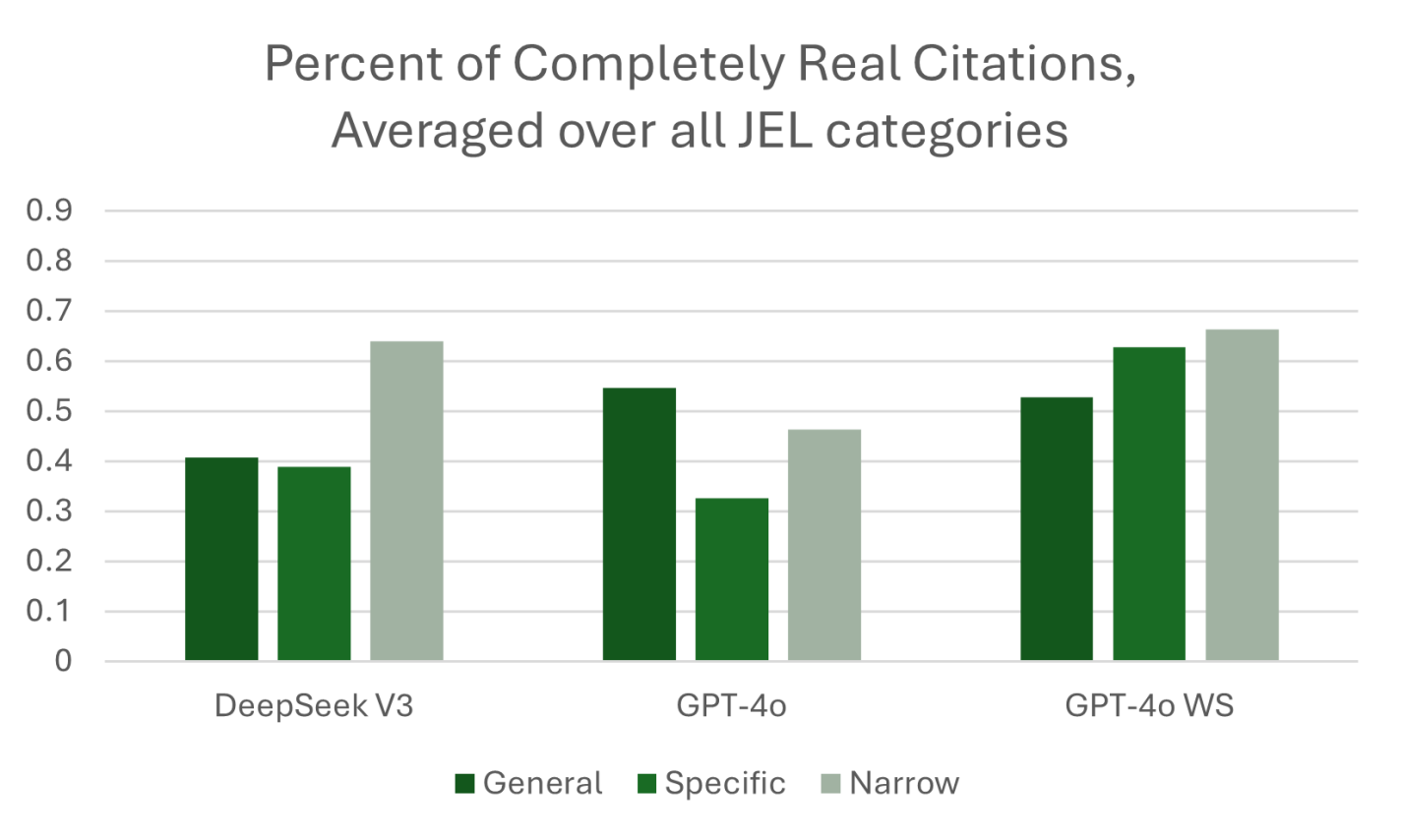
ChatGPT Hallucinates Nonexistent Citations: Evidence from Economics” (2024) 

Joy Buchanan with Stephen Hill and Olga Shapoval. The American Economist, 69(1), 80-87.

What the Superintelligence can do for us (Joy Buchanan, 2024)

Dwarkesh Podcast “Tyler Cowen – Hayek, Keynes, & Smith on AI, Animal Spirits, Anarchy, & Growth

Week 3: May 21, 2025, 2:00-3:30 pm EDT (Zoom meeting)
Pre-registration is required, and we ask you to register only if you can be present for the entire session. Readings are available online. We will get to talk in the same zoom room!

Required Readings: Great Antidote podcast with Katherine Mangu-Ward on AI: Reality, Concerns, and Optimism

Additional readings will be added based partially on previous sessions’ participants’ suggestions

Optional Readings: Rediscovering David Hume’s Wisdom in the Age of AI (Joy Buchanan, EconLog, 2024)

Professor tailored AI tutor to physics course. Engagement doubled” The Harvard Gazette. 2024. 

Please email Joy if you have any trouble signing up for the virtual event.

Joy on Al Jazeera

An Al Jazeera talk show called The Steam asked me to join a discussion on fast fashion as the contrarian or as “the economist.” The found me because of the my article “Fast Fashion, Global Trade, and Sustainable Abundance” 

Episode website: https://www.aljazeera.com/program/the-stream/2025/3/25/trends-trash-and-truth-fast-fashion-phenomena

“Trends, trash and truth: Fast fashion phenomena”

The guests were

Venetia La Manna – fair fashion campaigner

Walden Lam – president and co-founder, Unspun

Katia Osei – lead researcher and bioengineer, Or Foundation

Joy Buchanan – associate professor, Samford University

I am a small part of the 25-minute show. You can hear me  from about minute 9:20 to 11:35 and then at the end from 23:30 to 24:45.

The points I made are that “fast” fashion has a good side for consumers, even though people are worried about the environmental impact of clothing waste. I got a few seconds to talk about my ideas for solutions which include labels about clothing durability and AI help with sorting. At the end I said that, as people become more aware of the downsides of fast fashion, we could stop putting social expectations on each other to wear a new outfit to every party and buy a custom shirt for every club event.

Reaction to Rux on Fertility

Blog reading types might have already seen “Fertility on demand” by Ruxandra Teslo.

My first reaction is that, at the current state of technology, I feel like wishing for more IVF on women is cruel. If someone you love has gone through it, you wouldn’t wish it on more people. Supporting the careers of women who want to have children while they are young seems preferable and lower cost to society. The problem is that supporting mothers is a tricky collective action problem, so we seem stuck with this.

“The egg freezing process is also expensive, costing between $8,000 to $15,000 per cycle. Fortunately, more and more women are being covered by insurance plans that offer free egg freezing. According to a 2021 survey, 20 percent of American companies with over 20,000 employees and 11 percent of smaller companies offer such benefits – an increase from six and five percent respectively in 2015. But most women still have to pay out of pocket.” $15,000 is sort of a lot. It’s cheaper than a year of paid maternity leave for a PhD student, but the total cost of a “medical baby to an older couple” is pretty high.

Some of the technology Rux described was new to me and encouraging. If babies and birth becomes much more medicalized (and civilization doesn’t end), then I could imagine a world where most couples look like Simone and Malcolm Collins by choice with designer babies on demand after having a carefree childfree decade.

“The main advantage of IVM is that it allows immature eggs to be collected instead of mature ones, which significantly reduces the burden of hormonal stimulation.” Exciting! Think of how far we’ve come with cancer treatments or treating AIDS. If enough research goes into this, then potentially the cutting, injecting, pill popping hell that women have to go through for IVF could become smaller and more focused on exactly what is near certain to work.

Someone’s going to come along and grumble and say nature is better, but recall from earlier: “Supporting the careers of women who want to have children while they are young seems preferable and lower cost to society. The problem is that… “

On an optimistic note, I am witnessing a beautiful success story of embryo adoption among my relatives. It worked. A wonderful couple has twins now, and those twins are experiencing love and contact from both their birth family and genetic parents. That technology only became available in the late ’90s. Expect more stories like this.

We might even be close to AI childcare that works. Imagine a daycare where robots do 100% of the food and cleaning work so that the humans in the room can focus exclusively on emotional and relational work with the kids. That could make daycare better or cheaper or both.

The simple technology of food and grocery delivery has already helped parents. The founder of Shipt, Bill Smith, got the idea for grocery delivery by experiencing how hard it is to do grocery shopping with his young children. Guess what? We don’t have to take toddlers to the grocery store anymore, unless we want to.

earlier thoughts: Awards for young talent are antinatalist

Information Regarding Russian Voting

Grok 3 beta (paid version) says this:

The Reality

  • Opposition: Genuine opposition is stifled. Prominent critics like Alexei Navalny (who died in prison in 2024) are barred from running, imprisoned, or sidelined. Parties like the Communist Party or LDPR exist but are often seen as “systemic opposition”—allowed to operate but not to seriously challenge the regime.
  • Media and Campaigning: State-controlled media heavily favors United Russia and Putin. Independent outlets face censorship, shutdowns, or exile (e.g., Meduza, TV Rain). Campaigning for opposition is restricted, with candidates disqualified on technicalities or facing harassment.
  • Voting Process: Reports of irregularities are common—ballot stuffing, coerced voting (especially among public sector workers), and inflated turnout figures. The Central Election Commission oversees it all, but it’s widely viewed as Kremlin-aligned. Electronic voting, introduced in recent years, has raised further transparency concerns.
  • Turnout and Results: Official turnout often hovers around 50-70%, though skepticism about these numbers persists. Putin’s 2024 victory, with 87% of the vote, came amid the Ukraine war and suppression of dissent, with no credible challengers.

Public Perception

Many Russians see elections as a formality—Putin’s approval, while fluctuating (per Levada Center polls, it dipped to 59% in 2018 but spiked to 80%+ after Crimea’s annexation), reflects a mix of genuine support, apathy, and resignation. Critics argue the system prioritizes stability over democracy; supporters say it’s what Russia needs given its history and external pressures.

Recent Example

The 2024 presidential election (March 15-17) was a case study: held over three days, including in occupied Ukrainian territories, with Navalny’s death fresh in memory. Three token candidates ran against Putin, none polling above single digits. Protests like “Noon Against Putin” (voters showing up at noon to signal dissent) were symbolic but powerless against the machine.

In short, Russian elections are predictable, heavily managed spectacles—less about choice, more about reinforcing the status quo. If you want specifics on a particular election or X posts about it, I can dig deeper. What angle are you curious about?

Click Read More to see the answer to my follow-up question “Explain coerced voting for public sector employees?”

Continue reading

How Americans Can Thank the World

Dear World,

Thank you for the heritage of philosophical and scientific ideas, preserved through an international effort over thousands of years. Thank you for coming to study at American universities in this century, and for staying to teach.

Thank you all for buying into our heroes. What is Star Wars without a global audience? Your enthusiasm transforms our characters into shared legends. Thank you for cheering on Harrison Ford and Will Smith. Thank you for feeling the joys and heartbreaks of Taylor Swift, Luke Combs and Beyoncé. Thank you for sending us Lord of the Rings, Howl’s Moving Castle, and Squid Game.

Video games unite us all. Thanks for Elden Ring from Japan, and Minecraft, which started in Sweden before it was acquired by Microsoft. It helps us be more creative when the world buys U.S.-made games like Call of Duty and Fortnite.

Merci France, for helping us in our war of independence and giving us the Statue of Liberty. (And for printing my cartoon.)

Thank you to England, for the inheritance of a system of limited government, whose principles of common law, parliamentary tradition, and constitutional rights became the foundation upon which we built our republic.

Thank you, world, for listening to our national anthem at the Olympics. For training with us and competing against us in feats of endurance and collectively celebrating as humans have recently broken so many records of performance. Congrats to Eliud Kipchoge and Katie Ledecky.

Thank you for believing in the American Dream. The wealth enjoyed by average Americans today would not be possible without globalization.

Thank you for seeing good in us and trusting our soldiers and businesses.

Thank you for trading with us. Thanks for keeping the modern F-150 truck affordable.  Quality is better today, because it’s more powerful with stronger engines and still gets better gas mileage while being safer. Part of what keeps the price down is getting so many component parts through imports from places like Mexico and Asia.

Thank you for sharing your genuine thoughts on our social media platforms. Thank you for making the World Wide Web worldwide, starting with http://info.cern.ch.

Thailand, thank you for welcoming my college friends who do not speak your language. You gave them a break from the monotony of their local landscapes. What would our Instagram be without you, and Iceland and Ecuador? The generosity with which you welcome travelers enriches not just our photo albums, but our perspectives.

We are who we are because of you.