Historians Admit To Inventing Ancient Greeks

This just in:

Scholars apologize for attributing Western democracy to a make-believe civilization.

WASHINGTON—A group of leading historians held a press conference Monday at the National Geographic Society to announce they had “entirely fabricated” ancient Greece, a culture long thought to be the intellectual basis of Western civilization.

The group acknowledged that the idea of a sophisticated, flourishing society existing in Greece more than two millennia ago was a complete fiction created by a team of some two dozen historians, anthropologists, and classicists who worked nonstop between 1971 and 1974 to forge “Greek” documents and artifacts.

“Honestly, we never meant for things to go this far,” said Professor Gene Haddlebury, who has offered to resign his position as chair of Hellenic Studies at Georgetown University. “We were young and trying to advance our careers, so we just started making things up: Homer, Aristotle, Socrates, Hippocrates, the lever and fulcrum, rhetoric, ethics, all the different kinds of columns—everything.”

“Way more stuff than any one civilization could have come up with, obviously,” he added.

According to Haddlebury, the idea of inventing a wholly fraudulent ancient culture came about when he and other scholars realized they had no idea what had actually happened in Europe during the 800-year period before the Christian era.

Frustrated by the gap in the record, and finding archaeologists to be “not much help at all,” they took the problem to colleagues who were then scrambling to find a way to explain where things such as astronomy, cartography, and democracy had come from.

Within hours the greatest and most influential civilization of all time was born.

“One night someone made a joke about just taking all these ideas, lumping them together, and saying the Greeks had done it all 2,000 years ago,” Haddlebury said. “One thing led to another, and before you know it, we’re coming up with everything from the golden ratio to the Iliad.”…

Around the same time, a curator at the Smithsonian reportedly asked for Haddlebury’s help: The museum had received a sizeable donation to create an exhibit on the ancient world but “really didn’t have a whole lot to put in there.” The historians immediately set to work, hastily falsifying evidence of a civilization that— complete with its own poets and philosophers, gods and heroes—would eventually become the centerpiece of schoolbooks, college educations, and the entire field of the humanities.

Emily Nguyen-Whiteman, one of the young academics who “pulled a month’s worth of all-nighters” working on the project, explained that the whole of ancient Greek architecture was based on buildings in Washington, D.C., including a bank across the street from the coffee shop where they met to “bat around ideas about mythology or whatever.”

“We picked Greece because we figured nobody would ever go there to check it out,” Nguyen-Whiteman said. “Have you ever seen the place? It’s a dump. It’s like an abandoned gravel pit infested with cats.”

She added, “Inevitably, though, people started looking around for some of this ‘ancient’ stuff, and next thing I know I’m stuck in Athens all summer building a…Parthenon just to cover our tracks.”

Nguyen-Whiteman acknowledged she was also tasked with altering documents ranging from early Bibles to the writings of Thomas Jefferson to reflect a “Classical Greek” influence—a task that also included the creation, from scratch, of a language based on modern Greek that could pass as its ancient precursor.

Historians told reporters that some of the so-called Greek ideas were in fact borrowed from the Romans, stripped to their fundamentals, and then attributed to fictional Greek predecessors. But others they claimed as their own.

“Geometry? That was all Kevin,” said Haddlebury, referring to former graduate student Kevin Davenport. “Man, that kid was on fire in those days. They teach Davenportian geometry in high schools now, though of course they call it Euclidean.”

~ ~ ~ ~ ~ ~ ~ ~ ~ ~ ~ ~ ~ ~ ~ ~ ~ ~ ~ ~ ~ ~ ~ ~ ~

Happy April Fools…the above excerpt was pasted verbatim from a classic article published in the news-satire site The Onion. I thought it was a clever piece, which did a worthy service highlighting the wide-ranging achievements of a relatively small people group (compared to the teeming masses of ancient Mesopotamia and Egypt) in a relatively short period of time.

Apologies to any Greeks reading this post – -my wife has been to Greece and tells me it is in fact a very beautiful country.

It’s Not Too Late to Get Your Eclipse Glasses for the April 8 Solar Eclipse

Surely you have heard by now that a solar eclipse is coming. As the April 8 date approaches, the media/social media coverage will likely rise to a roar. I think we all know that the experience of being in the path of a total solar eclipse is eerie and memorable – – birds and insects can fall silent as night-like darkness falls, and a noticeable chill may be felt in the air.

Maps abound of the eclipse path across North America. For the U.S.,  it starts in Texas around 1:30 Central time, traverses southern Indiana and northern Ohio around 3:10 Eastern and ends in northern Maine about 3:30. Here is a snip I took from this NASA map, where I zoomed in the Midwest/Northeast section, and traced in red the lines of 90% totality:

If you really want the 100% experience, and if you want it to last the full four minutes, you must be in a relatively narrow strip. And if you want to have good chance of not having clouds obscure the fun, you may need to fly to central Texas. Buffalo, New York is in the middle of the eclipse path, but it is a notoriously overcast place.

But lots of folks, including residents of Chicago, Toronto, and the Boston-Washington corridor, live within the zone of (nearly) 90% totality, where you can see the moon sliding across most of the sun’s disk over the course of a few minutes, and experience significant darkening. The next solar eclipse to touch the U.S. will not be until 2044, and that will be barely visible from three less-populated states, Montana, North Dakota, and South Dakota.

So, I suggest you take the opportunity to enjoy this one to the max. This absolutely entails using special glasses with filters designed for safe viewing of the sun. Do not even think of looking at the sun without such glasses, and be alert lest children pick up the wrong cues and try to look at the sun.

The good news is that eclipse glasses are still available. I ordered some from Amazon a couple days ago that arrived two days later, and I saw them for sale in Lowe’s today. I got some extra to share with random friends and strangers. This can be a great chance to interact with neighbors and children.

The price per pair of glasses varies a lot, so do comparison shop.  I look for ones that say “CE and ISO Certified” like these. Be safe and have fun!

Recovering My Frozen Assets at BlockFi, Part1. How Sam Bankman-Fried’s Fraud Cost Me.

Back in 2021, interest rates had been so low for so long that that seemed to be the new normal. Yields on stable assets like money market funds were around 0.3% (essentially zero, and well below inflation), as I recall. As a yield addict, I scratched around for a way to earn higher interest, while sticking with an asset where (unlike bonds) the dollar value would stay fairly stable.

It was an era of crypto flourishing, and so I latched onto the notion of decentralized finance (DeFi) lending. I found what seemed to be a reputable, honest company called BlockFi, where I could buy stablecoin (constant dollar value) crypto assets which would sit on their platform. They would lend them out into the crypto world, and pay me something like 9 % interest. That was really, really good money back then, compared to 0.3%.

On this blog, I chronicled some of my steps in this journal. First, in signing up for BlockFi, I had to allow the intermediary company Plaid complete access to my bank account. Seriously, I had to give them my username and password, so they could log in as me, and not only be able to withdraw all my funds, but see all my banking transactions and history. That felt really violating, so I ended up setting up a small auxiliary bank account for Plaid to use and snoop to their heart’s content.

I did get up and running with BlockFi, and put in some funds and enjoyed the income, as I happily proclaimed (12/14/2021) on this blog, “ Earning Steady 9% Interest in My New Crypto Account “.

BlockFi assured me that they only loaned my assets out to “Trusted institutional counterparties” with a generous margin of collateral. What could possibly go wrong?

What went wrong is that BlockFi as a company got into some close relationship with Sam Bankman-Fried’s company, FTX.  Back in 2021-2022, twenty-something billionaire Sam Bankman-Fried (“SBF”) was the whiz kid, the visionary genius, the white knight savior of the crypto universe. In several cases, when some crypto enterprise was tottering, he would step in and invest funds to stabilize things. This reminded some of the role that J. P. Morgan had played in staving off the financial panics of 1893 and 1907. SBF was feted and lauded and quoted endlessly.

For reasons I never understood, BlockFi as a company was having a hard time turning a profit, so I think the plan was for FTX to acquire them. That process was partway along, when the great expose’ of SBF as a self-serving fraudster occurred at the end of 2022. He effectively gambled with his customers’ money. This would have made him even richer if his bets had paid off, but they went sour, which brought everything crashing down.

FTX quickly declared bankruptcy, which forced BlockFi to go BK as well. SBF was eventually locked up, but so were the funds I had put into BlockFi. The amount was not enough to threaten my lifestyle, but it was enough to be quite annoying.

Sam’s parents are both law professors at Stanford who are now resisting returning to FTX’s creditors the  $32 million (!!!) in assets (cash and real estate) that SBF had given them out of FTX’s operations. Some of that $32 million they are hoarding is mine, since BlockFi needs to recover its claims against FTX in order to make BlockFi clients whole. Sam’s mother has denounced the legal judgment against her son as “as “McCarthyite” and a “relentless pursuit of total destruction,” which is enabled by “a credulous public.” One wonders what little Sammy imbibed in the way of practical ethics in that household of idealistic Stanford law professors – the “effective altruism” that the Bankman-Fried family touts is perhaps a gratifying concept, until it actually costs you something you don’t want to part with. But I digress.

BlockFi Assets Begin to Thaw

I got emails from BlockFi every few months, assuring customers that they would do what they could to return our assets. Their bankruptcy proceedings kept things locked, but now they are starting to return some money. A judge ruled in early 2023 that assets held by users in their BlockFi “wallet” belonged to the users and could be withdrawn. However, assets in the interest-bearing account (which is where my stablecoin was) technically still belong to the bankrupt company’s estate, and were not necessarily available for withdrawal. But now, following another legal agreement,  BlockFi is returning funds from the interest accounts. The problem is that you will only get some fraction of what you put in. Some YouTube commenters have complained they only got 10-25% of their assets, and no one seems to know if they will ever get more. Ouch.

I got an email from BlockFi saying that I have assets to claim, but I need to set up an actual independent crypto wallet to receive them. BlockFi will only transfer the actual coin, not the dollar values. So, I am in the middle of this process. It’s one thing to open a wallet, where you can transfer crypto coins in and out. It is another to exchange or monetize your coin; for that you seem to need an exchange.

I have chosen to go with Coinbase. It is not the cheapest alternative, but it seems to be the most solid U.S. based crypto exchange. I have opened a Coinbase account now. As with BlockFi, I had to go through Plaid (ugh) for the connection to my bank account.

Next thing I need to do is to open a Coinbase wallet, and try to connect with BlockFi, and see what I get back. I will post later on what happens there.

Update: I got scammed in this process, see here. My bad for clicking on a link in an email, instead of going to the official website for the link…

Business Development Companies: My Favorite Class of High Yield Investments

It is easy to find securities which pay over 10% yield. It is not so easy to find securities which pay over 10% yield AND which maintain their share price over time. Many funds, especially closed-end funds, follow the “melting ice cube model” – they pay high current yields by slowly liquidating the fund assets, since the generous distributions are not matched by actual money-making by the fund’s investments. Oh, and the fund managers charge a nice fee for slowly giving you back your money. The result is that over longish time periods (e.g. five years) the stock price and the dividends decline.

I have been burned numerous times by such “high yield traps” in my longtime exploration of high yielding securities. A glorious exception has been business development companies (BDCs). These companies operate much like banks, lending out money and collecting interest on those loans. They lend to smaller, shakier enterprises that cannot get loans from banks. BDCs get to charge these (desperate?) clients very high interest rates, often around 6-7% over SOFR, which is the replacement for the old LIBOR benchmark, and which is very close to the current Fed funds rate. So back when regular short-term rates were near zero, BDCs were charging around 6%, and now (with Fed funds at 5.3%) they lend out money at around 11%. BDC’s leverage up by about 1:1 by issuing bonds, which boosts net income; this cash inflow is offset by really big management fees. The net result for us equity shareholders is that BDCs are paying out around 10-12% per year in dividends. That varies, of course, from one BDC to the next.

(If you just look at the usual “Forward Yield” value in your brokerage account or Yahoo Finance, it might only show like 9% or so. The reason is that BDCs, in good times like now, often pay out significant “special” dividends, which supplement the regular dividends; but only the regular dividends show up in the standard yield reporting).

One of the largest and oldest BDCs is Ares Capital Corporation, ARCC. If you just look at share price, ARCC does not look too inspiring. In the past five years, its price is up only about 9%, which is way less that the S&P 500 standard fund SPY. (But at least it is not down, like the generic bond fund AGG).

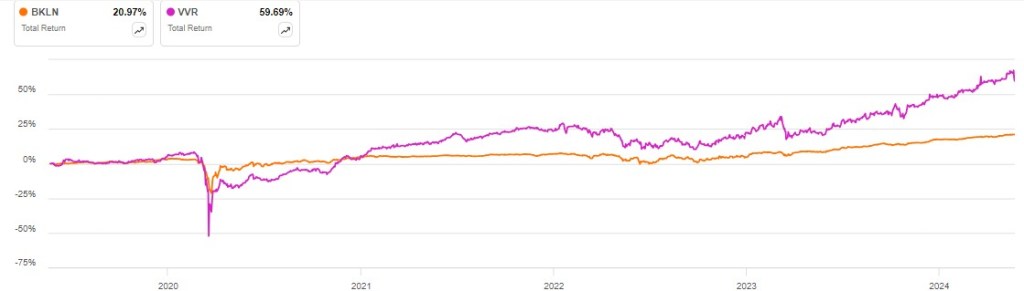
But when you look at total returns, which includes reinvested dividends, ARCC actually beats out SPY (85.7 % vs. 83.9% total returns), which is a noteworthy feat. Another large BDC, HTGC (green line in the plot below) did even better, with roughly 1.8 times the yield of SPY:

The current yield of ARCC 9.3%. This is on the low side for BDCs; ARCC is regarded as very secure, and so its price gets bid up. The yield of HTGC is 10.6%, while relative newcomer TRIN is paying 14%.

Lending to small, sometimes starting-up companies sounds risky, but the risk is mitigated by being at the tip top of the company’s capital stack. The loans are typically secured first-lien, which means in event of bankruptcy, they would get paid off before anything else. If the client company goes totally belly-up, the recovery on these loans is historically about 80%. In practice, a good BDC will often work with the client to come to some arrangement where the recovery is close to 100%. (For unsecured bonds, recoveries in bankruptcy are about 40%, while preferred stockholders get a few crumbs like shares in the reorganized post-bankruptcy enterprise, and common shareholders get zip). If you invest in a small cap stock fund like the Russell 2000, you are owning common stock in some of the companies that BDCs lend to. As such, you are actually in a much riskier position than owning shares in a BDC. Just saying.

Sound interesting? My short list of BDC favorites includes ARCC, HTGC, TRIN, TSLX, and BXSL. For one-stop shopping there are funds which hold a basket of BDCs. BIZD is the venerable big gorilla in this category. It blindly holds the largest BDCs by market cap. A newer, much smaller ETF is PBDC, which uses active, hopefully smart management. Since inception about 18 months ago, PBDC has beat out BIZD by about 12% in total returns, which more than compensates for its higher management fees (0.75% for PBDC versus 0.4% for BIZD).

Disclaimer: As usual, nothing here represents advice to buy or sell any security.

A Contrarian View from Apollo: No Rate Cuts in 2024

The mainstream view for the last 18 months has been that Fed rates cuts are always right around the corner. Markets are acting like the cutting cycle has already begun.

Apollo Global Management is a well-regarded alternative investment firm. (Disclosure: I own some APO stock). Their Chief Economist, Torsten Sløk, recently published his outlook, which differs sharply from the mainstream view. He notes that by various measures, the economy is heating up (or at least staying hot), and inflation has started to creep back up, not down. In his words:

The market came into 2023 expecting a recession.

The market went into 2024 expecting six Fed cuts.

The reality is that the US economy is simply not slowing down, and the Fed pivot has provided a strong tailwind to growth since December.

As a result, the Fed will not cut rates this year, and rates are going to stay higher for longer.

How do we come to this conclusion?

1) The economy is not slowing down, it is reaccelerating. Growth expectations for 2024 saw a big jump following the Fed pivot in December and the associated easing in financial conditions. Growth expectations for the US continue to be revised higher, see the first chart below.

2) Underlying measures of trend inflation are moving higher, see the second chart.

3) Supercore inflation, a measure of inflation preferred by Fed Chair Powell, is trending higher, see the third chart.

4) Following the Fed pivot in December, the labor market remains tight, jobless claims are very low, and wage inflation is sticky between 4% and 5%, see the fourth chart.

5) Surveys of small businesses show that more small businesses are planning to raise selling prices, see the fifth chart.

6) Manufacturing surveys show a higher trend in prices paid, another leading indicator of inflation, see the sixth chart.

7) ISM services prices paid is also trending higher, see the seventh chart.

8) Surveys of small businesses show that more small businesses are planning to raise worker compensation, see the eighth chart.

9) Asking rents are rising, and more cities are seeing rising rents, and home prices are rising, see the ninth, tenth, and eleventh charts.

10) Financial conditions continue to ease following the Fed pivot in December with record-high IG issuance, high HY issuance, IPO activity rising, M&A activity rising, and tight credit spreads and the stock market reaching new all-time highs. With financial conditions easing significantly, it is not surprising that we saw strong nonfarm payrolls and inflation in January, and we should expect the strength to continue, see the twelfth chart.

The bottom line is that the Fed will spend most of 2024 fighting inflation. As a result, yield levels in fixed income will stay high.

[END OF EXCERPT]

The big question, of course, is whether these recent signs of increased inflation are just blips of  noise, or the start of a new trend. Time will tell if Sløk’s contrarian view is correct, but I have to respect his intestinal fortitude in putting it right  out there, without any weaselly qualifications. He refers to many charts which are in his original article. I will reproduce four of these charts below:

Most Effective Over the Counter Cold Remedies

Cold symptoms are personally unpleasant, and also have economic aspects. In 2011, Americans directly spent some $40 billion on cold medicines, and the societal costs of workers and students staying home are much greater.

Having dealt with one or two colds a year for quite a few decades, I have
significant experience with cold remedies. Also, being a habitual researcher, I have nosed around the internet looking at various studies of the effectiveness of medications.

The biggest problem I have with colds is the nasal drippage at night. In the daytime, I can just blow my nose, but at night this can keep me from sleeping, and also leads to nasty coughing and even bronchial infection if the stuff goes down into my lungs.


There are various so-called first-generation antihistamines out there. They all have some sedative affects. Second-generation antihistamines (e.g. fexofenadine, loratadine, and cetirizine) have fewer sedating qualities, since they do less crossing of the blood-brain barrier, but they tend to be only effective for allergies and less effective for colds.


The best antihistamine for colds which I have found, which seems to be confirmed on the internet, is chlorpheniramine maleate. This was the key ingredient in classic Coricidin, and now appears in Coricidin HPB. HPB stands for high blood pressure. It seems to be always accompanied with some acetaminophen (Tylenol).

(Side comment: the internet seems to say that in general antihistamines are not a problem for people with high blood pressure. Decongestants are. I guess the manufacturer turned the lack of a decongestant in this formulation into a virtue, by calling it “safe for high blood pressure.”)

Coricidin HPB exists in many different incarnations on drugstore shelves. The one I go for is the Cold and Flu package, see below. It just has the chlorpheniramine maleate plus acetaminophen:

Most of the other variants have the word “cough” in the title, such as “Cough and Cold,” and contain dextromethorphan cough suppressant. I find the combination of the dextromethorphan plus the antihistamine to be extremely soporific. In my medicine cabinet I label them “zombie pills, since they leave me feeling torpid even 24 hours after taking them. The plain antihistamine version (Cold and Flu) also slows me down, but not nearly as much as the cough suppressant version.

I have also found generic versions (e.g. CVS brand) of chlorpheniramine maleate. However, less than half the pharmacies I check have this stuff on their shelves, for some reason. I guess it is not as heavily promoted as the Vicks NyQuil, which contains the heavily sedating doxylamine succinate (active ingredient in Unisom sleep aid) as the antihistamine component.

I recently ran across an article by Parkview Health which happens to come to the same conclusions I have. I will share their recommendations here in italics, with a little further commentary of my own. On antihistamines for runny nose:


In patients older than 12 years of age: Nyquil™ (doxylamine succinate), Tavist (clemastine fumarate), chlorpheniramine maleate or Benadryl® (diphenhydramine) may help relieve symptoms, although these may cause sleepiness. Chlorpheniramine maleate is the least sedating of the products listed above.

For Nasal Congestion:

The best oral medication would be Sudafed® (psudoephedrine) [sic], which is a medication behind the counter in the pharmacy. There is a medication that is similar and available over-the-counter, Sudafed PE® (phenylephrine), but it’s not nearly as effective as plain Sudafed®. These medications have precautions in some disease states so it is best to consult your physician before treating your nasal congestion.

The best nasal spray medication is Afrin® (oxymetazoline) and while this medication is very effective. It should only be used for 3 days due to the potential side effect of rebound congestion.

Nearly all the meds on the drugstore shelves for stuffy nose use phenylephrine, which is known to be essentially useless. Go figure. Anyway, go for the good stuff, the pseudoephedrine. I use the 12-hour slow-release formulation, keeps me going all day. This med does jazz up your nervous system, so some folks may find the racing brain to be unpleasant. Truck drivers use it to stay awake at night, but for the rest of us, don’t take this at bedtime.  I take the antihistamine at night (half hour before bedtime, and typically once in the middle of the night, since it only lasts about four hours), and the decongestant in the morning.

If I can’t afford to be slow-brained the next day, or if I am at peak nasal congestion, I might use the nasal spray at night once or twice, but I know from experience that using it too much leads to permanent stuffiness.

Pseudoephedrine can be used in the manufacture of methamphetamine, so you can’t just load up your shopping cart with boxes of it. In the U.S., you typically have to go to the pharmacist’s counter, and they dole all out maybe two boxes at a time, noting your driver’s license, and entering it into some national database.

I’ll let the good folks at Parkview Health offer the closing wisdom here on cold and flu meds:

Cough:

The best way to address cough is to assess what kind of cough it is. When you cough is it dry and non-productive? Or is it wet and mucus exits with the cough?

If the cough is dry and non-productive:

  • Utilize Delsym® (dextromethorphan)

If the cough is wet and produces mucus:

  • Drink water to make the mucus thinner
  • Utilize Mucinex® (guaifenesin)

Fever/Sore throat:
The best medication for fever and/or sore throat is plain Tylenol® (acetaminophen) or NSAIDs such as Motrin® (ibuprofen).

What medications are best to treat the symptoms of the common cold in children?
Many medications that are used in the common cold for adults should not be used in children because there have been few trials supporting their use in infants and children. Therefore, the best treatment is Children’s Tylenol® (acetaminophen) or Children’s Motrin® (ibuprofen) for fever or uncomfortable symptoms due to the common cold.

Other than the medications listed, the best way to help your infant or child get rid of the common cold is drinking an adequate amount of fluids. If further help or direction is needed, contact your physician.

What medication(s) are best to treat the flu?
Unfortunately, the flu is much harder to treat over-the-counter, as there aren’t medications to really treat this viral infection. The best measures to take are to get plenty of rest, drink enough fluids and utilize Tylenol® (acetaminophen) for fever.

There are medications that can be prescribed by your physician to help shorten the duration of the flu although studies have shown the medications shorten the flu by only a day.

The best way to prevent the flu by getting the flu shot

Other Types of Cold Remedies

The above discussion covered plain vanilla, non-prescription (over the counter) medications. There are other more exotic and expensive meds to be had by prescription, as well as a plethora of folk remedies. Here is a link to about a dozen such nostrums, such as garlic and cognac, vinegar and cayenne pepper, and sauerkraut.

Stock Options Tutorial 3. Selling Options to Generate Extra Income

In the first installment of this series on stock options, I focused on buying options, as a means to economically participate in the movement of a stock price up or down. If you guess correctly that say Apple stock will go up by 10% in the next two months, you can make much more money with less capital at risk by buying a call option than by buying Apple stock itself. Or if you guess correctly that Apple stock will go down by 10% in the next two months, you can make more money, with less risk, by buying a put option on Apple, then by selling the stock short.

In part two of the series, I discussed how options are priced, noting the difference between intrinsic value, and the time-dependent extrinsic value.

Here in part three, I will discuss the merits of selling, rather than buying options. This is the way I usually employ them, and this is what I would suggest to others who want to dip their toes in this pond.

Just to revisit a point made in the first article, I see two distinct approaches to trading options. Professional option traders typically make hundreds of smallish trades a year, with the expectation that most of them will lose some money, but that some will make big money. A key to success here is limiting the size of the losses on your losing trades. It helps to have nerves of steel. Some people have the temperament to enjoy this process, but I do not.

Selling Out of the Money Calls

Instead if spending my days hunched over a screen managing lots of trades, I would rather set up a few trades which may run over the course of 6 to 12 months, where I am fairly OK with any possible outcome from the trades. A typical example is if I bought a stock at say $100 a share, and it has gone up to $110 a share, and I will be OK with getting $120 a share for it; in this case I might sell a six-month call option on it for five dollars, at a strike price of $115. The strike price here is $5 “out of the money”, i.e., $5 above the current market price.

There are basically two possible outcomes here. If the price of the stock goes above $115, the person who bought the call option will likely exercise it and force me to sell him or her the stock for a price of $115. Between that, and the five dollars I got for selling the option period, I will have my total take of $120.

On the other hand, if the stock price languishes below $115, I will get to keep the stock, plus the five dollars I got for selling the option. That is not a ton of money, but it is 4.3% of $115. If at the end of the first six-month period I turned around and sold another, similar six-month call option which had the same outcome, now I have squeezed an 8.6% income out of holding the stock. If the stock itself pays say a 4% dividend, now I am making 12.6% a year. Considering the broader stock market only goes up an average of around 10% a year, this is pretty good money.

At this point, you should be asking yourself, if making money selling options is so easy, I have I heard of this before? What’s the catch?

The big catch is that by selling this call, I have forfeited the chance to participate in any further upside of the stock price, beyond my $120 ($155 + $5). If at the end of six months, the stock has soared to $140 a share, but I must sell it for a net take of $120, I am relatively worse off by selling the call. I have still made some money ($20) versus my original purchase price. However, if I had simply held the stock without selling a call option, I would have been ahead by $40 instead of $20. And now if I want to stay in the game with this stock, I have to turn around and buy it back for $140. This decision can involve irksome soul-searching and regrets.

There are two techniques are used to reduce these potential regrets. One is to only sell calls on say half of my holdings of a particular stock. That way, if the stock rockets up, I have the consolation of making the full profit on half my shares.


The other technique is to try to identify stocks that trade in a range. For instance, the price of oil tends to load up and down between about seven day and $90 a barrel, barring some geopolitical upset. and the price of major oil companies, like Chevron or ExxonMobil, likewise trade up and down within a certain range. If you sell calls on these companies when they are near the top of their range, it is less likely that the share price will exceed the strike price of your option. Or, if it does, and you have to sell your shares, there is a good chance that if you just wait a few months, you will be able to buy them back cheaper. On the other hand, a stock like Microsoft tends to just go up and up and up, so it would not be a good target for selling calls.

Some Personal Examples

From memory, I will recount two cases from my own trading, with the two different outcomes noted above. ExxonMobil stock has been largely priced between $95 and $115 per share, depending mainly on the price of oil. In early 2024, with the price of XOM around 117, I sold a call contract with a strike price of 120 and an expiration date in January, 2024. I think I got around $9 per share for selling this option. The next twelve months went by, and the price of XOM never got above 120, so nobody exercised this call contract against me, and so I simply kept the $9, and kept my XOM shares. Since each contract covers 100 shares, I pocketed $9 x 100= $900 from this exercise, covering 100 shares (approx. $12,000 worth) of XOM stock.

That was the good, here is a not so good: I bought some ARES (Ares Management Corporation) around February 2023 for (I think) around $80/share. For the next few months, the price wobbled between $75 and $90, while the broader S&P 500 stock index (lead by the big tech stocks) was rising smartly. I lost faith in ARES as a growth stock, but decided to at least squeeze some income out of it by selling a call option for about $10 at a strike price of $110 and a distant expiration of Dec 2024.

What then happened is ARES has taken off like a rocket, sitting today at $132/share. If it keeps up like this, it may be well over $150 by December, 2024. I will likely have to sell my 100 shares for $110 (the strike price), so I will get a total of $110 + $10 = $120 for my shares. That is far less than the current market value of these shares. I am not crying, though, since I have some more ARES shares that I did not sell calls on. Also, getting $120 for the shares I bought for $80 is OK with me. There is a saying on Wall Street about being too greedy, “Bulls make money, bears make money, pigs get slaughtered.”

Selling Puts

Briefly, selling out-of-the money puts is like selling calls, on the buy-side instead of the sell-side. It is a way to generate a little income, while garnering an advantageous purchase price, if things go as hoped. In my ARES example above, suppose my 100 shares get called away from me, when the market price is $150. I have various choices at that point. I could simply by a fresh 100 shares at $150, or I could get onto other investments. Or, if I were not happy about paying $150, I might sell a $140 put for say $6 per share. I would have to be OK with either of two outcomes: (1) either the price drops below $140 and the buyer of my put option forces me to buy it at $140 (in which case I need to have $140 x 100= $14,000 in cash available) , though net the stock will only cost me $140 – $6 = $134 ; or (2) the price stays above $140 and I simply pocket the $6 option premium.  And I have to be willing to live with the regret if ARES goes on to $180, in which case it would have been better to have simply bought shares at $150 instead of dinking around with options.

So, there is no one-size-fits-all approach. Again, I prefer to sell puts on companies that more trade in a range. For instance, gold tends to meander up and down – I have thought about it, but never got around to selling puts on gold companies at lows, and calls when they are high.

In Summary

I find judicious selling of calls and puts is a fairly tame way to make a little extra income on stocks. Also, it forces me to set some price targets for buying and selling. I have horrible selling discipline otherwise – I have a hard time making up my mind to buy a stock, but once I do, and once it goes up, I fall in love with it and don’t want to sell it (partly because lazy me doesn’t want to do the work to find a substitute). Selling calls is one way to force myself to set “OK” price targets for letting a stock go.

All that said, selling calls does forfeit participation in the full upside of a stock, and is probably not a good approach in general for growth-oriented tech stocks. Likewise, selling puts, instead of outright buying a stock, may lead to regrets if the stock price goes way up and gets away from you.

As usual, this discussion does not constitute advice to buy or sell any security.

Is “Rich Dad  Poor Dad” a Fraud?

With my interest in personal finance, the headline

Robert Kiyosaki, ‘Rich Dad Poor Dad’ Author, Says, ‘I Am a Billionaire in Debt’ — And Calls Dave Ramsey An Idiot For Encouraging People To Live Debt-Free

got my attention. I happen to know many people who have been helped by Dave Ramsey‘s sensible courses and books on managing personal finances. But I don’t know a single person who has gotten rich by following Kiyosaki’s advice. So, I decided to do a little fact checking here.

Richard Kiyosaki published his financial self-help book Rich Dad Poor Dad in 1997. The book purports to be non-fiction, and dispenses financial advice through a supposed autobiographical narrative which contrasts his well-educated, hard-working but not-rich father (“poor dad”) with the father of his next-door neighbor Mike. Mike’s father (“rich dad”) was an eight-grade dropout who owned “convenient stores, restaurants, and a construction company. “

According to the narrative, Kiyosaki learned financial business secrets from this rich dad, which Kiyosaki applied to quickly build a vast real estate empire, using the magic of borrowed money.
Rich Dad Poor Dad became a runaway success, selling over 32 million copies, and remaining on the New York Times best seller list for over six years. Kiyosaki has parlayed its success into a series of further books and related products. Kiyosaki’s narrative has fired the imaginations of millions, and made him rich through the sales of his books and other products.

I read his book back around 2000, and came away with mixed impressions. On the one hand, there was sensible advice to put your resources into money-generating assets rather than frittering it away on consumer goods. The narrative of how easy it is to make big money in rental real estate was alluring, and motivated me to delve further into the subject. On the other hand, the book was pretty short on specifics of how to actually do this, beyond recommending expensive courses offered by Mr. Kiyosaki. It seemed too good to be true, but hey, how could I argue with such apparent success?

It turns out that that skeptical intuition of mine was justified: the promises offered in Rich Dad Poor Dad are too good to be true, and in fact the whole narrative of the book appears to have been made up in order to appeal to gullible readers.

Various people have probed into the Kiyosaki story. The most extensive treatment I know of is “John T. Reed’s analysis of Robert T. Kiyosaki’s book Rich Dad, Poor Dad”, but see also “ Shocking Revelation: Kiyosaki’s “Rich Dad” Is Not Real, but a Myth Like Harry Potter “, by KSCHANG at Tough Nickel, and others.

As best anybody can tell, there never was this “rich dad” character as described by Kiyosaki. Also, there’s no evidence that Kiyosaki actually made significant money by real estate dealings, prior to making millions of dollars with his book sales (and presumably putting some of that into real estate.)

As a person who values personal integrity, I tend to be peeved when authors or screenwriters present a book or a movie as fact, when key parts of it are actually fictional.  The usual “Based on a true story“ disclaimer doesn’t cut it, since readers/viewers can’t help coming away with the impression that this is what happened, when really it didn’t (Think: Roots, A Beautiful Mind, etc., etc.).

So the dishonesty at the core of Rich Dad Poor Dad annoys me. What is more significant is that much of the advice is actually counterproductive, harmful, or even illegal. For instance, Kiyosaki recommends trading stocks based on private tips from friends in corporations; this is called “insider trading”, and people like Martha Stewart have gone to jail in connection with it. He also tells of how he can back out of contracts by inserting a clause “subject to the approval of my partner”, where said partner was actually his cat. That is called “fraud”.

Richard Emert at The Motley Fool opines, “Kiyosaki’s material is almost completely devoid of specific financial advice. Further, his material on making money in real estate appears to be little more than repackaged hype from the “no money down” real estate hucksters of the late ’80s.”
In deference to his exhaustive investigation, I’ll give John Reed the last words here (tell us how you really feel, John):

Rich Dad, Poor Dad is one of the dumbest financial advice books I have ever read. It contains many factual errors and numerous extremely unlikely accounts of events that supposedly occurred.

Kiyosaki is a salesman and a motivational speaker. He has no financial expertise and won’t disclose his supposed real estate or other investment success.

Rich Dad, Poor Dad contains much wrong advice, much bad advice, some dangerous advice, and virtually no good advice.

[emphases in the original]

…the book goes on to deliver a pack of lies that make getting rich seem much easier than it really is and make education sound much less valuable than it really is. Basically, people want to get rich quick without effort or risk. Kiyosaki is just the latest in a long line of con men who pander to that fantasy.

[But] to members of Kiyosaki’s cult, it matters not how many false or probably-false statements I find in Kiyosaki’s writings. They just like the guy. Personality is an appropriate criterion for selecting someone to hang around with. But it is a highly inappropriate criterion for evaluating Kiyosaki’s advice, because he’s not going to let you hang around with him and your family’s finances are serious business.

Bride Who Called Off Wedding Donates $15,000 Reception to Special Needs Families; and Other Good News.

My eye was caught my a recent random headline, “Bride Donates $15,000 Reception to Special Needs Families After Calling off Her Wedding”:

In the true definition of a worst-case scenario, an unnamed California bride-to-be is reported to have called off her entire non-refundable wedding reception worth $15,000, after learning something about her fiance.

But…she took the disaster and turned it on its head, donating the reception party complete with dinner, dessert, drinks, DJ, dancing, and photo booth to a non-profit called Parents Helping Parents which provides community support to parents with children who have special needs.

…Organizers at PHP sent out invitations for the “Ball for All” and had all the seats reserved 48 hours before the event. … “Nearly everyone [there] was a young adult with special needs, their parent or a member of the care team,” Daane said. “Their joy and delight really told the story about how special and unique this event was—the moment the ballroom was opened, and we all filed into a beautiful candlelit room with tables draped in white linen.”

Yay!

This cheering item is on the “Good News Network”, which I had never heard of before. Other headlines on this site include:

Irishman Whips Out Fiddle to Entertain Passengers in Flight–and People Dance a Jig in the Aisle (WATCH)

Singing or Playing Music Throughout Life is Linked with Better Brain Health While You Age

and

She’s a Pet Detective Who’s Tracked Down and Reunited 330 Lost Dogs with Owners for Free–Using Thermal Imaging.

 I think it is great to publicize such civic acts. Let’s make this the new normal.