50% Endowment Returns Driven by Private Equity Investments: How Rich Universities Get Richer (But You Can, Too)

A recent headline in the Dartmouth student newspaper reads, “Dartmouth’s endowment posts 46.5% year-over-year returns, prompting additional spending on students”.  That seems like really great investing performance. But the sub-headline dismisses it as less-than-stellar, by comparison: “The endowment outpaced the stock market, but fell short when compared to other elite universities that have announced their endowment returns.” After all, fellow Ivy League university Brown notched a 50% return for fiscal 2021, which in turn was surpassed by  Duke University at 55.9% and Washington University in St. Louis at 65%. The Harvard endowment fund managers are a bit on the defensive for  gaining “only” 34% on the year.

The stock market has done well in the past year, but nothing like these results. What is the secret sauce here? Well, it starts with having money already, lots of it. That enables the endowment managers to participate in more esoteric investments. This is the land of “alternative investments”:

Conventional categories include stocks, bonds, and cash. Alternative investments include private equity or venture capital, hedge funds, managed futures, art and antiques, commodities, and derivatives contracts. Real estate is also often classified as an alternative investment.

It takes really big bucks to buy into some of these ventures, and it also takes a large  professional endowment fund staff to choose and monitor these sophisticated vehicles. Inside Higher Ed’s Emma Whitford notes:

Endowments valued at more than $1 billion, of which there are relatively few, are more likely to invest in alternative asset classes like venture capital and private equity, recent data from the National Association of College and University Business Officers showed.

“Where you’re going to see higher performance are the institutions with endowments over a billion,” Good said. “If you look at the distribution of where they’re invested, they have a lot more in alternative investments — in private equity, venture capital. And those asset classes did really well. Those classes outperformed the equity market.” 

…Most endowments worth $500 million or less invested a large share of their money in domestic stocks and bonds in fiscal 2020, NACUBO data showed. This is partially because alternative investments have a high start-up threshold that most institutions can’t meet, according to Good.

“You have to have a pretty big endowment to be able to invest in that type of asset class,” he said. “If you have a $50 million endowment, you just don’t have enough cash to be able to buy into those investments, which is why you won’t see big gains from alternatives in those smaller institutions.”

Virginia L. Ma and Kevin A. Simauchi report in The Crimson on Harvard’s Endowment, “Harvard Management Company returned 33.6 percent on its investments for the fiscal year ending in June 2021, skyrocketing the value of the University’s endowment to $53.2 billion, the largest sum in its history and an increase of $11.3 billion from the previous fiscal year.” This 33.6% gain, though, represents underperformance compared to Harvard’s peers; this is rationalized in terms of overall risk-positioning:

However, Harvard’s returns have continually lagged behind its peers in the Ivy League, a trend that appeared to continue this past fiscal year. Of the schools that have announced their endowment returns, Dartmouth College reported 47 percent returns while the University of Pennsylvania posted 41 percent returns.

Narvekar acknowledged the “opportunity cost of taking lower risk” in Harvard’s investments compared to the University’s peer schools.

“Over the last decade, HMC has taken lower risk than many of our peers and establishing the right risk tolerance level for the University in the years ahead is an essential stewardship responsibility,” Narvekar wrote.

In 2018, HMC formed a risk tolerance group in order to assess how the endowment could take on more risk while balancing Harvard’s financial positioning and need for budgetary stability. Under Narvekar’s leadership, HMC has dramatically reduced its assets in natural resources, real estate markets, and public equity, while increasing its exposure to hedge funds and private equity.

There it is again, the magical “hedge funds and private equity”.

Harvard’s fund manager went on to warn that the astronomical returns of the past year were something of an anomaly:

At the close of his message, Narvekar cautioned that despite the year’s success, Harvard’s endowment should not be expected to gain such strong returns annually.  “There will inevitably be negative years, hence the importance of understanding risk tolerance.”

The following chart illustrates, at least in Harvard’s case, how extraordinary the past year has been:

Source:  Justin Y. Ye

The fiscal year of these funds typically runs September to September, so it’s worth recalling that back in September of 2020 we were still largely cowering in our homes, waiting for vaccines to arrive. The equity markets were still down in September of 2020, whereas a year later the tsunami of federal and Fed largesse had lifted all equity boats to the sky. So, it is not realistic to expect another year of 50% returns.

Final issue: can the little guy pick up at least a few crumbs under the table of this private equity feast? In most cases, you have to be an “accredited investor” (income over $200,000, or net worth outside of home at least $1 million) to start to play in that game. From Pitchbook:

Private equity (PE) and venture capital (VC) are two major subsets of a much larger, complex part of the financial landscape known as the private markets…The private markets control over a quarter of the US economy by amount of capital and 98% by number of companies….PE and VC firms both raise pools of capital from accredited investors known as limited partners (LPs), and they both do so in order to invest in privately owned companies. Their goals are the same: to increase the value of the businesses they invest in and then sell them—or their equity stake (aka ownership) in them—for a profit.

Venture capital (VC) is perhaps the more attractive, heroic side of this investing complex:

Venture capital investment firms fund and mentor startups. These young, often tech-focused companies are growing rapidly and VC firms will provide funding in exchange for a minority stake of equity—less than 50% ownership—in those businesses.

Some examples of VC-backed enterprises include Elon Musk’s SpaceX, and Google-associated self-driving venture WayMo.

Venture capital takes a big chance on whether some nascent technology will succeed (in the fact of competition) many years down the road, which has the potential to make the world a better place for us all. Private equity, on the other hand, tends to be somewhat more prosaic, predictable, and sometimes brutal. Here is putting it nicely:

Private equity investment firms often take a majority stake—50% ownership or more—in mature companies operating in traditional industries. PE firms usually invest in established businesses that are deteriorating because of inefficiencies. The assumption is that once those inefficiencies are corrected, the businesses could become profitable.

In practice, this often entails taking control of a company via a leveraged buyout which saddles the new firm with heavy debt, firing lots of employees, improving some strategy or operations of the firm, and sometimes breaking it up and selling off the pieces. This was the fate of several medium-sized oil companies that got in the cross-hairs of corporate raider T. Boone Pickens.  “Chainsaw Al” Dunlop also became famous for this sort of “restructuring” or “creative destruction”.

Private equity activities can be very lucrative. But again, is there any way for you, the little guy, to get a piece of this action? Well, kind of. There are publicly traded companies who do this leveraged buyout stuff, and you can buy shares in these companies, and share in the fruits of their pruning of corporate deadwood. Some names are: Kohlberg Kravis Roberts (KKR), The Carlyle Group (CG), and The Blackstone Group (BX). The share prices of all these firms have more than doubled in the past year (100+ % return). If you had had the guts to plow all your savings into any one of these private equity firms a year ago, you would have had the glory of beating out all those university endowment funds with their piddling 50% returns.

Eliminate the National Debt: Mint Trillion-Dollar Platinum Coins

The American patriots funded their Revolution largely by printing paper money, since they had no gold with which to buy supplies or pay troops. That got the immediate job done, but ended in disastrous inflation. Thus, when the U.S. Constitution was drafted a few years later, the states were explicitly forbidden to print paper money, and the federal government was deliberately not granted that authority.

Currently, printing of paper money is done by the Federal Reserve, which is essential a private bank on steroids, though under a certain amount of government oversight. What the U.S. Treasury (a part of the executive branch of the federal government) can do to cover its expenditures is to collect taxes, issue bonds and other debt, and also mint metal coins. 

These coins are considered legal tender. The size and value of most of these coins is spelled out in31 U.S. Code § 5112 – Denominations, specifications, and design of coins . For instance, gold coins can be struck in certain denominations between $5 and $50. Sharp legal eyes have noticed, however, that the value of platinum coins is left unspecified. The definition of such coins is left up to the discretion of the Treasury Secretary. 31 U.S.C. 5112(k) reads:

The Secretary may mint and issue bullion and proof platinum coins in accordance with such specifications, designs, varieties, quantities, denominations, and inscriptions as the Secretary, in the Secretary’s discretion, may prescribe from time to time.

Thus, in theory at least,  Treasury Secretary Janet Yellen could authorize the U.S. Mint to stamp 5 platinum coins, each bearing the words “One Trillion Dollars”. She could then (under heavy armed escort) walk these coins over to the Federal Reserve, and exchange them for nearly all of the $5.4 trillion in federal debt held by the Fed. These coins are by definition “legal tender”, which means that any creditor (bond-holder) must accept them to settle the debt represented by the bond.

Poof, the government would have another five trillion dollars to spend as it wished. No more bothering with issuing bonds to fund deficit spending, and no more pesky debt ceiling. This is a proposal which arises every few years, whenever the debt ceiling becomes an issue.

The Mint could even go ahead, pump out a total of 29 such coins, and retire the whole federal debt. No more interest to be paid on the national debt, no more hand-wringing over “can we afford it”. We can afford anything. Build it back better, tear it all down, and build it again even better. Jobs for all! And if people won’t work, send them money anyway. This puts us in a Modern Monetary Theory paradise.

Cooler heads have so far prevailed when the trillion-dollar coin ploy is proposed. Most parties agree it would be a violation of the spirit, if not the letter of the laws and customs of the land for the government to outright mint such quantities of fiat money. Arguably the purchase by the Fed of government debt  effectively amounts to the same thing, since the Fed conjures money out of thin air with which to buy these bonds. (Furthermore, the Fed remits to Treasury the vast majority of the interest that Treasury pays on those bonds, so the Fed purchase of these bonds really is free money for the government). However, the interposition of the overall bond market in the process and having the Fed as a quasi-independent counterparty maintain at least the semblance of traditional government funding via public debt.

Also, as Cullen Roche has pointed out, the trillions of dollars of secure, interest-bearing government debt floating around the financial markets serve a number of very useful purposes to keep those markets lubricated and functioning. Such bonds also provide a seemingly safe place for citizens and pension funds to park their funds. To redeem all these bonds with platinum coins and thus to yank them off the markets and out of millions of brokerage accounts would be a major upset. Not to mention the raging inflation that would surely follow such naked, unconstrained money printing. But this all makes for entertaining financial theater.

Alex Madrigal’s Atlantic Article on Testing Positive for COVID, and Pushbacks

A friend just texted me a link to an article by Alex Madrigal that came out yesterday in The Atlantic. Madrigal described how he made a last-minute decision to attend a wedding and associated gatherings in New Orleans. He knew there would be non-zero risk of infection, of course, but he had been fully vaccinated and he had reason to believe that essentially everyone else at the festivities was likewise vaccinated.  Madrigal had helped to assemble and lead a consortium of journalists who gathered and published COVID data in the early months of the pandemic, before officialdom got its act together on reporting good numbers, so he is well-acquainted with the math of this disease.

He had been seeing maskless people laughing and chatting  in restaurants, and he really liked New Orleans, and he wanted to support his friend who was getting married, and he wanted to enjoy some return to good old normal good times. So, he went and he mingled. Liquor flowed and happy chatter filled the air. And then he flew home.

He has a wife and two children, so to be on the safe side, upon his return he took no less than three PCR antigen tests, a day or so apart. All came back negative, even the one four days after the wedding. He did develop some cold symptoms, and upon his wife’s request, did one more swab at home on the fifth day. That was unmistakably positive, as was a follow-up test.

What followed was a nontrivial amount of inconvenience – – he went and  lived in a rental apart from his family for at least ten days, his kids got pulled out of school, and he worried that if he had passed it to them, they in turn would need to quarantine. He is 39 and in top physical condition, and was vaccinated, so his course of illness was just that of a nasty cold, but that was still not fun. For him the most poignant aspect was the reaction of his two children:

My nonbinary 8-year-old was so mad and maybe so scared that they could barely look at me. My 5-year-old daughter proved her status as the ultimate ride-or-die kid. She brought a chair down the street so she could sit 20 feet away from me outside in her mask, as I sat on the porch in an N95. I’m not sure which reaction was more heartbreaking. It was as if one never wanted to see me again and the other didn’t want to let me out of her sight.

He wrote all this up in “ Getting Back to Normal Is Only Possible Until You Test Positive “. The concluding lines echo the title, “Right now most policies appear designed to make life seem normal. Masks are coming off. Restaurants are dining in. Planes are full. Offices are calling. But don’t be fooled: The world’s normal only until you test positive.”

My reaction, which I’d like to think would be a common reaction to this piece, is sympathy for the hassle that he and his family have been through, and appreciation for this reality check: the newer variants of COVID multiply so fast that you can get sick and spread the disease, even if you have been vaccinated. You probably won’t die, but getting infected could be very uncomfortable and inconvenient. At the macro level, some activities may never get fully back to pre-2020 levels, and on the personal level we should keep all this in mind before entering a room with lots of talking (or singing) unmasked people. In the U.S. there are still a thousand people dying every day from this communicable disease, and Europe is getting hit hard. I guess we all have pandemic fatigue, but a thousand deaths at a pop used to be considered a lot.

That would be a fine observation with which to end this blog post. But I will throw in one other observation: the internet is a pretty harsh place, and Madrigal’s article spawned at least two fairly ascerbic pushback articles.  Claire Carusillo at gawker.com (which I know nothing about), in Alexis Madrigal: I Can’t Believe I, a Really Good Person, Got Covid , takes multiple jabs:

Alexis C. Madrigal, a columnist for The Atlantic and a cofounder of the COVID tracking project, got a mild breakthrough COVID case at a destination wedding in New Orleans. Instead of just going to bed for two weeks like a normal person, he wrote an essay about it wherein the only thing he makes clearer than his dedication to his workout routine is how he believes his story is a horrifying parable for our time.

It isn’t. It’s an unremarkable story from a public health perspective, though Madrigal’s inclusion of specific details make this piece a fascinating study of what it’s like to be an American man with a certain level of privilege who also just so happens to have a huge platform and a deadline to meet. Social distancing, it seems, has inflamed his out-of-touchness with what most people have endured over the course of the last 20 months.

… You may be thinking, spending a few childcare-light days at an Airbnb on your own block with a mild throat “tickle” that does not prevent you from either doing Peloton workouts or writing an essay for The Atlantic does not sound that bad. In fact, you may think it sounds a lot better than the trips I have taken to the Bay Area, particularly the family vacation we took to Alcatraz when I was nine. Either way, how dare you?

Ouch.

Tiana Lowe at the Washington Examiner blames Madrigal’s fear-mongering for his kids’ reactions to his plight, in her article If your nonbinary 8-year-old gets mad at you for getting COVID, tell them to grow up :

Over at the Atlantic, Alexis Madrigal engages in some light sadism, dedicating thousands of words to flagellating himself for the great sin of contracting the coronavirus….. He got a mild breakthrough case of coronavirus. But because the vaccines work well, he made a full recovery shortly thereafter.

….Children these days have dramatically calmed down from the bad behavior of the ’80s. This has brought with it the blessing of far fewer pregnancies and underaged smokers. But helicopter parenting, even before the pandemic, produced a significant cohort of children far, far too cautious and not nearly socialized well enough for adulthood. The share of teenagers who have ever had a job, gotten their driver’s license, or gone on a date, all previously the major milestones of young adulthood, has plummeted, and now we’re adding COVIDiocy to that trend?

An 8-year-old capable of making a parent abide by their preferred gender identity is probably also capable of bullying said parent out of having a normal social life. But the real fault belongs to the parent who would let a child live in such fear and fall so deeply into coronavirus delusions.

A virus for which we now have three vaccines and several new, inexpensive treatments does not provide any reason to stop living life to the fullest. To fail to explain this to children is the kindness of cowardice — or even cruelty masquerading as kindness.

Again, ouch. I think the two pushback articles make some valid points, particularly Lowe’s observations on helicopter parenting in general, and it does seem like the Madrigals’ kids had been given overly inflated fears about their dad’s prospects. That said, we need more in the way of civil discourse. The abrasive tone of these reactionary articles says more about their authors’ attempts to garner clicks than about Madrigal’s original earnest cautionary tale. It is a jungle out there.

Zuckerberg Wants to Suck You into His Metaverse

Facebook founder Mark Zuckerberg has been making a lot of noise in the past few months about the “metaverse”, and now has changed his company’s name from Facebook to “Meta Platforms” (MVRS on the NASDAQ). What, you may ask, is the metaverse?

The term itself has been around for a while. Wikipedia defines it as, ”The metaverse is an iteration of the Internet part of shared virtual reality, often as a form of social media. The metaverse in a broader sense may not only refer to virtual worlds operated by social media companies but the entire spectrum of augmented reality.” In the near term, it will to be embodied by people wearing headsets with Augmented Reality (AR) goggles (with little projector screens in front of your eyes) connected over the internet to other people wearing AR googles. Instead of seeing people on flat screens (think Zoom calls), both you and they will seem to be in the same room, interacting with each other in 3-D. You and they will each be represented by digitally constructed avatars. Eventually your body would have various sensors attached to it to convey your position and motions, and your sense of touch for objects you are handling. For instance, this just in:

Together with scientists from Carnegie Mellon University, artificial intelligence researchers at Meta created a deformable plastic “skin” less than 3 millimeters thick….When the skin comes into contact with another surface, the magnetic field from the embedded particles changes. The sensor records the change in magnetic flux, before feeding the data to some AI software, which attempts to understand the force or touch that has been applied.

Zuckerberg gave a presentation on October 28 touting his company’s pivot.  In his words:

The next platform and medium will be even more immersive, an embodied internet where you’re in the experience, not just looking at it, and we call this the metaverse….When you play a game with your friends, you’ll feel like you’re right there together in a different world, not just on your computer by yourself. And when you’re in a meeting in the metaverse, it’ll feel like you’re right in the room together, making eye contact, having a shared sense of space and not just looking at a grid of faces on a screen. That’s what we mean by an embodied internet. Instead of looking at a screen, you’re going to be in these experiences.  You’re going to really feel like you’re there with other people. You’ll see their face expressions. You’ll see their body language. Maybe figure out if they’re actually holding a winning hand…

Next, there are avatars, and that’s how we’re going to represent ourselves in the metaverse. Avatars will be as common as profile pictures today, but instead of a static image, they’re going to be living 3D representations of you, your expressions, your gestures that are going to make interactions much richer than anything that’s possible online today. You’ll probably have a photo realistic avatar for work, a stylized one for hanging out and maybe even a fantasy one for gaming. You’re going to have a wardrobe of virtual clothes for different occasions designed by different creators and from different apps and experiences.

Beyond avatars, there is your home space. You’re going to be able to design it to look the way you want, maybe put up your own pictures and videos and store your digital goods. You’re going to be able to invite people over, play games and hang out. You’ll also even have a home office where you can work…

We believe that neural interfaces are going to be an important part of how we interact with AR glasses, and more specifically EMG input from the muscles on your wrist combined with contextualized AI. It turns out that we all have unused neuromotor pathways, and with simple and perhaps even imperceptible gestures, sensors will one day be able to translate those neuromotor signals into digital commands that enable you to control your devices. It’s pretty wild.

The reactions to all this I have seen on the internet have not been particularly positive. Some suggest that this is largely a publicity stunt to deflect attention from recent revelations of hypocritical and harmful decisions by Facebook management. The Guardian scoffs:

First came the Facebook papers, a series of blockbuster reports in the Wall Street Journal based on a cache of internal documents leaked by Frances Haugen, a former employee turned whistleblower.

The dam broke wider last week after Haugen shared the documents with a wider consortium of news publications, which have published a slew of stories outlining how Facebook knew its products were stoking real-world violence and aggravating mental health problems, but refused to change them.

Now the regulatory sharks are circling. Haugen recently testified before US and UK lawmakers, heightening calls to hold the company to account.

Facebook, meanwhile, appeared to be living in another universe. Its rebrand to Meta this week has prompted ridicule and incredulity that a company charged with eroding the bedrock of global democracy would venture into a new dimension without apologizing for the havoc it wreaked on this one.

Ouch. Privacy advocates are concerned about the implications of identity theft taken into the 3D domain: imagine some malicious actor sending a realistic avatar of you around cyberspace doing things you would not do. Also, it is widely recognized that too much time on today’s (flat) screens is unhealthy; how would 3D glasses make that better?

Scott Rosenburg at Axios notes some more prosaic shortcomings of Zuck’s beatific vision:

The real you is just sitting in a chair wearing goggles…The video mock-ups of the metaverse Zuckerberg unveiled showed us what remote-presence wizardry might look like from within the 3D dimension. But they omitted the prosaic reality of most current VR… Right now, the metaverse isn’t “embodied” at all. It’s an out-of-body experience where your senses take you somewhere else and leave your body behind on a chair or couch or standing like a blindfolded prisoner…

Today’s headsets mostly block out the “real world” — and sometimes induce wooziness, headaches and even nausea. Why it matters: If you fear screen time atrophies your flesh and cramps your soul or find Zoom drains your energy, wait till you experience metaverse overload….

Virtual-world makers will feel the same incentives to boost engagement and hold onto users’ eyeballs in the metaverse that they have on today’s social platforms.

That could leave us all nostalgic for our current era of screen-blurred vision, misinformation-filled newsfeeds and privacy compromises.

Book Recommendation: “How the Irish Saved Civilization”

It is hard to wrap our minds around how rapid and thorough was the loss of literate culture throughout Europe after the collapse of the Roman political and economic order. As of 400 A.D, the Pax Romana held throughout the whole Mediterranean world, and up through what is now France (“Gaul”) and England. The immense depth and breadth of classical knowledge comes through, for instance, in the works of Augustine. Writing just as the barbarian wave was starting to overrun the empire, Augustine casually alludes to a wide range of Greek and Roman philosophers, historical events, skilled medical procedures and a long list of metals and precious stones, knowing that his contemporary readers would be familiar with all these things.

All this changed after 406. On the last day of that year, the Rhine River, which formed the border between the Roman empire and the Germanic tribes to the north and east, froze solid.  A vast horde of barbarians began to surge across the border, overwhelming the thin force of Roman frontier guards. Every German man was a warrior, and their armed women followed closely behind. The invaders quickly spread south through Gaul and into Italy, Spain, and North Africa, looting and doing the generally disruptive sorts of things that invading barbarians do. Rome itself was sacked in 410.

In an orderly, diverse pre-industrial economy, there are enough slaves and peasants toiling away at the bottom of the pyramid to support a reasonable number of merchants, priests and aristocrats who can carry on higher culture. But with societal collapse in the fifth century, and new class of overlords who knew and cared little about literacy, centuries of Greek and Roman learning were nearly lost to most of Europe. In this bare survival situation, nobody had the leisure or drive to learn to read and appreciate literature, and to do the physical copy of manually copying  manuscripts which was necessary before the printing press.

The big, bright, exception, which is the subject of Thomas Cahill’s book, was the newly minted set of monasteries in Ireland. The Irish had been thoroughly pagan (think human sacrifice) and thoroughly illiterate until Patrick brought Christianity to them in the middle of the fifth century. Cahill describes the Irish mindset in detail, and how Patrick appealed to its best elements.

(Patrick’s story is very dramatic and monumental in its impact, but I won’t try to summarize it here in the interests of space.  Just one quote:  “The greatness of Patrick is beyond dispute: the first human being in the history of the world to speak out unequivocally against slavery. Nor will any voice as strong as his be heard again until the 17th century”).

The few monasteries on the European continent saw little value in the ancient non-Christian Greek and Roman writers, so those works were not reproduced. The Irish had a more eclectic attitude, and happily copied whatever texts came their way, including “pagan” authors like Plato.

The final step in this cultural saga is that starting around 600 many of these Irish monks, along with their precious manuscripts, made their way back to Gaul and northern Italy. They established their monasteries, which served as outposts of literacy, and they started to educate the local kings and  warlords and their children. And that is how “the Irish saved civilization”.

Anyone with an inquiring mind should enjoy this book. It manages to be deeply erudite and deeply engaging, giving depth portraits of representative personages in the late Roman empire, the Irish before and after Patrick, and key leaders in the succeeding centuries. One thing the author points out is that life in the later Roman empire was not typically much fun unless you were in the oppressive, narcissistic upper upper crust. Although we may rightfully mourn the loss of classical learning, for the vast majority of its inhabitants, the demise of the empire and its tax collectors was maybe not such a tragedy.

Cahill further makes the case that the fusion of Patrick’s Christianity with Irish sensibilities gave rise to a richer, healthier spirituality than could be found in Roman-type Catholicism:

Patrick could put himself – imaginatively –  in the position of the Irish. To him, no less than to them, the world is full of magic. One can invoke the elements – the lights of Heaven, the waves of the sea, the birds and the animals – and these will come to one’s aid, as in the incantation of [Patrick’s famous prayer] the “Breastplate”. The difference between Patrick’s magic and the magic of the druids is that in Patrick’s world all beings and events come from the hand of a good God, who loves human beings and wishes them success. And though that success is of an ultimate kind – and, therefore does not preclude suffering – all nature, indeed the whole of the created universe, conspires to mankind‘s good, teaching, succoring, and saving.

Patrick… could assure you that all suffering, however dull and desperate, would come to its conclusion and would show itself to have been worthwhile.

… Christ has trodden all pathways before us, and at every crossroads and by every tree the Word of God speaks out. We have only to be quiet and listen.

…This sense of the world as holy, as a Book of God – as a healing mystery, fraught with divine messages – could never have risen out of Greco- Roman civilization, threaded with the profound pessimism of the ancients and their Platonic suspicion of the body as unholy and the world as devoid of meaning.

Some Gear I Like: Keychain Light, Helicopter Spinner Toy, and Folding Bicycle

Here are three things that I would recommend as gifts, depending on circumstances. The first is a really small, really bright keychain light, the second is a very inexpensive (40 cents apiece) flying spinner, and the third is a bike that folds up.

Photon Keychain Flashlight

I like the tiny lights from PhotonLight.com. They are so small that they do not burden your keychain, but they are powerful and physically tough. Most models are waterproof, and let you change batteries if they wear out. Nowadays everyone has a cell phone with a built-in light, but there are times when I am not actually carrying my phone (I know that may be hard for some readers to conceive of) and I need a flashlight function. If I pull out my keys to use in a dark situation, it is helpful to be able to just feel this little guy on my keychain and squeeze it, rather than pulling out my phone and manipulating that to get a light. I encourage other family members to use these little lights as a safety item.

The base model is the MicroLight I ($7.95):

This one you just squeeze to make it light up. That is perfect it you only need the light for a few seconds at a time. The MicroLight II ($11.95) adds a tiny slider on/off switch, so you can turn it on for minutes at a time, like a regular flashlight.

The Photon light model I carry is the Freedom light ($15.95). It has a number of modes you can access by squeezing for a couple of extra seconds. I put it in flashing light mode to get car drivers’ attention when I need to cross a busy road in our neighborhood. Photon sells a larger, rechargeable, very bright keychain light for $24.95.

Inexpensive Helicopter-Type Spinner Toy

Here is a fun kid toy which is really cheap per capita:

On Amazon it goes by the name of POPLAY Twisty Pull String Flying Saucers/Helicopters, 40 PCS.  Each set consists of a twisty stick, a helicopter spinner, and a little shover piece. You hold the stick in one hand, drop the collar-like shover piece down over it, then thread the spinner down the stick. To launch, hold the shover piece and lift quickly. It the spinner will reliably fly up 10-15 feet and then settle down. Kids can try to catch it on the way down.

For $15.99 you get 40 of these sets, which is 40 cents apiece (!!). So you can hand them out as party favors or whatever.

High Quality, Low-Priced Folding Columba Bicycles

I wanted to get a on-road/off-road bike that would not take up too much room in our townhouse, and that could fit in my Civic trunk. (I ditched my ancient previous bike when we moved a year ago, partly because it would have taken up too much room in our moving pod).

After a lot of roaming the web, I found a vendor that offers direct from-China-to-you savings. (Nearly all bikes are made in China, so there is no getting around that).  2KSilver supplies a wide line of “Columba” brand folding bikes. The Columba name is probably a knockoff of the highly-regarded  “Columbia” brand, but in fact the Columba bikes seem to be solid, middle-grade machines with Shimano derailleurs.   

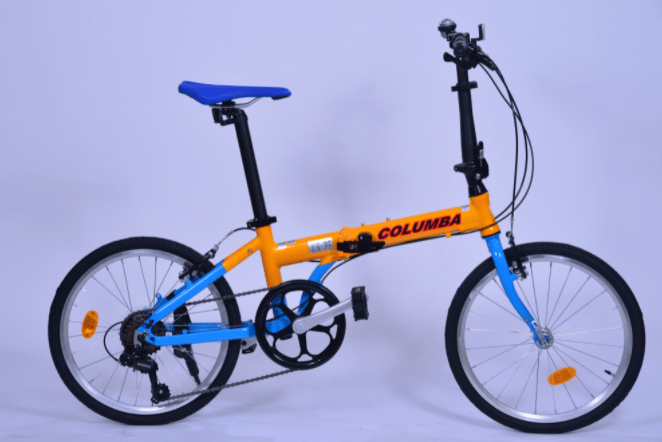
I eyed their line-up of 20-inch wheel folding bikes, like this one ($250 plus shipping):

It weighs only 27 pounds (  kg) and folds down to 31″x14″x25″. People sometimes take a bike like this on the train for commuting; they can ride to the train station, then ride from the station in town to their office. The 20” Columba bikes look fine for that application, but with the small wheels and the 7-speed gearing only on the back wheel, the internet opinion is that this sort of bike would get tiresome riding long distances or off-road. It might make a good mid-sized children’s bike.

I ended up getting an alloy-framed bike with 26” tires and 18 speeds, for $310 plus shipping:

I have been really happy with it. The tires and gearing are perfect for my casual on/off road use (moderate-length road trips or dirt/gravel trails; not 100-mile marathons or extreme mountain biking). It has shock absorbers in the front fork and below the seat. The frame folds in half, and the seat post and handlebar assembly pop out quickly to make a package that will fit in a cloth bag. But it is a good machine at a good price even if you don’t care about compact storage.

One touch I appreciated about the web site is that (unlike some sites) they were realistic about the comfort level for tall riders. I bought the recommended longer seat post, so my legs are not crunched. They used to offer an extended handlebar stem so you are not so hunched over while riding. That seems to be out of stock, so I bought some “Bar Ends” that attach to the ends of the handlebars and stick up a couple of inches. For a younger teen or for shorter men or most women, these accessories would probably not be needed.

The seat that came with this bike was a perfectly fine, standard narrow seat. However, I find it painful to have my weight on those little “sit” bones like you are supposed to. So I ended up getting a big fat padded Bikeroo bike seat, and then putting a gel seat pad on top of that, for luxurious sitting comfort.

Bottom line: If you are in the market for a general-purpose bike for you or a family member, I’d recommend looking at the bikes available on the 2KSilver site.

Growing/Shrinking Jobs of Next Decade: Good Times Ahead for Nurse Practitioners, Wind Turbine Technicians, and Animal Trainers

The good folks at Visual Capitalist have put together a big juicy infographic depicting employment trends over the next decade, based on projections from the Bureau of Labor Statistics. The vertical axis is % decadal growth for each category, the horizontal axis is 2020 median annual wage for that category, and the size of the bubble indicates the absolute numbers of change. The color of each bubble is keyed to “Occupational Group”, i.e.,  “Health related”, “Computer and mathematical”, etc.

Below I snipped part of the infographic which shows occupations which will be growing. The horizontal positioning (median annual wage) runs from $20,000 on the left to $120,000 on the far right; nurse practitioners fall in the $105,000-120,000 range. The fastest growing, percentagewise, are wind turbine service technicians (68%), followed by nurse practitioners and solar installers tied at about 52%. The biggest absolute numbers of job growth are in “Home health and personal care aides”, to tend aging baby boomers.

From the color coding, we can see at a glance that job growth is mainly in the Health Related and Computer and Mathematical categories, with a smattering of “Other”, including Animal Trainers (for dog obedience schools ??) and Crematory Operators, as those baby boomers age all the way out.

Some of the losing professions are shown below. Most of these are in the “Office and Admin Support” (purple) category and Production workers (including nuclear power reactor operators). Some “Other” categories will get hit hard, such as parking officers and door-to-door salesmen.

Most of these shrinking jobs are lower paid, while many of the growing jobs are better paid. Bottom line: advise your kids to consider careers like data security/analysis, or a health care specialty, including management.

China Cracks Down on Cryptocurrencies

The Chinese Communist Party (CCP) is all about control. In the well-known words of Chairman Mao:

Every Communist must grasp the truth, “Political power grows out of the barrel of a gun.” Our principle is that the Party commands the gun, and the gun must never be allowed to command the Party.

These days political power is linked to economic power and control of information, as well as raw military firepower. Cryptocurrencies have assumed financial importance and they entail information processing and tracking.

On the other hand, a key driver for cryptocurrencies is precisely to escape from the domination of big central authorities, such as the CCP. Proponents of crypto revel in the fact that anyone with a PC can get in on “mining” and that the crypto universe does indeed operate on the web as a largely democratized enterprise. Anybody can transact large sums with anybody, with a moderate degree of anonymity.

These two different visions of life collided on Sept. 28 when the Chinese government banned nearly all crypto-related transactions:

China’s central bank said on Friday that all cryptocurrency-related transactions are illegal in the country and they must be banned, citing concerns around national security and “safety of people’s assets.” The world’s most populated nation also said that foreign exchanges are banned from providing services to users in the country.

In a joint statement, 10 Chinese government agencies vowed to work closely to maintain a “high pressure” crackdown on trading of cryptocurrencies in the nation. The People’s Bank of China separately ordered internet, financial and payment companies from facilitating cryptocurrency trading on their platforms.

The central bank said cryptocurrencies, including Bitcoin and Tether, cannot be circulated in the market as they are not fiat currency. The surge in usage of cryptocurrencies has disrupted “economic and financial order,” and prompted a proliferation of “money laundering, illegal fund-raising, fraud, pyramid schemes and other illegal and criminal activities,” it said.

Offenders, the central bank warned, will be “investigated for criminal liability in accordance with the law.”

The Chinese government will “resolutely clamp down on virtual currency speculation, and related financial activities and misbehaviour in order to safeguard people’s properties and maintain economic, financial and social order,” the People’s Bank of China said in a statement.

Well, those are the bare facts. It’s good to know the CCP is so diligently safeguarding people’s assets and public order. And as noted, Mao’s successors would not naturally favor systems that allow people to just do what they want to do, free from guidance from the Party. But inquiring minds want to know or at least speculate further regarding the reasons for this move and its consequences.

Brian Liu and Raquel Leslie highlighted two other motivations for this crackdown. One motivation  concerns China’s desire to launch its own state-controlled digital currency. This will give the government heightened ability to track every single transaction by every single user. It would also provide China with a new means of exerting influence over other nations and corporations:

The ban comes as the People’s Bank of China (PBOC), China’s central bank, is piloting its own digital currency, the eCNY or “digital yuan.” Unlike private cryptocurrencies, the eCNY is issued directly by the central government and is being designed to provide the PBOC with near-real-time financial data on user transactions. Some observers fear that the eCNY will be used as a tool to strengthen the Chinese Communist Party’s domestic surveillance. Others worry that the eCNY will be used to retaliate against international companies that speak out on human rights issues. Fan Yifei, a deputy governor of the PBOC, announced last week that the eCNY has entered a “sprint stage” ahead of the February 2022 Winter Olympics in Beijing.

Another motivation may be to help prevent wealthy Chinese from taking their money abroad:

The crypto ban may also be intended to deter capital flight. Despite past crypto crackdowns and strict capital controls, wealthy Chinese have used cryptocurrencies to funnel more than $50 billion overseas in 2020. As China is in the middle of an economic slowdown that has been exacerbated by other regulatory crackdowns on the tech and education sectors, China may be redoubling its efforts to ward off skittish entrepreneurs from exporting their money overseas.

Will this crackdown fully succeed? Many observers doubt it. They think that people will find ways to do what they want to do, using platforms that are hosted outside China.

As for the digital yuan, well, it kind of goes against most of the reasons people have gravitated to crypto. It represents a move back to government control and surveillance. It is not really a “crypto” currency at all, but simply another form of regular money.  It could get traction, however, in international trade among countries who have reasons to try to escape from the current U.S. dollar dominance. Also, China could hand out its digital currency like candy to impoverished nations, to get them on board. Millions, maybe billions of people live without regular banking access, and so a medium of exchange and store of value that requires only a cell phone to move funds around town or around the world could be attractive. At any rate, count on China to make the digital yuan a big “thing” for international visitors due at the February 2022 Olympics.

The price of Bitcoin took this news in stride. It continues to bounce around in the same $40,000-$50,000 range that it has been in for the past three months. And being banned by China is not a death-knell for a financial entity.  Indeed, it could be a contrarian indicator. Consider that China has also banned Youtube, Facebook, Google, Instagram, Pinterest, and even (because of his uncanny resemblance to President Xi) Winnie the Pooh.

Europe Natural Gas Shortage: Factories Shut, Maybe Worse to Come

Shut down your old reliable coal and nuclear power plants. Replace them with wind turbines. Count on natural gas fueled power plants to fill in when the breeze stops blowing. Curtail drilling for your own natural gas, and so become dependent on gas supplied by pipeline from Russia or by tankers chugging thousands of miles from the Middle East. What could possibly go wrong?

That is what Europe is discovering now as natural gas prices have quintupled, taking electricity prices up with them. Europe is having a hard time finding enough gas supply to fill up storage facilities to get them through the winter. If consumers are prioritized, widespread industry shutdowns are possible if there is a cold winter. Prices for many things will rachet up, with implications for inflations and in turn for central banks’ response to inflation. (The Fed’s Powell has been talking down the current inflation as merely transitory).

 In the UK, energy companies are going bankrupt because the wholesale price that at which they purchase gas is higher than the government-mandated cap on gas price they can charge consumers. Plants which use natural gas as a feedstock like fertilizer plants are shutting down, which impacts farmers. Carbon dioxide is a byproduct of some of these operations, and the resulting shortage of CO2 is affecting meat-packers who use it in their operations. Indeed, a food producer has warned that the Christmas dinner could be “cancelled.” That’s just how bad it is. The Brits are even delaying the shutdown of the country’s largest remaining coal-burning power plant.

Jason Bordoff of the Columbia Climate School and the Center on Global Energy Policy just published a long article giving his perspective on all this. He identifies several contributing factors:

( 1 ) Cold and hot weather affected gas consumption this year. Winter in much of the Northern Hemisphere was unusually cold earlier this year, which boosted gas demand for heating. And then a hot summer consumed more gas to make electricity for air conditioning. 

( 2 ) Other sources of electricity have been hampered. “Wind generation in Europe has been far below average this year due to long periods of less windy weather. …Demand for fossil fuels is set to spike further as Germany takes another three nuclear reactors off the grid this year as part of its nuclear shutdown. Meanwhile, drought conditions in China and South America have led to reduced hydropower output, drawing supplies of globally traded gas into those markets instead.”

( 3 ) The post-COVID economic recovery has boosted industrial demand.

( 4 ) Russia has restricted gas deliveries to Europe though the existing pipeline that runs through Ukraine. (Many observers see this as a pressure tactic to get Europe to switch over to a northern pipeline route, which would then remove the importance of Ukraine for Russian gas marketing, which would then give Russia a freer hand to resume military harassment of that country.) Also, European countries have restricted their own gas production. The Dutch are curtailing the production rate at their big Groningen gas field because local residents fear earthquakes from ground subsidence, and the Brits have restricted fracking of promising gas fields due to public protests.

As might be expected in our interconnected world, the European supply crunch has affected U.S. prices, which are at their highest level in five years. America exports gas via liquified natural gas (LNG) tankers, but U.S. gas supplies so far have not responded much to the price increase. The hostility of the Biden administration and pressure from green-leaning investors has discouraged petroleum companies from expanding drilling.

Meanwhile, California is running its own experiment in green energy  adoption:             

California, for example, is having trouble keeping the lights on as it rapidly scales the use of intermittent solar and wind power. It recently requested an emergency order from the U.S. federal government to maintain system reliability by, among other actions, allowing the state to require certain fossil fuel plants scheduled to retire to stay online and by loosening pollution restrictions. California is also proposing to build several temporary natural gas plants to avoid blackouts, even as the state shuts down the Diablo Canyon nuclear power plant, which produces more zero-carbon electricity than all the state’s wind turbines combined.

Professor Bordoff notes that “Many projections for how quickly and how much clean energy can be scaled are based on stylized models of what is technically and economically possible”, and unsurprisingly calls for policies which mitigate volatility, e.g., “…regulatory and infrastructure policies can facilitate more integration, flexibility, and interconnectedness in the energy system—from power grids to pipelines—so there are more options to pull energy supplies into a market when needed.”

Oh, and this restatement of the obvious:  

Uncertainty about the pace of transition may lead to periodic shortfalls in supply if climate action shutters traditional fossil fuel infrastructure before alternatives can pick up the slack—as may be starting to happen in some places now. And if fossil fuel supply is curbed faster than the pace at which fossil fuel demand falls, shortfalls can result in market crunches that cause prices to spike and exacerbate existing geopolitical risks. In fact, this is what the International Energy Agency just warned is happening in oil markets—a striking contrast to what it said only a few months ago, when it warned that new fossil fuel supplies would not be needed if nations were on track to achieve net-zero emissions by 2050.

Me? After working through  all this material, I’m going to go buy me some shares of ExxonMobil, the largest natural gas producer in the U.S.

Likely Collapse of Chinese Real Estate Conglomerate Evergrande Roils World Markets

Nearly a year ago, on this blog we described the sequence of events that led to the Great Recession ( or “Global Financial Crisis”) of 2008-2009. The underlying problem was real estate-related debt: as inflated housing prices collapsed, many people couldn’t (or wouldn’t) pay their mortgages. Various financial dominos fell, but the one that gets singled out as the single most critical event was  the collapse of Lehman Brothers investment bank on September 15, 2008. The Dow Industrial average fell 504 points that day, and loss of confidence in the financial markets led to a freeze-up in credit, which was/is the lifeblood of business.

The likely bankruptcy of the gigantic Chinese real estate conglomerate Evergrande is being discussed as another possible “Lehman Moment”. It is hard to comprehend just how big this outfit is. It owns more than 1,300 real estate projects across China, directly employs 200,000 people, and is indirectly sustains some 3.8 million jobs. It got that big by borrowing (including selling bonds) and spending enormous amounts of money. The problem now is that it seems like it cannot service its $300 billion debt. Once things like this start to go bad, they often get much worse, quickly. Other parties stop wanting to do business with you, and it all goes downhill. (A famous reply in Ernest Hemingway’s The Sun Also Rises to the question, “How do you go bankrupt?” was “Gradually, and then suddenly”). The market prices on Evergrande’s bonds indicate that the market expects bankruptcy, with bondholders getting only about 25 cents on the dollar.

If this collapse materializes fully, a lot of investors will lose a lot of money, a lot of suppliers of building materials to Evergrande will not get paid and may go broke, and a lot of real estate development in China will freeze up for the time being.  Goldman Sachs estimates a 1-4% hit to China’s GDP, which is huge, and would reverberate across the whole world.

Wall Street seems to have been ignoring this drama, until yesterday (Monday). Blam, stocks fell around 2%, and were still headed south at the end of trading. Is this the start of The Big One? Well, that makes for dramatic commentary, but most observers seem to take a more nuanced approach. First, the all-powerful Chinese government could order the People’s Bank of China to “fix this”. We all now know that central banks have magical powers to create as much money as needed to, e.g., buy all outstanding Evergrande bonds at near-par. On the other hand, the Chinese government lately has been clamping down on speculation. So there may be some sort of compromise, a semi-orderly unwinding, with bondholders feeling some pain, but actual real estate operations being sold off and continuing under some other names.

Wall Street may be more worried about whether the Fed announced on Wednesday that it will take away the punch bowl by tapering of its bond purchases. The last time the Fed did that, in 2018, stocks took a long and hard tumble. Again, a range of outcomes is possible here.

Ironically, all these concerns, as long as they don’t really turn into something serious, may be a bullish indicator for stocks. Stocks are said to “climb a wall of worry”; it is when everyone is totally complacent that is a setup for a crash. Time will tell whether the Evergrande difficulties end up being part of  a bullish wall or a bearish cliff.