Truth As a Casualty of Wars

The saying that “The first casualty of war is the truth”  has been credited to anti-war Senator Hiram Warren Johnson in 1918  and also to the ancient Greek dramatist Aeschylus. We have seen this played out dramatically with Russia’s invasion of Ukraine. From the Ukrainian side have come the predictable overinflated estimates of the enemy’s losses, and perhaps understated reporting of their own casualties. Also, on the first day or two of the war there was a raunchy defiant response of Ukrainian defenders to a “Russian ship” that was demanding their surrender; as far as I know that exchange was for real, but the initial report by Ukraine that all the heroic defenders were killed was not true. Maybe I am biased here, but these sorts of excesses are stretching some core truth, not trampling over it roughshod.

On the Russian side, perhaps because there is no even vaguely legitimate justification for their invasion, the lies have been simply ludicrous. Apparently, the Russian troops have been told that they are going there to rescue Ukrainians from the current regime which is a bunch of  “neo-Nazis”.  If Putin’s thugs had a sense of humor or perspective, they might have discerned the irony of characterizing the Ukrainian regime as “neo-Nazi” when the president (Zelenskyy) is a Jew, whose grandfather’s brothers died in Nazi concentration camps.

And the Russian lies go beyond ludicrous, to revolting and inhuman. Russian Foreign Minister Sergey Lavrov has dismissed concerns about civilian casualties as “pathetic shrieks” from Russia’s enemies, and denied Ukraine had even been invaded.

The Associated Press snapped a picture in the besieged city of Mariupol a few days ago which went viral, showing a pregnant woman with a bleeding abdomen being carried out on a stretcher from a maternity hospital which the Russians had bombed. The local surgeon tried to save her and her baby, but neither one survived. The Russian side put out a string of bizarre and contradictory stories, claiming that they had bombed the hospital because it was a militia base (a neo-Nazi militia, of course) but also that no, they didn’t bomb it, the hospital had been evacuated and the explosions were staged by the Ukrainians, and the bloody woman in the photos was a made-up model. Ugh. I find it chilling to observe a regime in operation where there is absolutely no respect for what the truth actually is; rather, lies are manufactured to serve whatever purpose will suit the regime.

I know that some of that goes on even with Western democracies, but we are still usually ashamed of outright lying, and stand discredited when exposed. But with hardcore authoritarian regimes, there does not seem to be even this minimal respect for integrity.  

Freedom of speech becomes even more critical as cynicism about truth becomes more widespread in the world, even in our own political discourse. Putin is trying to suppress the truth within Russia, now with very harsh penalties (fifteen years in prison) for those disseminating information contrary to the party line. All he needs to do is deem such talk as “treasonous”, and into the clink you go.

I do worry about similar trends towards censorship within the West. In our case, it is not so much governments (so far) doing the censorship, but Big Tech. If Google [search engine and YouTube] / Facebook/Twitter disapprove of your content, they can label it “hate speech” or whatever, and your voice disappears from public discourse. But what gives the high priests of big tech the authority and the powers of moral discernment to rule on what discourse is permissible? Also, the algorithms of social media sites usually direct you towards other sites that reinforce your own point of view, so you rarely get exposed to why the other side believes what it does. However annoying it may be to see various forms of nonsense circulating on-line, the time-tested democratic response is to allow (nearly) all points of view to be fairly stated, and to trust in the people to figure out where the truth lies. Otherwise, the truth can become a casualty of culture wars, as it is in shooting wars.

How Overzealous Green Policies Force Europe to Bankroll Putin’s Military

There is a difference between healthy zeal for a basically good cause like reducing CO2 emissions, and unbalanced myopia. Back in September I wrote about the European power debacle (skyrocketing gas and electricity prices):

Shut down your old reliable coal and nuclear power plants. Replace them with wind turbines. Count on natural gas fueled power plants to fill in when the breeze stops blowing. Curtail drilling for your own natural gas, and so become dependent on gas supplied by pipeline from Russia or by tankers chugging thousands of miles from the Middle East. What could possibly go wrong?

Well, now we know what can go wrong.

In January I noted more specifically, “This energy shortage also makes Europe very vulnerable to Russia, at a time when Putin is menacing Ukraine with invasion.” Now it has come to pass. All the huffing and puffing about economic sanctions on Russia is mainly just hot air. Because Europe is utterly dependent on Russian gas, massive “carve-outs” have been made in sanctions in order to continue these purchases to continue. The vaunted SWIFT restrictions on Russian banks have been carved down to practical irrelevance. While sanctions may impact the lifestyles of oligarch playboys, this flow of euros to Russia ensures that Putin will not run short of money for his war.

Ecomodernist Michael Shellenberger writes that behind the Ukraine military drama “is a story about material reality and basic economics—two things that Putin seems to understand far better than his counterparts in the free world and especially in Europe.” Shellenberger asks, “How is it possible that European countries, Germany especially, allowed themselves to become so dependent on an authoritarian country over the 30 years since the end of the Cold War?” and then answers this question in his trademark style:

Here’s how: These countries are in the grips of a delusional ideology that makes them incapable of understanding the hard realities of energy production. Green ideology insists we don’t need nuclear and that we don’t need fracking. It insists that it’s just a matter of will and money to switch to all-renewables—and fast. It insists that we need “degrowth” of the economy, and that we face looming human “extinction.” (I would know. I myself was once a true believer.)

… While Putin expanded Russia’s oil production, expanded natural gas production, and then doubled nuclear energy production to allow more exports of its precious gas, Europe, led by Germany, shut down its nuclear power plants, closed gas fields, and refused to develop more through advanced methods like fracking.

The numbers tell the story best. In 2016, 30 percent of the natural gas consumed by the European Union came from Russia. In 2018, that figure jumped to 40 percent. By 2020, it was nearly 44 percent, and by early 2021, it was nearly 47 percent.

…The result has been the worst global energy crisis since 1973, driving prices for electricity and gasoline higher around the world. It is a crisis, fundamentally, of inadequate supply. But the scarcity is entirely manufactured.

Europeans—led by figures like Greta Thunberg and European Green Party leaders, and supported by Americans like John Kerry—believed that a healthy relationship with the Earth requires making energy scarce. By turning to renewables, they would show the world how to live without harming the planet. But this was a pipe dream. You can’t power a whole grid with solar and wind, because the sun and the wind are inconstant, and currently existing batteries aren’t even cheap enough to store large quantities of electricity overnight, much less across whole seasons.

In service to green ideology, they made the perfect the enemy of the good—and of Ukraine.

There we have it.  It’s not just the Europeans. As I write this, shells are raining down on Ukrainian cities but the U.S. is not restricting its imports of Russian oil, lest our price of oil go even higher. The present oil shortage (even before the Ukraine invasion) is what happens when a president on his first day in office signs an executive order to cancel a pipeline expansion which would have enabled increased oil production from Canada’s massive oil sands, and the whole ESG movement hates on investing in projects for producing oil or gas.

All that said, what the West gives with one hand it may take back with the other. Although energy exports from Russia are theoretically permitted, Western private enterprises, including finance arms, are pulling back from any dealings with Russia. This means in practice, lots of wrenches are being thrown into the machinery of international finance, such that energy exports from Russia are being slowed, though not stopped. But in turn, the Russians are getting higher prices per barrel for the oil that does get exported. There are many moving parts to all this, so we will see how it all shakes out.

How Volodymyr Zelenskyy Went from Playing the Ukrainian President in A Sitcom to Actually Being the Ukrainian President

The man of the hour is Volodymyr Zelenskyy. Russia underestimated the amount of resistance they would face in their invasion of Ukraine, and Zelensky is the heart and face of that resistance. The usual pattern in countries like Ukraine with a history of corrupt leadership is that when hostile armies close in on the capital, the leaders stuff money and jewels into suitcases and disappear to some safe haven (think: Afghanistan). Zelensky has chosen to stay and fight against Vladimir Putin, a man with a fearsome reputation for brutal military tactics (see: Chechnya and Syria) and for political assassinations.

Where did Zelenskyy come from? American politicians are nearly all lawyers or businessmen. Zelenskyy was a professional comedian. He did get a law degree, but then went into stage and film comedy. He starred in a number of lightweight films such as Love in the Big City,  Office Romance, and the zany Rzhevsky Versus Napoleon:

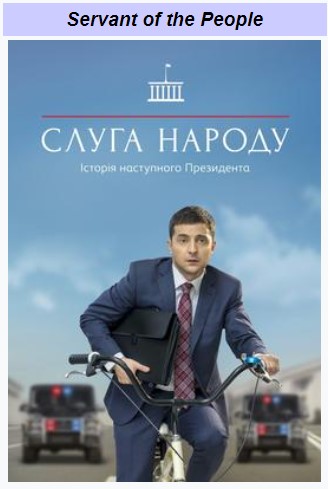
In 2015 the actor created, produced and starred in a comedic television series, Servant of the People:

In this political satire, a young high school teacher happens to let loose with a rant about corruption in Ukraine. One of his students captures this rant on his phone and puts it out on the internet. That YouTube video goes viral, and (to his complete surprise) the teacher gets elected president of Ukraine. He then proceeds to govern honorably, amidst various comedic situations.

In a case of life-mimics-art, the real Zelenskyy ran for the presidency of the country in 2019. Fueled by the popularity of the TV series, Zelenskyy’s campaign was almost entirely virtual. It succeeded in unseating the incumbent candidate, with Zelenskyy receiving a landslide 73% of the vote.

Although his Ukrainian presidency began on a whimsical note, it has turned into a global epic. However, it is difficult to envisage an ending to this epic that is not tragic. Drawing on his acting skills, Zelenskyy has been a master of internet communications in the present crisis, but there is only so much that can be done in the face of hard military realities. While the images of Ukrainian resistance are inspiring, the Russians have far greater military might and have the will to employ it as needed. And as long as Europe continues to fund Russia by guzzling Russian natural gas, sanctions can only bite moderately hard.

Economics of an Alabama Small Farm Homestead

When I took a trip to Alabama a couple of months ago, I visited a small farm about an hour’s drive south of Birmingham. The proprietor of Rora Valley Farms, Noah Sanders, makes a living for his family mainly by selling vegetables from a garden plot, plus raising chickens for selling eggs and meat. I was curious as to how he manages to do this, since the usual model of agriculture is to operate at large scale, with big machines efficiently  plowing and harvesting hundreds and thousands of acres.

I had read online about a low tech, compost-intensive method of farming developed in Zimbabwe called Foundations for Farming. This method  has proven extremely successful in southern Africa at mitigating food insecurity; I posted a longish description of it at   “Pfumvudza” Planting Technique Revolutionizes Crop Yields in Zimbabwe.   Noah is listed as the U.S. representative for Foundations for Farming, which led me to contact him.

The Modern Homesteading Movement

The most fundamental aspect of his operation is not the specific crops he grows. Rather, it is the overall vision than he and his wife have for their lives and their family. Trying to start up a small farm is not something folks do just for the money. There are much, much easier ways to make a buck.

The Sanders are part of a small but growing homesteading movement. It is hard to pin down precisely what that means these days, but in general it denotes a lifestyle aimed at self-sufficiency. Thus, homesteaders grow a large portion of the food they eat, and often install solar panels and rain catchment systems to reduce dependence on the electrical and water grids. Raising chickens for eggs and meat is common. All this can be done in a suburban or even an urban back yard; nearly anyone can put in a garden, and some cities allow a few egg-laying hens to be kept (but no roosters, because of the noise nuisance). More typically, homesteading is done in a rural setting, on maybe 3-10 acres. Most of that acreage would be pasture, to support some larger animals, such as goats, sheep, and pigs, all the way up to cows.

Besides producing more of what you consume, part of the homesteading ethos is to consume less. Instead of buying yet more made-in-China stuff and watching hours of contrived mass media and movies, homesteaders are found making cheese or canning vegetables, or maybe just sitting on the back porch watching the ever-entertaining chickens. To keep overall investment down, a homestead dwelling itself is typically no-frills. You are more likely to see pine boards than designer ceramic tile when you look down at a homestead kitchen floor. Hopefully all this producing more/consuming less allows the adults to spend less time working away from home, and more time with their families. Most homesteaders still need to drive off to work “in town” to make ends meet. Holding down an outside job plus running a farm operation plus doing home-schooling can lead to stress and burnout, even for a strong young couple. A homesteading ideal, therefore, is to be able to support oneself entirely from home-based activities.

A big driver for homesteading is to raise children in a situation where they can see their parents daily working productively, and where the children themselves make genuine contributions to the family’s welfare, rather than being merely consumers that cost the family time and money to entertain and occupy them.   This small-scale, subsistence-type agricultural activity runs contrary to the conventional wisdom that economic welfare consists of increasing specialization and then exchange of goods/services that are produced by efficient specialists.    

Continue reading

Half of Deliberately Exposed Unvaccinated Volunteers in UK Study Did Not Get COVID; Why?

A British study by Ben Killingley and 31 co-authors recently appeared in pre-print form, where 36 (heroic) healthy young adult volunteers were deliberately exposed to the Covid virus by nasal drops. These volunteers then went into quarantine for 14 days, and logged their symptoms and were subjected to various tests for a total of 28 days.


Of the 36 subjects, only 18 (53%) became infected with the virus, as determined by PCR testing (the gold standard for Covid tests) and by direct counting of viral loads in mucus cells by FFA.

The study found that viral shedding (as estimated by mucus viral loads) begins within two days of exposure and rapidly reaches high levels, then declines. Viable virus is still detectible up to 12 days post-inoculation. This result supports the practice of people quarantining for at least 10 days after they first exhibit symptoms of infection. There were significant higher viral loads in the nose than in the throat,  which supports the practice of wearing masks that cover the nose as well as the mouth.


The cheap, fast, LFA rapid antigen test method (used in home tests) performed fairly well. Because it is less sensitive, it did not it did not yield positive results for infected individuals until an average of four days after infection, or about two days after viral shedding may have begun. But from four days onward, the LFA method was sensitive and reasonably accurate which supports the ongoing use of these quick, cheap tests.

These direct inclusions from the paper are helpful, but not earthshaking. The elephant in the room, which the paper did not seem to directly address, is why nearly half of the people who were exposed did NOT become infected. This raises all kinds of issues about what mechanisms the human body may have to naturally fight off COVID or similar viral infections. Gaining insight on this could lead to breakthroughs in preventing or mitigating this pernicious virus.

An article by Eileen O’Reilly at Axios probes these questions. There is nothing conclusive out there, but four ideas that are under investigation are:

1. Cross-immunity from the four endemic human coronaviruses is one hypothesis. Those other coronaviruses cause many of the colds people catch and could prime B-cell and T-cell response to this new coronavirus in some people.

2. Multiple genetic variations may make someone’s immune system more or less susceptible to the virus.  Some 20 different genes have been identified which affect the likelihood of severe infection, and a genetic predisposition to not getting infected is seen in other diseases where people have one or multiple factors that interfere with the virus binding to cells or being transported within.

3. Mucosal immunity may play an underrecognized role in mounting a defense.

This suggests nasal vaccines might have a chance at stopping a virus before it invades the whole body.

4. Where the virus settled on the human body, how large the particle was, the amount and length of exposure, how good the ventilation was and other environmental circumstances may also play a role.

These considerations support continuing with the usual recommendations of social distancing, wearing facemasks, and ventilating buildings, especially when caseloads are peaking. Also, the doses administered to the volunteers in the study were considered quite small by clinical standards. It was surprising that such a low dose was effective as it was in causing full-blown infections; and the particular strain used in the experiment was not necessarily one of the more recent highly virulent variants. After reading these results,  it is more understandable to me why so many reasonably careful friends and family members of mine (nearly all vaccinated, fortunately) have come down with (presumably) omicron COVID in the past two months. Just a little dab will do ya.

Controversial Study Finds Lockdowns Don’t Reduce COVID Mortality; Some Less Controversial Takeaways

A recent working paper, A LITERATURE REVIEW AND META-ANALYSIS OF THE EFFECTS OF LOCKDOWNS ON COVID-19 MORTALITY,  released by Steve Hanke (professor of Applied Economics at Johns Hopkins) and other applied economists (Jonas Herby of Denmark and Lars Jonung of Sweden) has been understandably controversial. I will survey some of its methods and conclusions, and (very briefly) some of the reactions to it.

I will not take a position on how valid its conclusions are, for the simple reason that I am totally unqualified to make such a judgement. What I would like to contribute are a couple of takeaways that are worth considering for the next pandemic or even the remainder of this one.

Methodology of the Paper

Where and how you start largely determines where you will end up. The authors included studies which were (as much as possible) straight apples-to-apples ex post empirical observations (e.g., between otherwise similar countries or U.S. states, at similar times), while avoiding ex ante studies which relied primarily on models of what-would-have-happened-without-lockdowns:

They write (I omit some details, marked with ellipses):

We distinguish between two methods used to establish a relationship (or lack thereof) between mortality rates and lockdown policies. The first uses registered cross-sectional mortality data. These are ex post studies. The second method uses simulated data on mortality and infection rates. These are ex ante studies.

We include all studies using a counterfactual difference-in-difference approach from the former group but disregard all ex ante studies, as the results from these studies are determined by model assumptions and calibrations.

Our limitation to studies using a “counterfactual difference-in-difference approach” means that we exclude all studies where the counterfactual is based on forecasting (such as a SIR-model) rather than derived from a difference-in-difference approach. This excludes studies like…We also exclude all studies based on interrupted time series designs that simply compare the situation before and after lockdown, as the effect of lockdowns in these studies might contain time-dependent shifts, such as seasonality. This excludes studies like….

The authors in particular address a study by Seth Flaxman, which had claimed great effectiveness for lockdowns. They note Flaxman’s modeling approach likely overstated the effects of lockdowns, as noted by other critics of Flaxman:

Given our criteria, we exclude the much-cited paper by Flaxman et al. (2020), which claimed that lockdowns saved three million lives in Europe. Flaxman et al. assume that the pandemic would follow an epidemiological curve unless countries locked down. However, this assumption means that the only interpretation possible for the empirical results is that lockdowns are the only thing that matters, even if other factors like season, behavior etc. caused the observed change in the reproduction rate, Rt. Flaxman et al. are aware of this and state that “our parametric form of Rt assumes that changes in Rt are an immediate response to interventions rather than gradual changes in behavior.” Flaxman et al. illustrate how problematic it is to force data to fit a certain model if you want to infer the effect of lockdowns on COVID-19 mortality.

Conclusions and Controversy

In the interests of time/space, I will give just a few snapshots here. A key conclusion is:

Overall, our meta-analysis fails to confirm that lockdowns have had a large, significant effect on mortality rates. Studies examining the relationship between lockdown strictness (based on the OxCGRT stringency index) find that the average lockdown in Europe and the United States only reduced COVID-19 mortality by 0.2% compared to a COVID-19 policy based solely on recommendations. Shelter-in-place orders (SIPOs) were also ineffective. They only reduced COVID-19 mortality by 2.9%.

The authors are well aware that this is highly controversial, so they cite other studies that have reached similar conclusions. They offer further defenses against a number of other objections, which again I will not elucidate here.

As might be expected, U.S. mainstream media outlets (which have long accused red-state governors of reckless endangerment for not locking down as hard as blue states) have either ignored this paper, or tried to discredit it. An article in the Sacramento Bee, for instance, devoted nearly a whole paragraph to statements by Seth Flaxman (yes, that Seth Flaxman, see above) attacking the paper, while not reaching out to the paper’s authors for a response. And as might be expected, right-leaning media outlets are citing the study as vindicating the freedom-loving red states’ policies over against the heavy-handed Establishment.

Some Maybe Useful Takeaways

Pushing past this predictable partisan unpleasantness, I’ll share a couple of items from the paper that seem worth pondering. One was a strong statement of the harms done by lockdowns, with a plea for considering these in future policy-making. This sort of balancing of wide-ranging consequences is normally considered enlightened economics; in general, we as a society do not say, “The only thing that matters is saving/prolonging every life, no matter the other costs” :

The use of lockdowns is a unique feature of the COVID-19 pandemic. Lockdowns have not been used to such a large extent during any of the pandemics of the past century. However, lockdowns during the initial phase of the COVID-19 pandemic have had devastating effects. They have contributed to reducing economic activity, raising unemployment, reducing schooling, causing political unrest, contributing to domestic violence, and undermining liberal democracy. These costs to society must be compared to the benefits of lockdowns.

The other general issue that was touched on at several points in the paper was the importance of voluntary (as opposed to mandated) social distancing. Nothing in this paper disputed that social distancing, especially in pandemic peak periods, will slow the spread of a disease. The issue here is the effectiveness of state-imposed measures versus voluntary actions. These voluntary actions could be (on the positive side) conscious adoption of distancing and masking with or without legal requirement, or (on the other side) flouting of the laws or careless interpersonal contacts which were unsafe even if they were not illegal. These more risky actions may simply reflect local cultural attitudes (which are hard to change), or they may reflect less urgent government messaging (which is something that can be addressed by policy). A couple of relevant paragraphs are:

What explains the differences between countries, if not differences in lockdown policies? Differences in population age and health, quality of the health sector, and the like are obvious factors. But several studies point at less obvious factors, such as culture, communication, and coincidences. For example, Frey et al. (2020) show that for the same policy stringency, countries with more obedient and collectivist cultural traits experienced larger declines in geographic mobility relative to their more individualistic counterpart. Data from Germany Laliotis and Minos (2020) shows that the spread of COVID-19 and the resulting deaths in predominantly Catholic regions with stronger social and family ties were much higher compared to nonCatholic ones…

Government communication may also have played a large role. Compared to its Scandinavian neighbors, the communication from Swedish health authorities was far more subdued and embraced the idea of public health vs. economic trade-offs. This may explain why Helsingen etal. (2020), found, based on questionnaire data collected from mid-March to mid-April, 2020, that even though the daily COVID-19 mortality rate was more than four times higher in Sweden than in Norway, Swedes were less likely than Norwegians to not meet with friends (55% vs. 87%), avoid public transportation (72% vs. 82%), and stay home during spare time (71% vs. 87%). That is, despite a more severe pandemic, Swedes were less affected in their daily activities (legal in both countries) than Norwegians.

And:

We believe that Allen (2021) is right, when he concludes, “The ineffectiveness [of lockdowns] stemmed from individual changes in behavior: either non-compliance or behavior that mimicked lockdowns.” In economic terms, you can say that the demand for costly disease prevention efforts like social distancing and increased focus on hygiene is high when infection rates are high. Contrary, when infection rates are low, the demand is low and it may even be morally and economically rational not to comply with mandates like SIPOs, which are difficult to enforce. Herby (2021) reviews studies which distinguish between mandatory and voluntary behavioral changes. He finds that – on average – voluntary behavioral changes are 10 times as important as mandatory behavioral changes in combating COVID-19. If people voluntarily adjust their behavior to the risk of the pandemic, closing down non-essential businesses may simply reallocate consumer visits away from “nonessential” to “essential” businesses, as shown by Goolsbee and Syverson (2021), with limited impact on the total number of contacts.

Looking at the vastly different death tolls per capita between, say, Australia (with a more rigorous lockdown and quarantining policy) and the U.S. or U.K, I find it difficult to believe that policy mandates have as little effect as found in this study. That point aside, I think the study is helpful in reminding us that it is what people actually do that matters. Foot-dragging compliance with imposed regulations is a different thing than fully-bought-in compliance, which speaks to motivation and values.

Regarding messaging by governments and other organizations, I suspect that there is not a one-size-fits-all motivational message here. It could be worth reflecting on what sort of message would resonate with a particular population subgroup. (This is just basic Marketing 101: Identify your various segments and tailor the messages to them). Berating some subgroup for their poor choices to date may make the berators feel warmly superior, but that does not move things forward.

I’ll close with some anecdotal observations regarding behaviors, independent of mandates. I have personally continued to generally avoid gatherings where large numbers of people are talking or singing, and wear an effective mask*  when in such a meeting, regardless of what the current rules are.

Also, I have shuttled back and forth between northern Virginia (very blue) and Alabama (very red) in the past two years. Whether or not formal lockdowns or mask mandates were in force, I saw much more mask-wearing in northern Virginia, compared to Alabama. I suspect this reflected overall attitudes and behaviors regarding social distancing. Not saying one is right and one is wrong, but the total COVID deaths per 100,000 in Virginia (196) to date are roughly half of deaths in Alabama (356).

*See Suggestions for Comfortable and Effective Face Masks, e.g., Korean KF94’s on effective, comfortable face masks

“Pfumvudza” Planting Technique Revolutionizes Crop Yields in Zimbabwe

Birth of a New Farming Method

Brian Oldreive is a Zimbabwean, born there in 1943. A star cricket player as a young man, he moved on to become a successful tobacco farmer. In 1978, he became convinced (given the harm that tobacco causes) that he should no longer grow tobacco. When he tried to switch to food crops like corn (called maize in Africa), using standard agricultural practices, he could not make a go of it. He ended up losing his farm and his livelihood due to his moral stand against growing tobacco. He went to work for another large farm, but even there it was a struggle to grow food at a profit. Soil was eroding and crop yields were falling.

He began to think that maybe there was a better way to farm than the usual Western model. One day in 1984 when he was walking in the forest, he noticed that the trees and bushes there grew just fine, with no help from humans, no plowing or irrigation. How was that possible? He observed two things. First, the ground was covered with a thick layer of leaves and other debris, which formed a natural mulch. Beneath this mulch layer (“God’s blanket”), the soil was moist. This was while the region was experiencing drought, and regular farmers’ fields were parched. Secondly, the undisturbed mulch layer naturally decayed to return nutrients to the soil.

Oldreive parlayed those observations into a system of no-till agriculture which mimics the created order. He called this “Farming God’s Way”. The emphasis is on high productivity from a small plot. This involves precision planting at the proper time, crop rotation (corn/beans), and deep mulching to retain moisture and keep weeds down. Nutrients are supplied by both compost and chemical fertilizers.

This method can be practiced by farmers owning no tool other than a hoe. This breaks the cycle of farmers or nations going into debt to purchase expensive Western agricultural machinery, which then may become useless due to inadequate maintenance out in the bush.    

This approach contrasts with conventional farming practice which plows up the soil, leaving it to erode away when it rains and to dry out when it doesn’t rain. Plowing also disturbs the natural ordering of the microbial communities within the upper and lower soil layers. (There is aerobic metabolism near the surface, and a whole different anaerobic community in the soil lower down).

Oldreive started by planting one small plot using this approach in the estate he was then managing:

I decided to copy what God does in natural creation and I observed that the leaves fall down on the ground and the grass dies down and there is a protective blanket over the earth, and that is how God preserves soil to infiltrate the water that we receive…

Many people did not believe me and said I was wasting time. But I was not deterred because I was convinced that this method would work. I decided to put the model into practice by starting with just two hectares. I prayed for wisdom and God showed me how to plant maize into wheat straw residue. This is just the same as what God does in nature.

That two-hectare (about 5 acre) plot confounded the skeptics, yielding about ten times more corn per hectare than the local average yields. He then planted more acreage using this approach. Over the next few years, while a number of conventionally-run farms around him went broke, he kept expanding and growing more food with his system.

Oldreive believed these insights were gifts from God which were meant to be shared with others. Therefore, he shifted his effort towards teaching other Africans how to farm with this method.

Things Fall Apart in Zimbabwe

Continue reading

European Energy Crisis, Updated: Germans Shut Down Perfectly Good Nuclear Plants, Utilities Send Socks to Shivering Customers and Advise Eating Porridge

As we noted in September, natural gas prices are sky-high in Europe. Coal-burning power plants have been shut down and the windmills have not spun as fast as expected, which led to a drawdown of European natural gas stocks for electric power generation. The Russians are not sending as much gas as hoped through their pipelines, so Europe is scratching around for (very, very expensive) liquified natural gas to be shipped by ship from the U.S. and the Middle East.

As noted, this hurts European economies in various ways. Fertilizer plants and aluminum smelters have shut down because of too-costly natural gas feedstock, consumers are paying much more in utility bills, and some governments are going deeper into deficit by paying subsidies to partially cushion consumers. This energy shortage also makes Europe very vulnerable to Russia, at a time when Putin is menacing Ukraine with invasion.

France derives about 70% of its electricity from nuclear energy. Due to its low cost of generation, France is the world’s largest net exporter of electricity, earning over €3 billion per year from this. China and other countries are ramping up nuclear. (The U.S. is sadly dysfunctional when it comes to building nukes; we can’t seem to do anything without years of delay and billions in cost overruns).

Like nearly everything in Germany, the German nuclear power plants are well-run. They have never had a serious incident. Nuclear power plants pump out gobs of electric power with essentially no CO2 emission.  If you think that green advocates in Germany would therefore desire to keep these plants running, you would think wrong. Such is the loathing for nuclear power that Germany is shutting them down. Every single one. Katja Hoyer writes:

Just before midnight on Dec. 31, Germany switched off three more of its nuclear power plants [including one in Grohnde]. Once it had 17; now only three are left, and they too will be shut down at the end of the year. Soon Germany will produce no nuclear energy at all. But the activists were wrong to celebrate. Germany’s hasty nuclear retreat is neither safe nor green. It’s a disastrous mistake that will have ramifications well beyond the country’s own borders.

The Grohnde plant is a perfect example of what Germany is giving up. It was one of the most productive nuclear power plants in the world. It provided enough electricity to cover 15 percent of Lower Saxony’s annual energy needs single-handedly, saving 10 million tons of carbon dioxide emissions a year in the process. The site even made headlines in February 2021 for producing more electricity than any other nuclear power plant in the world. Now it will have to be dismantled at a cost of around 1 billion euros.

The loss of these nukes puts further strain on the European-wide grid. The irony of shutting these plants down and therefore buying more power from other countries generated by nuclear power and by burning more gas and coal seems to be lost on the Germans. Their plan to mitigate the effects of calm winds is to build even more windmills, even if that requires deforesting vast tracts of woodland.

Let Them Eat Porridge

The U.K. utility Ovo, which prides itself on providing all-renewable power, sent customers a link with advice for keeping warm whilst turning down their thermostats this winter. These suggestions included cuddling your pets, eating hot porridge, cleaning the house, having a hula hoop contest, doing star jumps (jumping jacks), and leaving the oven open after you are done baking. I leave to your imagination how this advice was received by the British public. In lieu of affordable electricity, the utility company E.ON which shut down one those German nuclear power plants sent out 30,000 pairs of socks to encourage people to get by with less power and heat.

You couldn’t make this stuff up.

Ongoing Drama with Turkey’s Currency: Heterodoxy or Lunacy?

Economics involves human beings making decisions. Where there are humans, drama is never absent. Hence, somewhere in the broader financial sphere, there is always some drama. The chart below displays gyrations in the exchange rate of the Turkish lira which may be fairly characterized as “dramatic”. This chart shows the lira-per-dollar exchange rate over the past six months; a higher number here means lower lira valuation.

Foreign Exchange Market Prices, Turkish Lira per Dollar.         Source: TradingView.com

What is going on here? Why the spike up in November/December, followed by an even more sudden drop?

As usual, loss of value in foreign exchange goes hand in hand with domestic inflation. Inflation within Turkey for the month of December was reported to 36% on an annualized basis. Now, an orthodox economic response to runaway inflation includes raising interest rates. Higher interest rates tend to make a currency more valuable. Higher interest rates encourage people to hold onto their currency, since they are rewarded by interest on their savings. Conversely, low interest rates, especially when coupled with inflation, motivates people to spend down their money before it loses more value. In the case of emerging market countries like Turkey,  high inflation/low interest drives people to exchange their local currency for more stable foreign currencies, like dollars or euros (or crypto stablecoins like Tether).

But Turkey is Turkey, and Turkey is run by the authoritarian President Erdogan. He has economic views which might most charitably characterized as “heterodox”. Erdogan claims that high interest rates actually cause inflation. His views may be influenced by the prohibition on charging interest in classic Islamic practice. The Turkish president has stated, “My belief is that interest rates are the mother of all evils. Interest rates are the cause of inflation. Inflation is a result, not a cause. We need to push down interest rates.”  President Erdogan has sacked numerous treasury officials who disagreed with him, and pressured the central bank to implement four interest rates cuts in the last four months of 2021.  

It seems he hopes to stimulate enough internal growth to paper over any other problems. I think there could be some merit to that notion, but the current inflation level is toxically high. Lower- and middle-class Turks find it hard to purchase necessities.

 Lowering the value of your currency to make your exports more attractive has been practiced successfully by various Asian nations, but Turkey is too exposed to foreign exchange to weather such a huge drop in the value of the lira. A large part of Turkey’s recent economic growth has been funded by foreign investors, and that may dry up because of the currency instability. Turkey is dependent on imports for many essentials, including all of its energy needs, so imports have become much more expensive for Turks as their currency depreciates. Furthermore, because of the fluctuating value of the local currency, many loans are denominated in dollars or euros. This makes it burdensome for borrowers to keep up payments of interest and principal, when these foreign currencies have become more expensive.

Modern currencies have essentially no intrinsic value. Money is a big confidence game. A shopkeeper will take my dollar bill in exchange for some candy, because he is confident that some other party will in turn accept that dollar bill in exchange for something else of value. If confidence in a currency collapses, so does its exchange value.

Foreign creditors and domestic Turkish consumers were becoming more and more nervous about the prospects for the lira in late 2021, as inflation was fueling further inflationary expectation.  It crashed to a record high exchange rate of 13.44 against the dollar on November 23 after the Turkish leader insisted that rate cuts would continue.

Things really started getting out of control in mid-December. Turks frantically ditched their currency in exchange for euros and dollars, which led to further devaluation of the lira.  On December 21st, however, the Turkish government unleashed an innovative initiative. They offered to backstop the value of the lira deposits of Turkish residents, as long as those deposits were held in lira for a certain period of time. Besides offering interest on the deposits, the offer was to compensate depositors for any loss in value against the dollar. The intent was to motivate residents to keep their lira as lira.  

Turkey’s new Finance Minister Nureddin Nebati has no real finance background; his main qualification for office appears to be a willingness to do what his boss wants. When Nebati was asked to give details of this initiative, he reportedly answered thus: “”I won’t give a number now. Can you look into my eyes? What do you see?… The economy is the sparkle in the eyes.”   Hmm.

President Erdogan has said he is protecting the country’s economy from attacks by “foreign financial tools that can disrupt the financial system.” Western economists are not impressed. Market strategist Timothy Ash commented, “ More complete and utter rubbish from Erdogan…Foreign institutional investors don’t want to invest in Turkey because of the absolutely crazy monetary policy settings imposed by Erdogan.”

At any rate, this unusual measure, combined with old-fashioned central bank intervention (the Turkish central bank is believed to have used some 10 billion dollars’ worth of its foreign reserves to buy lira), seemed to stem the immediate panic. Within a day, the exchange rate thudded down from about 18 to about 13, which is roughly the level today.

It has been pointed out that it simply is not feasible for the government to backstop all relevant bank deposits against a huge currency depreciation;  the Turkish government and central bank would burn through all their foreign reserves, and have to resort to printing ever more worthless lira. However, sometimes the mere promise of such a guarantee (whether or not it is practical) is enough to restore some measure of confidence, which in turn means that the currency will not collapse and  thus the resources of the central bank will not be put to the test.   As we said, confidence is what it is all about. We will see how this plays out.

Primary Driver for This Inflation Is Surging Demand (Fueled by COVID Payments), Not Supply Chain Constraints

Inflation is colloquially defined as, “Too much money chasing too few goods (and services)”. Supply chain constraints get talked about, and these are widely blamed for the inflation we are seeing.  Of course, supply limitations play into inflation, but to focus on them is to miss the elephant in room. The primary driver of this inflation is not “too few goods”, but “too much money.”

Such is the thesis of a widely circulated article by Ray Dalio’s investing firm Bridgewater Associates, “It’s Mostly a Demand Shock, Not a Supply Shock, and It’s Everywhere.” The point is summarized:

While the headlines tend to focus on the micro elements of the supply shock (the LA port, coal in China, natural gas in Europe, semiconductors globally, truckers in the UK, etc.), this perspective largely misses the macro cause that is likely to persist and for which there is no idiosyncratic solution. This is not, by and large, a pandemic-related supply problem: as we’ll show, supply of almost everything is at all-time highs. Rather, this is mostly an MP3-driven upward demand shock. [emphases in the original]

In Bridgewater’s terminology, “MP3” is “Monetary Policy #3”, and refers to massive deficit spending combined with central bank quantitative easing. We saw this implemented in 2020-2021 when the federal government pumped out trillions of dollars of stimulus payments and enhanced unemployment benefits, and the Fed instantly soaked up the bonds that were issued to pay for these trillions. This fed/Fed combo amounts to simply printing money on an enormous scale.

Those trillions of dollars funded a huge surge in durable goods purchases. By late 2021 the supply of these goods was well above 2019 (pre-COVID) levels, and even above normal growth trendlines. However, the supply and transport systems simply could not grow fast enough to accommodate this insatiable demand. Charts below substantiate this. To focus on supply chain bottlenecks of themselves is misleading. The primary driver for this inflation has been the trillions of dollars of federal largesse. The Fed knows all this, obviously, but Jay Powell (the Chief Enabler of this deficit spending) would likely not have been reappointed if he spoke too directly about the cause of this inflation. Hence the endless prattle about supply chains.

Continue reading