I just ran across a short article [1] summarizing a talk with some techniques on learning more efficiently, which seemed worth sharing here. It may be something for professors to pass along to their students.
The speaker was Andrew Watson, who is an expert on learning and the brain, and currently a teacher at the Loomis Chaffee School in Connecticut. He noted three key ways that students (and adults) can work with the ways the brain learns information. The last two points are good but well known, while the first point was not something I have seen emphasized much:
( 1 ) Retrieve information while studying:
To study better, students should focus on the idea of retrieval rather than review. Trying to recall information before looking back at it produces more remembering than simply reading it through again. He suggested creating flash cards and using visual hints and clues as effect retrieval techniques.
( 2 ) Change the environment to avoid distractions:
The environment in which someone studies also affects how well they retain information because the human brain works best when it focuses on one activity at a time.
(My comment: That is absolutely true for me, I can’t stand any distraction when I am studying or writing, but I know people who claim they study more effectively with a TV show or music going in the background…I wonder what academic studies show about that.)
( 3 ) Bolster your health:
The brain, like the rest of the body, benefits from a healthy lifestyle, including eating well and exercising regularly. Ample sleep helps the brain to process and solidify information absorbed during the day. If homework is everything that helps a person learn and if sleep help you learn, then sleep is a part of homework.
[1] “Brain Hacks for Brainiacs” in the Loomis Chaffee Magazine, Spring 2022, page 13.
More than 47 million workers quit their jobs in 2021, in what has become known as The Great Resignation. However, many of these workers are getting re-hired elsewhere. Hiring rates have outpaced quit rates since November, 2020.
The U.S. Chamber of Commerce has published some statistics on this reshuffling of the labor force, which I will reproduce here. As shown in the chart below, quit rates in leisure and hospitality (which require in-person attendance and pay lower salaries) were enormous. However, the recent hiring rates have been even higher in this area, so the shortage of labor there is only moderate.
When taking a look at the labor shortage across different industries, the transportation, health care and social assistance, and the accommodation and food sectors have had the highest numbers of job openings.
But yet, despite the high number of job openings, transportation and the health care and social assistance sectors have maintained relatively low quit rates. The food sector, on the other hand, struggles to retain workers and has experienced consistently high quit rates.
I am not sure I understand exactly what the following chart represents, but it was deemed important:
I think the % of yellow is the ratio of unemployed persons with experience in the field (i.e., who could readily participate) to the total job openings in that field. E.g., “…if every unemployed person with experience in the durable goods manufacturing industry were employed, the industry would only fill 65% of the vacant jobs.” These are interesting data, although I’d be even more interested in seeing numbers on unfilled job openings as fraction of total (filled and unfilled) job openings to give a better idea on how much each industry is hurting for labor. Anyway, here is some of the commentary from the article:
It is interesting to look at labor force participation across different industries. Some have a shortage of labor, while others have a surplus of workers. For example, durable goods manufacturing, wholesale and retail trade, and education and health services have a labor shortage—these industries have more unfilled job openings than unemployed workers with experience in their respective industry. Even if every unemployed person with experience in the durable goods manufacturing industry were employed, the industry would only fill 65% of the vacant jobs.
Conversely, in the transportation, construction, and mining industries, there is a labor surplus. There are more unemployed workers with experience in their respective industry than there are open jobs.
The manufacturing industry faced a major setback after losing roughly 1.4 million jobs at the onset of the pandemic. Since then, the industry has struggled to hire entry level and skilled workers alike.
And finally:
Some industries have been less impacted by labor shortages but are grappling with how to deal with the rise of remote work. For example, the rise of remote work might explain why there has been less “reshuffling” in business and professional services.
Saturday Night Live fans were introduced to Non-Fungible Tokens (NFTs) a year ago with this skit. Most people know that an NFT is a digital ownership certificate of some asset. That could be a physical asset, or a purely digital asset, like a crude graphic of an ape wearing a sailor’s hat which people are willing to pay hundreds of thousands or millions of dollars for.
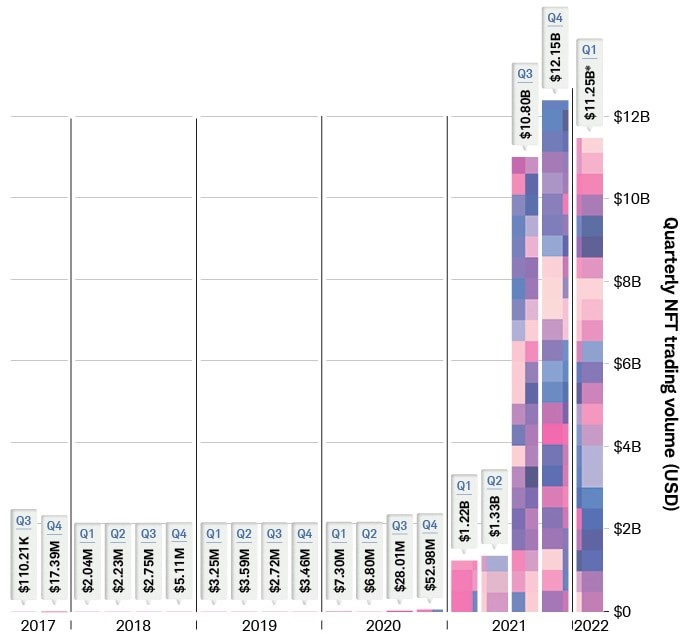
The NFT market volume exploded in the second half of 2021:
On-line chain transactions as tracked by DappRadar. Source: Schwab.
The global NFT market is projected to grow from $1.9 billion in 2021 to $5.1 billion by 2028, an annual growth rate of some 18%.
But, why??? Why would people plunk down millions of dollars for just a certificate of ownership of something which may not be particularly beautiful or functional? It is just not something that would ever occur to me.
Part of the answer must be that there are a lot of people who have a lot of money that they don’t really need. This may be a function of the ever-increasing income inequality, but we will not go down that rabbit hole. But still, assuming some 30-something has 50 grand that he doesn’t need — why spend it on an NFT?
I did a real quick search on this topic. The most common reason appears to be the same reason many people buy rare coins or rare wines or other “collectibles” – they hope that someone else will pay them a higher price in the future. There also seems to be a sense of participating in some “community”, e.g., of Bored Ape Yacht Club aficionados. Much of it comes down to the psychology of what others will pay for something, which can be often explained in hindsight, but can be hard to predict if some asset class has not yet become “hot”.
It turns out that there are some other nuances to NFTs beside just hoping some “greater fool” will pay you more for the ownership of your ape drawing five years from now. I will conclude by pasting in some excerpts from an article on the Hyperglade blog, which frames the discussion partly in terms of the familiar economic concept of scarcity:
The key value proposition that NFTs often claim is scarcity. NFTs, as their name suggests, are each inherently unique on the blockchain, i.e. they can be attributed to a specific ‘hash’ or ID. But scarcity alone doesn’t drive value – it has to be a ‘scarcity’ that people want.
One of the first types of scarcity that people want is exclusivity. Exclusivity in this context means something that is very rare and has attributes of originality. Long before NFTs existed, collectibles took center stage in this arena. For example, trading cards, comic books, and antique toys were very valuable due to their scarcity and history associated with them. For example, the Captain America Comics No. 1, from 1941 sold for over $3 million! The NFT equivalent of this would be Jack Dorsey’s first tweet, which went for $2.9 million. Jack’s tweet illustrates the quintessential NFT qualities; distinct historical moment, a special creator, and only one of them.
Collectible NFTs come in many forms (in image, audio, or video formats), but the primary category is art (e.g. the Beeple NFT), followed by music, and sports moments (e.g. NBA top shot). Subsequently, given the depth of the cultural penetration of the content involved, collectibles are the most popular reason for investing in NFTs. According to Crypto.com’s NFT survey of ~30,000 polled users, 47% of those who own NFTs bought them for collectible value. Their primary motive – to be able to ‘flip’ (sell) at a higher price.
Access to a Network
More recently however, is the emergence of NFT collections that empower communities. These collections give holders access to special privileges, primarily access to special cryptocurrency related services and benefits (e.g. higher investment rates). For example, The famous Bored Ape Yacht club holders get to attend special events, E.g. in October 2021, members celebrated annual Ape Fest in New York City, Bright Moments Gallery.
Assets in virtual worlds and gaming
If you haven’t heard of them already, Virtual digital worlds are computer-simulated environments in which users roam around using their personal avatars. So NFTs neatly solve the problem of immutable land ownership. And depending on the demand, access and foot-traffic to certain places in these simulated world prices for virtual lands have skyrocketed. For example, even the cheapest land in decentraland exceeds $10,000. In a very similar way, web 3.0 games are expanding the use case by digitizing in-game assets so that they can be physically owned by players on the blockchain. In-game assets can include characters, cards, skins, etc. a list of which you can find here.
It has been such a volatile couple of days in the markets that you hardly know where to focus. Friday’s inflation print was 8.6% (year/year), higher than expected and the highest in forty years, showing (yet again) that the Fed’s “transitory inflation” line was always just fantasy. Despite its glacial, foot-dragging pace of response to date, the Fed will need to raise short-rates (which they directly control) faster and farther than earlier planned. The Fed does not directly control long-term rates, but they influence them by buying and selling bonds on the open markets. For years, they have been buying bonds (driving interest rates lower), but they will have to stop that and maybe go the other way, being net sellers of bonds. This will make financing government deficits much more difficult.
Anyway, both short and long term rates have gone vertical in the past few days as markets price in all this, reaching levels not seen since the aftermath of the 2008 Global Financial Crisis:
Mortgage rates will likely march even further upward, increasing the monthly payments for most homeowners. At some point, this will deflate the housing market. Some of today’s eager new homebuyers who paid over asking price, assuming that housing only goes up, may be in for a rude awakening.
It seems like the only way to tamp down inflation is old-fashioned demand destruction. Stock market participants are starting to price in the dreaded R-word (recession). The plunging stock market has been in the news the last few days. Yes, it has dropped a lot, but shown on a five-year chart below it may not be so apocalyptic. It is dropping from ridiculously over-optimistic market highs at the end of 2021. We are still slightly above the pre-COVID peak:
If you are young and working, you should see lower prices as a buying opportunity. If you are making regular contributions to a savings plan in stocks (dollar cost averaging), your dollars are buying you more stocks. If you feel you must DO something, you could always rebalance your portfolio, shifting some funds into stocks from something else, to maintain a say 70/30 stock/bond portfolio. Peace…
The Renaissance in northern Italy was a period between roughly 1350 and 1550 (definitions vary) when a proto-modern outlook and culture and economy replaced feudal medieval society. We all know about the great artistic and literary and scientific advances made at this time and place. I got curious about the economics behind all this. It is clear that the cities of northern Italy, such as Florence, were extremely prosperous, otherwise they could not have funded all these artists and architects.
It has jokingly been said, “Ah, I don’t see what is so great about Shakespeare – – all he did was string together a bunch of famous quotes.” Well, since I know little about all this, what I will do here is mainly string together a bunch of relevant quotes. Let the citations begin….
This blurb from “helenlo-weebly” (?) gives a good overview, noting the importance of trade and the shift from rural barter to an urban money economy:
Trade brought many new ideas and goods to Europe. A bustling economy created prosperous cities and new classes of people who had enough money to support art and learning. Italian city-states like Venice and Genoa were located on the trade routes that linked the rest of western Europe with the East. Both these city-states became bustling trading centers. Trading ships brought goods to England, Scandinavia, and present-day Russia. Towns along trading routes provided inns and other services for traveling merchants.
The increase of trade led to a new kind of economy. During the middle ages people traded goods for other goods. During the Renaissance people began using coins to buy goods which created a money economy. Moneychangers were needed to covert one type of currency into another. Therefore, many craftspeople, merchants, and bankers became more important i society. Crafts people produced goods that merchants traded all over Europe. Bankers exchanged currency, loaned money, and financed their own business.
Some merchants and bankers grew very rich. They could afford to help make their cities more beautiful. Many became patrons and provided new buildings and art; they helped found universities. This led many city-states to become a flourishing educational and cultural center.
Bartleby.com notes technical advances in ship construction, and the rise of Florentine bankers: Genoa and Venice also made advancements in shipbuilding allowing ships to sail all year long and the increased the volume of goods that could be transported (accelerated speed)…Florentine merchants and bankers acquired control of papal banking (acting as tax collectors).
Brewminate notes the rise of modern commercial infrastructure (which depends on law and order, with contracts being honored) and the virtuous cycle of trade and urban craftsmanship promoting each other. Also, the economic and social impact of the Black Death (which is a huge topic of itself):
The Crusades had built lasting trade links to the Levant, and the Fourth Crusade had done much to destroy the Byzantine Empire as a commercial rival to Venice and Genoa. Thus, while northern Italy was not richer in resources than many other parts of Europe, its level of development, stimulated by trade, allowed it to prosper. Florence became one of the wealthiest cities of the region…
In the thirteenth century, Europe in general was experiencing an economic boom. The city-states of Italy expanded greatly during this period and grew in power to become de factofully independent of the Holy Roman Empire. During this period, the modern commercial infrastructure developed, with joint stock companies, an international banking system, a systematized foreign exchange market, insurance, and government debt. Florence became the center of this financial industry and the gold florin became the main currency of international trade.
The decline of feudalism and the rise of cities influenced each other; for example, the demand for luxury goods led to an increase in trade, which led to greater numbers of tradesmen becoming wealthy, who, in turn, demanded more luxury goods…
The Black Death [in the fourteen century] wiped out a third of Europe’s population, and the new smaller population was much wealthier, better fed, and had more surplus money to spend on luxury goods like art and architecture.
What motivated the newly rich urban elites to so assiduously patronize the arts? According to dailyhistory.org, it was largely a desire to assert one’s status and to curry favor with the local citizens:
The New Elites such as the De Medici used spectacles and display to assert themselves in society and to demonstrate their wealth. Wealthy members of the urban elite and the aristocracy were always keen to demonstrate their status. This need to publicize and affirm one’s status led to the patronage of great artists and writers to provide displays and exhibit the wealth and power of the elite. This need for others’ recognition was vital in the Renaissance, which led to the lavish patronage of the period. This led to a great deal of competition to patronize the best artists and writers.
Ah, Davos – – that yearly gathering of billionaires (some fresh from combusting unfathomable amounts of rocket fuel launching themselves into space for fun), flying in on their private jets and lecturing the rest of us about burning fossil fuels. That Swiss resort watering hole for elites who seemingly prefer to have the world run by unaccountable international corporations and NGO institutions rather than national governments elected by those pesky little people (“populism” is a dirty word). Here is the Wikipedia blurb on these meetings:
The World Economic Forum (WEF) is an international non-governmental and lobbying organisation based in Cologny, canton of Geneva, Switzerland. It was founded on 24 January 1971 by German engineer and economist Klaus Schwab. The foundation, which is mostly funded by its 1,000 member companies – typically global enterprises with more than five billion US dollars in turnover – as well as public subsidies, views its own mission as “improving the state of the world by engaging business, political, academic, and other leaders of society to shape global, regional, and industry agendas”.
The WEF is mostly known for its annual meeting at the end of January in Davos, a mountain resort in the eastern Alps region of Switzerland. The meeting brings together some 3,000 paying members and selected participants – among which are investors, business leaders, political leaders, economists, celebrities and journalists – for up to five days to discuss global issues across 500 sessions.
… The Forum suggests that a globalised world is best managed by a self-selected coalition of multinational corporations, governments and civil society organizations (CSOs), which it expresses through initiatives like the “Great Reset” and the “Global Redesign”. It sees periods of global instability – such as the financial crisis of 2007–2008 and the COVID-19 pandemic – as windows of opportunity to intensify its programmatic efforts.
The Davos meeting is usually held at the end of January, but this year was pushed back to May 22-72 because of the COVID surge last winter. How did last week’s globalization-fest fare?
From what I have read, the mood was less upbeat than usual. Douglas Sieg, managing partner of fund manager Lord, Abbett & Co., said: “It’s amazing that six months ago the world didn’t feel all that complicated and all of a sudden the last three months have been nothing but major issues.” Obviously, the war in Ukraine is casting a pall over the world community and economy. Soldiers and civilians are being slaughtered on a scale not seen in Europe since WWII, and Europeans are realizing too late the folly of becoming so dependent on Russia for their energy supply. China’s saber-rattling over Taiwan is making other nations nervous about their heavy reliance on semiconductor chips fabricated in that island nation.
The wild orgy of 2020-2021 COVID-related deficit spending (especially in the U.S.) has predictably led to inflation; in response, the U.S. central bank is threatening to raise rates high enough to dampen demand, which means dampened (maybe negative) economic growth. A number of the non-business speakers worried aloud about these dark clouds gathering on the horizon:
We have at least four crises, which are interwoven. We have high inflation … we have an energy crisis… we have food poverty, and we have a climate crisis. And we can’t solve the problems if we concentrate on only one of the crises…But if none of the problems are solved, I’m really afraid we’re running into a global recession with tremendous effect .. on global stability.
– German Vice Chancellor Robert Habeck
Climate change got less attention than in previous years. Europe is starving for fossil fuels at the moment, so there is more focus on keeping factories running than on pushing costly new green agendas. Trends toward re-shoring vital production and away from hyper-globalization are expected to make supply chains less efficient and thus create more persistent cost pressures.
On the other hand, corporate CEOs, perhaps taking a shorter-term view, were more chipper, saying their businesses are doing just great:
George Oliver, chairman and CEO of heating and air-conditioning manufacturer Johnson Controls, is typical of the positive current business. “We’ve been doing very well,” he said. “We see robust demand…we’re obviously watching that closely.”
“Here [in Davos] everybody’s pessimistic,” says Standard Chartered Chairman José Viñals. “But when I ask them how their business is doing, the picture is wonderful. It may be that the business reality catches up with the [very negative] macro-political reality.”
Time will tell how the global economic scenario actually plays out.
Shell Oil scientist M. King Hubbert made a remarkable prediction in 1956. He had analyzed the depletion patterns of various natural resources, and proposed that the production rates of a given resource from a given region would tend to follow a roughly bell-shaped curve. More specifically, he used what is now called the “Hubbert curve”, which is a probability density function of a logistic distribution curve. This curve is like a gaussian function (which is used to plot normal distributions), but is somewhat “wider”:
Hubbert used various reasonable assumptions (which we will not canvass here) in formulating this model curve. Notably, it predicts that the peak production rate will occur when the total resource from that region is 50% depleted, and that the fall in production on the back side of the curve will be as fast as the rise in production on the front (left) side of the curve.
In 1956, while U.S. oil production was still rising briskly, he fit his curve to the data to that point in time, and predicted that U.S. production would peak in 1970 and thereafter enter a rapid and permanent decline. His prediction was somewhat ridiculed at the time, but it proved to be uncannily accurate over the following 25 years; oil production peaked right when King said it would, and then declined per his curve until about 1990:
Lower 48 U.S. Oil Production: Actual (Green curve) vs. 1956 Hubbert Prediction (Red Curve). Blue Arrow marks deviation ~ 1990-2008, and green arrow marks acceleration of shale oil production. Source: Wikipedia, with arrows added.
I drew in a red arrow at 1956 to show when King made his prediction, and also a blue arrow showing a significant deviation that starting to show after about 1990. Once production had declined maybe halfway down from its peak, the production started to flatten out and decline much more slowly. More on this “fat tail” feature below.
Another feature I called attention to with a green arrow is the remarkable resurgence in production after 2008, which is mainly due to “fracking” of tight shale formation. That new-to-the-world technology has unlocked a new set of oil fields which had previously been inaccessible for production. This illustrated a well-recognized feature of Hubbert curves, which is that a given curve can (at best) apply only to a given region and for a “normal” pace of technological improvement. Fracking production should sit on its own up-and-then-down production curve.
The plot above is for lower 48 states only; a big find in Alaska gave a bump in production 1980-2000 (not shown here) which distorted the whole-U.S. production curve. That Alaska oil peaked by about 2000 and is now in its own terminal decline pattern.
The shape of production curve on the back (declining) side is of particular interest in trying to do economic modeling of future oil production. If the declines really follow a Hubbert curve, the prognosis is pretty scary – – oil production is slated to crash to practically nothing in the near future. However, it seems that in reality, after an initially rapid decline, production can often be sustained much longer than predicted by a simple symmetrical curve. We saw that pattern in the lower 48 curve above, starting around 1990, even before the fracking revolution. Below I show two other examples showing the same feature. The first example, from Hubbert’s original paper, is Ohio oil production 1885-1956:
I am not prepared to make quantitative generalizations, but there does seem to be a pattern of sustained production at reduced levels, following the initial rapid decline from the peak. Others also have noted that asymmetric curves may give better fits to real-world production. These “fat tails” on production from various oil-producing regions should help us keep our cars running longer than predicted by simple peak-oil models. How this pertains to future U.S. shale oil production, and to global oil production, are (since oil and gas are the main energy sources for the world economy) key questions, which we may address in future articles.
Last month I posted on “The Different Classes of Crypto Stablecoins and Why It Matters “. The main point there is that some so-called stablecoins (e.g., USDC) maintain their peg to the dollar by holding a dollars’ worth of securities (preferably U.S. treasury notes) for each dollar’s worth of stablecoin. This mechanism requires some centralized issuer to administer it. As long as said issuer is honest and transparent, this should work fine.
Crypto purists, however, prefer decentralized finance (de-fi), where there is no central controlling authority. Hence, clever folks have devised stablecoins which maintain their dollar peg through some settled algorithm which operates more or less autonomously out on the web; various other coins or assets are automatically bought or sold, or created/destroyed in order to keep the main stablecoin value more or less fixed versus the dollar. We warned that this type of stablecoin is “potentially problematic”; it is the sort of thing which works until it doesn’t.
In 2018 the Terra project was launched by Do Kwon and others. The Terra stablecoin (UST) was designed to “maintain its peg through a complex model called a ‘burn and mint equilibrium’. This method uses a two-token system, whereby one token is supposed to remain stable (UST) while the other token (LUNA) is meant to absorb volatility.” Terra grew very rapidly, to become something like the fourth largest stablecoin at over $30 billion in capital value. As the supply of Terra increased, the market value for LUNA also increased. Many investors bought into LUNA and for a while were making big bucks as its value soared. A headline from February read, “LUNA shines with a 75% surge in February as $2.57 billion is delisted.” Woo-hoo! And this headline from May 10 proclaimed, “Terra Ecosystem is the strongest growing ecosystem in 2021.”
However, just as that laudatory article was hitting the internet, Terra/Luna blew up. I am not clear on the exact sequence of events, especially on whether the catastrophe was a result of just some accidental market fluctuation or of deliberate dumping by some party who was positioned to benefit. In any event, the value of Terra quickly dropped from $1.00 to around $0.61, which triggered the issuing of vast amounts of LUNA, which cratered its value by some 98%. Since Luna was mainly what backed Terra, this was a positive feedback death spiral. This is same way the $2 billion IRON stablecoin imploded in June, 2021: a “stablecoin” was backed by an in-house crypto token whose value depended on more people buying into the system. Ponzi scheme, anyone?
Both Terra and LUNA got delisted from major exchanges for several days. As of today, the value of Terra (UST) is about ten cents. Poof, there went some $40 billion of investors’ money, just like that. Do Kwon is under police protection in Seoul after a man who lost $2.3 million in Terra/Luna tried to break into his home to demand an apology.
In other news, transactions connected to the insanely (I chose that word deliberately) popular and costly Bored Ape Yacht Club NFTs overwhelmed the Ethereum transaction network about two weeks ago; this is kind of a big deal because a whole lot of de-fi and other blockchain applications depend on Ethereum as the backbone of their transactions:
When Bored Ape Yacht Club creators Yuga Labs announced its Otherside NFT collection would launch on April 30, it was predicted by many to be the biggest NFT launch ever. Otherside is an upcoming Bored Ape Yacht Club metaverse game, and the NFTs in question were deeds for land in that virtual world. Buoyed by the BAYC’s success — it costs about $300,000 to buy into the Club — the sale of 55,000 land plots netted Yuga Labs around $320 million in three hours.
It also broke Ethereum for three hours.
Users paid thousands of dollars in transaction fees, regardless of whether those transactions succeeded. Because the launch put load on the entire blockchain, crypto traders were unable to buy, sell or send coins for hours. The sale highlights the growing profitability of the NFT market but also the uncertainty around whether blockchains are robust enough to handle the attention.
… Because the Otherside mint impacts the whole Ethereum blockchain, people doing completely unrelated things like selling ether or trading altcoins would also have to pay huge fees and wait hours for their transactions to clear. Someone tweeted a picture of them trying to send $100 in crypto from one wallet to another, showing it required $1,700 in gas fees.
The Raspberry Pi 400 is billed as a complete desktop PC for under $100 ($99.99). Is this for real, considering the cheapest regular computers are around $300 (plus paying for Word and Excel)? Your intrepid correspondent here dives deep to bring you the truth.
The Raspberry Pi series of microcomputer have been around since 2011. A typical Raspberry Pi is a printed circuit board, about 3 inches by 5 inches, with a microprocessor chip, some RAM memory, and many input/output ports. These ports include four USB ports, two micro-HDMI monitor ports, an Ethernet LAN port, a 3.5 mm audio/visual jack, and special camera-related ports (which can also handle a touchscreen). Also, a port for a micro-SD memory card, which is where the operating system and apps and data reside. But wait, there’s more: in addition to Bluetooth and wi-fi capability, the Pi has a 40-pin port for input and output to interact with the physical world. All this for around $35! [1]
Developed by the British nonprofit Raspberry Pi Foundation as an affordable educational tool, millions of Raspberry Pi units have been purchased by students and techies to learn-as-you-play and to do some useful projects. I have been aware of these devices for years, but I have been put off by how many peripherals you have to add to get an actual working unit – you have to add a USB-C type power supply, a keyboard, a mouse, and a monitor or other display. And you have to make or buy a case to put the circuit board in. All of which seems like a sprawling mess of wires and stuff. Also, the Pi does not have the computing power and memory to graciously run Windows and Microsoft Office apps like Word. Instead, it uses a Linux operating system instead of Windows, and LibreOffice apps for word processing and spreadsheets. I have never used Linux; it sounded exotic, maybe with a steep learning curve.
However, the good folks at the Raspberry Pi Foundation have come out with a new package for the Pi. This is the Raspberry Pi 400. The computing guts are housed inside a keyboard, with all the ports in the back. Thus, they provide the case and a keyboard, all in one tidy package, for about $70. The 400 lacks a few of the input/output ports found on the regular Pi, namely the camera-related I/O and the 3.5 mm headphone/video jack, but retains the 40-pin I/O port. For $100 you can get the complete Raspberry Pi 400 Personal Computer kit which includes a power supply, a mouse, a micro-SD card with operating software, a cable for the monitor, and a thick manual. I finally succumbed and bought the complete kit. [2] (Tip: To get the $100 price, you may do better to find a physical store location like Micro Center, since sellers on Amazon mark it way up to around $160, or sometimes they substitute the bare keyboard for the full kit). You just need to supply a monitor or a TV that has an HDMI input. [3]
So, how good is the Raspberry Pi 400? I have been pleasantly surprised. First, there was almost no learning curve on using the operating system. The version of Linux that is on the microSD card and which gets booted into the working RAM has a very Windows-like visual interface. I did not have to type in any arcane commands. It was all obvious point and clicks to open apps and documents. It helps that this is a pretty simple system, so not a lot of choices to wade through.
I entered my LAN wi-fi password, and was immediately on the internet using the built-in generic Chrome (not Google Chrome) browser. With the recent, improved software on the Pi, it happily streamed YouTube videos, etc. The LibreOffice suite includes apps which have most of the capabilities of Microsoft Office Word, Excel, and PowerPoint. You can configure some settings in LibreOffice to get the appearances, menus, etc., to even more closely match the Office apps. LibreOffice can save and open files in standard Office formats ( .docx, .xlsx, etc.) so as to share files with the rest of the world. This is pretty good for free software.
I’d rate the keyboard experience as “OK”. The keys are full size, but the feel and the keyboard angle are enough different from my laptop that my typing was slow. Maybe that would improve with use. If I were going to do a lot of typing on this, I would prop it at a more horizontal angle and rest my wrists on a pad sitting in front of the keyboard, to replicate my hand position on my laptop.
I have not yet played around with the 40-pin I/O port on the Pi 400. That sets it apart from a regular PC, giving the user a means to read inputs from the physical world, analyze them, and output desired actions (e.g., operate the watering hoses in a greenhouse or garden, depending on temperature and dryness of the ground). There are zillions of plans available on line for projects controlled by Raspberry Pi’s. Some are practical, some involve robots, and some are just whimsical, like retro video games and like this sugar cube launcher, which measures the distance to a coffee cup and shoots a sugar cube through the air with a trajectory calculated to land it in the cup. And here are another 26 Awesome Uses for a Raspberry Pi , including stop-motion and time-lapse videos (may not work on Pi 400 because it lacks regular Raspberry camera interface) and turning your Raspberry into a Twitter bot or web server that can host your own blog site.
The Verdict: Is This a Real PC?
Would I recommend this as a primary computer? Well, maybe, for someone on an extreme budget or living in a low-income country, or for someone in a situation where their computer is liable to get lost or broken or stolen. After all, it can do practically anything that a regular PC can do (email, YouTube, word processing, etc.). One area it falls way short in is compute-intensive gaming, so it is not for you if you need realistic spatters on your screen for Call of Duty. Also, if you have to go out and buy a new $150 monitor to use it, the value proposition starts to fall apart, but usually you have an old monitor or TV around or can borrow one from someone.
The LibreOffice apps will do most of what Microsoft Office does. The Pi cannot download Office and run it offline. However, if you can’t live without the authentic Microsoft Word experience, you can use the Pi as a terminal to log into Microsoft 365 and pay for and run the Web version of Word, Excel, etc. Also, you can plug in a USB microphone and USB webcam and use the Pi with Zoom.
Here is a list of further recommended programs ( all open source, Linux compatible) to install on a Raspberry Pi. These include programs for photo editing, media streaming, gaming, and connecting to a VPN. Here are more tips on the Pi 400 for home office use, including printing and online collaboration tools.
So, yes, a Pi 400 can do most of what desktop PC does, all for $99.99 plus tax [4]. Not to mention not paying an extra $150 or so for Microsoft Office. That said, most of us already have a portable laptop as our primary computer. We can carry it anywhere, and it has built-in display, camera, and speakers. And we have a large monitor on our desk for the desktop experience. For most of us, it is worth spending say $600 for our laptop-plus-monitor versus using an underpowered desktop PC tethered to a monitor and power cord.
So, realistically, most adults in the West would not probably choose the Pi 400 as their primary computer. However, it is a great little spare machine to have around for guests or for kids or for if something happens to your main PC. It can be a second PC on the corner of your desk to use while your main computer is tied up on a Zoom call. Multiple people (e.g. students in a classroom) can share a Pi, especially if each person has their own microSD card or USB to store their individual documents. You could use a Pi to stream music or video over some random speaker or monitor or TV or dedicate it to some similar specific purpose.
The software load includes Python, a popular programming language which may be worth learning. Also, the Linux operating system is very widespread in the computer world, powering most servers, so it can be useful to learn Linux as well. Although the newbie user will likely just use the Windows-like graphical user interface, the command line text Linux commands are available for use and practice on the Pi. The Pi 400 software also includes “Scratch” (good tutorial here):
Scratch is an easy to use block-based visual programming software that can run on a Raspberry Pi. Using this tool, you will be able to create your very own animations, games, and more using a straightforward drag-and-drop interface. The Scratch software is a great way to get young people started with programming and develop a general interest in computing.
The Raspberry Pi is a powerful tool for interfacing with the physical world, in the “internet of things.” A tech-inclined person (including a high school student) can find or invent a variety of fun and useful projects which make use of the input/output capabilities of the Pi. Since the internet can be problematic for kids, these sorts of projects with the Pi can keep them busy and learning on a real computer without necessarily having routine internet access.
Endnotes
[1] Some even cheaper, more stripped-down Raspberries have recently become available, such as the Pico and the Zero 2 W, to use as dedicated microprocessors for some specific application.
[2] I think one reason I got the Pi 400 was sheer nostalgia; my very first personal computer, purchased around 1985, was a Commodore 64. Like the Pi 400, the Commodore 64 was a low-cost keyboard with interface ports that you hooked up to a TV or monitor. I used the I/O port on the Commodore to control a Radio Shack robot arm, using relays on a printed circuit board that I etched myself. Good times.
[3] Normally, the sound output from the Pi 400 is transmitted to the monitor/TV along with the video in the HDMI. If you have some old monitor or TV that only has VGA video input, you can buy an adapter cable that converts HDMI to VGA (make sure you specify male/female correctly), but that only gets you the visual output. To hear the sound in this case, you’d have to either pair up an external Bluetooth speaker with the Bluetooth in the Pi, or plug in a USB speaker. (The other Raspberry Pi models, like the 4 B, include a 3.5 mm jack that sends both sound and video, so you could just plug in a headphone and skip the USB speaker).
A couple of random tips on the Pi 400 keyboard: The Raspberry key, near lower left, brings up the main menu. To get a clean shutdown, properly saving and closing documents and apps, use Fn F10. Another observation: You can run the Pi off a USB thumb drive instead of the micro-SD card, which can give faster performance and more storage.
[4] One learning I got from doing this review is that you could use your phone as a desktop PC: with an iPhone or iPad, for instance, you can drive an external monitor with a cable from the Lightning port, and use a Bluetooth keyboard/mouse for inputs. There are word processor and other apps that run on phones and tablets, including Microsoft Office. This should give a computing experience similar to that on a Raspberry Pi, although using iOS or Android-specific forms of the various apps.
What if you could get your phone or tablet to read Kindle or other text aloud to you? I have recently come across an easy way to do this. This is an economics blog, so I will note that this approach saves considerable money versus paying for audio books like Audible, or paying for the Narration option on Kindle. Most of us already have text books we have bought from e.g. Kindle. Also, if you search on the subject, there are various sources for free on-line books, including hundreds of thousands titles available through Libby/Overdrive via your public library. This text-to-voice method should work with all of these e-books.
Directions for iPhone/iPad: A short YouTube video “How to get your iPhone to read Kindle books aloud” by Kyle Oliver tells you all you need to know. The key step is to go to Settings, then Accessibility, then Spoken Content. At that screen, turn on Speak Screen. With Speak Screen ON, whenever you are on a page with text (including Kindle or other e-book), you swipe down from the top of the screen with two fingers. That will activate reading of that page of text. Also, a little speech control panel will appear. That panel will allow you to play/pause/jump forward and back. It will also allow you to you toggle between multiple speeds: 1x, 1.5x, 2x, & 1/2x.
If you want, while you are in the Spoken Content screen you can also turn on Speak Selection. That will give a Speech option to read aloud just whatever text that you have select, and then stop.
Also, on in the Spoken Content screen there is a Voices link, for selecting what voice you want to hear. You can experiment with various voices. I have found that the male Siri voice (“Siri voice 1”) is preferable. The female Siri is too syrupy sweet listen to for long, and most of the other voices are robotic. I find that if I select a new voice, I have to turn the reading off, then on again to get the new voice to start working. One more tip from that YouTube is to dim your screen, since with continuous reading of Kindle pages, the screen will stay on, and drain the battery quickly if the screen is bright.
Once you do the two-finger swipe down to commence reading, it should keep reading onto following pages as well. For unknown reasons that does not work sometimes. I find that using the jump forward then jump back buttons on the little speech control panel unsticks this functionality.
(In this blog post I originally referenced 2017 video Kindle Android Text to Speech . This got rave comments back when it was first put on YouTube, but more recent comments there suggest that Android may have changed so that this approach no longer works well).
There is a harder way to do all the above, which is to download a separate text-to-speech app like Speechify or Voice Dream Reader. These apps will read most text that is on your screen, but NOT Kindle or other e-books that have Digital Rights Management (DRM) protection. For these e-books, you’d have to download yet another app such as Epupor Ultimate on your computer, download your Kindle files onto your computer, then run Epupor on these files to create unprotected versions. Then, I suppose, load these files back onto your phone/tablet where the text-to-speech app can access them to read aloud. This does not seem worth it (compared to the simple method above using built-in iPhone/Android capabilities) unless you want to utilize some extra feature of the outside text-to-speech app.
Note: Under the subject of low cost text to speech, there are apps like Librivox or (using your local library) Overdrive or Libby that offer free audiobooks – see this article by LifeWire. Also, you can find audio versions (which probably violate copyright) of many popular and classic books on YouTube. If a book is already available as an audiobook, it is probably better to use that format for listening to it, rather than downloading it in text form and then using the approach here for listening.