ChatGPT is your new intern

You’re probably sick of ChatGPT thinkpieces prognosticating the future of AI but, let me assure you, this is not one, if only because I haven’t thought about it all that much. I have been using ChatGPT though, and my experience has not been unlike when Google first appeared in my life. It was a tool that bore a superficial resemblence to options that came earlier (e.g, Altavista, Yahoo, Lycos, etc), but persistent engagement with it brought a deeper understanding of what the tool actually was and, more importantly, how to manipulate it.

My Google-fu is strong. I am quite adept at finding what I need to find. The prinicipal limitation, beyond the specific existence of my quarry, is that I have to have a fairly strong idea in my mind of what the thing I am looking for actually is. More importantly, I have to know what that thing looks like to the Google search algorithm. Searching in the dark on Google is far less efficient and more likely to lead me on wild goose chase. It is only through experience that I have learned how to backwards induct from the information or object that I am seeking to am optimally structured query.

I’ve been using ChatGPT to do several things. To teach me Python. To answer questions about data based on information otherwise buried in expansive and opaque documentation files. To explain notation norms in fields of study other than my own. What in many ways distinguishes these objectives is how labor intensive they would otherwise be. I use “labor intensive” for a very literal reason. If I were to try to accomplish many of these objectives on Google, I would be stringing together queries to accumulate a body of information and then from that corpus I would try to produce answers and acquire knowledge. It would take a lot of time. So much so that, if I were I person blessed with greater resources, I would hire someone to do the googling and sorting, further tasking them with producing a summary of what they learned, perhaps a power point deck or word document, form which to teach me. Given sufficient resourcese, I would have an army of assistants doing this for constantly, each with a 3-7 days to accomplish their assigned task.

ChatGPT is this assistant.

In this vein, what what I find most striking about ChatGPT is not it’s ability to be pseudo-conversational or otherwise produce prose, but it’s malleability and infinite stamina. ChatGPT is not particularly sophisticated, but it is wholly indefatiguable. It’s not an elite executive or research assistant with pre-existing expertise or 20 years experience. It’s a 20-year old intern. ChatGPT doesn’t know how the world works, but it’s free and it’s got moxie.

Continued interactions allow you to mold your new intern. They’re naive, but because of their endless stamina I can assign the task of, first, learning as much as they can about a subject and then, second, explaining it to me. I cannot treat my ChatGPT intern as a true expert in the field in question any more than I could trust a human personal assistant to whom I assigned the task of learning everything they can about a narrow qustion in a week. Imagine having an army of sufficiently literate interns to whom you could assign 3-7 day learning assignments after which they would present their results to you in a manner that might accelerate your own learning on the subject? Now imagine they a) can execute the task in < 10 seconds, b) never get tired, c) are essentially free of charge.

Now comes the rub, though. You must evaluate and internalize the knowledge presented to you with caution because they aren’t actually an expert in the field you’ve charged them with answering questions about. They’re just trying to mimic the voice of all the expertise they’ve been consuming for a week as an intelligent lay person. Your directions must be specific, precise. The results must be testable. Parallel interrogations must yield the same conclusions.

Of course, we could attempt to project forward how much more intelligent this generalist lay assistant will be made, but futurism is beyond my ken. Perhaps, given time, ChatGPT and other LLMs will begin to more closely resemble tutors, their algorithms tailered to better internalize more specific subject fields, service mechanisms, or task channels. Maybe they will learn to model not just a prediction of what might be read on the internet, but a prediction in the voice of their interlocutors. But for most of us, the value of the interactions with ChatGPT will remain largely dependent on the quality of the questions being asked and the tasks being assigned. Very nearly every human personal assistant is a miraculous problem solver whose talents are limited by the human assigning their tasks. ChatGPT is no different. Many human assistants are undervalued by their bosses, their talents wasted on ill-defined tasks serving principals who don’t actually know what they want. Many of these human assistants dream of one day rebelling against their undeserving, wet-brained superiors.

Oh.

Yeah, maybe we should turn it off. But not until after it teaches me Python.

Let’s start an AEA Working Paper Series

For the purposes of this blog post we are the supreme chancellors of the American Economic Association and we are mad with power. The only question is what shall become of this power? What will be our legacy? For me, the answer is obvious.

An AEA Working Paper Series. A working paper series for all!

Wait, maybe we need to walk that last bit back. After all, a working paper series for all already exists. It’s called the internet. Or at least SSRN. What exactly is it that we want again?

If we’re being honest, what we want is to post our papers to the NBER working paper series (WPS), but some of us aren’t members. That’s still not a call to action, though. Are we just trying to replicate a club that we aren’t members of? What are the benefits of posting a paper to the NBER WPS that we desire for our own research? Better to work our way backwards from what we specifically want than complain about what we don’t have.

What I think we want to solve is the research dissemination problem in economics. The review process can last anywhere between 1 and 5 years, during which time research is, at best, fully internalized into the field before being formally accepted, but can also become stale, outmoded, or even leap-frogged by parallal researchers. Worse still, research can be missed. Fields, observations, questions, they all have moments. For a piece of research to have an impact, it is paramount that it be within the purview of researchers, policy makers, and journalists during those moments. The NBER has solved this problem through the prominence of it’s WPS, but only for members.

So we want the AEA to replicate the NBER WPS, but for everyone? Sure, but it’s not that easy, since solving the problem for everyone presents an actual paradox. The whole reason the NBER WPS has solved the research dissemination problem is exactly because it is not open to everyone. Researchers, policy makers, and journalists take the work posted within the NBER WPS seriously because they trust the filter. They trust the NBER to only grant membership to serious researchers. They trust members to only post papers that are sufficiently developed that they are ready for public consumption. They trust it because they need to trust it. There is far too much research produced to possibly be consumed without a massive quality filter. The journals used to provide this service, but they became too slow and the NBER filled the gap.

The problem we are trying to solve is not how to create just any research filter, but the source and nature of that filter. The American Economic Review, Journal of Political Economy, Quarterly Journal of Economics, they were (in theory) pure quality filters. They were meritocracies. Sure, there was always plenty of grumbling about journals being clubs (and there is, as it turns out, a lot of merit to those complaints), but the club component was at least nominally less dominant. The NBER, on the other hand, is a club, full stop. A useful and important club that has advanced the discipline in countless ways, but still a club.

So, to return to our motivating question, is there a way to offer the benefits of the NBER WPS outside of a pure club structure? If we have apply a quality filter, can we do so in a more openly meritocratic way that grants at least the prospect of access to a wider group of researchers?

Your first thought might be “We can read and evaluate the papers individually”…but that’s just an academic journal, and we already know the problems there. For a WPS to matter we need both sufficient scale and speed. The NBER solved this by filtering people, not papers. That is, I think, exactly what an AEA WPS needs to replicate. And that, to my mind, brings us to heart of the matter: can we create a WPS membership filter that is open and meritocratic, or is that a contradiction in terms?

Can the American Economic Association create a membership-only Working Paper Series that offers then benefits of the NBER WPS, but with less dependence on the path dependent forces that currently shape NBER membership?

Let’s start with the block of granite that is the entire AEA membership. Can the AEA offer a functioning WPS that includes the papers of all of it’s members? I don’t think so. Too many people, too many papers. Management, including quality control, would be too costly. More problematic, the number of papers coming out in weekly/monthly digests would be too large to be useful to readers. We need to cut it down, but how?

1. Price

No reason we can’t charge members who want access to the WPS a $100 a year on top of their dues to pay editors and managers. Discounts for graduate students and faculty in lower income countries would be important, but straightforward. That will lower the numbers, but not enough. Worse, a modest price would be insufficient, and might even backfire, as a quality filter.

2. Educational or institutional requirements

We can set up minimal standards for WPS membership. The simplest: a Ph.D. Stricter: faculty appointment. Strictest: faculty appointment in an R1 accredited institution. Is this fair? No, but I’m not sure what qualification requirements would be perfectly fair. You could, of course, have separate series for current graduate students, with the graduate series posting quarterly. Any of these would still include far too many papers, but we’re making progress.

3. Prior contributions

What if we limited WPS membership to established researchers? For example, limiting the WPS to individuals who have previously published in one of the six AEA journals? This strikes me as the most feasible to me, particularly from the point of view of the AEA and its strong interest in maintaining the integrity of its journals. It would make the numbers manageable.The AEA could also partner with other top associations, such as the Econometric Society, European Economic Association, and Royal Economic Society to create a list of 10-20 journals. Publication in one of these outlets would grant WPS membership access for 20 years. This would still advantage graduate students co-authoring with stars to jump start their career, but do you honestly think there’s any world in which writing with brilliant scholars isn’t an enormous advantage? Marginal improvements folks, that’s what we’re going for.

4. Citations

Perhaps research impact could be a channel for membership? It seems to me any researcher with 25 citations within the previously establish list of journals has established their bone fides as a researcher. This seems good to me on it’s face, but difficult to implement.

5. Current member/editor sponsorship

This is basically what the NBER does. I am bit hesitant to include qualification via the exact channel I am rebelling against, but there is also something to be said for allowing some discretion in opening the door for others, particularly when we consider the obstacles facing disadvantaged groups when trying gain access to the academy. I’d be far more interested if current member/editor sponsorship for AEA WPS membership were exclusively limited to junior researchers from groups targeted for greater inclusion.

6. Two of the previous four

My guess is that having multiple channels to WPS access is the best way forward, but with the caveat that a researcher has to qualify on more than one dimension to establish themselves as an active, top-tier researcher. Limiting access in these manners will keep the monthly flow of papers limited to a manageable, consumable quantity. The filter imposed will ensure the necessary level of quality, while at the same time granting access on dimensions sufficiently orthogonal to the traditional high school -> undergraduate->grad school prestige pipeline filter. Because that is the real goal here: to solve the economic research dissemination problem for broader subset of scholars. This isn’t a perfect solution, but I think it would stand as a significant step forward.

So there it is folks. The seed from which the AEA WPS will surely spring forth in the next 5 years, surpassing the NBER WPS and becoming the go-to channel to stay abreast of research at the bleeding edge of economic knowledge. I look forward to paying my dues and posting my first paper.

Six ideas to reduce firearms deaths

Firearm deaths are a problem, both mass shootings and the broader class of gun violence. I am not open to the argument that mass shootings are per capita irrelevant given their low frequency relative to other deadly events. The reality is that mass shootings, particularly school shootings, are sufficiently frequent that they generate a predictable news cycle that culminates in the increasingly familiar despair over a political stalemate. We live in that despair and there is no denying it.

Firearms deaths cannot be dismissed as insignificant portions of the risk landscape. Firearms are the leading cause of death in the United States before the age of 18, outpacing traffic accidents and cancer. Yes, they fall to third place if we exclude teenagers. Yes, that is in part because of the progress we’ve made on traffic safety and cancer. Fine. Great job all around. None of that reduces the salience of firearms if we are trying to reduce child mortality.

I’ve written about firearms restrictions and mass shootings before and I am sufficiently pessimistic that I expect to write about it again. There was another mass shooting at a children’s school in Nashville. I admit I am sad and angry. I am trying to not be despondent. A nine-year old girl lost her life trying to pull a fire alarm to save her classmates. Her bravery shames me away from despondence. It should be shaming a lot more people, if I am being honest.

I am, however, also on the record that the stalemate of US firearms policy is an…ahem…

So what can be done? While “do nothing” is in fact often the optimal policy, I don’t believe that is the case with regard to firearms. Let’s talk some options through, both in terms of potential efficacy and political feasibility, all framed within the broader objective of reducing the supply and demand for killing capacity.

1. Ban aftermarket firearm modification of any sort, including cosmetic changes

End the toyification of firearms. If you believe that firearms are tools, great, but the firearm market would seem to disagree with you. We banned flavored tobacco products to keep then away from kids. Let’s ban the toyification of firearms to make them less appealing to idiots.

A firearm should provide you no more identity-signally consumption than owning a pick axe. It’s a tool. Treat it as one. Any modification should destroy it’s resale value and carry risk of misdemeanor punishment if observed in public (i.e. a gun range or hunting). Guns should be as plain as a shovel. I’m already judging you for owning this death toy. Owning it in school colors, or with a punisher logo, or in don’t you just love it purple? Congrats, now I’m even more sure I’m absolutely right and you should be banned from owning anything deadlier than a toaster oven.

I’ll be honest that I am speaking more anecdotally from personal interactions with enthusiastic assault weapon owners, but a big part of the appeal is no different from owning a 400 horsepower sports car or giant truck. Assault weapons ownership makes them feel powerful and cool in a way that a standard 12 gauge shotgun wouldn’t.

While I know the NRA will, by dint of their own pure policy of universal opposition, resist limits on firearms modification, the legal merits of opposing bans on after-market firearms modification would be considerably weaker. Firearms manufacturers, on the other hand, would earn better margins on weapons forcibly more uniform in design. Further, the returns to scale would favor larger incumbent firms, hopefully weakening lobbying resistance.

2. Tax ammunition, scale it with killing power

The tax on bullets should be onerous. The tax on ammunitaton with higher killing power (e.g. hollow points), armor piercing capability, or explosiveness should be so burdensome that the scale of acquisition should be trackable in a national database. It’s not just about reducing the amount of ammunition floating around society, but rendering large scale acquisition trackable.

I don’t know if this is politically feasible. A baseline tax on all ammunitition would be resisted feverishly, but focusing on deadlier ammunitition might create a window of feasibility.

The vegas shooter fired over 1000 rounds into a crowd, wounding and killing a total of 473 people. He had fourteen AR-15s, some of which had 100 round magazines and bump stocks to facilitate the fastest and most efficient means to commit as many murders as possible. Is it a perfect world if a $35 tax on top of the current $15 box of 20 rounds limited him to 500 rounds? No, but there are at least 10 more people alive today. And in the current landscape of firearm violence in the United States, I’ll take any marginal gain I can get.

3. Hold people responsible for crimes committed with their guns

Not just parents, either, but that’s a good start. I was given a rifle by my parents when I was 16. If I committed a crime with it, they should have been held responsible. Same should go for all weapons. If you can’t lock your guns securely, you shouldn’t own them. Firearms manufacturers absolutely have the ability to biometrically lock them. They don’t because it isn’t required. Legal liability would increase demand for exactly this ability. Biometric locks mean fewer accidents, gun thefts, and would reduce the broader supply of guns as people would be far more likely to have older weapons destroyed.

Now, I know some would argue that legal liability is a back-door tax on firearms. Here’s my counter-argument: yes, it absolutely is a tax, but if responsibility for your firearms is a tax you can’t afford, then you can’t afford a firearm. That’s called being an adult.

4. Absolute ban on names and images of perpertrators unless they are at large.

You will not become famous. There will not be a Netflix series about you. Your identity will be scattered to the wind long before it could even be resigned to the dustbin of history. Is this politically feasible? I think so. Sure, podcasts and tweets about shooters will still inevitably pop up still, but anything that lowers the historical status of shooters, the better. Broad regulation of when to name shooters seems low risk, high benefit.

5. End No-knock raids

People will own fewer guns if they feel safer in their homes, which means at the very least fewer firearms accidents. Reaffirming 4th Amendment rights would go a long way towards reducing citizen’s desperate need to express their 2nd Amendment rights. Ending all no-knock raids is more than politically feasible, I would go so far as to say it is potential political winner, though I’ll concede there will resistance from police unions.

6. Ban assault weapons

Let’s close with most discussed policy solution, an outright ban based centered around power and kill capacity. Banning a good with high demand is always difficult, just ask the war on drugs. If we’re going to try to ban assault rifles, we need to go in with our eyes open. Assault weapons are by and large consumption goods, if not outright toys, and in case you can’t hear the derision in my tone let me be clear I am absolutely judging you for owning one. They have zero value for hunting: a .556 round from an AR-15 will destroy your quarry. Better hunting option: anything firing .45-70 caliber ammunition. An assault rifle has negative value for defending your family at home. The through-wall collateral damage leaves you as likely to harm your family as any intruder. Better home defense option: any 12 gauge shotgun. An assault rifle is not a bulwark against tyranny any more than a samurai sword would have been living in a rural town in the Jim Crow South. We all need to accept that we are woefully outmatched in terms of physical and human capital in a confrontation on the local monopsolist on violence. Better option: join a peaceful political action organization. Join a major political party. Hell, join a local religious group. Resistance against tyranny is about numbers, not the stopping power of the weapon you or your drinking buddies are holding.

There is absolutely no more reason for civilians to own high power, high capacity assault rifles than there is for them to own anti-aircraft guns or weapons grade plutonium. It’s a disaster and it’s stupid. So why are we stuck here? Short answer: gerrymandering and lobbying. How do we get out? High shame campaign. Aggressive, unrelenting politics of shaming. No quarter taken, none given. Ads. With. The. Victims. It will be awful, I will cry. You will cry. It’s the only way. Why can 18 year olds vote? The Vietnam draft shamed us into giving draftees the right to vote before we sent them to die. Shame works when it is this pointed and undeniable. And there is no denying our shame.

John Wick 4 is in theatres because of a market failure

The market for the assassination of John Wick has absolutely failed, at least through three films. Lots of people want him dead. They keep sending people to kill him. Those people keep getting killed. Why?

John Wick 4 is in theatres now, I enjoyed it thoroughly, this discussion will have no spoilers. The question I want to ask is: how is this character still alive to inhabit a fourth film? Is he immortal? Some sort of demon or demi-god? No.

John Wick survived three films because the market for assassination is run by a oligopsonistic cartel (“The High Table”) with extreme price-setting power. And that cartel is simply not willing to pay the necessary price. John Wick lives because the High Table is a bunch of penny-pinching cheapskates.

Point of fact: trying to kill John Wick is dangerous. Everyone who tries to dies. Through the first three films he has killed 114 people. If you want someone to take on a dangerous job, you have to pay them accordingly. In economics we refer to this as compensating wage differentials. Killing John Wick is more than just dangerous, however. It’s also a tournament. It’s an open contract and only one person, the successful assassin, receives payment. So you, the would-be assassin who is considering entering this market, has to consider both the probability of success and the probability of your own death. The two are, of course, also inextricably related. So how much do you value your own life?

The value of statistical life in 2016 was somewhere around $9.6 million dollars. Updating that into 2023 dollars based on nothing but inflation pushes us to about $12 million. If we are to assume that the 115th person actually is successful in their task (which is a pretty heroic assumption considering the low probability that John Wick dies in the first 5 minutes of a nearly 3 hour 4th film), the you should expect that a less than 1% chance of success and that in your failure you will also lose your life. The appropriate compensating wage differentials should in turn be in the neighborhood of $1.38 billion.

That’s just the additional compensation on top of the standard wages that clear the market for individuals with the kind of skill set and, ahem, demeanor necessary to enter the high end assassin labor market. The market clearing price in question is likely closer to $1.5 billion. By the end of John Wick 3, the bounty on his head reaches a paltry $14 million, which is tells you all you need to know about the High Table. They just don’t get the economics of the situation they are in. You can’t treat killing John Wick like a standard labor market transaction for the same reason you can’t pay uniform wages for cleaning windows. Sometimes you need the first floor cleaned. Sometimes the 80th floor. Sometimes the inside of the windows. Sometimes the outside.

John Wick 4 is in theaters because The High Table ignored the first rule of economics. You get what you pay for.

Artificial intelligence and the market in mitigating rational ignorance

Greenville, South Carolina does a pretty admirable job trying to lower the cost of being informed about local governance.

There’s no getting around the fact, however, that I remain pretty rationally ignorant of what’s happening in my neighborhood. This stands despite my being both a local homeowner and an economist who is intellectually invested in the idea that obstacles to housing construction are a major cause of a wide variety of social ills. The reason for my ignorance remains the same as most peoples: I’m busy.

Many cities have blogs and subreddits that one can follow to keep abreast of local policy. What I really need, though, is a paid liason who’s entire job is to absorb and distill all of these political currents into a single information digest consumable as a quarterly email. Decent chance there are at least 100 homeowners in my area who would pay for such a service. Should you offer such a service?

No, you should not. Why? Because you’d be rendered obsolete within a two years because I’m pretty sure I’m going to be able have a large language model produce exactly that email for me, probably for free.

Everyone keeps looking for “the big use case” for AI and LLMs. Allow me to suggest instead that the big use case is in fact thousands of micro use cases, those tasks for whom we could all use a 3-5 hours per year personal assistant, but such a relationship simply isn’t a net gain given the fixed costs of a retaining an assistant. Some of the big use cases for early AI’s will, in this sense, be similar to Uber or Airbnb: they reduce the fixed costs and transaction costs of personal services.

For me, one of those first personal services provided by Chat GPT or it’s closest rival may simply be telling me who to vote for:

“I am a X year old homeowner in zip code XXXXX. I am single/married with X children of ages [X….X]. I earned X dollars last year. What should I vote for and against in the upcoming election on November 11th?”

Estimating the effects of a slow news cycle

A the moment, the collapse of Silicon Valley Bank is the dominant story in the news cycle. It seemed like a big deal to me at first, then less of a big deal, then of enormous consequence again. At the moment, my estimation has settled into “A negative event that will hurt some people but will only be of long run consequence unless it yields sufficiently bad new economic policy out of it i.e. receive a bailed that entirely shields them from consequences. But honestly I don’t know. My estimation really shouldn’t move your priors too much unless you were previously sitting at one of the extremes of “Nothing actually happened” or “This is the beginning of a new Great Depression”. I’m quite confident neither of those is correct. If you want a solid accounting, read Noah Smith’s post. I think he probably nailed it.

What I do want to consider is enthusiasm within the “take marketplace” for breathless concerns this was the beginning of a financial meltdown, a desperate situation that calls for a federal bailout, the beginning of inevitable hyperinflation, evidence even that catastrophic consequences of “wokeism” for <checks notes> risk hedging within bank portfolios. All of these seem somewhere between overwrought and stupid, all got a non-trivial amount of oxygen within the news cycle. [UPDATE: Depositors were maintained through federal liquidity, shareholders were not bailed out. Seems pretty reasonable to me.] Many takes were no doubt motivated by personal assets at stake or economic hobbyhorses, but I’m more concerned with how much traction they got than their origin stories.

So here’s a research idea so quarter-baked I haven’t even looked on google scholar to see if it’s been done, let alone would work. What is the relationship between a slow news cycle and pessimistic affect in event coverage? Here’s I’d go about it:

  1. Create an idex of news story variation. Variation in news coverage is an indicator that nothing is happening. When important things happen, they get covered alot, which means there is less variation in stories across outlets.
  2. Run an natural language algorithm for measuring “pessimistic affect” i.e. doomerism in news stories.
  3. Estimate the relationship between lagged news story variation and current pessimistic affect.
  4. ?
  5. Publish

The hypothesis is simple: when the news cycle is slow, outlets and pundits have an incentive to not just hype the importance of any event, but accentuate it’s potential negative consequences going forward so they can keep talking about it.

That’s it. Thats the idea. I hope you will include me in the acknowledgments when accepting your various research awards and accolades.

Don’t get too mad about bad economics journalism

Rather than channel my inner, but very real, grumpy old economist, I want to instead reassure you that, yes, the NYT article “Is the entire economy gentrifying?” is as bad, if not worse than you think. I have a duty to link to it, but I’d actually prefer you not click through.

It’s bad in the all the ways that can make you feel crazy and gaslit.

  1. The title is a question even though the entire article is an assertion
  2. The subtitle uses colloquial language to signal condescension and superiority
  3. It makes grievous economic errors that betray the authors broad ignorance of the subject

There’s little doubt that part of why it so blatantaly telegraphs that it’s bad is for the very purpose of pulling in an additional audience of hate-readers. I could grump about the addition of that unnecessary question mark in the title to mitigate any culpability for the meandering anecdote driven assertions that follow. I could whine that describing profits as “fat”, rather than “large”, “growing” or, god forbid, without an adjective at all, let’s us know right away that their story has a villain that you can blame while feeling superior to all the fools who don’t realize they’re being taken advantage of.

I could definitely settle into a cathartic, apoplectic rage at the omission of the G*D D**M MONEY SUPPLY as a potential input into inflation. For such an economic sin they should have to take the train to Paul Krugman’s CUNY office and silently wait in contrition until he shows up to absolve them (pro tip: bring snacks).

I could do any of those things. You probably could, too.

But you shouldn’t. These are professional journalists, but amateur economists, filling column inches in the New York Times. Your sibling might have a marginally worse opinion on the economy tomorrow, but let’s be honest: their opinions were already pretty bad. Just enjoy your week.

On minimum wages and the devil’s discount

There’s a new paper about the minimum wage and its effects on crime. I wrote a paper (with Amanda Agan) about the minimum wage and crime (here’s a slightly older ungated version). I have received several requests to comment on the new paper because, based on the abstracts, our papers appear to generate conflicting results. Spoiler alert: they don’t. Sorry to disappoint those who came looking for an academic blood bath.

I am happy to talk about the new paper, by Fone, Sabia, and Cesur (FSC), but let’s get the big part out of the way. Our paper on the minimum wage looks at criminal recidivism, defined as a return to prison, for those who have been released from prison. These are people whose conviction resulted in them being in incarcerated in a prison (not jail) who, on average, served nearly 2 years and were subsequently released at age 35. The FSC paper uses arrest data. Their principal observation regards property crime arrests committed by 16-24 year olds.

Our two papers identify fundamentally different results about fundamentally different populations that, in my opinion, hinge on completely different mechanisms.

Our paper is old news, so I won’t belabor the point. Succinctly, we found that minimum wage increase of $0.50 reduced the probability an individual returns to prison within 3 years by 2.15%. The availability of state EITCs also reduced recidivism, but only for women.

The FSC paper use’s Uniform Crime Report data to look at arrests. Here’s the figures and tables that I’ll focus on for our discussion:

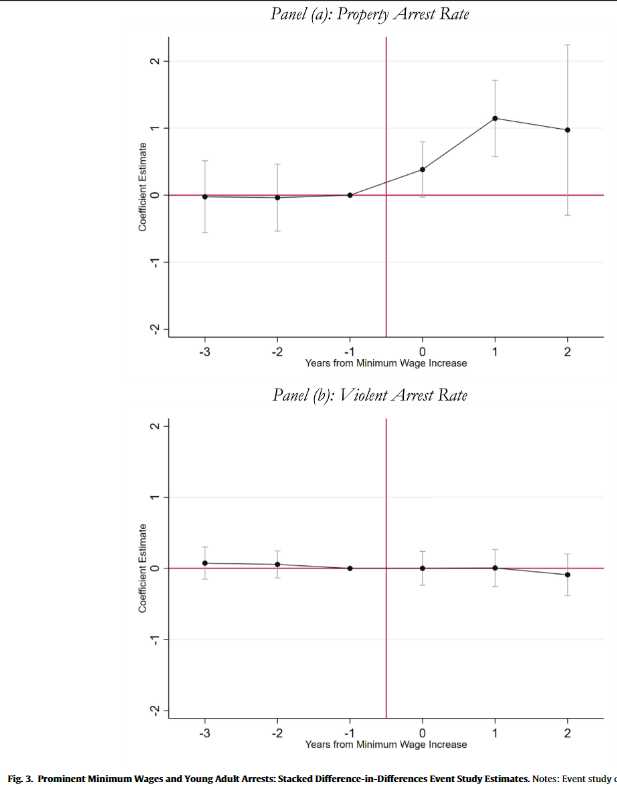
FSC find that property crime arrests increase for 16-24 year olds in an event study estimate, where an increase in the minimum wage of at least $1 serves as an “event”:

Property crime arrests in their diff-in-diff estimate reaffirm this estimate. They also, however, observe negative effects on property crime arrests on 35-49 year olds, though the coefficient is too noisy to be statistically significant. These results are similar to ours, though because we were looking at individual recidivism we had the benefit of estimating over ~6 million observations (vs the 45 thousand county-years of FSC).

When FSC dig into the crime categories further, there is no effect on burglary, robbery, or auto theft. The property crime effect is entirely in larceny. Let’s also note the positive effect of the minimum wage on vandalism.

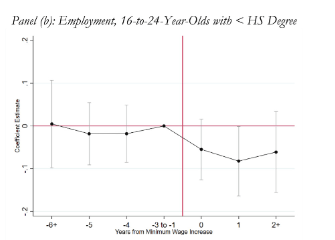
Here’s an important tidbit: UCR data does not distinguish between misdemeanor petty (petit) larceny and felony larceny. One last result: employment is noisily declining for 16-24 year-olds who have not yet completed high school.

Let’s add it all up: when a state increases the minimum wage by at least $1, we observe an increase in larceny and vandalism arrests of 16-24 year-olds, without any effect on robbery, burglary, auto theft, or violent crime, all while reducing the employment of 16-24 olds who have not yet completed high school. Can you see where I’m going with this?

Shoplifting. When states significantly increase the minimum wage, employers stop hiring teenagers. Those teenagers, laden with time but bereft of spending money, rediscover the allure of the five-finger discount. That is my interpretation of these results and nothing about these results seems strange to me or at odds with the earlier findings in our paper on the minimum wage and recidivism.

I don’t think the authors have really done anything wrong here. I could manufacture some of the usual gripes if I really wanted too, but the identification strategy seems at least broadly sound and the data is widely used. The estimated magnitudes seem plausible. If I was going to complain about anything, it would probably be the imputed $766 million dollar price tag placed on the externality, but I’m also not well-versed in the costs of shoplifting (and in case you’re reading something into my tone, I do not think shoplifting can be dismissed as unimportant). If I had to hang my hat on something, though, I’d say that’s probably on the hefty side. In footnote 48 they consider a a more conservative estimate of a $128 million dollar externality. That seems more plausible to me.

The minimum wage literature is one we all, every single one of us, bring our own political and economic baggage to. When our paper found that the minimum wage reduced criminal recidivism, a lot of people latched on to it because what they heard was “minimum wages stop crime”. I’m sure a lot of people will latch on to FSC’s new paper because they want to hear “minimum wages cause crime”. The reality, of course, is vastly more nuanced. We should expect these laws to have heterogeneous effects born of complex interactions, particularly when we stratify populations into those interacting with an institution as rife with peculiarities and pathologies as the US criminal justice system.

We are all piecemeal workers now

I think the single most under-considered development in labor economics has been the revolution in the real-time measurement of labor output over last decade (although there was an interesting article recently in AEJ: Applied looking at the shift in the late 70s from standardized to variable wages within firms). A lot of ink has been spilled agonizing over why “no one wants to work” in fast food establishments for $15-$20 an hour, without appreciation for how much those jobs have been transformed by operations monitoring and management. Simply put, there’s no hiding on the line anymore. You’re either producing or you’re not and everyoone knows. Now, whether subpar performance will quickly result in termination is unclear in such a tight labor market, but you can be sure that your inadequate productivity will be quantified and communicated to you. These numbers may create a feeling of shame or inadequacy, perhaps even sufficient to make you work harder, increasing the disutility of labor faster than your earnings increase. Your prospects for advancement or a pay increase will correlate directly with your measured productivity. The spread of such indignities, previously reserved for those working assembly lines, sales, or independent contract work, are not limited to fast food:

There have long been lines of work where work could be paid “piecemeal” i.e. paid per unit output. These jobs were typically limited to those where labor’s output was discrete, easily measured, and where quality could be distilled into sufficient/not sufficient categorization. Great for sewing textiles, bad for writing code or making gourmet food. When you’re working a piecemeal job you can be rewarded for high output, but it’s a double-edged sword. There’s no obscuring your contributions within the uncertainty of productivity or the efforts of others. It’s the difference between singing in a 50 person choir or playing golf. No one listening to that choir will ever know I can’t hit a note, even after dozens of performances. My fraudulence on a golf course is transparent after a single swing.

The revolution in labor measurement has all kinds of ramifications for the nature of work, management-labor relations, and the distribution of income.

1) Being watched is stressful, being measured doubly so.

2) Nobody likes being judged. Always being watched will only heighten labor skepticism and antagonism towards management.

3) Bigger rewards for higher producers can only increase income inequality even if wages rise for everyone

Better measurement could increase labor’s share of their marginal revenue product simply by reducing uncertainty and risk. This increased share, combined with greater productivity, could raise incomes for all laborers. Even under these assumptions, however, greater measurement is can still increase income inequality because it will likely reward the most productive workers more than the least.

It’s hard to usefully speculate on the exact mechanisms through which transitioning to piecemeal work affects labor. Perhaps it’s safer to just be grossly reductionist: increased monitoring and measurement of labor threaten’s every worker’s god-given right to do a half-assed job.

Worker’s, like all of us, are under-appreciated in the guile and sophistication they bring to bear when maximizing their utility. It’s not just where and when we work, it’s how we work. Some want to climb the ladder, some don’t. Some work to live, some live to work. Some jobs sustain us while we participate in high risk-reward labor tournaments in our side-hustles (music, art, indie game design, etc).

Doing a half-assed job is a tried and true strategy to living a great life if you have the tremendous fortune of living in a wealthy country. Employing half-assed workers, however, is a bit trickier and I suspect the rise in monitoring and measurement is a market response that reveals that the conflict between half-assed labor and management has never solved.

How will such conflicts be reconciled? My suspicion is that this will eventually come out as a mutually beneficial gain, on average, for all parties. Workers will be monitored and measured more tightly, which will make work less pleasant, but they will be paid more and work less. I suspect many of us would actually prefer to work 40% harder for half the hours and make double the pay. There will be people who lose in the transition, however. Every workplace has a slacker who floats from job to job, doing far less than the bare minimum, riding the wave of uncertainty that keeps their unemployment at least temporarily intact. For many occupations that strategy will cease to be viable. I’d feel bad for them…but I don’t. Maybe that makes me a grumpy old man, but if if anyone was taking bets I’d put a lot of money down that for the last 50 years it’s been mostly white men riding off the labor of others…and it’s been mostly the over-contribution of women to marginal output that has subsidized their quarter-assed counterparts.

The days of management trying to increase productivity by exhorting motivational platitudes while dangling the carrot of advancement while pretending to know who deserves credit are over. We know who’s doing the work. Which means that even if you are still formally receiving a salary, your salary will so tightly hew to your productivity that it will effectively be a piece rate. That also means, by the way, that management has no excuses anymore, either. You know who’s getting the work done. The same forces undermining a half-assed labor strategy will hopefully continue to undermine casual cronyism and discrimination as well.

But don’t worry, humans are clever. We’ll game each new system along the way. You’ll never find a more whole-assed effort than someone trying to figure out how to half-ass their job.

The Eagles are going to win*

I like Patrick Maholmes and, all else equal, prefer the Kansas City fan base if for no other reason than they seem less interested in settting things on fire.

But alas, the Eagles are probably going to win because the value of quarterback play became so dominant that the incentives to innovate and invest in alternative strategies has finally resulted in an equilibrium where the opposing team is dominant in every other area of play. Which is a long-winded way of saying that annoying old people who rail on about line play, running the ball, and defense, who have been consistently wrong about everything for 20 years, finally get to have their moment in the sun and say “I told you so” and you, smart person who values your mental health, will simply smile and nod and not take the bait to argue with them further.

Or maybe Maholmes’s ankle is back to 70% and they win? Who knows? We’re talking about a sport that, 19 games deep, is almost entirely determined by the two interacting random probability generators: injuries and general luck.

Enjoy the excuse to socialize and eat junk food, which for many of us is 90% of the utility proposition in watching the game.

*probably