Who’s afraid of ranked choice voting?

Alaska had it’s first election with a new voting rule and Tom Cotton is pissed.

I want very badly to be snarky here and make fun of the Senator for being so nakedly Trumpian in an effort to discredit any democratic institution the instant it doesn’t produce exactly the result he prefers. Fun aside, snark at Senator’s expense misses the bigger and more important mechanisms that are in play. I think the current instantiation of the Republican party is afraid of ranked choice voting. The Senator, in his angry little tweet, only lends greater credence to the theory. More broadly, its often worth unpacking when incumbents get upset about legitimate institutions, particularly when that anger is asymmetric across parties and coalitions.

What is ranked choice voting?

Quickly, ranked choice voting is any system where voters are asked to rank some number of candidates, n, from 1st to nth. Those rankings are then used to implement a runoff system, where a winner isn’t declared until a candidate he or she has a majority of the top choice votes. If someone has 50% of the first place votes, they win and it is effectively no different that a standard plurality system (i.e the standard system in most US elections). If no one has >50% of the first place votes, then the candidate with the fewest first place votes is eliminated and all of their votes are then divvied up amongst the candidates based on those voters’ 2nd choices. The process then iterates, tallying up the votes, eliminating the last place candidates, and allocating votes from the eliminated candidates based on their 2nd, 3rd, etc choice preferences. The election isn’t called until someone has greater than 50% of the counted votes.

It’s not a point system, like a Borda count, so it doesn’t grant a specific weight to being a 2nd or 3rd choice, so the balance of outcomes is still heavily tilted towards a voter’s top choice candidate. It’s not explicitly an approval system, though voters are under no obligation to rank all of the candidates i.e. if you only want to choose a 1st and 2nd choice out of 10 candidates, that is fine. What the system is explicitly designed to do is reduce the impact of large numbers of candidates splitting the electorate so thinly as to increase electoral noise while also reducing the impact of otherwise irrelevant candidates. It’s not a perfect system (nothing is), and it certainly doesn’t magically nullify the irrefutable math of Arrow’s impposibility theorem. It’s just another way of counting votes, and one that is in no way controversial or even especially complicated compared to the variety of voting rules used in established democracies around the world.

So why the fuss?

Political fragility

Overspecialization is an ecological trap, just ask the koala. Sure, it’s great if you can digest and subsist off of a food source that no one else can, that sounds like a swell way to avoice resource competition. But if you overspecialize in that food such that you can no longer live off anything else, well, then you aren’t likely to survive any meaningful shift in you environmental context. What someone like Nicolas Taleb extolls the virtues of anti-fragility, a lot of what he is talking about is akin to adaptability to and tolerance for unforecastable events.

At the moment, if we can put aside policy positions entirely for a moment, there is an argument to be made that the Republican party is looking incredibly fragile. A sequence of events, some slow progressions over the last 20 years, others shocking events of the last 20 months, have left the Republicans looking highly specialized. Senator Cotton’s response to the outcome in Alaska leads me to wonder if they are electorally specialized to succeed in a context that doesn’t exactly exist anymore.

When I think of the Republican coalition and electoral base, what stands out in sharpest relief is:

  1. The urban-rural divide
  2. Single-issue voters, predominantly regarding abortion and firearms
  3. Trump

The urban-rural divide, specifically the overwhelming dominance of Republicans in rural settings, is the fulcrum upon which Republicans leverage their advantage through gerrymandered district maps. By cracking and packing districts, they’ve ceded a large number of landslide urban districts to Democrats for the express purpose of leaving them thinner elsewhere. The catch with gerrymandering as a minority party in the broader population, though, is that if you get greedy you can go grow accustomed to lots of predictable, but nonetheless narrow victories. Narrow victores, no matter how previously safe and easy to forecast, do not grant a lot of leeway for absorbing electoral shifts. Like, for example, significant numbers of educated urban voters moving to medium-sized cities in red and purple states.

Abolishing abortion has long been a rally cry to turn out voters, and seemingly a pretty good one at that. While pro-choice voters may be just as passionate, protecting the status quo has rarely the same draw as tearing down a cruel and unjust system. Voters may have remained the same, but the status quo has changed and, with it, the prospects for drawing voters to the polls.

Bizarre as it would have seemed to say this 10 years ago, Trump is a bonafide cult of personality. His people love him and he has as much influence with at least half the Republican party as anyone since Reagan, and probably more than even he did. I wouldn’t have said this 10 months ago, but there is a very real chance that he is going to prison. Even if he doesn’t, though, the investigation and trials are unlikely to put Republicans in a positive light with moderate and independent voters, and without the office of the presidency, Trump lacks the same power to shape the narrative that he previously enjoyed.

Actually, let’s revisit the Trump as Republican icon for a quick moment.

One of Seventeen

In the aftermath of Trump’s surprising win of the Republican presidential nomination in 2016, there was floated the possibility that Trump was a Condorcet loser. That is to say, in a head to head election he would have lost to every other major candidate. A retrospective analysis challenged this idea, suggesting that Trump had far broader support in the party than just a loyal and dedicated minority, but I’m not sure how much of that is a product of post hoc endogeneity.

What is not argued is that the 2016 Republican primary still had a lot of candidates late in the game. Seventeen candidates qualified for the first debate. By the fifth debate there were still 13 candidates sufficiently viable to claim a spot on stage. Even if we can’t perfectly adjudicate who Trump would or would not have beaten head to head, the outcome of the eventual election was highly sensitive to the voting rule given the sheer number of candidates. If the primary had been subject to anything other than standard plurality rule voting, it is highly possible, if not probable, that a different winner would have emerged.

The thing about a polarizing candidate is that you are that much less likely to be anyone’s second choice. Under a plurality system you rely on the people who love you, attack the ones that hate you, and comfortably ignore the rest. But some voting rules increase the cost of those you ignore.

About that Alaska Primary

Did I mention that Alaska didn’t just change the voting system for the general election? They had an open primary (meaning candidates from any party competed to be one of the final four candidates). Through a simple plurality rule election, everyone voted for their favorite candidate and the top 4 advanced to the general election where the ranked choice rule was employed.

What would have happened if such a rule were applied in the Republican primary of 2016? What would happen if such a rule were applied across the country where

  1. Roe vs Wade has been overturned
  2. Trump may very well be going to prison.
  3. A lot of people are moving from big blue cities to low housing costs and adequate amenties of medium size cities in purple states

A Democrat hadn’t won a statewide election in Alaska since 2008. Less than a week ago they did it in an election against a former Alaskan governor and Republican vice presidential nominee who’s been on Saturday Night Live. In the second round of vote counting, the eventual Democratic winner received 29% of the votes redistributed from the Republican who finished in 3rd place. There are, it seems, a lot of Republicans who preferred a Republican to a Democrat, but nonetheless preferred a Democrat to Sarah Palin.

Cotton is right. Republicans should be freaked out

I don’t expect ranked choice voting to sweep the nation (though I do think it is better than a standard plurality rule). But I think it is one more sign that Republicans have become overspecialized as a party and are not well-suited to adapt to changing political landscapes. Big things, like Roe being overturned, happen. The public can turn on any celebrity, including your party’s talisman. Rural voters might still mathematically individually be weighted more in the broad political calculus (cough Senate cough), but there’s still the problem that fewer voters live there, which means it only takes a small percent of the population moving to break your map. And what happens when the baby boomers don’t dominate electoral math anymore?

No, the Republican’s aren’t doomed to irrelevance. Yes, they will adapt and rebrand…eventually. But the reality is that there is no greater sign that a party is forecasting electoral difficulty for themselves than declarations that the system is rigged against them, regardless of whether they are railing against fictional corruption or actual institutions that really do work against them. In both cases, however, they are signaling the same thing: we’re in trouble. The Republican strategy of recent decades has been to terrify and pander to the base, attack and ignore the rest. And it’s worked. Ranked choice voting is a threat to that strategy because it increases the cost of attacking and ignoring voters outside of your base.

Maybe that alone is a sufficient argument for ranked choice voting – it increases the cost of attacking people outside of your political base. Given the evidence of political polarization and associated social fracturing, anything that shifts the balance of political incentives from outgroup antipathy to big-tent inclusion is proabably a good thing for all of us in the long run.


Papers I’ve been reading

In no particular order:

Moonshot: Public R&D and Growth by Shawn Kantor and Alexander Whalley. Whether its going to the moon or vaccinating a country, government spending sure seems to have a much better impact when there is a big, bright, and highly-specific outcome target.

The Economic Consequences of Being Denied an Abortion by Sarah Miller, Laura Wherry, and Diana Greene Foster. Being denied an abortion leads to significant financial distress.

Preferences for Firearms and Their Implications for Regulation by Sarah Moshary, Bradley Shapiro, and Sara Drango. Different types of guns serve as strong substitutes for each other, which will likely temper any regulatory effects from limiting one or more specific strata of firearms. As with any regulation, narrowly identifying what it is you want and expect from the policy remains the key to making an evidence-based argument for it.

A panel-based proxy for gun prevalence in US and Mexico by Daniel Cerquiera, Danilo Coelho, John Donohue, Marcelo Fernandes, and Jony Pinto Junior. Using “percent of suicides committed with a firearm” remains a the best proxy for firearms. Regional variation across the US remains exactly what you’d expect in the US. Is the same true of Mexico?

BONUS PAPER. From twitter this morning:

How Much Should We Trust the Dictator’s GDP Growth Estimates? by Luis Martinez

I’d seen this before, but I think about all the time. We don’t give nearly enough time consideration ro the endogeneity of results to the incentives behind data creation/recording anywhere, let alone autocratic countries. I get why – it invites the dismissal of any data inconvenient to your status quo thinking, but ignoring it completely is foolish.

Don’t just be an input, be an investment

As we sit here with both historically low unemployment, but also a labor force participation rate that hasn’t yet recovered from covid, I expect that we will start to see workers lured back not just with the prospect of high wages, but the prospect of re-tracking their careers. I expect to see a bump in field and industry switching, as well an interest in educatonal programs that might enable such a switch. Since we’ve already wrung our hands over the fields (teaching, nursing, etc) that are mired in labor shortages, we should start thinking more about the opportunity to re-track their careers that workers are grabbing with both hands. And with that, I’d like to give my one piece of universal career and education advice: be an investment, not just an input, and never customer.

This works in a lot of ways. First, and this isn’t trivial, it will keep you out of scams and traps. They want to hire you, but you have buy $300 worth of training videos? Scam. You can start immediately, but you have to buy your sales stock from the partner who recruited you? Ponzi scam and trap. You’re admitted to the professional degree program, but you can’t find any evidence that recent placements are earning at least double the tuition immediately after graduating? Trap. Your incoming cohort seems wildly underprepared given your expectations for the program? Sorry to be the bearer of bad news, but you’re not there to bring presige to the school with your subsequent exploits. You’re there to write checks and wait for your degree in the mail. You’re not an employee or a protege, you’re not even a product. You’re a customer and, I promise, you’re not getting your money’s worth.

Avoiding drains on your wealth isn’t sufficient, of course. You’re trying to pay your bills and hopefully build a career. Well, if you wank into an office filled with uniform, impersonal and undecorated cubicles filled with nothing but recent graduates and temps, you should be on immediate alert. Decent chance you haven’t stepped on the first rung of a corporate ladder – you’re entered a mill that does the grunt work for the people actually on the ladder. Your job, on the other hand, will be to execute monotonous tasks until boredom or a loose labor market pushes you out the door, while a rotation of temps ensures that your exit proves esssentially unnoticeable for your employer. You’re not an team member, you’re barely an employee. You’re a commodified cog, one that they expect to wear out before any improvement in your capacities or value could possibly pay off.

What you want to be is an investment. Whether it’s school or an entry-level job, the most important thing to find is firm/school that has a stake in your long-term success, incentive to invest in your human capital, and a structure within which this investment can in you can reliably flourish. Easily advised, harder to pull off, especially as a job applicant on the outside. There are, however, signs and signals to look for.

A mixture of employee ages is a good sign that people are sticking around because they see a payoff to long-term employment. While a program of temp-to-hire can actually be a great sign, a constant rotation of temps to backfill in a perpetual exodus is a huge red flag. Training and education reimbursement programs? Great sign, doubly so if they come with built-in time off. It might seem counter-intuitive, but I consider it a better sign if the company requires continued post-training employment i.e. you have stick around for at least x years or pay the company back for the training. It might seem like a limitation on your career, but it’s also a really good sign that your employer anticipates significant value in the labor market for your training. They’re not just looking for good PR, they’re looking to protect their investment in you.

Training and education are great, but the absolute best signal that your employer views you as an investment remains dedicated mentorship. If your senior leadership is investing time and energy to prepare you for the next round, great. What you really want, however, is leadership investing in you to eventually replace them. Why is that such a positive signal? Because it means that they don’t see training you as a threat because they’re going to keep moving up too! It means that the firm invests in their employees up and down the ladder, and everyone is anticipating the continuedf acquistion of skills and progression in their careers. If, on the other hand, every bit of process knowledge is a secret fiefdom, every scrap of credit jealously fought over? That’s a sign of employees that feel stuck, desperate only to find an exit while clinging to job security like under-paying driftwood in a storm.

If you’re going to grad school for a doctorate, it’s easy to assess whether you’re an investment or a customer.

  1. Are they paying you or are you paying them?
  2. Is there a defined pattern of how people are trained, granted a degree, and eventually placed within the job market?
  3. Is the program transparent about their students first job placements?

If you’re picking a PhD program, you should obviously go work with professors whose research excites you, but always on the understanding that they view you as an investment. Sure, they’ll get cheap labor our of you with regard to research and teaching assistance, but even those should be investments in your skill sets and experience. At the end of the day, good departments are eager, bordering on desperate, to brag about their former students. They are willing to pay you to go to school there because you will become a valued and hard-to-duplicate input in their research in the short run and a labor market star that further contributes to their own prestige in the long run.

Whatever step you are taking next in your career, especially if you are making a big sweeping change, make sure to find people who’s interests are aligned with investing in you, not just plugging you into their machine or selling you something. Remember, labor is an input, but that doesn’t mean you have to be an easily replaced and interchangeable commodity. Everybody wins if you become more valuable. Make sure you work and study somewhere smart enough to know that.

Six months working a Waffle House griddle and other irreplicable labor market signals

Rather than wade into the long running argument about how much of the value of education is in acquired skills versus the ability to signal ability or aptitude, let’s take a moment to appreciate the majesty of signaling in the wild. I hold the view that education has value far in excess of simply demonstrating to others that you can execute four years of tasks in a structured environment sufficient to warrant a degree. Make no mistake, however, I also firmly believe the labor market is constantly on the lookout for signals of high productivity employees that are entirely orthogonal to education and often values them more than most forms of broad training. To be honest, part of the reason I believe that education must have some training value is that the wage premium remains enormous, but the signal itself is actually kinda, well, generic. Sure, different degrees have different signals (i.e. did you dodge calculus?), but the fact remains that you really don’t learn all that much about a person from their simply having a degree.

If they worked the griddle at a Waffle House for a year? Now that’s a signal.

Perfectly summarized by icookfood42

I’ll tell you straight up – I’d take a faculty job candidate with a PhD from State U and 12 months of Waffle House on their CV over someone who got an Ivy League PhD straight out of undergrad. And not just accept, I’d push hard for them. That person has seen. some. ahem, stuff, and they came out the other side a person that then went and finished their doctorate? That’s the stuff co-authoring dreams are built on.

There are plenty of attributes that certain lines of work leverage. Grit. Attention to detail. Follow through. Resilience. Calm. Creativity. Cleverness. Reliability. I could go on for a 100 more at least, but at some point it just becomes a thesaurus for “awesome person who can accomplish tasks and handle challenges that are hard to define in advance”. And those kinds of things are difficult to ascertain without a) observing them first hand over an extended period of time, or b) those attributes being vouched for by someone whom you trust implicitly, neither of which are options for the typically hiring process, unless you’re “hiring” a 10-time All Star that was once coached by the person who took a knife for you in 5th period study hall 20 years ago.

There are some occupations and life experiences, however, like an extended run paying your bills scattering and smothering the world’s best hash browns, that do manage to signal those incredibly valuable, but hard to credibly observe attributes with at least some degree of reliability. Here’s a few that come to my mind:

  1. Restaurant. Back of House and Front of House are very different signals. Bonus points for BOH in a short order or quick serve setting, you’re basically getting a soldier without a specialization in violence. Any generic FOH experience, short of selling ice cream at a posh beach, is at least useful for stepping out of social bubbles.
  2. Military, especially if they fulfilled their duty, but chose to change careers. This is a person who not only follows through, but can make independent decisions. Immune to sunk cost fallacies.
  3. Flight Attendant. They are emotionally bulletproof.
  4. Hotel. Problem solvers.
  5. Peace Corps or missionary work. Committed and make good on promises.
  6. Delivery (i.e. UPS or FedEx). Big tasks don’t overwhelm them.
  7. Independent Record Label/Zine distributor/Band promoter Utterly unfazed by high risk endeavors, get lots of intrinsic value out of their own labor

Before I wrap up, let me tack on a few specific summer jobs that have signal value to me. I’ve never met anyone who worked construction as a summer job who wasn’t tireless and reliable. Everyone I ever knew who worked at a movie theatre is funny and interesting, though usually a bit introverted. Kids with paper routes grow up to be independent adults. Screenwriters and novelists who never got a foot in the door make good industry creatives. Anyone who’s done an open mic comedy night more than once is probably a good teacher.

What about you? Are there jobs on a resume that let you know something important about a person that you couldn’t learn any other way?

The underrated genius of great athletes

I’ve been a sports fan for as long as I can remember, but there are a handful of athletes I’ve manage to form deep admiration for despite never having the opportunity to watch them while they were still actively playing. The two at the very top are Bill Russell (basketball) and Johan Cruyff (soccer). Russell passed away last week at the age of 88. He was an important man whose deep committment to the Civil Rights Movement we are still growing in appreciation of, but I want to talk about his genius.

I mean genius in a far more literal sense than what we typically mean when referring to brilliant athletes or (ugh) “sports IQ”. What Bill Russell did on the basketball court was no less genius than what might be admired in chess or physics. I really believe that. There are a handful of team sports (basketball, soccer, hockey, etc) where the game involves enough independent agents interacting that real-time prediction elevates to a level of complexity that success within the game demands that a player either

  1. Dominate through one or more overwhelming attributes
  2. Wait for randomness to grant you an opportuntity to contribute
  3. Forecast events to maximally pursue opportunities to succeed

A teenager playing basketball with younger, smaller children can dominate absent any particular insight into the game. Similarly, someone who has practiced shooting 15 foot jumpshots or knows how to skate can contribute to a game simply by repeatedly going to a handful of positions and waiting for the game to presnt an opportunity. Neither, however, is remotely sufficient to come within a mile of sports played at the highest amateur levels, let alone sports played professionally. The very greatest athletes in professional sports come to dominate their respective games through their possession of both overwhelming attributes (both natural and acquired) and genius for pattern-recognition and real-time, within-game forecasting. We spend far too much time goggling over former and, in doing so, subtly denigrating the brilliance of the latter.

Bill Russell saw the patterns at play within a basketball game. When he played defense he knew where the ball was going, what the relevant player’s options would be, and how he could not only deny them the chance to score, but to deny them in a specific manner that would lead to his own team scoring in the subsequent transition. When Johan Cruyff played soccer, he could make as many as 6 or 7 consequent moves into open spaces, each creating different options for his teammates that would eventually lead to a goal scoring opportunity emergent from the series of micro-interactions created by the space and gravity of his own actions. These moments were neither clairovoyance or instinct. Their dominance was a product of intelligence in the purest sense.

Stop calling it “Sports IQ”

Instead of saying Lebron or Sidney Crosby is a genius, people instead often remark that they have a high basketball or hockey IQ. It drives me crazy. Don’t get me wrong, I’m glad we’ve evolved from saying someone has great sport-specific “instincts”, which imply they are not even intellect-adjacent, but I don’t think we even need the sports-genre qualifiers. No one ever talks about a chemist or economist having field-specific intelligence, we just say they’re smart. You watch any fast-moving sport played at the highest level for a couple years, and you will come to appreciate that players are accomplishing feats of analysis under duress that are nothing short of incredible intellectual feats.

Funny enough, I think one of the contributors to our growing appreciation of the intellectual side of sports is video games. We knew chess players were really smart, but when we started programming computers to analyze millions of moves per second and it still took years for them to consistently beat the best humans, it probably raised our esteem for what chess players had achieved at the highest level.

Similarly, there is something about playing a game and controlling multiple players, transforming a team into a perfect hive mind of coordination granted by the top-down omniscience of their controlling deity that you appreciate what how perfect play might look. You participate in simulated perfection only to then subject yourself to the humbling limits of reality. Suddenly you are constrained by the information limitatons of a first-person view within the chaos of separate minds, moving at top speed (possibly on ice), while being hunted by an aggressive opposition (sometimes carrying lumber). And then it dawns on you that professionals produce an order within this caucophy of sweaty chaos that is only otherwise observable in a video game.

There are no doubt a host of reasons for this bias against crediting athletes with genius. First, racism. Nothing much more to say there other than, yeah, just straight-up racism and the penchant within sports commentary to de-intellectualize sports with the ascendancy of Black athletes in the 20th century.

Racism aside, I think there is also a particular bias against genius when it manifests in something hyper-specialized, particularly when the screening mechanisms are so intense that most of what gets observed is at the one in a million level (i.e. the 99.9999th percentile). At the highest level, professional sports are executed in a manner almost unrecognizable to how most observers might themselves have played or even observed first-hand, to the point of becoming unfamiliar, alien, and most importantly, unachievable. If something is intellectually unachievable, that may lower the relative estimation and status of the observer’s own intelligence. If, instead, what the athlete is demonstrating an innate proficiency for the specific physical task at hand, that’s just random, an anomaly made only relevant because of the peculiar game they play.

I’ll close with a manifestation of intelligence in sports that isn’t based in pattern-recognition or external complexity, but rather internal complexity. Simone Biles, in case you are not aware, is the greatest gymnast in history. To deny her standing in history is your prerogative, but even as a non-expert in gymnastics, allow me to assure you that you would be wrong. A moment that stuck with me in revealing her brilliance, ironically, was when she pulled herself from the previous Olympics. During the floor exercises and vault, Biles creates speed, vertical lift, shape, and multiple dimensions of body rotation. To organize a singular force diagram of her a physicist would require significant computational assistance or a whole bunch of math. Not only does Biles do this, she does it while her body is running, jumping, and rotating. She essentially tracks the problem in real time. What was amazing is that in the recent Olympics, still competing at an age considered well post-prime for gymnastics, she understood that she was not managing the physics problem with the reliablitiy and accuracy sufficient to perform her own routine. Could she have managed a set of simpler routines? Probably, but simpler ones had never been practiced. She confronted a dilemma: she had practiced routines that up until that moment no one else in the world could do but her, only now even she could not do them without presenting significant danger to herself and, in turn, no real help to her team. So what did she do on global television?

She withdrew from the Olympics. Which might be the single greatest moment of self-possession I’ve ever seen from an athlete. That probably counts as emotional intelligence, but I don’t actually know how that works and is a different post anyway.

There is real genius in professional sports. It’s time we started crediting them for it.

Converting office space and why second-best solutions are what move the world forward

Subscribing to the “Housing Theory of Everything” is to confront the fact that a problem can 1) be important, 2) effect (nearly) everyone, 3) have an obvious and welfare improving policy solution, and 4) still be politically stuck. Whether it’s classic prisoner’s dilemmas or a more subtle transitional gains traps, the reality is that building housing has proven incredibly difficult because there is a group whose wealth is overly concentrated in the stock of housing they own (i.e. nearly every homeowner in the US) and who have every incentive to fight to prevent new housing from being built because restricting housing supply increase the value of their propterty.

That’s it. That’s the whole story, everything else is bookkeeping and tactical anecdotes. So how do we solve this problem? One way is to motivate large swaths of voters to push for reform, but there’s only the entire body of political theory and history telling you that’s easier said than done when the opposition is concentrated and organized.

The thing is, building more housing is the “first best” solution- it’s not the only solution. Should we increase the housing stock, lower prices, make the average person wealthier and more economically secure, reduce homelessness, and spend all of eternity celebrating the victory of common sense in the halls of Valhalla? Yes, of course. But that “first best” solution isn’t available in a lot of places (see the previous two paragraphs). Besides beating our heads against the wall in the hopes of victory one spoonful of brick at a time, what else can we do? We can go looking for second-best solutions, particularly ones where the political opposition is softer and less organized.

Converting office space to residential housing is a near Platonic-ideal second best solution. Why? Because it produces more housing, albeit with the costs of conversion and likely subperfect design. What makes it a dream second-best solution for our dilemma, however, is all of the opposition mechanisms it dodges:

  1. There’s nothing remotely historic about most of these buildings.
  2. The are structured in such a way that lend themselve to high-density housing (i.e. apartment and condo towers).
  3. They’re predominantly in relatively dense urban and edge-city areas.
  4. Whatever views or skylines they are obstructing are already obstructed!
  5. There’s a built in interest group to push for the conversion (i.e. the building owners).
  6. There’s no pre-existing tenant or tenants who’s losses can be highlighted at the expense of everyone else’s gain.

First and second best categorization are always a little squishy because they depend on what you include in the costs and benefits. Building new housing from scratch might seem obviously the best possible outcome, but once you factor in the political costs of zoning and approval, there’s going to be a lot of locales where building conversion is the far lower cost option. I’m very much team “work from home” and this is just one more reason you should join our merry band of robe and slipper-types. Hollow out the offices, convert the buildings to housing, and watch the urban landscape transform from gray and glass offices to a utopia of urban singles skipping from brunch to brunch until their kids are born and their metabolisms slows down.

Now, to be clear, there is no political free lunch here. There will still be costly and difficult re-zoning obstacles in lots of places. Plenty of these building will need to be brought up to code. The locations may not be ideal relative to schools. But those costs and concerns are trifles when considered in the context that the median income in half of US cities is insufficient to rent a two bedroom apartment for less than 30% of gross income.

Democracy is messy and there’s no changing that. While it makes for bad sloganeering and will never insulate you from getting slagged on twitter, the reality is that second best solutions are what move peaceful societies forward. We have a lot of coalitions to keep happy, they all want something for themselves, and nothing is free. We have to work with what we got.

And what we got is a bunch of office buildings that nobody wants to work in anymore. Let’s live in them!

…and then work from home in them? In what used to be the offices we didn’t want to work in?

Yes.

How many of our problems come from captured land value?

I can’t shake the idea that captured land value serves as the origin, or at least accelerant, of a great deal of the problems in the United States. What if the YIMBY vs NIMBY fight is just the most visable element of the core economic disease in America? A heads up, if you’re expected a deeply researched 5,000 word post that will YIMBY “pill” your most skeptical colleague, make your peace with disappointment now. But if you’re into policy failures and run-on sentences, you’re in for a good time.

I just can’t get over how often the examination of seemingly every subpar economic context (not immediately attributable to a pandemic or war) comes down to people X are geographically constrained, they need to be proximate to a specific physical location to produce or consume Y, and a huge amount of the economic surplus that would be created from any sort of exchange is captured by land/property owners because legal constraints on development have made the physical place in which an exchange happens THE short side of nearly every market that is pointed to as a failing institution.

Seriously, go through the list of everything that leaves critics of markets ready to burn capitalism (and its fostering society) to the ground. Wages are too low relative to rent. Rent is too high in the places that are near the jobs I want. Public schools aren’t good enough unless you’re willing to carry a mortage that would account for 70% of your take-home pay. Healthcare…eh, maybe not healthcare. Healthcare is crappy for its own bespoke and byzantine set of reasons.

I am a person with no shortage of bodily ailments because I chose to play lots of sports despite never being especially good at them. As a result, I am an avid consumer of physical therapy and therapeutic massage. I have had many conversations about the economics of these fields, and I am now 100% certain that the key to making a career at either, given a minimal level of competence, is not how good you are at your job, but your capacity and good fortune in solving your real estate problem. The entire Massage Envy empire appears to exist not based on greater competence in technique, training, or personnel. It exists solely to extract rents from employees because scale lets them solve the real estate problem (and probably pool liability risk, too). The single biggest thing an individual professional can do to increase their yearly income is not win an award for Therapist of the Year or get 5 stars on Yelp. It’s buying a house with a room they can use as a home office, where they can pay “rent” to themselves and take a tax deduction for the office.

I was once told a likely apocryphal story (that I can’t find on the internet, so it’s probably not true) that the then CEO of Starbucks declared “We make coffee, but we’re in the real estate business.” That their business had matured to the point where revenues could be projected with sufficient accuracy that the profitability had been reduced to identifying opportunities in the real estate market. I don’t know if that ever happened, but that still seems about right to me.

Housing costs hold a special place in how we view our own economic status and security going forward, in part because food costs have been reliably low for so long (knocks on all of the wood). When the rent goes up we feel worse off, not just because we have less disposable income today, but because it increases our expectations for future rent increases as well. We have lots of words for economic insecurity and desperation, but nothing quite makes your blood run cold like the prospect of being homeless, even for the briefest moment.

The phrase “paying your nut” is a lot less common these days. You usually only hear it from self-employed people who live off of a la carte incomes, either in entertainment, freelance, or contracting work. It refers to the minimum amount you have to earn in a month to avoid significant consequences, usually the aggregate of rent/mortgage, utilities, and debt payments. Economists talk about “nominal” and “real” incomes to account for the changes in prices people face. Sometimes there is discussion of “money illusion” where people living under inflation are fooled by higher take-home pay into thinking they’ve become richer. I’ve never been persuaded that nearly anyone suffers from money illusion, nor do I think folks track national price indices and growth statistics.

I think people just know whether it’s easier or harder to pay their nut, and the simplest version of that is the ratio of their take home pay to their rent. Paycheck divided by rent, full stop. If you follow this blog or Jeremy on twitter, you’ll know that one of the puzzles frequently revisited is why Americans are so pessimistic about the economic dynamics of the last 20 to 30 years, and why younger people seem terribly aggrieved about their relative economic status.

So if generational income is fairly consistent and median home mortages account for a slightly declining fraction of median income, what gives? Well, it could all be one big economic mass hysteria, but I’ve got a simpler explanation: the ratio of rent to income to has skyrocketed in the places that young people want to live. Maybe I’m overprojecting my own lived experience, but when I was 25 I did not want to live in a rural area, the suburbs of a major city, or even the downtown of a minor city. I wanted to live in a proper big city. And for a young person, that means living in a small apartment, possibly with roommates, which is exactly the kind of housing places like California stopped building.

Why do so many young people seem pessimistic? Putting aside the absolute failure of politics to produce meaningful climate policy, the simplest explanation is that they have an unpleasant choice. They can live in the same places young people have always lived, only absent any possibility of savings and economic security. Or they can be dispersed from the cultural and economic capitals of our country, and try to build social networks without the benefits of the generational density, plethora of events, and dating markets that have been the hallmark of being a young person in the city since World War I (if not longer).

What will solve this? Policy? California has showed some glimmers of hope. Young people voting with their feet, moving to the shining middle-sized cities that are allowing for growth and affordable rents? Could be, but critical mass is real and growing into a proper metropolis takes decades. Work from home?

That’s interesting enough that I’ll write about it next week. I have thoughts and policy prescriptions, in case any major city is looking for a czar of housing policy (NB: I’m not qualified, but available).

Severance and the Disutility of Work

For those who were unaware, we are apparently a Severance blog now, a trend made all the better since nobody else is talking about the show anymore. Like all high concept fiction, the show can be consumed as a metaphor, in this case usually as a metaphor for modern office work. While I consume more than my share of metaphors, I usually find speculating about the “true” underlying metaphor driving a piece of storytelling to be more fun than useful. Instead, let’s talk about what the central conceit of the show actually is, namely a return to explicit slavery. Not almost slavery. Not wage slavery. Not “I’d rather be playing Minecraft on Twitch than making pivot tables in Excel ” slavery.

Actual slavery. The hook, through a clever bit of science fiction, is that it is slavery through a channel that allows a person to enslave the only person that we can imagine the world allowing to pass as anything but grossly criminal: themselves. The person you are enslaving to toil on your behalf happens to be a partitioned-off portion of your own consciousness (known as an “innie”) who continues to operate within a now shared bodily meat sack while your “outie” consciousness goes into a apparent blacked-out stasis. The innie does all the work, while the outie reaps (nearly all) all of the material rewards.

One take away is that there are people so desperate to not have to go to their jobs that they will carve off 8 hours a day out of their own claim to existence, a full third of their life, grant independent sentience to that third, and then enslave it. Putting aside the moral repugnance of such a decision for a second, one can’t help but ponder the preferences being revealed by an individual paying such a price.


Never trust a “unified theory” of damn near anything. It’s usually bullshit from the first moment, a cheap trick for gaining attention while grotesquely overreaching for importance in what is either a relatively mundane insight or a bit of intellectual sleight of hand designed to misdirect the reader from a deep underlying fallacy.

Anyway..


The price we’re willing to pay to not do something we don’t like often reveals more about ourselves than the prices we pay for the things we do like. The cost we’re willing to inflict on others reveals it all the more.

One of my little mental tricks when trying to understand human behavior that I can’t quite grok is to swap out a “utiliity maximizing” model for a “disutility minimizing” model. Trying to understand why a person would enslave a portion of themselves within the framework of “what are they maximizing?” lends itself to complex speculation on dimensions of their lives we can’t observe. Flipping it around, however, and asking what they are minimizing is immediately more intuitive. Without getting too deep into spoilers, there’s clearly a motive to minimize the disutility of work itself. Of toil, tedium, and drudgery. Of being told what to do and doing what you are told.

The hypothesis of Severance is that people will create an enslaved conscious person and explicitly deny the humanity of that person if, in doing so, they can minimize their own disutility of work. The corporation that creates these institutions in this fictional world will probably turn out to be either decadently evil in pursuit of pure profit or banally evil in pursuing some sort of yet unseen greater good. Even if they have rich and tragic back stories, the middle management that keep the plantation functioning are morally wretched individuals who have chosen to enable slavery to preserve their own status quo. The corporation, the managers, these are the bad guys. The heavys. The bullys who gain from the suffering of others.

But they’re not the monsters. The only monsters in the world of Severance are the individuals who made a choice to create and enslave another person solely so they themselves might enjoy a life without toil or tedium.

The cost that you are willing inflict on another in an effort to minimize your own discomfort reveals a lot about you. Whether you’re a socialist preaching “solidarity”, an economist who knows that Smithian “sympathy” is the glue of modern society, or just someone who thinks that it all comes down to coping with the prisoner’s dilemma, how a person values the suffering of others is a defining attribute.

Which brings me to a question I think only the creaters of Severance can answer. Is the conceit of their show to show that people will enslave a portion of themselves because they deny the humanity of their creation? Or is it that an office job is so abhorrent that opportunity to offload that burden to another while keeping the rewards for themselves overcomes any sympathy they might have for the other?

This show isn’t a metaphor. It’s a model. In this sense, Severance may be the most misanthropic hypothesis of humanity in the economically developed world I’ve ever observed. That humans, freed of the disutility of possible starvation or annihilation, will take any opportunity to minimize their own discomfort, even at the cost of a third of their lives and moral rot that comes with the enslavement and denied humanity of another. Somewhere, in the deep dark noughaty core of this piece of fiction is the consideration that, freed from our need for one another, our antipathy for discomfort will birth an idle, half-drunk decadence that will lead us to literally eat away at ourselves.

Or maybe the creators just all had office jobs while they were trying to make it in hollywood, and they really, really hated them.

Be Like Pete

Pete Buttigieg is the Secretary of Transportation in the Biden administration. He has made an interesting habit of going on Fox News and willingly submitting himself to what his interlocutors clearly anticipate to be difficult “gotcha” questions that will leave their liberal target squirming on camera. Secretary Buttigieg seems to always come out the clear winner and I think there is something to be learned from it.

The easy answer is that Buttigieg is smarter and more polished than the Fox News interviewers, which he is, but I think that’s easy to overrate. There is no shortage of smart people who wouldn’t fair half as well as the Secretary does. Part of it is his calm and poise, but credit should also go to just being nice. That niceness really puts people on the back foot. The secret sauce, in my estimation, is that he never for a second sounds like he is arguing. There’s no sense that he is interested in a back in forth. He never gives anyone an opening to raise their voice, to seem attacked.

But it’s not just being nice. The interviewer in the first clip quickly realizes that his question has failed to get the desired reaction, and subsequently tries to interrupt him at multiple points. The Secretrary simply ignores him and proceeds with his answer without missing a beat or raising his voice. He’s the G-d— Secretary of Transportation. He doesn’t have to be deferential to some teleprompter anchorman trying to raise points of political decorum and social norms with a member of the opposition party that has been given no quarter on their network for 20 years.

So how do you be like Pete?

  1. Be nice.
  2. Know your stuff.
  3. Never defer to anyone who isn’t nice and doesn’t know their stuff.

Being nice is inclusive of being polite, but there is more to it. It means being generous in the motives you assume in others, including those who are questioning or arguing with you. It means using tones of voice and choices of language that don’t imply you are dealing with an enemy or a fool, even when dealing with a foolish enemy.

Knowing your stuff means that you can explain choices and positions clearly and concisely in a manner than allows the people listening to you to actually learn something. Knowing you stuff, however, also confers on you the right to finish your thoughts. If others prefer your conversation be more akin to a verbal brawl, that’s their prerogative, but that doesn’t mean they get to dictate where your thoughts begin and end just because they’ve lost control of the outcome. Knowledge should confer some privleges, be them however limited.

And finally, being like Pete means never deferring to people who don’t want to play by the rules of basic civility and have nothing to contribute to the conversation. You’ve got a job to do and being nice will help you do it all the better. So be nice, until it’s time to not be nice.

The Third Act of American Prohibition

As you know, the Supreme Court overturned Roe v Wade, effectively giving states the ability to legislate the conditions, if any, under which abortion is legal. Many states had trigger laws in place, meaning that abortion became partially, mostly, or entirely illegal immediately. While some states already had laws in place protecting the right to an abortion, others are expected to pass new legislation restricting abortion access in the near term.

So, to summarize, there is a medical service for which there is significant demand. That demand, at the micro level of an individual consumer, comes with time pressure in a heightened emotional context. The supply of the service will vary geographically. Given the clustering of states that are prohibiting abortion in the south and midwest, there will be considerable heterogeneity in legal abortion access based almost entirely on physical distance and access to transportation.

Advocates for the banning of abortion are aware of this and have responded in some states by adding heavy punishments for aiding and abetting abortion access, some going as far as granting access to civil lawsuits or offering rewards for third-parties who tip off authorities to those who have received an abortion.

Prohibition of a good with strong demand, heterogeneous legal supply, and heavy punishments for those seeking to enable arbitrage across state lines. This is not a new story. First alcohol, then narcotics, now abortion. This might feel different because abortion is a service good, but it’s not. Why?

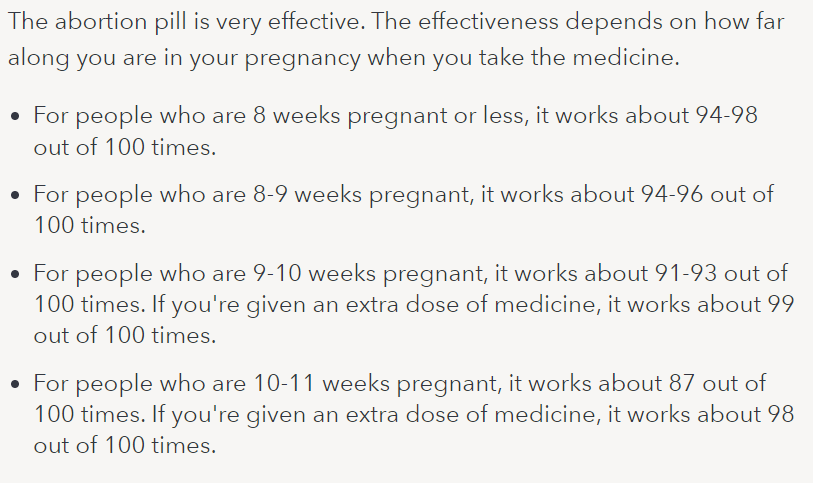
Because of mifepristone and misoprostol, often referred to as “The abortion pill”:

As it stands, a state cannot ban a drug with FDA approval, but access is nonetheless thin. There will also be, with similarly little doubt, efforts to quickly ban mifepristone and misoprostol, with accompanying heavy punishments. Eleven weeks is a long enough window that it will cover the majority of abortions. It’s small and portable, which means it will be easily transported and resold. It will also remain perfectly legal in a number of states bordering those prohibiting abortion. There will be, with nearly zero doubt, a booming black market in mifepristone and misoprostol within a matter of months.

But this isn’t a medical procedure provided in a fixed building with identifiable practitioners. These will be pills that will be exchanged in school bathrooms and college dorms, purchased by professional women who drove 300 miles in a Lexus and came back with enough to give to their professional friends who want to be proactive and prepared for daughters who may be sexually active. Further, these aren’t addictive products: there won’t be weekly customers whose symptoms will create patterns of consumption and the kinds of collateral damage that attract attention. Passive enforcement of these laws will be highly ineffective.

In some places, enforcement on pill restrictions will simply be weak, meaning anyone whose pregnancy can be terminated in the short run will retain some meaningful access. The price will be elevated like any good where suppliers incur legal risk, which means access to abortion will correlate heavily with income, resources, and social privilege. This will also shift the effective burden of abortion restrictions towards the later term “abortions” that only account for 1.3% of terminated pregnancies, but are more heavily associated with medical emergencies, incomplete miscarriages, and the kinds of pregnancy events associated with trauma and shame (e.g. rape or incest) where a women is not necessarily in a position to take decisive early action. Given that the majority of Americans averse to abortion are principally concerned with late term abortions, but also believe abortion should always be an option when the health of the mother is in jeopardy, it is expecially vexxing that laws that reduce access to early term abortions will increase the previously miniscule demand for late term abortions.


I expect some states will attempt to enforce prohibitions or limitations on mifepristone and misoprostol with a war-on-drugs like zeal. How do you heavily enforce a ban on a small pill that is easily hidden, not regularly used, legally manufactured in other states, and has a viable market with high income individuals? Experience tells us the answer is to dedicate lots of resources while carrying little regard for individual rights or public safety.

Marijuana legalization has spread rapidly across the country. District attorneys are increasingly uninterested in prosecuting minor possession charges of nearly any drug. In 1993 state and local governments spent $15.9 billion on the criminal justice of drug enforcement, $26 billion by 2003. Now it’s probably closer to $40 billion (I couldn’t easily find a good current estimate). That’s a lot of money. That’s a lot of jobs. That’s a lot of government jobs, with government job security, many of whom might be wondering what their job is actually going to be in five years. They needn’t worry. When one prohibition closes a door, a new one opens a window.

Local governments have been seizing property, charging fines and fees, and generally subsidizing their local tax bases on the back of the drug war for decades now. Cracking down on a new banned substance might not work for a variety of reasons already listed, but that doesn’t mean they won’t try, particularly if trying means getting a lot of political attention while hosting photo ops with seized contraband next to local police and publicly shaming perpetrators as unforgivable monsters.


Prohibition of alcohol failed in large part because it made nearly everyone a criminal. Alcohol appealed across every strata of American life. Most Americans had a hidden liquor cabinet, a favored speakeasy, or even a backyard still. That breadth and depth of demand brought tremendous profits to those who could supply it outside of the law and, eventually, tremendous violence from those eager to capture those profits.

Demand for abortion access, whether for discretionary reasons or medical necessity, appears randomly in lives, but those rolls of the dice are inclusive of nearly every woman and every family. With that breadth and depth of demand will come a black market. Possibly even a highly profitable market. Materially profitable for suppliers. Politically profitable for those legislating to suppress it. Budgetarily profitable for those working every day to destroy it. These prohibition rents will appear, they will be fought for, and they will sustain themselves through a process that will destroy lives. Mostly women.

The third act of American Prohibition is here and it will hurt us all. Mostly women.