Your happiness is why your sports team stopped being good

Equities are an excellent long-term investment in part because they offer nearly zero value outside their prospect to grow in value. Ownership of a share of a publicly traded firm exists as nothing more than byte in a digital ledger, asbsent any aesthetic or collectible value. In contrast, a beautiful painting or a bottle of whiskey offers consumption value. You can speculate on the future value of such assets, but the prospective consumption value will always be baked into the market equilibrium price. If you want to maximize the expected growth in the market value of your holdings, focus on investment assets that have near-zero consumption value. It is because of your sports team’s failure to invest solely in assets based on their value as inputs into the production of wins that they suck and should immediately fire everyone.

Yes, in years past your sports team used to be bad. They were bad for many reasons. They were poorly managed. Fewer resources were invested in your team. They existed in a less attractive city to live for prospective players and other employees. They were badly coached and never listented to you.

But then a miracle happened.

I can’t speak to the specific miracle(s) that happened to your team, but it likely includes one or more players undervalued by the market that came into your team’s employ only to subsequently reveal their true value through the quality of their play. They were outstanding and, in turn, your team started regularly winning at a rate previously considered unachievable. Supporters grew emotionally attached to their outstanding players. They hung banners, wore jerseys, gifted bobbleheads to wide-eyed children. Being a fan of your team began to pay emotional dividends that went beyond simply cheering for a winning team. It meant being a part of something emblematic of teamwork, a source of collective joy.

And that’s where it all began to go wrong.

Players are employees. They signed contracts reflecting their market value which was itself a collective estimation of their future output. Your team benefited from employing this underpriced input, freeing up resources otherwise constrained by either finances or a cartel…I mean league-mandated salary cap. Contracts aren’t forever, though, and those contracts are starting to run out. You beat the market once, but those assets are now properly valued. Furthermore, the uncertainty discount that applied before is long-gone, replaced by the premium that applies to a sure thing. Whether or not you can afford them, they will no longer offer any advantage, in terms of freed up resources, relative to any other player in the market.

But that’s not your biggest problem.

Your team’s biggest problem is you, the fan. You are emotionally attached to this cohort of players that brought you previously unknown levels of success. Success you’ve grown maybe just a bit accustomed to. Returning to past, lower, standards of quality, of winning, will not return you to your previous level of contentment. You’re gonna complain. Gripe. Call in. Tweet. Boo. You demand they retain these players you’re emotionally attached to so you might maintain the standards of winning you are entitled to.

We haven’t even gotten to the bad part yet.

There’s going to be a de facto auction for the players whose contracts are up. A bidding war. And in that bidding war the team that values them the most is going to get them. Which is obviously the team whose fans are desperate to retain their beloved heroes. Congratulations, you’re now a textbook example of the the winner’s curse. You’re going to win an auction already buoyed, not by the average value in the market but by the teams that have overestimated their future value. That certainty premium probably got a little too big because at least one poorly managed team doesn’t seem to appreciate that playing thousands of minutes of professional level sports takes a grinding toll on the body and that eventually leads to injuries at worst, athletic decline at best. But you’ve paid even more for these players than that the team that over-valued them the most because the team used to be so bad for so long and then they showed up and the team stopped being bad and you love them for it.

The rest of the market is evaluating them as inputs into the production of wins. You’re getting additional consumption value out of having their specific last names on your jerseys. Of seeing their faces and hearing their voices and remembering the good times. You’re getting the warm fuzzies of a good hang. And every dollar you pay for that hang is one less dollar to spend on other players. Other inputs into the production of wins.

So you need to ask yourself, next time you’re mad that your team isn’t good anymore, why are they bad? Is it bad luck? Limited resources? Poor management? Or is it because of you and your insistence on getting more out of supporting a sports team than just victories accumulated within a ledger that accounts for competitive success that you in no way contributed to?

Maybe your sports team is bad because you were part of a fanbase that wanted more than just wins. A fanbase that wanted to let the emotional investments they made in specific humans pay out for just a little bit longer. Your sports team is bad because you are rationally maximizing the emotional consumption value out of supporting them. It’s your fault and that is totally ok.

But if this goes on much longer they probably should fire everyone.

What happened to EconTwitter?

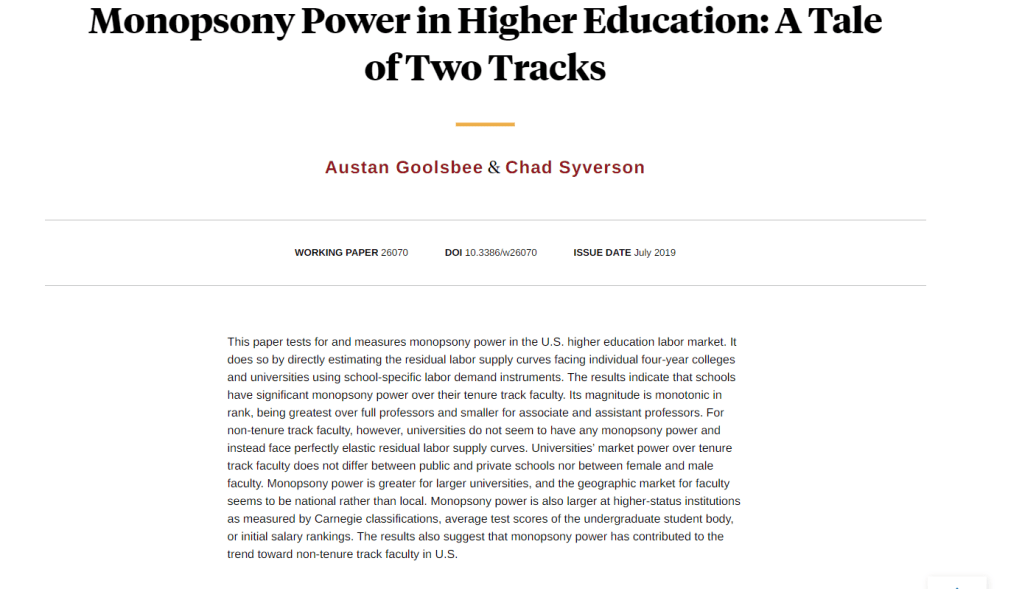
EconTwitter might be dead. Might be. Maybe. Regardless of it’s status, I thought it would be interesting to think about what EconTwitter was, what happened to it, and where (if anywhere) it might be going.

What was/is EconTwitter?

EconTwitter was a sub-network of (mostly) economists, policy professionals, and journalists that produced an unusually tidy amount of useful content and mutual support. The culture was largely positive, even amidst the occasional spats and political aggression. Research was promoted and discussed, expertise valued (especially in applied metrics), and policy ramifications argued over. The discourse was, by both the standards of Twitter and economics, broadly civil. Perhaps most importantly, voices often marginalized in more traditional academics institution attained prominence, most notably women and faculty in less famous institutions. Wit could carry you a long way, being helpful farther still.

What happened?

Elon happened is too simple of an answer, but it’s not a trivial component. I mean, Donald Trump used to have overwhelming gravity on the site, but EconTwitter persisted nonetheless. The negative impact of Elon Musk’s attempts to curtail criticism from journalists, failed changes to verification, and general ability to troll his way into being the main character of seemingly every Twitter sub-network all had negative effects on the discourse everywhere, but it seemed to hit EconTwitter particularly hard. Why? To get into this without careening off into a 6,000 word thinkpiece, let’s revisit the three sub-groups that make up the consituents of any collective action: privleged, intermediate, and latent members.

Privleged members are those who benefit so much from the public good being collectively produced that they would independently produce the good absent contribution from any other member types. For EconTwitter, you can imagine the 15-20 people with sufficient followings or fame that they can run profitable substacks or blogs, produce leading textbooks, or write a regular column for a major publication. These are the people with the most gravity on EconTwitter, who create the most within-cluster connections. Were any of us more than two degrees from Paul Krugman?

Privleged members could probably produce a club good that re-produces a lot of the EconTwitter discourse, but it would be unlikely to ever have the same reach outside of the academic and wonk bubble. The reach of EconTwitter only happened because of intermediate members, without whom the net benefit of the collective good meaningfully declines, but standard collective action obstacles would typically undermine the public good in question. These are the people who produced the research grist for EconTwitter mill, connected it to other clusters of journalists and policy influencers outside of the economist core, and consistently stirred the conversational pot.

Finally, there were the latent members, those whose contributions were negligible or even negative to the collective good. What EconTwitter seemed to be especially good at was keeping these people safely on the periphery, rarely taking the bait from trolls and “reply-guys”. There were a handful of economists who attracted thousands of followers from outside of EconTwitter simply by trolling and generally being a jerk, making wild accusations or throwing political wildfire seemingly at random, but EconTwitter was pretty good at rendering them irrelevant at best, annoying at worst.

So what happened? If we think of EconTwitter as a collective network good, the damage done to Twitter by Elon seemed to hit the intermediate members of EconTwitter especially hard. Journalists saw their peers attacked and became both less attached to the site and, when there, less concerned with content produced by non-journalists or less directly relevant to journalism as a protected enterprise. People promoting their newest research felt less urgency to take the conversation to Twitter. Perhaps most importantly, the urbane wits that ignited and maintained our conversations simply found less joy in holding a conversation on a platform being actively debased by it’s new owner. Less importantly, but perhaps non-trivially, those net-negative latent members became more prominent in threads, choking off conversations before they could get started. EconTwitter became less fun, a fact that left privleged member contributions largely unchanged, but dipped intermediate contributions sufficiently that the broader network good suffered to the point of flirting with a line it long ago surpassed: critical mass. It was worth taking time out of your day to curate a thread explaining your research or walk a stranger through the vagaries of standard error clustering because you knew there was an audience ready to both pay it back (by further sharing your work) and pay it forward (by helping the next person with a useful question).

The conversation slowed down just enough, combined with the usual holiday lull, that EconTwitter fell to the back of our minds. Some of the most frustrated tried to move to Mastodon, taking their contributions with them, pushing EconTwitter further below the critical mass threshold while simultanesouly producing nowhere near a criticial mass of discourse at Mastodon. Every day below the critical mass is another day of EconTwitter decay, making a revival that much harder save a massive shift in the platform.

What’s next?

I see a couple possibilities.

  1. Nothing. EconTwitter heals.
  2. Nothing. EconTwitter dies.
  3. Re-creation on a private, invite-only server run by the NBER or the AEA. I think this would be an enormous failure because the goods produced would be almost entirely redundant with the club goods already produced. Re-creating an exclusive club good in the current climate would also be fraught with a liability risk that these institutions would be wise to avoid.
  4. A moderated sub-Reddit or Discord. This would be potentially extremely useful, but success would come down to the quality and commitment of what would have to be nearly full-time moderators, otherwise risking being hijacked by the troll legions on the site-that-shall-not-be-named (no, I’m not going to link to it).
  5. A collaboration of previously privleged substack writers, bloggers, and columnists to start a Discord or Mastodon Server. This would do the most to recreate the economic discourse. It would be fabulous for metrics conversations and other technical concerns. It would be good for getting feedback on working papers. But could it ever have the same reach to policy influencers and the lay public?

It’s the last one I find most intriguing. That attempt to collectively create a mini-Twitter on Mastodon. The interface is clunkier, the server less reliable, a critical mass discouragingly far in the distance. And yet.

I can’t help but think that if we built it they would come. If a converstaion amongst academics and wonks were to start and persist for a couple years, then those beloved intermediate members, journalists, wonks, lay enthusiasts, meme geniuses, and, yes, even the joyful sh*tposters might find their way over. It sucks to have to start over, and maybe EconTwitter will recover, but if there is one thing I believe about society, it is this: once you’ve achieved proof of concept on a large-scale collective good, you should never give up on it, not matter how much water it’s taken on. These things are hard, but necessary for the broader social project. We made it work before, we can make it work begin.

You can find me on Mastodon at: https://econtwitter.net/@mikemakowsky I’m going to try to start contributing to the conversation there while not entirely abandoning Twitter quite yet.

(Thanks to Paul-Goldsmith Pinkham for administering the Mastodon server!)

Present your work earlier

I presented some new research three times in the last six weeks. There’s nothing new about that save the fact that we haven’t finished writing the paper. I can’t overstate how much I’ve learned about what our paper is and, more importantly, what it isn’t.

I can’t speak for you, fellow writer/scholar/waffle enthusiast, but I have a tendency to lose track of what we’ve actually, specifically, learned from the research in question when it comes time to present the research to the world. Instead, I get wrapped up in why we started the project in question. A haze of almost scholarly nostalgia can obscure the communicating of the contribution being made.

Often, for me, research is motivated by a discomfort I feel with how a question is being asked or answered in the literature, or often, not being asked at all. That sort of righteous indignation is great for fueling the sense of self-importance necessary for starting a 3-5 year research project, but it can be inhibitive to communicating the actual contribution produced by those years of work.

Sure there were the standard identification quibbles from audiences. And yes, I felt the groping reach of arms trying to pull me into their more narrowly siloed research areas. This isn’t labor, it’s IO. It’s not monopsony, it’s imperfect competition. Why don’t you talk more about policy? The history? That’s useful, it will help you refine your analysis and keep it up to date, but it’s not the kind of commentary that can fundamentally change how you write a paper.

What I’ve been able to observe, through these early presentations absent a draft, is the conversation the audience wants to have. Where there minds naturally take them without the structured guidance of a written draft. What our findings can and cannot convince them of.

What I’m learning isn’t how to convince them of the grand thesis that initially motivated the work. What I’m learning is the conversation our work can generate and, within that conversation how I can persuade them to take just a few steps down a path I want to see explored in the field going forward.

Present your work early. You’ll be amazed how much the audience can teach you about a paper you haven’t written yet.

Ideological overconfidence is a trojan horse for entitlement

I re-watched “The Big Lebowski”. I have watched this movie many times, but like all great films, you often find yourself appreciating new things with each re-watch. Usually these are simply small, but interesting details that simply slipped by your attention previously, but in this case it was a broad theme that smacked me in the face as if I stepped on a rake. The Dude is the Buddha.

Spoilers, both narrative and spiritual, are ahead

Let me back up. For those unfamiliar with the film, there are four parties relevant to this story. Jeffrey Lebowski (old rich guy), three nameless German nihilists, Walter Sobchak, and The Dude. Jeffrey Lebowski’s trophy wife, Bunny, runs off to Vegas unannounced. Hi-jinks ensue.

The Nihilists falsely claim to have kidnapped her and demand ransom. Jeffrey wants Bunny to go away so he can better hang on to the money she is frittering away, so he fills a briefcase with deadweight and gives it to the Dude to deliver in the hopes the kidnappers will be angered and make his problem go away. Walter becomes privy to this exchange and swaps out “a ringer for a ringer”, hoping to keep the ransom money for himself. A perfect triangle of scams.

All three scamming parties are driven by selfish entitlement and all three rationalize it behind blustery, paper thin philosophies. The Nihislists believe in a chaotic universe absent responsibility, morality, or ethics. They simply want a thing so they try to take it. Jeffrey Lebowski casually gives in to his own avarice and greed to push Bunny out, rationalized by the belief that he has earned his wealth through “achievement”. Walter Sobchak wants to take the money because he has been wronged by fate and society, an unloved Veteran whose reactionary ethos assures him that he has earned anything he subsequently takes through past valor. Over the course of the film all three rationalizations are found to be more or less fabricated, their philosophical fascades disintegrating as soon as the objects of their desire prove out of reach.

Only the Dude remains whole and unblemished. His innocence isn’t shielded by superior philosophy, morality, or intelligence. He remains above the destruction and greed simply because of his lack of desire. A burned out hippie of nearly zero consequence, his lines are the only reliable words spoken throughout the story simply because he doesn’t want anything more than to go bowling and, if possible, recover a lost rug. It is the emptiness of The Dude that preserves his soul.

Too much unbending confidence in your own philosophy often betrays a far starker reality. You don’t just want something, you want a reason that you deserve it.

Anyway. Go a little easier on each other. Make yourself a White Russian tonight. Take a moment to reflect on my remedial cinema film analysis and how sure you really are. About any of this.

Maybe authoritarianism doesn’t scale

Many of us, myself included, were fretting about role that surveillance technologies would play in creating more resilient authoritarian regimes, but we’re starting to see the cracks forming in multiple regimes all at once.

I don’t want to try to share in not-as-yet-achieved victories half way around the globe as innocent civilians are still being killed and imprisoned while bearing no personal risk myself. That said, I can’t help but observe that surveillance technology seems to offer relatively little for maintaining a regime. In fact, it may be the case that all it serves to do is accelerate government overeach and eventual public resistance.

Sureveillance doesn’t seem to actually grant any additional scale to authorities, the increasing the population a smaller group in power might control. It may, however, accelerate the rate at which the public achieves a critical mass of awareness of not just transgressions by authorities, but the true beliefs of their peers regarding those transgressions. Social media and other technologies seem to be accelerating the process through which preference falsification is being unraveled.

The simpler observation, however, is that modern information technology appears to have given some authoritarian regimes the misguided belief that simply being aware of resistance earlier, and reacting ruthlessly, would be sufficient to maintain greater control and reach. Instead, this unwarranted confidence has simply greased slide to overreach. When a bunch of stormtroopers show up to force people to work, the broader public arrives at a dark calculus all the faster: resisting is no riskier than not resisting in the short run, resisting is likely less risky in the long run.

There’s no shortage of fiction reminding us that authority is brittle. Even in a world of imagined sci-fi technology, absent a dystopian robot apocalypse, controlling humans using other humans remains an analog mechanism where the returns to scale remain gratefully constant. Sometimes a small number of people can achieve control over a larger number, but their days are always numbered. The technology that we feared might tilt the balance of this equation may have, in fact, merely sped up the timeline.

The long tail of American politics

The Democratic party won more elections than was broadly anticipated last week, though results fell roughly within a standard deviation of the highest regarded forecasts. There were, however, some patterns worth noting. Election deniers seemed to have systematically underperformed expections. Conservative democrats seem to have overperformed expectations, sometimes radically so.

Putting aside forecasts based on polls, make no mistake: the Democrats should have been slaughtered in these elections. High inflation, high gas prices, a frozen housing market, a declining stock market? I’m not Ray Fair, but his inflation+income+incumbency model has been accurately forecasting elections for 50 years for a reason. If Democrats overperformed as massively as it appears they have, then the most likely explanation is that Republicans did something wrong.

First, as is tradition, let us render tribute unto the median voter theorem by whispering Anthony Downs name before taking a sip of coffee. Now, again as is tradition, let us cast mild aspersions upon those who declared the theory obsolete at best, comically reductive and coarse at worst, a relic of a less sophisticated era of social science. Yes, politics exists in more than just the single liberal-conservative dimension and we are all characterized by multi-dimensional preferences. But the liberal-conservative spectrum is the dominant political shorthand for a reason. If politics really were a played out on a single dimension with single-peaked preferences, then the candidate closest to the preferences of the median voter would always win. That has to count for something.

But that’s all just (mildly silly) social scientific gloating. What might we have learned, if anything, from the last two elections? What I think I’ve learned is that the elections– not the discourse, elections, are moving to the center relative to six years ago, and the forces behind it are the same ones that gave us Amazon and the golden age of television. The fixed costs of serving the long tail of consumer demands.

Quick refresher. Amazon succeeded as a retailer not by selling you the 90% of things that everyone else buys, but by offering the 10% of things that you want that relatively few other people want. Once you enter into the long tail of consumption, its extremely difficult for a brick-and-mortar to offer everyone what they want because the opportunity cost of stocking and shelving are to high relative to the small number they will sell. Similarly, in the age of 5 channels, the opportunity cost of niche entertainment is too high. You can’t make Mad Men for 2 million people when you have the potential to air a show that is close enough to the median viewer to grab the attention of 40 million. When the marginal cost of a product listing approaches zero, though, when a 500 channels cut audiences into thousands of slices, however, the math changes. Now the opportunity lies not in serving the lowest common denominator, but giving each person exactly what they want. That’s easier said than done, of course, just ask current Netflix shareholders.

And this appears to be exactly that is happening in the political discourse. The conversation around politics is becoming more niche and, yes, in many cases more extreme. Yes, we are increasingly living in echo chambers served by content producers more than happy to produce bespoke information bundles that will confirm your pre-existing beliefs at the highest possible pitch and volume. But elections are not the discourse. Elections are still played out in a one person, one vote construct and politics is still reducible to a single coarse dimension. Politicians have incentive to incite the id of voters, especially their base, to rile them up to turn out in greater numbers, but that is not without cost. Aligning yourself with your party’s id distances you from the true median voter, who through the forces pushing and pulling political brands will always find herself wary of the most extreme elements of clubs she isn’t particularly interested in joining.

Parties continue to exist and thrive for the same reason that Amazon does. Super-niche product sellers and echo chambers can thrive independently, but when the moment of aggregation arrives, scale matters. Where decision-making bottle necks, either with a credit card or a ballot box, there’s an enormous advantage to having a brand that lowers information costs and mitigates risk. Amazon wins because it’s boring. Amazon mitigates the risk of buying from a million niche producers, some of whom you might only buy from once in your life, but at the end of the day you know everything is almost definitely going to show up. Democrats won more last week than they should have because they’re boring. Voters knew the candidates, some of whom they may never vote for again, would show up to govern and maintain longstanding institutions. The Republican party, in their independent efforts to serve specific niches within their coaltition, let their collective brand deteriorate and, in doing so, failed to mitigate the risk facing the median voter.

Republican’s got caught up serving the discourse, fractured across a thousand channels, but elections aren’t carried out on a thousand channels. There’s still just one ballot box in every election. The median voter theoreom may be based on an unchanging analog model, but so is our democracy.

On Elon, Twitter, and updating priors

I am not interested in ad hominem attacks, being a part of an internet mob, or signaling group affliation by attacking the internet’s “main character” of the day. But a significant determinant of our (hopefully always evolving) world views are how we feel about individuals who are prominent in the discourse, endowed with political power, and influential in markets. Not necessarily because we want to align or distance our selves from them as markers on a political mapping, but because at the core of our sensibilities are what we believe to be the optimal constraints and opportunities that shape the wielding of power.

<invokes best middle-aged-dude-from-a-midwestern-city-with-a-mustache accent>

Which brings me to this friggin’ guy:

My beliefs regarding Elon Musk, a man I have never met nor heard speak in person, as of twelve months ago could be summarized as such:
  1. Made prescient investment in PayPal. Could be luck, but it took some real insight to see the merits of PayPal over other transactions start-ups at the time, so he’s probably a very keen observer of nascent tech companies and talent.
  2. Tesla was run with a deep understanding that the cars would get the attention, but the money was to be made in battery innovation while circumventing the autodealers lobby and their fully-entrenched protections against market entrants. Clever.
  3. He’s excellent at getting attention, even if it isn’t always positive attention. Not sure he knows the difference. Not sure it matters.
  4. Obsessive workaholic, possibly to the point of some mild self-destructive tendencies. Decent chance he leverages prescription amphetamines when his body and mind can’t hold onto a task as long as his ego would prefer.
  5. Funnier than most people think he is. Not as funny as he thinks he is.*
  6. Highly likely (>98%) to be very, very smart. Likely (>75%) to be an excellent engineer. Highly likely (<98%) to be an excellent pitchman.

Since then I’ve listened to people call him dumb, malevolent, and childish. I mostly disregarded those as “social media ideas”, the kind of only lightly-considered opinions that are fun to have, grant you the light dopamine drip of both feeling superior to a famous billionaire while also implicitly reminding listeners that any deficiency in your own status is at least in part a product of the unfairness and stupidity of the world. It all struck me as kind of silly and deeply unconsidered. To this point – if we accept the premise that Elon Musk is a malevolent person, then we also have to accept that the market incentives combined with targeted government subsidies harnessed the powers of a smart, dedicated, malevolent person towards the creation and management of a company that measurably reduced the amount of carbon in the atmosphere. Are there a 100 people on the planet who can be credited with a greater impact mitigating global climate change? Are the fiercest critics of Elon Musk also willing to stipulate that the (neoliberal? new liberal?) melding of markets and governance can manipulate horribly selfish people to dedicate their lives to producing massive public goods?

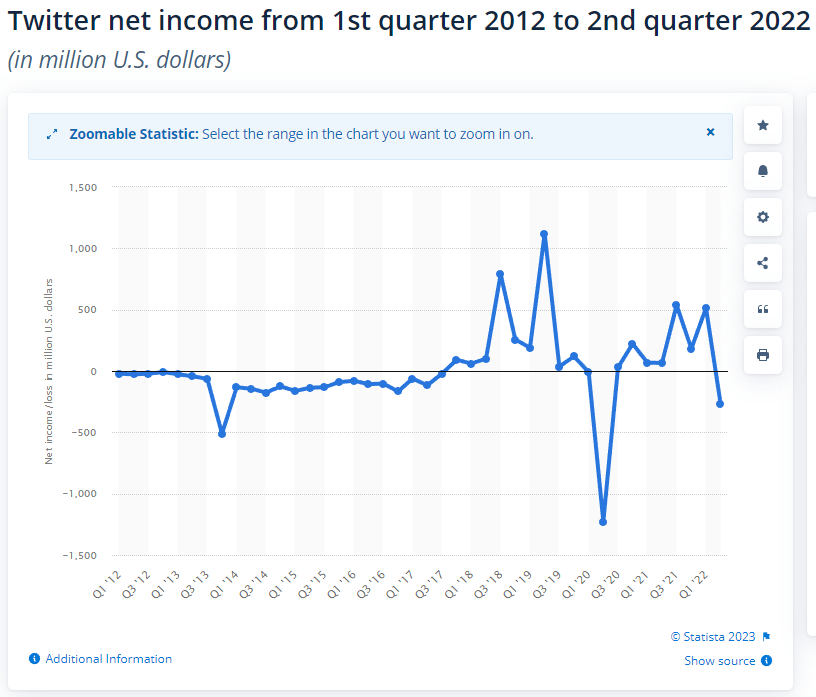
So yeah, my estimation was pretty strong. Then he he decided to buy Twitter. That, and his subsequent public statements, have forced my periodic reconsideration.

First, while owning Twitter could certainly be considered the stewardship of a valuable public good, it seems unlikely to be a good investment relative to the price paid. Maybe more importantly, it seems outside his comparative advantage as an investor. It’s not a moonshot and there is no engineering marvel behind the customer-facing product. It is big and already expensive, so even if it plays out incredibly well over the next ten years, it yields, what, a 15% annual return?

Second, if there’s going to be a political victory, it’s not going to happy via lobbying or creative circumvention. It will always come back to free speech, which means if a conflict happens it will be settled in the courts over many, many years. Patience and constitutional nuance do not strike me as in his comparative advantage.

It might not matter that he is getting a lot bad attenion, but it does seem like he is getting, and engaging with, too much attention. How much of his bandwidth is actually left for the other companies he ostensibly runs?

He’s saying a lot of weird stuff. Or maybe the weird fraction of his public persona is just getting a greater share of the attention. I can’t tell.

If he’s not building something or re-engineering something, he must be selling something. What is he selling? The only thing I can come up with is that he’s selling himself, just not to me. Who’s he selling himself to?

My updated beliefs, as of 11-6-2022:

  1. He’s probably a very keen observer of nascent tech companies and talent, but has become distracted from that comparative advantage by ego and age.
  2. Tesla was run with an eye towards engineering, subsidy, and sales opportunities, but that has left him overconfident in his ability to manufacture an engineering opportunity by dint of his own interest in something.
  3. He’s still excellent at getting attention, even if it is polarizing attention that will have negative effects on how large swaths of the population feel about him. He’s acting more like a politician than an executive.
  4. Obsessive, and not just about work.
  5. He’s still funnier than most people think he is, but his sense of humor is becoming meaner. Some people like cruelty and their admiration comes with consequences.
  6. Likely (>85%) to be very, very smart, but there is a growing probability (<15%) that what he is actually exceptional at is taking credit where brilliance has occurred. I’ve met a non-trivial number of people in my life who were good at “playing the part” of the genius, full of quirks and big statements and bad hair, whose real gift was standing in front of other people’s contributions. Of course, there is a certain sales and political genius in manufacturing the appearance of deep foresight.

Now that I’ve impugned (probabilistically, at leat) the capacities of a highly accomplished individual who has never done any personal harm to me or been (to my knowledge) ever accused of anything explicitly destructive, I should at least note why. I think it is important to make a regular practice of reconsidering our heroes and villains in the public sphere. It’s just good political hygiene. The sheer quantity of narratives we consume, particularly the infovores among us, is simply too much to continually process without constructing heuristic reductions of public figures: genius engineer, corrupt monster, generous savior, doddering fool, etc. And, to be clear, I think those heuristic models are probably necessary just to stay mentally afloat, but if we’re going to do that we need to update those models regularly.

I used to think Elon Musk was a tech genius whose confidence was earned and of limited consequence. Now I think he’s a tech very-smart-guy whose overconfidence has yielded an investment decision with potentiallly disasterous consequences for both his own wealth and the broader discourse in our country. Who knows what I’ll think of him next week or if I’ll even think of him at all? Maybe Elon will save an island of puppies while a genius he casually fired resurrects Tumblr into the pivotal social media of a new American golden age. We’ll have so much to reconsider!

*To be fair, neither am I.

Harness your compulsions

Every year the writers on this blog each recommend a product or gift. My recommendation for gifts to others remains the same: buy them two hours. But what about yourself?

My advice for you is this: what are the things you are compelled to do that runs against the preferences of your past and future selves? Make that list in your head or on paper. Okay, now make a second list of the things your past and future selves wish that present you would do more often? Great.

Are there activities on that list that you can bundle together into a single activity?

For example, and directly from my personal life, I am a middle-aged man who can get wrapped up in video games to the detriment of the rest of his life. I’m pretty sure that 10 hours in a given week would never make the grade of “video game addiction”, where whole lives are left to erode into dust while a soul spends every waking our gaming. But 10 hours is really costly in my current life.

Like, I don’t know, very nearly every middle-aged American, I should exercise more. We all know this, that’s why we pay for memberships in gyms we never use and buy exercise equipment that finds greater use drying our clothes.

Rather than purge my house of video games, I have instead located them strategically in a room with no chairs save an exercise bike and no TV save a one in an elevated position. I have two choices: I can either stand while I play or sit on the bike. Once on the bike, I have two choices: I can pedal or sit there stewing in my own sloth.

I bike 3-4 hours a week now.

Now, let’s be clear. I’m not telling you to buy a Playstation, TV, wallmount, and an exercise bike as the solution to your deficiency of exercise.* That’s a pretty privleged set of advice to give, especially the presumption you have the living space for all of that. What I am saying, however, is that if you already have a video game system that you know you use too much and an exercise bike you know you use too little, you may find a benefit in bundling the two together in a manner that your future self cannot easily un-bundle. [Sidenote: if you’re only short the bike, stationary bikes are (relative to my expectations), shockingly cheap. If you’re short on space, get one that folds so you can lean it against a wall while you are not using it.]

We all have our compulsions, the activities we can’t resist. Most of us also have the beneficial activities that we know will improve our lives, we can’t just through that initial inertia. Bundle them together. Draw in your sketchbook at an easel set up where you watch crappy reality TV. Keep the good whiskey and glasses wehre you write your weekly blog entries. Rack up 100 hours of Civilization 6 while doing those lying on a yoga mat doing those boring exercises your physical therapist prescribed.

Managing ourselves is often a tug of war between who we wish we wanted to be and who we actually want to be. If there is an opportunity to align the two a little better, that’s worth investing in. Now if you any of you know of a way I can harness my tragi-comic addiction to Cheetos into greater research productivity and physical strength, I’m all ears.

*I’m also not not telling you to buy those exact things.

Elite private schools and the rents of early talent filters

An email from a (no doubt loyal) reader about my post last week:

“I’m a big believer that – for all the problems with our educational system – it’s a strength of the US that it’s possible to be a late bloomer and still succeed. But your piece also resonated with me because I’ve been revisiting  my thoughts about [Thomas Jefferson High School for Science and Technology of Northern Virginia, a public magnet school] through all of the recent controversies over promoting diversity. (Not my topic here. I’m for it, but that’s a whole other discussion.)

I will state up front that my opinion is not a popular one among the TJ crowd (as evidenced by the bemused reactions it got at my 25 year reunion), but here goes: 

I believe people are using the wrong baseline when they point to the success of TJ – most wonder “what would my life have been like if I hadn’t gotten into TJ?”   but I think the proper question is “what would my life have been like if TJ didn’t exist?” 

I think that is well observed, but lets unpack it a bit more. The broader framing of “Would admitted students’ lives be different if schools like TJ didn’t exist?” is an extremely useful one, especially if you compare them to the elite private schools whose entire sales pitch boils down to “For $60K a year we’ll give your child a real shot at getting into the Ivy League or the Supreme Court“. When that is your pitch and your price tag, schools have no choice but to invest significant resources ensuring that their graduates have not just an advantage, but pre-designated slots in the incoming classes of the elite undergradute institutions. They aren’t passively part of a filter system, they are actively working to ensure that their admissions process for those 13 or younger serve as a talent filters for the Ivy League.

Full Disclosure: I attended the Thomas Jefferson High School for Science and Technology in the mid-90s. It was no doubt less competitive to get in then, so don’t feel obligated to update your prior beliefs regarding my intelligence or insight. My time there was a lovely experience that I am grateful for, though, so I am no doubt biased.

For all of it’s incredible local reputation, TJHSST isn’t nearly as big a deal in the broader world, in part because it remains very much a public school, albeit one with an admissions process beyond pure geography. There is no board of trustees working actively to promote it as a filter, no club structure committed to the long-term prestige of the institution to be passed down through legacy admission​s. Part of the reason I find the TJ model more tolerable is that it promotes itself as an educational opportunity and adjuvant for its students, rather than a probabilistic ticket to the next stage of the social ladder.

The cost of TJ not existing is roughly equivalent to that borne by students who applied but were not admitted: a set of kids each year who receive an arguably inferior education, nothing more, nothing less. The external cost imposed by TJ admissions on the rest of the school system is largely neglible. Yes, the peer networks within each of the schools they pull from will be slightly weaker academically, but they are pulling from a lot of schools, so that cost is spread pretty thin.

What about the filter effect, you might ask? Are the students not admitted to TJ suffering at a disadvantage later applying to college? There may be some small signal disadvantage at the margin, but my suspicion is that it is pretty small. There are no resources dedicated to creating dedicated pipelines into elite schools, and absolutely no legacy systems incentivizing the creation of those generational pipelines. For an institution to become a talent filter it has to on some level, I believe , dedicate resources towards becoming a filter. It has to not just want that status, it has to have club members willing to invest in it acquiring that status.

Conversely, the effect of Georgetown Prep, the Phillips Academy, and others of their ilk not existing is, similarly, a probable decline in the quality of education of some subset of students. It would also mean, however, that the pool of consideration for Harvard and Yale would get wider and the relevant talent filters would be applied 4 years later in student development. As it stands, students not being admitted, not being unable to afford, or not even being aware of the existence of these educational institutions and opportunities is that they’ve been removed from the track to the professional elite. The composition of the Supreme Court and Congress are being indirectly determined by the admission boards (and legacy donors) sorting children before they’ve learned algebra or finished growing.

You want my opinion? Well here it is: we need more TJHSST’s, not less. We need more public magnet schools, more elite public colleges and universities. Schools where, yes, students are competing for admission, but for whom the prize of admission is the education itself and not entry into a club whose principal endeavor is procuring rents for their matriculants and the offspring of their alumni by offering signal value through their admission. If a filter occurs, it should occur through the quality of their educational outputs, not the narrowness of their admission criteria inputs.

In the end, private schools as early talent filters are an institution prime for capture by highly capitalized rent-seekers. Truly great public schools are not part of that problem. They may even be a solution to it.

Professional Hunger Games and the costs of filtering out talent too soon

For all the fuss over whether schools provide actual skills or merely signal underlying ability, I think we may underappreciate the consquences of internalizing education within employment tournaments. “Neurotic parents worry for their kid’s future if they don’t get into the best pre-school” is a fairly trite sitcom premise at this point, but like a lot of tropes it bears enough truth to carry an episode. Parents “red-shirting” their kids to give them a competitive advantage in both academics and sports has received plenty of attention. Researchers have observed that birthdays early in the calendar year are overly predictive of selection into hockey at the advanced amateur and professional levels. These are all products of, and reactions to, the long and grueling tournaments that portend to identify talent.

We are rightfully obsessed with how to best identify talent at the micro level, but I spend more of my time thinking about the broader consequences that emerge from how we sort talent. More specificly, when and how we sort talent out. The filters.

The above is two academics arguing, both quite reasonably, about how a department should hire faculty. What I want to focus on is that last line of the second tweet:

“are you arguing we should hire.. (people) who weren’t competitive for higher-tier PhD programs?”

And there it is. The filter. If you weren’t good enough to get into a good PhD program at 22-25 years old, why should we waste our already thin resources considering you for position when we have plenty of candidates who did get into a higher-tier program? That’s a completely reasonable argument. The candidates at the best programs are, on average, better than those from less prestigious academic pedigrees.

What I want to do now is persuade you that this is a deeply flawed strategy. To overweight entry into your pool of consideration based on these early filters is bad for your academic department, company, or your hockey team. It will not only cause you to miss out on whole swaths of talent, but will have long run consequences upstream as well, as more and more resources will be wasted within an increasingly desperate all-pay auction to avoid being filtered out. In fact, those resources will be worse than wasted, as growing resource demands to survive the filter will result in both a shrinking and homogenizing final talent pool, condemning departments and disciplines to the stultifying malaise of sameness.

(From here on I’m going to overly lean on an academic framing here becuase it’s what I know best, but I think the story and argument are broadly applicable.)

Surviving the academic filter

I myself am part of a generation of tenured academic economists that can’t help but quietly wonder if we would have made it to the other side of what is now less a path to an academic career and more a post-baccalaureate Hunger Games. Two years predoc, six years of graduate school, three years postdoc, six years on the tenure clock at your first job, a-hopefully-shortened-to-four-year clock at your second job. That’s a 17 to 21 years of often brutal competition for publications at journals and grants from institutions with <5% acceptance rates. But now let’s walk backwards through that path.

Getting published in top outlets and getting funding for your research is a lot easier given the resources available to junior faculty at elite research institutions, appointments which are almost exclusively available to graduates of elite PhD programs. Even if one fails to receive an appointment or receive tenure at a top research institution, the networks you build in a top graduate program will bear fruit your entire career. You will get invited to present in seminars, join the right clubs, and disseminate your work through the best working papers series.

So how do you get into a good graduate program? I haven’t inspected the numbers personally, but I have been told by colleagues that the vast majority of students at top programs have at least near-perfect GRE scores and GPAs. These standard performance metrics left insufficient for final decisions, what’s left is the the prestige of your institution, extraordinary non-traditional undergraduate performance (i.e. writing an outstanding senior thesis), or procuring a prestigious post-baccalaurare research experience (a predoc). The net of this is that when you weight faculty appointmentss disproproportionately towards the prestige of a graduate academic program, you are indirectly weighting your decisions towards the selective criteria of undergraduate admisisions and a young person’s ability to independently network with faculty. You are effectively filtering out candidates based on attributes they failed to display when they were teenagers.

The trap of failed forecasting and early filters

When hiring and admitting talent, you are playing a statistical game. You’re not just trying to maximize the expected value (the mean), you’re also pursuring optimal variance, specifically upside variation. An NBA team would rather draft 1 hall of famer, 2 all-stars, and 7 busts that never play a minute than 10 players with average NBA careers. Pursuing upside and the upper tail, pursuing outliers, has a strange alchemy to it. To say that outliers and the rest of extreme upper tail is less understood than average outcomes is almost tautalogical, but in this case it’s important. To pursue upside variance in recruitment is, at least partly, an effort to forecast that upper tail. Forecasting these people is not only hard to do, it’s hard even to tell ex post if someone has been successful at it for reasons attributable to skill or merely luck.

When we filter out candidates based on where they went to graduate school, we are indirectly saying we believe that undergraduate admissions can forecast outcomes of considerable rarity. That’s quite the leap of faith.

I don’t get the impression that venture capitalists are particularly concerned with the prestige of their entrepreneur’s undergraduate education. Some people might use this as a cudgel to demean the value of a college education or an opportunity to extoll the greatness of genius that refuses to be suffocated by a structured education, blah blah blah. You will be shocked to learn that I think both of these strawmen arguments I’ve created are entirely silly. I think venture capitalists place so little weight on educational prestige because they are looking for extreme outliers in dimensions that are not necessarily orthogonal to education, but are simply unforecastable at any sort of scale. They can’t be predicted, only observed retrospectively in evidence of successfull entrepreneurship.

I put it to you, humble department hiring committee, that attributes that make for a high quality researcher are similarly difficult to forecast early in life. Further, the skills that make for great student, I am sorry to say, do not correspond all that well to successful research. While perhaps not as extreme as professional basketball players or billionaire entrepreneurs, top researchers are in many ways outliers. They are strange amalgams of, yes, intelligence, but also conscientousness and rebelliousness. They are creative and pragmatic, capable of working with other outliers and managing teams while also tolerating long periods of loneliness and even professional derision. These combinations of characteristics are not necessarily special, but they certainly are unusual.

Mechanisms that maximize the mean of your recruited talent will not maximize the upper bound on the pool you are choosing from. It will not maximize your upside outliers. Maxmizing the mean, however, is exactly what undergraduate admissions are largely doing. They are maximizing the SAT scores and GPAs of their incoming class and, in doing so, they are maximizing expected 5-year graduatiuon rates, post-graduation employment, medical school admissions, etc. They are maximizing the quality of each admission cohort. They are maximizing the mean and, in the process, minimizing the variance of those cohorts.

When you are recruiting talent to your research faculty you are looking for upside variance, the exact statistical characteristic that undergraduate admissions are often minimizing. When you overweight your hiring decisions based on whether candidates were competitive when applying to graduate school, you are likely increasing the mean of your pool of consideration but also reducing it’s variance. You are indirectly filtering your candidates through a chain of graduate and undergraduate admissions criteria that are minimizing upside variance.

Now, to be clear, this may be exactly what you want. If you’re recruiting to a job or field that is about minimizing downside risk, then this may be the optimal strategy. I’d be thrilled to learn that the mechanism that produced primary care physicians was explicitly designed to maximized the mean and minimize the variance of physician quality. But for a research department recruiting junior faculty (or a basketball team, or entrepreneurial tech incubator,…), downside risk is fairly minimial while upside potential remains enormous.

The cost of early filters

Early sub-optimal talent filters are costly in two ways. First, they filter out talent before its value can be observed. Second, they incentivize individuals and households to commit resources to wasteful tournaments.

The first, micro, costs of early filters are pretty obvious: we miss out on the contributions of potential stars because of decisions overweighted towards criteria that reflected mean cohort maxmization, an attribute at least orthogonal, if not explicitly counter to, the qualities you are recruiting. The second, more macro, costs should be considered as well.

If an individual identifies a career they want, whether its professor, medical doctor, or professional athlete, and observes institutions that filter people out of consideration, they will invest resources to survive the filter. If slots that survive the filter are a fixed quantity, it will quickly devolve into a tournment, where surivival will depend, at least in part, on the resources an individual is willing to commit. These resources are largely unrecoverable. This is an all-pay auction. It’s a trap where social welfare goes to die.

This is a trap in which diversity dies, too. Social and economic diversity for sure, but also diversity of ideas, perspective, patterns of though, and intuition. The fraction of households that can commit significant resources to gain admission to top secondary and undergraduate institutions, that can endure the opportunity cost of unpaid internships and underpaid “predocs” is not representative of the broader population. It is wealthier, Whiter, and far more educated. As Schultz and Stansbury note, 65% of U.S.-born economics PhDs had at least one parent with a graduate degree, while only 14% of those PhDs were first-generation college graduates.

Every academic scholar knows the pressure to conform to trends in models, theories, hypotheses, sometimes even explicit policy prescriptions. This pressure comes in the form of editorial, hiring, and promotion decisions. This pressure is only further augmented by the forces that filter talent into these positions. Filters that may, in fact, increase the how smart and diligent we are on average, but in doing so sand off the fat tails of our distribution of colleagues. The very people perhaps most likely to think of something completely different. The people most likely to change our minds.

To lose them for the possibility of being a little smarter on average? That is costly indeed.